
Importer of Record in Switzerland
Switzerland sits outside the EU and its VAT system, which makes it a genuinely misunderstood market for technology and medical imports. Cargo moves through Zurich and Geneva airport terminals, the Port of Basel (Rhine), and the road corridors from neighbouring EU states.
Every commercial consignment must be declared to the Federal Office for Customs and Border Security (FOCBS), through the national customs system now transitioning from e-dec to the digital platform Passar, by a party that can act as the Swiss importer. An EU EORI or EU VAT registration does not replace the Swiss customs and VAT requirements, and under delivered-duty-paid terms the seller carries import clearance and taxes, which in Switzerland requires a Swiss customs and VAT structure or a local importer, obligations a foreign company usually cannot meet from abroad.
Importer of Record in Switzerland
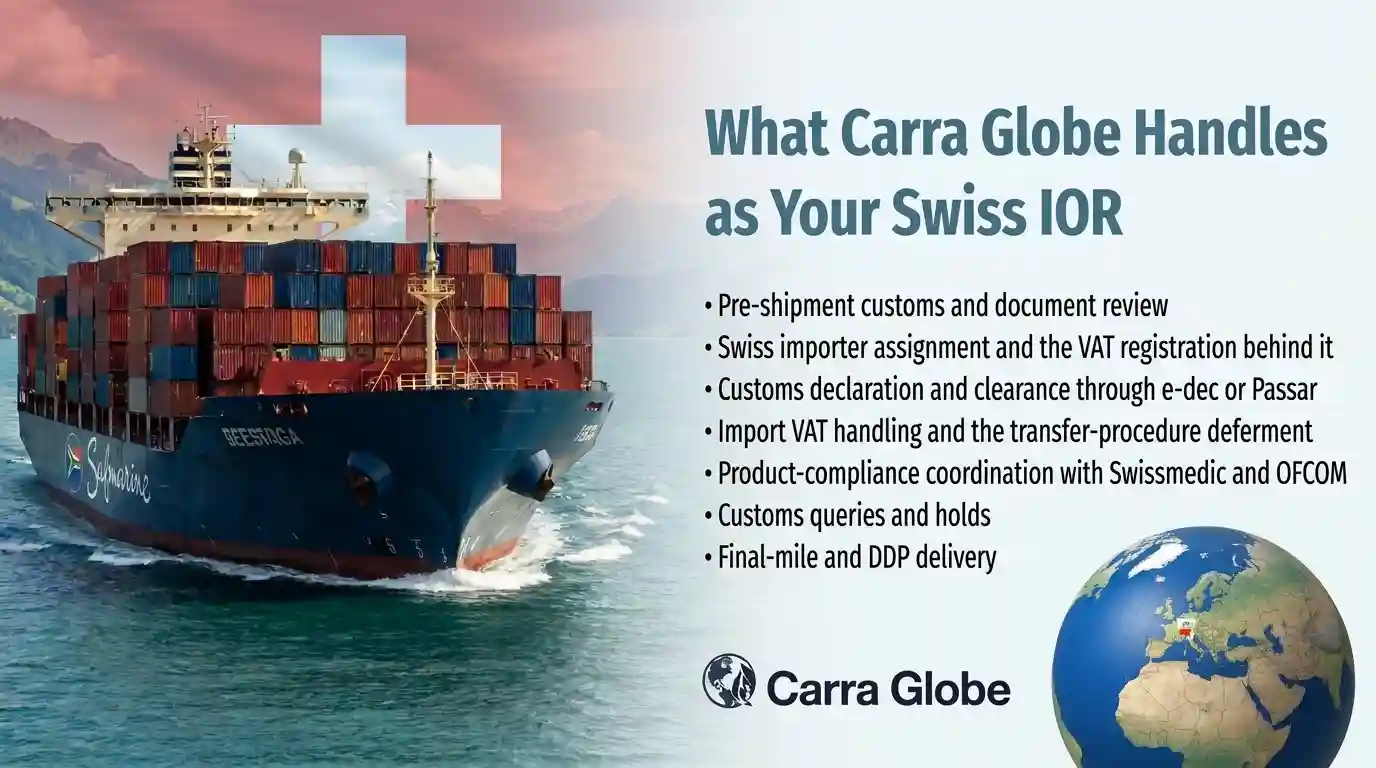
Carra Globe acts as your Importer of Record in Switzerland, standing as the declared importer, managing the 8.1% import VAT through Swiss VAT registration and fiscal representation, and coordinating Swissmedic, OFCOM, and product-conformity obligations. We deliver full DDP shipments into Zurich, Geneva, and Basel, so you can ship to Switzerland without a Swiss entity.
Switzerland charges zero duty on industrial goods, and you still cannot clear your own shipment. Since 1 January 2024 industrial duty has been abolished, so the barrier is no longer duty. It is who can legally be the importer, recover the 8.1% import VAT, and hold the product approvals. That is the trap this page exists to solve.
You may need a Swiss Importer of Record if:
- You ship equipment into Switzerland with no Swiss subsidiary, and your customer or data centre partner will not act as importer.
- You sell on DDP terms and must clear the goods yourself.
- You are sending servers or GPU hardware to a Swiss data centre, placing medical devices on the market, or shipping telecom equipment subject to Swiss conformity.
- You are handling repair or return shipments that need a declarant in both directions.
Who Can Legally Act as Importer of Record in Switzerland
The Importer of Record (explainer) is the party named on the Swiss import declaration filed with the FOCBS, which clears the declaration, issues the electronic assessment decision (the eVV, the proof of import and the basis for recovering import VAT), and releases or holds the goods.
The point that catches foreign companies: with duty on industrial goods abolished, most technology hardware enters at zero duty, so clearance looks trivial. It is not, because the barrier is who can legally be the importer and recover the import VAT. Where the importer makes taxable supplies in Switzerland, Swiss VAT registration can become mandatory once the applicable CHF 100,000 worldwide turnover threshold is met, and a foreign company without a Swiss establishment generally needs a fiscal representative under Article 67 of the Swiss VAT Act to register.
That leaves three routes, from heaviest to lightest:
- Option 1, establish in Switzerland. Requires a Swiss entity and your own VAT registration. Setup burden high, and it creates a permanent taxable presence.
- Option 2, register for Swiss VAT with your own fiscal representative. No Swiss entity, but your own registration and a Swiss-domiciled representative. Setup burden medium.
- Option 3, appoint a third-party Importer of Record. No Swiss entity and no VAT registration of your own where the IOR structure applies. Carra Globe is the declared importer, maintains the Swiss VAT registration and fiscal representation for its IOR structure, and becomes the party Swiss authorities look to, carrying the classification, valuation, and compliance risk. You still supply clean documentation, correct Incoterms, and product-compliance inputs, so it is the lowest burden but a shared responsibility, not hands-off.
Switzerland vs the EU: what changes for importers
Switzerland looks European but does not follow EU import rules, which is the source of most confusion:
- Customs union: the EU is one; Switzerland is not, so goods need a full Swiss customs declaration.
- EU EORI and EU VAT registration: used for EU imports, neither replaces the Swiss equivalents.
- Import VAT: Switzerland charges 8.1% at import, outside the EU VAT system entirely.
- Medical devices: the EU framework does not carry across; Switzerland runs a separate Swissmedic regime.
- Radio equipment: Swiss conformity under OFCOM applies, separate from EU market access.
Import Liability in Switzerland: What the IOR Answers For
Once the FOCBS accepts the declaration, the Importer of Record carries the applicable customs and import-tax responsibilities and must ensure the declaration is supported by accurate classification, valuation, documentation, and any product-compliance requirements that apply to the shipment. Swiss authorities can audit years back and have become notably more active in pursuing unregistered foreign suppliers.
- Tariff classification and weight: even at zero duty, the correct tariff number and goods weight must be declared, because Swiss import VAT and statistics depend on them.
- Customs valuation: import VAT is charged on the value delivered to the Swiss border, including transport to that point.
- Import VAT at 8.1%: payable at entry, and generally recoverable through the Swiss VAT return only where the importer holds the required registration and the documentation supports the deduction.
- Product compliance: Swissmedic for medical devices, OFCOM for radio equipment, plus Swiss labelling and safety obligations.
- Records: retained for ten years.
When Foreign Companies Need an IOR in Switzerland
The requirement bites hardest on two of Carra Globe’s core sectors, IT hardware and medical technology. A vendor shipping servers, GPU nodes, switches, or storage into a Zurich or Geneva data centre has no Swiss entity, because the equipment goes to a colocation or cloud facility, not an office. The facility will not act as importer, because that makes it responsible for the customs and VAT position on equipment it does not own, so without an Importer of Record no party can clear the cargo and recover the VAT.
The same pattern repeats wherever:
- You have quoted DDP terms and are responsible for Swiss clearance and taxes.
- Medical devices need a Swiss importer registered with Swissmedic, a role no foreign manufacturer can hold from abroad.
- Radio or wireless equipment needs a compliant importer for OFCOM purposes.
- Temporary imports, repairs, and returns need a declarant in both directions.
Switzerland’s pull is its concentration of pharma, medtech, and financial-sector data infrastructure. As a European headquarters location for those sectors, the hardware feeding them arrives overwhelmingly from outside a market whose rules diverge sharply from the EU next door.

Common Hold Triggers in Switzerland & How Carra Globe Prevents Them
Holds at the Swiss border cluster around a predictable set of failures:
- No valid Swiss importer: the declaration cannot resolve to a party who can clear and recover VAT.
- No VAT registration or fiscal representative: import VAT becomes an unrecoverable cost and DDP flows break.
- Tariff or weight errors: even at zero duty, a wrong tariff number or weight triggers queries.
- Mismatched documents: most delays come from inconsistency between invoice, transport documents, and declaration.
- No Swissmedic registration or CHRN: medical devices cannot be placed on the market.
- No OFCOM conformity: radio and wireless equipment is stopped.
- Missing advance declaration: non-EU-origin cargo without the required security data is held.
- Valuation disputes: high-value server and GPU consignments face scrutiny where the value is not properly evidenced.
Every one is preventable before the cargo leaves origin. Carra Globe stands as the registered Swiss importer, so there is no missing party and no VAT gap.
Switzerland Import Compliance Framework (2026)
- Customs authority: Federal Office for Customs and Border Security (FOCBS), bazg.admin.ch
Passar: the new Swiss customs system
Switzerland is replacing e-dec with Passar, the digital goods-traffic platform built under the FOCBS modernisation programme DaziT.
- Transit and export already run on Passar, and the old export system is retired.
- Imports are in phased rollout. Passar import (Passar 2.0) entered pilot operation from Q2 2026 for authorised-consignee domicile procedures and selected border crossings. Per the FOCBS, until the system reaches widespread use only pilot companies may file imports in Passar and all others continue in e-dec, with the full NCTS and e-dec migration to Passar targeted for completion by the end of 2027.
- Advance declaration applies. Movements between Switzerland and countries other than the EU and Norway require an electronic advance declaration with security data before the border.
Zero industrial duty, but full declaration
Since 1 January 2024, Switzerland has levied no customs duty on industrial products (confirmed by SECO), covering the overwhelming majority of IT and electronic hardware, with duty still applying to agricultural goods by weight. The abolition did not remove the duty to declare: every import still needs the correct tariff number and weight, and classification determines VAT treatment and which product rules attach. Tariff data sits in the Swiss Tares system.
Import VAT and the fiscal representative rule
Swiss import VAT is 8.1%, the standard rate since January 2024, with a reduced 2.6% for defined categories such as certain medicines and books. It is charged on the value delivered to the border and is generally recoverable through the Swiss VAT return only where the importer holds the required registration and the documentation supports the deduction. Companies that are not Swiss-VAT-registered can instead use the FTA’s annual refund procedure, on calendar-year claims with a 1 January to 30 June deadline, a CHF 500 minimum, and a Swiss representative required. That is why who appears as importer matters commercially, not just administratively.
Registration is administered by the Swiss Federal Tax Administration, and a company with no Swiss establishment cannot register without a fiscal representative (Article 67 VAT Act). In current 2026 practice the FTA generally does not impose security deposits on routine foreign registrations, though it retains the statutory power to require one for risk cases. Once registration and representation are in place, import VAT can be deferred and settled through the return under the transfer procedure.
Schedule Free Consultation With Our Experts
Send us the hardware list and the destination. We will come back with the compliance route, the landed cost, and a realistic timeline.
Medical devices: the biggest divergence from the EU (swissdamed, 2026)
This is the sharpest break from the EU and the point that catches medtech and pharma importers most often. Since the EU-Switzerland mutual recognition agreement lapsed in 2021, a CE mark and EU registration no longer carry a device across the Swiss border. Switzerland runs its own regime through Swissmedic under the Medical Devices Ordinance (MedDO, SR 812.213) and the equivalent ordinance for in-vitro diagnostics.
Two roles must be structured before the device is placed on the Swiss market, and they are related but distinct: the Swiss customs importer and the Swiss medical-device economic operator. Switzerland-based economic operators register in Swissmedic’s swissdamed platform and receive a Swiss Single Registration Number (CHRN) within three months of first placing a device on the market. A foreign manufacturer cannot hold a CHRN and works through its CH-REP.
The 2026 timing matters: device registration in swissdamed becomes mandatory from 1 July 2026, with a transitional period through 31 December 2026. From that point a device cannot be lawfully placed on the Swiss market without it. Guidance is published by Swissmedic.
Radio equipment and CE conformity: OFCOM
Because Switzerland is outside the EU, EU conformity does not automatically carry across. OFCOM (Federal Office of Communications), via bakom.admin.ch, governs radio and telecommunications equipment. Switzerland requires no separate national type approval; radio equipment must meet CE-aligned Swiss conformity, but the importer, or a manufacturer or authorised representative established in Switzerland, must present the declaration of conformity and technical documentation and meet traceability obligations. CE and Swiss conformity marking apply to electrical and electronic equipment more broadly, alongside Swiss language and safety-information requirements.
Switzerland Import Documents Checklist
- Commercial invoice: precise goods description and value, both parties, and Incoterms.
- Packing list: itemised, stating gross weight.
- Transport document: CMR for road, air waybill for air freight.
- Swiss import declaration: filed in e-dec or Passar in the importer’s name.
- Advance declaration: security data for non-EU-origin movements.
- Proof of origin: where a preference is claimed, though industrial duty is zero regardless of origin.
- Swissmedic registration and CHRN: for medical devices and in-vitro diagnostics.
- CH-REP appointment: the Swiss authorised representative for a non-Swiss device manufacturer.
- OFCOM conformity documentation: for radio and wireless equipment.
- CE and Swiss Declaration of Conformity: for electrical and electronic equipment.
- Import permits: for controlled or regulated goods.
- Dual-use export licence from origin: where applicable.
Product Categories Requiring Special Attention in Switzerland
Carra Globe’s IOR service is built for the sectors shipping high-value, tightly regulated hardware into Switzerland, where the barrier is rarely duty and almost always who can legally be the importer.
Renewable Energy & Power Equipment
Inverters, batteries, and grid equipment carry Swiss conformity and safety obligations, and correct HS classification for solar and inverters governs the declaration. Lithium cells carry dangerous goods requirements in transit. Carra Globe manages the compliance stack and dangerous goods paperwork as importer of record.
IT Hardware & Data Centre Equipment
Most servers, storage, and networking hardware enters at zero customs duty, but 8.1% import VAT still applies and is recoverable only by a registered Swiss importer. Correct HS classification for servers and accurate weight remain mandatory, and any wireless unit carries OFCOM obligations. Carra Globe holds the registration and stands as importer, clearing data centre equipment before cargo departs.
Medical Devices & Diagnostics
Switzerland's sharpest divergence from the EU. Since the mutual recognition agreement lapsed in 2021, the Swiss importer of a medical device is a distinct regulated operator that must register in Swissmedic's swissdamed platform for a CHRN, with the manufacturer appointing a Swiss authorised representative (CH-REP). EU registration does not carry across, and swissdamed device registration begins 1 July 2026 with a transition to 31 December 2026. The Swiss customs importer role and the medical-device economic-operator role must both be correctly structured before placement, and Carra Globe coordinates that structure and holds the importer role.
Telecommunications Equipment
Radio, wireless, and telecoms equipment must meet OFCOM conformity, and the importer carries the obligation. Encryption-capable network hardware also needs dual-use screening at origin. Carra Globe secures the conformity position and acts as Importer of Record for telecom equipment.
How Long Does Swiss Customs Clearance Take?
There is no universal Swiss clearance time. Release depends on the declaration, transport channel, document quality, customs controls, and whether all product requirements are satisfied, and clearance times vary widely by country and channel. Clearance moves quickly when the declaration is clean, because industrial duty is zero and assessment is largely automated.
- Clean declaration: released once accepted and the import VAT position is settled.
- Document mismatch: the most common cause of delay.
- Physical or documentary check: the FOCBS may inspect, adding time and any storage cost at Zurich, Geneva, or Basel.
- No registered importer: the consignment cannot clear to a party that can recover VAT, and it waits.
Carra Globe already holds every licence, certification, and approval listed above, so your cargo moves without any delay with customs clearance in 1 to 2 business days.
Get in Touch
Carra Globe Services in Switzerland
Carra Globe provides Importer of Record and Exporter of Record services in Switzerland, Delivered Duty Paid shipping, freight forwarding by air and road into Zurich, Geneva, and Basel, white glove delivery and rack-and-stack installation for data centre hardware, warehouse logistics, and global trade compliance covering export controls at origin and Swiss product-compliance obligations on arrival.
Switzerland is a landlocked hub surrounded by the EU, and our network covers the corridor: Importer of Record in Germany, Importer of Record in France, Importer of Record in Italy, Importer of Record in the Netherlands, Importer of Record in Belgium, and Importer of Record in the UK.
Carra Globe operates across 175+ countries.Frequently Asked Questions: Switzerland IOR
Can a foreign company be the importer of record in Switzerland?
Not directly: acting as importer requires Swiss VAT registration past the CHF 100,000 threshold and a fiscal representative under Article 67, which a foreign company cannot hold from abroad. A third-party Importer of Record solves this, because Carra Globe holds the registration and representation and stands as the declared importer.
If Switzerland has zero duty, why do I need an importer of record?
Because the barrier is VAT recovery and legal importer status, not duty. Industrial goods enter at zero duty, but 8.1% import VAT still applies and is recoverable only by an importer with the required Swiss VAT registration.
Does an EU EORI or EU VAT number work in Switzerland?
No. Switzerland is outside the EU VAT system, so an EU EORI, EU VAT registration, OSS, or import VAT deferment mean nothing for a Swiss import, which needs its own customs declaration and VAT registration.
What is Passar and does it affect my shipment?
Passar is the FOCBS’s new digital customs system, replacing e-dec. Transit and export already run on it; imports are in pilot from Q2 2026 with e-dec continuing for all non-pilot companies, and the full migration is targeted for completion by the end of 2027, so either system may apply during the changeover.
Do I need a fiscal representative to import into Switzerland?
If you register for Swiss VAT with no Swiss establishment, yes: Article 67 requires a Swiss-domiciled representative and registration cannot complete without one. Using a third-party Importer of Record means you do not arrange this yourself.
How are medical devices treated differently in Switzerland?
Since the mutual recognition agreement lapsed in 2021, EU registration no longer carries across. The Swiss importer must register in swissdamed and hold a CHRN, and the manufacturer must appoint a Swiss authorised representative, so a foreign manufacturer needs a Swiss party for both roles.
What is the import VAT rate in Switzerland?
The standard rate is 8.1%, with a reduced 2.6% for defined categories, charged on the value delivered to the border. It is recoverable only by the registered importer, so importer status decides whether the VAT is a cost or a reclaim.
What if my Swiss customer refuses to be the importer?
The refusal is rational: being the importer means carrying the customs and VAT position for goods they may not own. A third-party Importer of Record removes the request, because Carra Globe clears the goods and your customer simply receives them.
How long does customs clearance take in Switzerland?
Clearance is fast when the declaration is clean, because industrial duty is zero and assessment is largely automated. Delays come mainly from document mismatches or from having no registered importer, and the FOCBS publishes no guaranteed window.
Does Carra Globe handle DDP delivery into Switzerland?
Yes. We hold the Swiss VAT registration and act as the declared importer, so we clear the goods, account for the 8.1% import VAT, and deliver on DDP terms to any Swiss address.