
Case study · EU distribution hub
Hardware arrives from four suppliers on four different schedules. Eight destination countries are waiting, and not one of the sites is ready to receive it yet. Clearing each consignment separately in each country would have meant eight importing arrangements, eight sets of classifications and eight chances to get something wrong.
Carra Globe brought the whole programme into one Dutch entry point instead, cleared it once into free circulation, held it near Schiphol, and released it to each site as that site became ready. One import. Eight countries. No client entity anywhere in the EU.
Outcome · this programme
Key takeaways
- The problem
- A global technology company was rolling out IT infrastructure across more than eight EU countries with no EU entity of its own. Hardware was arriving from several origin countries on supplier schedules, while destination sites were still being fitted out.
- The method
- Carra Globe acted as Importer of Record, consolidated the inbound flows into a single Dutch entry point, and cleared the goods into free circulation rather than into a customs warehouse. Stock was held near Schiphol and released against each site's readiness date.
- The result
- One customs entry point instead of eight. Average dwell under 30 days, fewer than ten outbound releases, and no EU company established by the client.
The challenge
Nothing here was difficult in isolation. The difficulty was that four separate problems arrived at once, and solving any one of them badly would have delayed sites in countries that had nothing to do with the mistake.
- 01
Eight destination countries, no EU entity
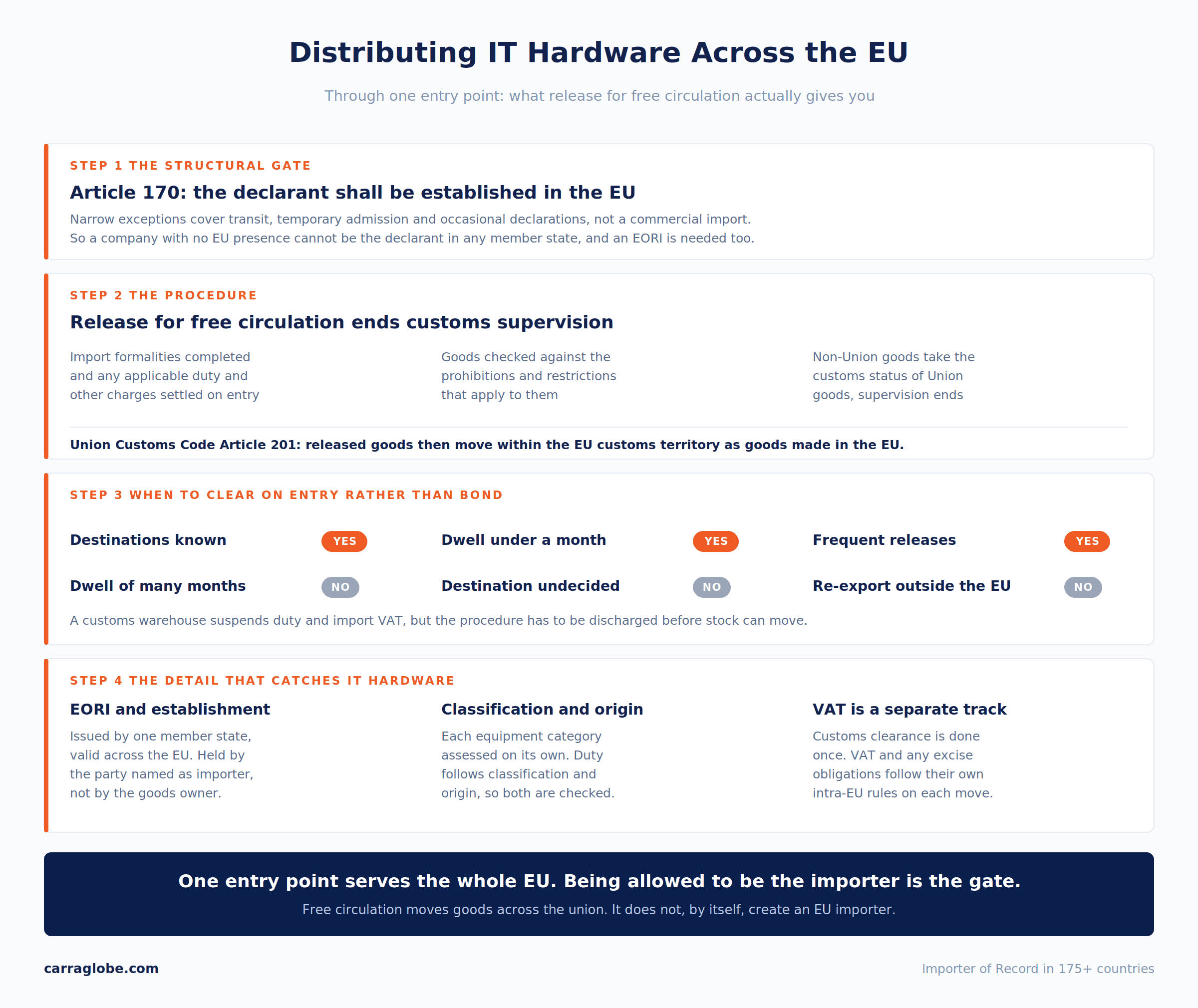
The client held no registered company anywhere in the EU. The declared importer on an EU customs entry must be established in the EU and hold a valid EORI number, so without a local structure there was no lawful route to be named as importer in any of the eight markets, let alone all of them.
- 02
Supplier schedules that did not match site schedules
Equipment was being manufactured and released by several suppliers in different countries, each to its own lead time. The destination sites were still being fitted out. Hardware was going to arrive in Europe well before anywhere was ready to take delivery of it.
- 03
Repeating the same customs work eight times
Shipping direct to each country would have meant a separate import in each one: separate entries, separate classification decisions, separate importing arrangements, separate points of failure. The difference between a broker filing a declaration and a party carrying the import liability is covered in Importer of Record vs customs broker. The same mixed IT consignment would have been assessed from scratch by eight different customs administrations.
- 04
A mixed consignment, not a single product line
The programme covered servers and storage, networking and security appliances, end-user devices, and rack power and infrastructure. Each category carries its own classification, and several fall within EU product compliance frameworks that apply on placing goods on the market rather than at the border.
The solution
Carra Globe acted as Importer of Record in the Netherlands, which solved the structural problem first: an EU-established party held the EORI and was named as the declared importer, so the client needed no company of its own anywhere in the union. If the model is new to you, we explain how the arrangement works here.
The consolidation decision followed from that. Rather than eight imports into eight countries, the inbound flows from several origins were brought into one Dutch entry point. The classification work, the origin and duty position, and the importer arrangement were done once and applied to the whole programme, instead of being repeated and re-litigated in every destination.
The goods were then released for free circulation. That is the procedure that completes all import formalities for goods to be placed on the EU market, and it is worth being precise about what it does: once duty and other applicable charges are settled and the goods are checked against any prohibitions or restrictions, they take the customs status of Union goods and customs supervision ends. From that point they move within the EU customs territory in the same way as goods made in the EU.
That status is what made a single entry point work. A release from the Dutch hub to a site in another member state is an intra-EU movement of Union goods, not a new import. VAT and any excise obligations remain separate from customs and follow their own intra-EU rules, so the accounting still needs handling properly, but the customs clearance is done once and stays done.
Storage did the rest. Holding the stock near Schiphol decoupled arrival from installation: suppliers shipped to their schedule, sites took delivery on theirs, and the gap between the two sat in the warehouse rather than in a queue of delayed containers or a rented yard.
Rolling out across several EU countries without an EU entity? Talk to our team about your programme.
How it ran
Five stages, one of which is deliberately dull: the storage step is where the value sat, because it absorbed every schedule mismatch in the programme.
- OriginsSeveral supplier countries
- 01
Pre-arrival classification
Each equipment category classified and the origin position confirmed before anything shipped, so the entry could be prepared rather than assembled on arrival.
- 02
Consolidation into one entry point
Inbound flows from several origin countries routed into the Schiphol-area facility instead of direct to eight destinations.
- 03
Release for free circulation
Entry lodged with Carra Globe as Importer of Record, duty and import VAT settled, and the goods released into free circulation as Union goods.
- 04
Storage against site readiness
Stock held and tracked by destination while sites completed fit-out, with dwell kept under 30 days on average rather than open-ended.
- 05
Staged release across the EU
Fewer than ten outbound movements, each an intra-EU delivery of Union goods to a site that was ready to receive it.
- Delivered8+ EU countries
The results
The programme ran without a customs hold or a query at entry. One entry point served more than eight EU countries, the classification and importer work was done once rather than eight times, and the client established no company anywhere in the EU.
Average dwell stayed under 30 days. That figure matters more than it looks: a hub that quietly turns into long-term storage is a cost centre, not a solution. Keeping dwell short meant the warehouse was doing its actual job, absorbing the gap between supplier lead times and site readiness, rather than parking stock indefinitely.
Fewer than ten outbound releases covered the whole rollout, each one an intra-EU movement rather than a fresh import. The client's project teams could confirm a site date and have hardware arrive against it, without a customs process sitting between the decision and the delivery.
Certain programme details have been anonymised or rounded to protect client confidentiality.
Who this applies to
The pattern fits any multi-country EU rollout where the hardware and the buildings are on different schedules.
Free circulation or a customs warehouse
This is the decision most EU hub programmes get wrong, usually by defaulting to bonded storage because it sounds more sophisticated. The two options solve different problems.
| Release for free circulation | Customs warehouse | |
|---|---|---|
| Customs status while stored | Union goods, supervision ended | Non-Union goods, under customs supervision |
| Duty and import VAT | Settled on entry | Suspended while the goods remain in the procedure |
| Moving stock onward in the EU | Intra-EU movement, no further customs entry | Procedure must be discharged first |
| Authorisation needed | No warehousing authorisation | Yes, a customs warehouse authorisation |
| Suits | Known EU destinations, short dwell, frequent releases | Long or uncertain dwell, possible re-export outside the EU |
Why free circulation was right here
Every unit in this programme had a known EU destination, dwell was short, and nothing was going to be re-exported outside the customs territory. Suspending duty would have bought nothing and cost operational friction, because each release would have required discharging a customs procedure before the goods could move. Clearing once at entry meant every subsequent movement was a simple intra-EU delivery.
When bonded genuinely is the better answer
Flip any of those facts and the answer flips with them. Stock that may sit for months, destinations that are not yet decided, or goods that might leave the EU again all point toward a customs warehouse, where duty and import VAT stay suspended until the goods are actually released onto the market. The mistake is not choosing one or the other, it is choosing without checking which set of facts you have.
Why operators bring this to Carra Globe
Importer of Record, Exporter of Record, and DDP across 175+ countries, including every market in this programme.
Classification, entry, storage and onward distribution handled by the same team, rather than split across a forwarder, a broker and a warehouse.
IT hardware, data centres, telecoms, medical devices, aerospace, and renewable energy, not general freight.
Carra Globe Ltd is a UK registered company (Companies House no. 16657216). Local importing structures are held separately in the markets where they are used.
What this means for your rollout
If you are deploying hardware across several EU countries, the question to settle first is not which freight lane to book. It is who will be the declared importer, and whether one entry point can serve the whole programme. Get those two right and the rest is scheduling.
Requirements differ by market, which we map in IT hardware import regulations by country. The same structure supports warehouse and staging programmes and data centre equipment deployments in any market. For a contrasting example where the barrier was product compliance rather than distribution, read our Taiwan to Australia case study.
Frequently asked questions
Can a foreign company import into the EU without an EU entity?
An import into the EU can be arranged without the foreign owner establishing its own EU company, provided it is structured through an appropriate EU importer or Importer of Record arrangement. The declared importer must be established in the EU and hold a valid EORI number, which is why the importing structure matters more than the freight route.
What does release for free circulation actually mean?
It is the customs procedure that completes all import formalities for goods to be placed on the EU market. Once import duty and any other charges are settled and the goods are checked against applicable prohibitions and restrictions, non-Union goods take the customs status of Union goods and customs supervision ends.
Can goods cleared in the Netherlands be sent to other EU countries without clearing customs again?
Once goods are released for free circulation in one member state, they hold Union goods status and move within the EU customs territory in the same way as goods produced in the EU. That is the basis of a single-entry distribution hub. VAT and excise obligations are separate from customs and still follow their own rules on intra-EU movements.
Why import through one EU country rather than shipping direct to each site?
Consolidating into one entry point means one customs entry, one set of classifications and one importing party, instead of repeating that work in every destination country. It also decouples arrival from installation, so hardware can land while sites are still being fitted out and be released as each site becomes ready.
What duties and taxes applied on this consignment?
Duty and import VAT were settled at the point of release for free circulation rather than suspended, so the goods entered the EU market fully cleared. Rates depend on the classification of each item and the country of origin, and any preferential rate requires valid origin documentation.
Do goods have to be stored in a bonded warehouse to be distributed across the EU?
No. A customs warehouse suspends duty and import VAT while goods remain under customs supervision, which suits long dwell times or uncertain destinations. Where goods are cleared into free circulation on arrival, ordinary commercial storage is sufficient and releases are simpler, because there is no customs procedure to discharge each time stock moves.
Deploying hardware across the EU without an EU entity?
Carra Globe imports high-value IT and data centre hardware into 175+ countries as your Importer of Record, with clearance, storage and onward distribution handled by one team. Where the applicable structure requires a local entity, we provide it.
Talk to our teaminfo@carraglobe.com
+44 7748 533273 · +1 (786) 936 0405