
Importer of Record in Germany
Germany presents a structural barrier that most non-EU companies do not anticipate until their first shipment stalls. Under the Union Customs Code, German customs brokers filing on behalf of a non-EU principal face joint and several liability for any declaration error, and most refuse to proceed under indirect representation. This means a foreign company without a German-established IOR has no practical route to clear goods through ATLAS. On top of this representation problem, CBAM entered its definitive phase on 1 January 2026, requiring authorised declarant registration and certificate purchases for steel, aluminium, cement, fertilisers, and hydrogen imports above 50 tonnes annually. Mandatory B2B e-invoicing took effect in January 2025, and Germany’s import VAT system requires border payment and subsequent recovery rather than at-border deferment.
Carra Globe acts as your Importer of Record in Germany, holding the DE EORI, filing ATLAS declarations as principal declarant, managing German VAT registration and import VAT recovery, handling CBAM authorised declarant compliance, coordinating CE marking and product approvals, and managing FTA preference claims so your cargo clears on first submission.
Importer of Record in Germany
An Importer of Record in Germany is the legally accountable entity for customs declaration, duty settlement, and import VAT obligations at the point of entry into the EU customs territory. Germany operates under the EU Union Customs Code (UCC), meaning the same rules apply at Hamburg, Frankfurt, Munich, and Bremen as at any other EU port. Goods cleared into free circulation in Germany move freely across all 27 EU member states without further customs formality.
The practical complication for non-EU companies is representation. German freight forwarders filing on behalf of a non-EU principal face joint and several liability for declaration errors, and most refuse to proceed under indirect representation. Carra Globe removes this barrier entirely, holding the DE EORI number, carrying the legal liability, filing as principal declarant via ATLAS, and managing German VAT registration so your company can ship DDP into Germany without a local entity.
Why Companies Use Carra Globe as Their Importer of Record in Germany
Germany’s compliance framework combines EU-wide customs rules with German-specific implementation that creates practical barriers for foreign shippers. ATLAS is fully digital with complete digital processing mandatory since late 2025. The indirect representation liability problem means most German brokers will not file for non-EU entities. Import VAT at 19% is funded at the border and recovered on the subsequent VAT return, creating a cash-flow gap that must be planned for.
Beyond customs, the 2025 and 2026 compliance landscape has introduced new layers. CBAM’s definitive phase requires authorised declarant status, certificate purchases, and embedded emissions data for carbon-intensive goods. Mandatory B2B e-invoicing applies to domestic German transactions between VAT-registered businesses from January 2025, with transitional provisions through 2027. ICS2 Entry Summary Declarations are now mandatory for all non-EU goods across air, sea, road, and rail. Carra Globe manages all of these before cargo departs.
When You Need IOR Services in Germany
Working with an Importer of Record in Germany becomes necessary when no registered entity exists in Germany or the EU, when your German recipient cannot act as EU importer due to missing DE EORI, VAT registration, or ATLAS access, when your customs broker refuses indirect representation for a non-EU principal, when DDP obligations require one party accountable for all entry costs, when importing CBAM-covered goods above the 50–tonne threshold from January 2026, when shipping regulated goods requiring CE marking, MDR certification, or dual-use licensing, or when FTA preference claims need origin documentation ready for Zoll post-clearance audit.
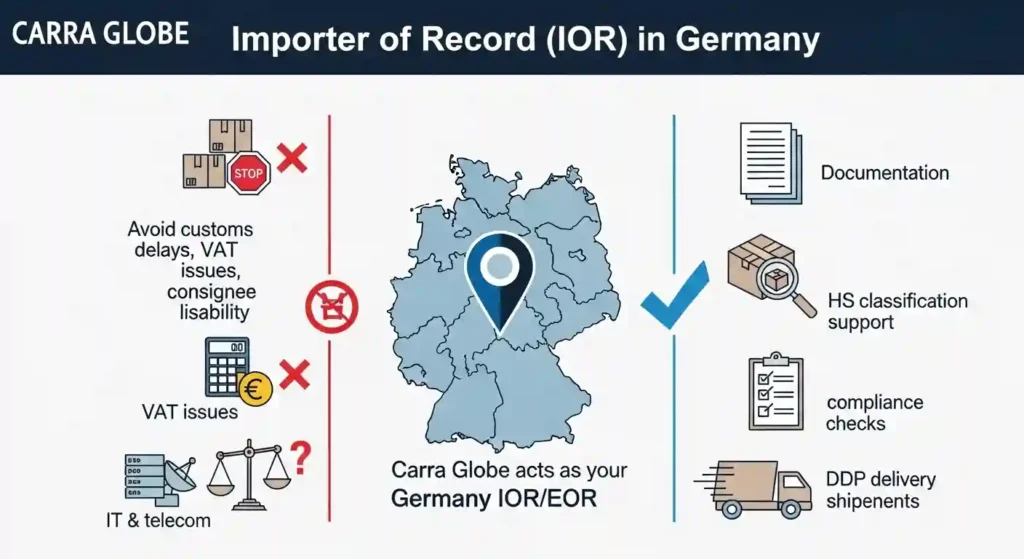
Common Hold in Germany & How Carra Globe Prevents Them
The most frequent causes of holds at German ports follow a consistent pattern: missing or invalid DE EORI, incorrect CN/TARIC code triggering wrong duty rates or missed anti-dumping measures, import VAT not registered, FTA preference claimed without valid origin evidence, ENS not filed before arrival, CBAM authorised declarant status not obtained for covered goods above 50 tonnes, CE marking absent for regulated products, BAFA licence missing for dual-use goods, and customs value understated. Every one of these results in a hold, duty recovery, or refusal that cannot be resolved at the port.
Carra Globe prevents these by verifying compliance before cargo moves, covering DE EORI, CN/TARIC classification with anti-dumping checks, German VAT registration, FTA origin documentation, ENS filing, CBAM declarant status and emissions data, CE marking verification, BAFA licence review, and customs valuation confirmation.
Germany Trade & Compliance Framework (2026)
Zoll, the Union Customs Code & ATLAS
Generalzolldirektion (GZD) is the German federal customs authority. Germany applies the Union Customs Code (UCC), the EU-wide legal framework governing all customs procedures, supplemented by German national implementing rules. All declarations are filed electronically via ATLAS, with complete digital processing mandatory since late 2025 (ATLAS 10.2 with Centralised Clearance for Import).
The customs tariff is the EU Combined Nomenclature (CN), an 8-digit code extended to 10 digits in the TARIC database incorporating anti-dumping duties, tariff suspensions, and preferential rates. The 2025 CN update introduced new codes for electronics and eco-related goods. Customs value is assessed on a CIF basis. Every importing entity must hold a valid EORI number with the DE prefix, valid across all 27 EU member states. In Germany, the DE EORI is linked to the company’s customs number (Zollnummer), not the VAT number, which differs from most other EU states. The importer remains legally responsible for declaration accuracy. Records must be retained for three years.
EU Tariff & Free Trade Agreements
Germany applies the EU Common Customs Tariff (CCT), the same rate applying regardless of which EU member state goods enter through. Key FTAs active in 2026 include the UK-EU TCA, EU-Japan EPA, CETA (Canada), EU-South Korea, EU-Singapore, EU-Vietnam, EU-New Zealand (in force since 1 May 2024), and others. The UK’s CPTPP accession entered into force in December 2024.
Preference claims require valid proof of origin: a supplier’s declaration, statement on origin, or EUR.1 movement certificate, held at declaration and available for Zoll audit. Anti-dumping duties apply on specific goods from specific origins on top of CCT rates, with steel, ceramics, solar panels, and chemical compounds from China among the most significant. The €150 customs duty de minimis threshold exempts low-value consignments from duty, but import VAT applies from €0 on all commercial imports with no de minimis.
Import VAT (Einfuhrumsatzsteuer) & German VAT
Import VAT (EUSt) is charged at 19% standard rate or 7% reduced rate on CIF value plus duties. German VAT-registered businesses reclaim it as input tax (Vorsteuer) on their VAT return using the import declaration as evidence. Following the §15 UStG amendment effective 30 December 2025, import VAT may be deducted as input tax as soon as it has arisen, regardless of whether it has been physically paid, removing a prior cash-flow constraint.
Germany does not operate a full at-border deferment system like the UK’s Postponed VAT Accounting. Import VAT is generally funded at the border and recovered on the next return. No fiscal representative is required for VAT purposes in Germany. The small business exemption threshold under §19 UStG should be confirmed at the current level before relying on it, as recent legislative updates have adjusted the figure. VAT returns are filed via ELSTER: monthly if prior-year liability exceeded €9,000, quarterly between €2,000 and €9,000, annually below €2,000.
Mandatory B2B e-invoicing took effect 1 January 2025 for domestic transactions between VAT-registered German businesses, requiring structured electronic invoices in XRechnung or ZUGFeRD format. Transitional provisions apply through 2027. Intrastat reporting is required for intra-EU movements exceeding €800,000 arrivals or €500,000 dispatches, filed monthly by the 10th.
Carbon Border Adjustment Mechanism (CBAM)
CBAM is now in its definitive phase from 1 January 2026. Covered goods: cement, iron and steel, aluminium, fertilisers, electricity, and hydrogen, with proposed expansion to selected downstream steel and aluminium-intensive products from 2028. Importers bringing in more than 50 tonnes annually must register as authorised CBAM declarants in the CBAM Registry. Importers below 50 tonnes are fully exempt.
From January 2026, authorised declarants must purchase CBAM certificates priced at the weekly average of EU ETS allowance auction prices. Declarants must hold certificates covering at least 50% of embedded emissions imported year-to-date at the end of each quarter (reduced from the originally planned 80% under the 2025 Omnibus simplification). The first certificate surrender for 2026 imports is due by 30 September 2027. Carbon prices paid in the country of origin can be deducted from the surrender obligation. Non-EU manufacturers must supply verified emissions data at the installation level. Without it, EU importers cannot complete CBAM declarations accurately. For Carra Globe clients, CBAM authorised declarant status and embedded emissions verification must be confirmed before cargo departs.
CE Marking & EU Product Regulatory Compliance
CE marking is mandatory for products within the scope of EU harmonisation legislation, including machinery, electronics, radio equipment, medical devices, PPE, toys, construction products, and pressure equipment. There is no German-specific alternative and no indefinite recognition of foreign national marks as in the post-Brexit UK. Products must carry CE marking before they can be legally placed on the German market.
The EU Radio Equipment Directive (RED) and EMC Directive require CE marking and technical documentation for radio-capable equipment. MDR (EU 2017/745) and IVDR (2017/746) require Notified Body CE marking for Class IIa and above medical devices. Non-EU manufacturers must appoint an EU Authorised Representative. MDR full enforcement has been in effect since May 2021, with legacy device transition extending to 2027–2028.
REACH (Regulation EC 1907/2006) requires ECHA registration for chemicals above tonnage thresholds. RoHS Directive 2011/65/EU restricts hazardous substances in electrical and electronic equipment. BAFA requires licence assessment for dual-use goods and strategic exports before dispatch. Import without authorisation results in seizure and penalties.
ICS2 & Entry Summary Declarations
Import Control System 2 (ICS2) is the EU’s pre-arrival security system. All goods from non-EU origins must be covered by an Entry Summary Declaration (ENS) before arrival. Air: house and master level data required before loading. Sea: filed before vessel arrival. Road and rail: phased into ICS2 from April 2025. Failure to file results in holds at the German border.
Duty Rates & Tax Structure
Electronics and IT hardware: 0 to 14% (many at 0% under WTO ITA). Machinery and industrial equipment: 0 to 4.7%. Textiles and clothing: 8 to 12%. Vehicles: 6.5 to 10% from most origins, reduced under FTAs. Food and agricultural products: variable, staples often 0%, processed goods and dairy significant. Steel and aluminium carry standard CCT rates plus anti-dumping surcharges. Import VAT: 19% standard, 7% reduced (the 7% reduced rate for restaurant services was made permanent from January 2026). Excise duties on alcohol, tobacco, and mineral oils via EMCS. Anti-dumping surcharges apply on specific goods and origins on top of CCT rates, though individual measures expire periodically and must be verified per TARIC code before importation. Under DDP, the seller settles duty, import VAT, and all clearance costs. Under DAP, the consignee handles all entry charges.
Germany Import Documents Checklist
- Commercial Invoice (8/10-digit CN/TARIC code, CIF value, full description, country of origin, Incoterms)
- Packing List
- Bill of Lading, Air Waybill, or CMR consignment note
- Certificate of Origin or supplier’s statement on origin (for FTA preference claims)
- Entry Summary Declaration (ENS) via ICS2 before arrival
- ATLAS import declaration
- CE Declaration of Conformity and technical file (all regulated categories)
- EU Authorised Representative appointment letter (non-EU manufacturers)
- MDR/IVDR Notified Body certificate (Class IIa+ medical devices and IVDs)
- REACH registration confirmation or downstream user notification (chemicals)
- BAFA import/export licence (dual-use, strategic goods)
- CITES permit (endangered species and derived products)
- Phytosanitary or veterinary health certificate (plants, animal products from non-EU origins)
- Excise documentation (alcohol, tobacco, mineral oils via EMCS)
- CBAM authorised declarant reference number (covered goods above 50 tonnes)
- Embedded emissions verification data (for CBAM declaration accuracy)
Product Categories Requiring Special Attention in Germany
Carra Globe’s IOR services are tailored to industries that rely on precision, speed, and reliability.
IT Hardware & Data Centre Equipment
Many technology goods attract 0% duty under WTO ITA. CE marking and RoHS compliance mandatory. EU Radio Equipment Directive applies to wireless components. TARIC classification critical for anti-dumping and preferential rate accuracy. Dual-use or encryption-capable equipment requires BAFA licence verification before dispatch.
Medical Devices & Diagnostics
MDR Notified Body certification required for Class IIa and above. EU Authorised Representative mandatory for non-EU manufacturers. Legacy device transition extends to 2027–2028. IVDR applies to in vitro diagnostics. UDI labelling requirements in effect.
Telecoms & Radio Equipment
EU Radio Equipment Directive and EMC Directive compliance required. Bundesnetzagentur type approval applies. CE marking mandatory, UKCA not valid in Germany.
Pharmaceuticals
BfArM import authorisation required. GDP cold chain compliance. Controlled substances require additional permits.
Chemicals
REACH registration with ECHA for substances above tonnage thresholds. RoHS compliance for electrical and electronic equipment. Classification, Labelling and Packaging (CLP) regulation. Safety Data Sheets required.
CBAM-Covered Goods
Steel, aluminium, cement, fertilisers, hydrogen. Authorised declarant registration, certificate purchases, and verified embedded emissions data required above 50-tonne threshold. First surrender deadline September 2027.
Dual-Use & Strategic Goods
BAFA licence verification required before dispatch. Encryption-capable technology subject to additional controls.
Germany Customs Clearance Lead Times
- Standard commercial cargo with complete documentation: 1 to 2 business days
- Customs examination or physical inspection: 2 to 3 additional business days
- Medical device market access (MDR Notified Body certification): months to years for new devices, pre-certification essential
- CBAM authorised declarant registration: several weeks, apply before first covered shipment
- DE EORI registration: a few business days online via Customs Portal, longer for paper applications
- REACH substance registration: months for new substances above tonnage threshold
Lead times depend on Zoll examination decisions, documentation completeness, and product compliance status. Issues identified after cargo arrives at a German border consistently produce longer delays and higher costs than compliance built before loading.
Carra Globe already holds every licence, certification, and approval listed above so your cargo moves without any delay.
Get in Touch
Carra Globe services in Germany
Carra Globe provides Importer of Record in Germany (IOR), Exporter of Record (EOR), DDP shipping coordination, DE EORI registration, ATLAS customs declaration management, German VAT registration and import VAT recovery, EU CN/TARIC classification, EU FTA preference management, ICS2/ENS filing, CBAM authorised declarant compliance, CE marking and EU product regulatory support, REACH and RoHS advisory, BAFA export control licence support, duty deferment and customs special procedures (inward processing, customs warehousing, temporary admission), freight forwarding (air, sea, road), and last-mile delivery coordination in Germany and across the EU.
Frequently Asked Questions — Germany IOR & DDP Shipping
Can I ship to Germany on DDP terms without a German or EU entity?
Yes, but Germany’s indirect representation rules mean most customs brokers refuse to file for non-EU principals due to joint and several liability. Carra Globe acts as a German-established IOR with DE EORI, VAT registration, and ATLAS access, filing as principal declarant and removing the liability barrier.
Why won't German freight forwarders act as my customs agent?
Under the UCC, indirect representatives are jointly and severally liable for any duty shortfall or declaration error. Most will only file for non-EU principals with established credit and deep documentation confidence. Appointing a German-established IOR who files as principal declarant removes the joint liability issue entirely.
How does import VAT work in Germany?
EUSt is charged at 19% (or 7% reduced) on CIF plus duties, funded at the border and reclaimed as input tax on the next VAT return. Germany does not operate a full at-border deferment like the UK’s PVA. The §15 UStG amendment effective 30 December 2025 allows deduction as soon as the liability arises, regardless of physical payment.
Is a fiscal representative required for German VAT?
No. Germany does not require EU or non-EU businesses to appoint a fiscal representative. A German contact address must be provided to the tax office for non-EU registrations. Many engage a local tax adviser for ELSTER filing convenience, but it is not a legal obligation.
What is CBAM and does it affect my shipments?
CBAM entered its definitive phase on 1 January 2026, covering cement, steel, aluminium, fertilisers, electricity, and hydrogen. Importers above 50 tonnes annually must register as authorised declarants, purchase certificates at EU ETS prices, and declare embedded emissions. First surrender covers 2026 imports, due 30 September 2027. Below 50 tonnes, fully exempt.
What is the difference between a DE EORI and an EORI from another EU state?
A DE EORI is issued by the GZD in Dresden and linked to the company’s customs number, not VAT number. However, any single EORI registered in any EU member state is valid across all 27 states. Companies importing first into Germany should register a DE EORI.
What CE marking requirements apply in Germany?
CE marking is mandatory for products under EU harmonisation directives. There is no German-specific alternative and no indefinite recognition of foreign marks as in the post-Brexit UK. Non-EU manufacturers must appoint an EU Authorised Representative for most regulated categories.
Can Carra Globe handle IT and data centre imports into Germany?
Yes. CN/TARIC classification, CE marking and RoHS review, EU Radio Equipment Directive assessment, FTA preference documentation, ATLAS declarations, German VAT registration and import VAT recovery, ENS filing, and BAFA export control verification for dual-use equipment.