
The same GPU can cost three different amounts to import, and nothing about the chip changes. Shipped as a bare component, it enters under one code, duty-free in most major markets. Mounted on a module and presented as a processing unit, it moves to a code that in the US can now carry a 25 percent surcharge. Built into a complete server, it travels under a third code, back outside the surcharge lines. Same silicon, three classifications, three prices. That is what HS codes for electronics have become in 2026: not paperwork, but the variable that decides what a shipment costs, whether it needs a licence, and sometimes whether it can move at all.
This guide maps the codes for the equipment modern infrastructure runs on, organised the way the work actually happens: by project and by decision, not by chapter number. Each product family has its own deep-dive guide; this page is the map that holds them together.
The core HS codes for electronics and tech equipment are: 8471 for servers and computers, 8542 for chips and GPUs, 8517 for routers and network equipment, 8507 for batteries, 8541 for solar cells and modules, 8504 for inverters, and 9018 for medical devices. Base duty on most of these is low or zero, but in 2026 the code also determines tariff surcharges, export controls, and regulatory requirements, which is where the real cost and risk sit.
The Master Table: HS Codes for Electronics, and What Each One Really Triggers
If you came for the codes, here they are. Every HS reference online will give you the first two columns. The fourth column is the one that decides whether your shipment moves, and it is the reason each row links to a full guide.
| Heading | What It Covers | Base Duty Posture | The Real Constraint in 2026 |
|---|---|---|---|
| 8471 | Servers, computers, storage, processing units | Zero under the ITA in most major markets | US Section 232 surcharge on 8471.50 and 8471.80 lines meeting technical thresholds |
| 8542 | Chips, GPUs, CPUs, memory, integrated circuits | Zero under the ITA | Export controls on advanced chips: destination and end-use licensing |
| 8517 | Routers, switches, base stations, modems | Zero under the ITA | Type approval from the destination telecom regulator |
| 8507 | Batteries, lithium-ion under 8507.60 | Varies by market; no single global rate | Dangerous goods rules: UN 38.3, Class 9, packaging, plus origin tariffs |
| 8541 | Solar cells and modules (8541.43) | Often zero at the base rate | Anti-dumping and countervailing duties by origin, sometimes several hundred percent |
| 8504 | Inverters and static converters (8504.40) | Low or zero in major markets | Lighter burden, but origin measures can still apply |
| 9018 | Medical, surgical, and dental instruments | Low or zero in many markets | Regulatory approval: FDA clearance, CE marking under MDR, national registration |
| 8473.30 | Parts of data processing machines | Zero under the ITA | Caught in the same Section 232 net as 8471 |
Adjacent medical headings are worth knowing too: implants and orthopaedic appliances sit under 9021, and X-ray, CT, and radiation apparatus under 9022, each with its own regulatory track. For any product in or near these families, our free HS Code Finder covers 400+ products across 16 national code formats, with the official US Harmonized Tariff Schedule as the authoritative confirmation for any US line.
Twenty years of the Information Technology Agreement made classifying this hardware feel like a formality; the constraint column is why it no longer is. For the arithmetic of what stacks on a given entry, see our landed cost guide, and for the price of getting the line wrong, the cost of incorrect HS codes.
Importing across several of these headings at once? Carra Globe classifies the full project, confirms the tariff and regulatory exposure per line, and clears as your importer of record across 175+ countries.
One Project, Many Codes
Here is what the code-lookup sites never show you: real imports are not one product, they are projects, and a single project sprawls across headings that behave completely differently at the border. Three examples from the work we see every week.
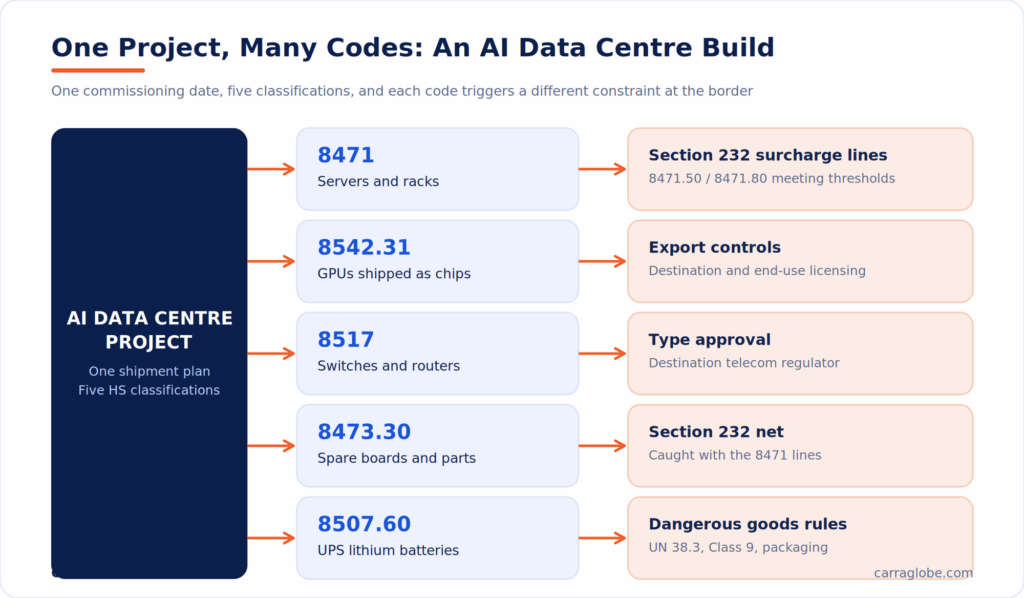
An AI data centre build. The racks of servers arrive under 8471. The GPUs, if shipped separately as chips, come in under 8542.31, but presented as processing units they move to 8471.50, which is precisely where the US Section 232 surcharge lines sit. The switches and routers that stitch the racks together are 8517, a different heading with a different gate: type approval. The spare boards are 8473.30, parts. The UPS batteries backing the whole thing up are 8507.60, lithium-ion, which means dangerous goods rules. One commissioning date, five classifications, and at least three different ways for the schedule to slip.
A solar-plus-storage farm. The modules are 8541.43, where the base duty is often zero and the trade-defence tariffs are anything but. The inverters are 8504.40, generally lighter. The battery containers are 8507.60 again, dangerous goods again. The mounting structures are not in any of these headings at all; they classify as aluminium or steel structures. The duty on this project is decided almost entirely by where the solar cells were made, and no other line item comes close.
A hospital fit-out. The patient monitors and ultrasound units are 9018. The implants going into the orthopaedics department are 9021. The imaging suite, X-ray and CT, is 9022. The servers running the hospital’s records are back in 8471. Four headings, and for the medical ones the duty is beside the point, because the health regulator can hold the devices even after customs has cleared them.
Once you see imports this way, the question stops being “what is the code for X” and becomes “what does each code in my project trigger.” That is the question the constraint column exists to answer.
The Three Questions That Classify Almost Anything
Strip away the jargon and nearly every classification decision in these categories comes down to three questions, asked in order.
What is it? Form first. A bare chip is not a module, a module is not a machine, and a battery is not the laptop it powers. The physical form of the goods as they cross the border, not what they will become later, is what customs classifies.
What does it do? Function separates the neighbours. A switch and a server can sit in the same rack and look like cousins, but one moves data and one processes it, so one is 8517 and the other is 8471. The same test splits a diagnostic instrument (9018) from an implant (9021) from an imaging system (9022).
How is it presented? This is the question importers forget, and it is the expensive one. The GPU from the opening of this guide: as a chip in a tray it is 8542.31, mounted on a board as a processing unit it is 8471.50, and integrated into a complete server it travels with the system under 8471.41 or 8471.49. The silicon never changed; the presentation did, and in 2026 that is the difference between zero and 25 percent. Batteries follow the same logic: alone, 8507.60 and UN 3480; inside a device, the device’s heading and UN 3481.
Form, function, presentation. If a classification dispute lands on your desk, one of those three is almost always the hinge.
The 2026 Overlay: Five Systems That Key Off the Same Code
Five separate systems read the same six digits and act on them independently, and none of them is standing still.
- Tariff surcharges. The US Section 232 semiconductor measure applies 25 percent to specific 8471 and 8473 lines meeting technical thresholds, with end-use exceptions including one for large US data centres. Further phases have been recommended, so the covered lines are likely to widen, not shrink.
- Trade-defence duties. Anti-dumping and countervailing measures, heaviest on solar under 8541, attach to codes and origins together and move mid-year: the US Section 201 solar safeguard expired in February 2026 even as the AD/CVD net widened.
- Export controls. Advanced chips and AI hardware face destination and end-use licensing that operates entirely apart from duty. A duty-free chip can still be unshippable without a licence.
- Product regulation. Radio and network equipment under 8517 needs type approval from the destination regulator, a global gate, not a Western one: the FCC, CE under the RED, ANATEL in Brazil, SDPPI in Indonesia, SIRIM in Malaysia. Medical devices under 9018 need FDA clearance, CE marking, or national registration, and the health authority can hold a device customs has already cleared.
- Transport safety. Lithium batteries under 8507.60 are Class 9 dangerous goods, with UN 38.3 testing and packaging rules that decide whether a carrier takes the shipment at all; the rules tightened again in 2026 for batteries packed with equipment.
Each system is covered in depth in the guide for its heading, linked in the table above.
The Codes Themselves Are About to Change
One more thing a static code list will never tell you: the nomenclature is not standing still either. The World Customs Organization has adopted HS 2028, the eighth edition of the Harmonized System, which enters into force on 1 January 2028. It carries 299 sets of amendments, creating 428 new subheadings and deleting 172, and it lands directly on these headings: health equipment is a central theme, with new lines for ventilators and diagnostic and monitoring devices that will reshape classification for 9018 importers in particular. Correlation tables were published in 2026, and the review work belongs in 2026 and 2027, not after the deadline. We cover the transition, and the four steps to take before it lands, in our guide to the HS 2028 update.
Running Classification Like a Discipline
None of this requires heroics. Classify before the purchase order is signed, not after the vessel sails. Confirm origin in the same breath, because the code and the origin together set the duty. Check the constraint column for every heading the project touches. Write down why each line was chosen; that record is the difference between an audit and a crisis. And when the number is big enough, get a binding ruling, not an opinion.
Frequently Asked Questions
What are the main HS codes for electronics and tech equipment?
Servers and computers are 8471, chips and GPUs are 8542, routers and network equipment are 8517, batteries are 8507, solar modules are 8541, inverters are 8504, and medical devices are 9018.
The subheading within each is what sets the duty and any surcharge exposure, which is why each heading in the table links to its own deep-dive guide.
Are electronics duty-free to import?
Often at the base rate, yes, under the WTO Information Technology Agreement. But VAT, tariff surcharges, trade-defence duties, and origin measures can stack on top, so the landed cost is rarely zero.
The code determines which of those layers apply, so confirm the full stack for your specific line and origin before budgeting.
How do I find the right HS code for my product?
Work through form, function, and presentation: what the item physically is, what it does, and how it ships. Then confirm the line against the destination country’s official tariff schedule or a binding ruling.
The six-digit HS level is universal; the full national line (ten digits in the US, eight in the EU) is what the duty attaches to. Our free HS Code Finder covers 400+ products across 16 national formats for that first step.
Will these HS codes change?
Yes. HS 2028, adopted by the World Customs Organization, enters into force on 1 January 2028 with 299 sets of amendments, including new subheadings for medical and diagnostic equipment.
Correlation tables mapping current codes to the 2028 structure are already published, and reviewing your product range against them belongs in 2026 and 2027 planning.
The code used to record the decision. In 2026, the code is the decision. Read the guide for each heading your project touches, run the three questions on anything ambiguous, and classify before you commit. Carra Globe works at exactly that layer as importer of record for tech and infrastructure hardware across 175+ countries.
Disclaimer: This guide is for informational purposes only and does not constitute legal, customs, or trade advice. Classification is fact-specific, and duty rates, tariff measures, controls, and regulatory requirements vary by country, product, origin, and date, and change frequently. Always verify the current position with the relevant customs authority, a binding ruling, or qualified counsel before importing.