
What the Importer of Record Will Be Carrying by 2028
Five regulatory regimes, working on unrelated problems, have moved the same way this year. Each one wants an identifiable party to answer for an import, and each one defines that party for itself. Commercial paperwork collapses all of them into a single word: importer. The law does not. That gap is the subject of this […]
Importer of Record for Technology Resellers: The VAT in Your DDP Quote
The deal is signed. The customer is in a country where you have no entity, no registration and no intention of opening one. Procurement asked for delivered to site, and you quoted it, because the competitor who said “ex works, you sort out customs” lost. Now somebody has to be named as importer. Whether that […]
Importer of Record for System Integrators: Multi-Vendor Projects
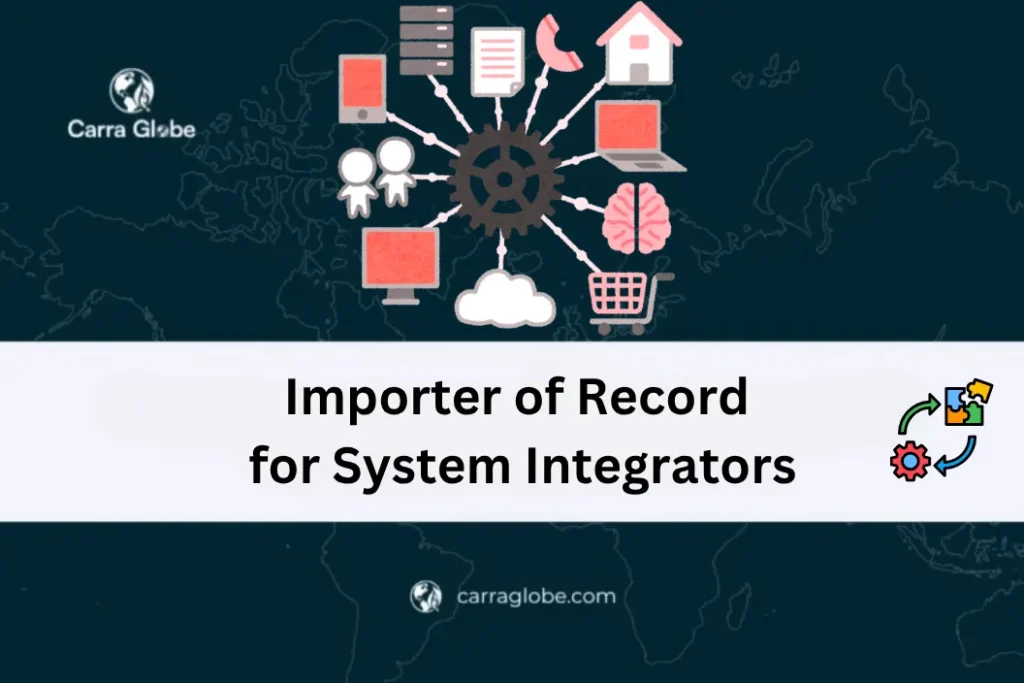
An integrator sells one solution at one price. Customs values goods, not solutions. That gap is where integration projects come unstuck, and it is almost never in the project plan. The import conversation usually starts with who signs the declaration. It should start earlier, with what the declaration is going to say. Carra Globe provides […]
CBP Heightened Import Disclosures ANPRM: Comments Close 1 December
There is a document filed with Chinese, Vietnamese or Mexican customs before your goods leave. You have probably never seen it. It may be your supplier who files it. It may equally be a trading company, a distributor, a consolidator or a third-party logistics provider, which is the range CBP itself names. Either way you […]
Import IT Equipment into the Philippines Without a Local Entity
The Customs Modernization and Tariff Act does not define “importer” in its definitions section, and it does not define “consignee” there either. The statute that governs every Philippine import uses both words throughout without ever setting out what they mean. So the question “can my company be the importer of record in the Philippines” cannot […]
Suez vs Cape of Good Hope: Days, Miles and Cost per Container
Ask what the Cape of Good Hope costs instead of Suez and you will be given a number. Ask where that number came from and it is usually a distance with no cost attached, a cost with no emissions exposure in it, or a transit time lifted from a different trade lane. The honest answer […]
Red Sea Shipping 2026: Carriers Return as the Risk Rises
Two things happened in the Red Sea this month that should not be happening together. Carriers moved more services back through the Suez Canal, and Houthi forces made further territorial gains along the Yemeni coast that the canal’s southern approach runs past. Both are documented, and they point in opposite directions. That gap matters commercially. […]
Importer of Record for Robotics & Industrial Automation 2027
On 20 January 2027 the EU rulebook for machinery changes, and the part that matters most to anyone shipping robots is easy to miss. The importer stops being a bystander and gets an article of its own. Under Machinery Directive 2006/42/EC, conformity responsibilities sit with the manufacturer or its authorised representative. Regulation (EU) 2023/1230 adds […]
Import IT Equipment into Vietnam Without a Local Entity
A foreign company cannot make itself the importer in Vietnam by contract alone. Not through a service, and not because a provider says otherwise. In the ordinary structure for a shipment with no local entity, a Vietnamese trader imports in its own name and the declaration carries that company’s details. “Import without a local entity” […]
Importer of Record for Automotive Electronics and EV Components
Customs can release a shipment of traction inverters that cannot lawfully be fitted to a single vehicle. Nothing has gone wrong at the border. Clearance and approval are separate systems, run by different authorities, and only one of them is customs. That gap is where vehicle programmes lose weeks. The parts land, the invoice is […]