
There are two ways to lose a high-value shipment. One is dramatic: a truck is hijacked, a container disappears, a pallet of servers is gone. The other is quiet: the goods sit untouched in a bonded warehouse for three weeks because the paperwork was wrong, the importer was not authorised, or customs flagged the valuation. Both cost you the shipment. Only one gets talked about.
Most advice on protecting high-value cargo covers the dramatic version, theft, damage, security escorts, and stops there. That half matters, and cargo crime is getting worse. But for many technology importers, the quiet version can be just as expensive as theft and may occur more frequently on some lanes. A shipment stranded at the border is an operational loss even when the cargo remains physically intact, whether the cause is a thief or a missing declaration.
This guide covers both halves: the physical risks that damage or steal your cargo, and the compliance risks that strand it. Protecting high-value tech means closing all of them, not just the visible ones.
The Short Answer, At a Glance
- Protection has two halves. One stops theft and damage. The other stops the shipment being detained, examined, reassessed, or seized at customs. High-value tech needs both.
- Cargo theft is shifting to your exact goods. Organized groups have moved from consumer electronics to enterprise computing hardware: higher resale value, concentrated in a single pallet.
- The rising threat is fraud, not just force. Deceptive pickups, criminals impersonating legitimate carriers to collect cargo voluntarily, make carrier and driver verification essential.
- A compliance failure strands cargo as surely as a thief. Wrong classification, an unauthorised importer, or missing documentation can hold a shipment for weeks.
- Clear accountability beats uncontrolled handoffs. One coordinated plan, with defined ownership for routing, security, customs, and insurance, closes the gaps between providers.
Part One: Protecting Cargo From Theft and Damage
The physical threat is real and it is escalating. Cargo theft losses across the United States and Canada reached nearly 725 million US dollars in 2025, a 60% increase on the prior year, even though the number of incidents rose more modestly. The FBI has warned the transportation and logistics sector about the scale of the increase. The reason is that organized groups became more selective: the average value per theft climbed 36% to roughly 274,000 US dollars, because criminals stopped stealing opportunistically and started targeting fewer, far more valuable shipments.
For technology importers, one detail matters most: industry analysis found that thieves have shifted away from consumer electronics like televisions toward enterprise computing hardware, which offers higher resale value in concentrated loads. For most technology importers, that is precisely the cargo you move.
Visibility: Know Where It Is at All Times
You cannot protect what you cannot see. Real-time tracking of location, and where the cargo is sensitive, of temperature, shock, humidity, and light, turns a black-box journey into something you can monitor and react to. The value is not the data itself; it is the early warning. A shipment that deviates from its route, stops where it should not, or registers a shock event can be flagged before a loss becomes final. For high-value tech, continuous visibility across the whole journey, not just at the endpoints, is the baseline.
Routing: The Fastest Path Is Rarely the Safest
The straight line from origin to destination is the cheapest route on paper and often the riskiest in practice. Protective routing weighs the mode against the threat: the right choice between air, road, and sea; the fewest possible handling touchpoints; the avoidance of known theft hotspots; and, for sensitive equipment, terrain smooth enough to spare it from vibration. A well-planned route may add time while materially reducing exposure to known risks. A badly planned one saves the time and raises the odds of losing the cargo.
Carrier and Driver Verification: The Fraud Gap
The threat is shifting from force to fraud. One of the methods to watch is the deceptive pickup, and CargoNet expects theft-by-deception groups to sharpen their focus on misdirecting shipments tendered to legitimate carriers in 2026. Criminals use stolen load information, falsified credentials, and impersonation to have cargo handed over voluntarily, then disappear. The defence is verification: vet carriers and drivers in advance, confirm identity at handover, and treat any mismatch as a stop signal. A thief who arrives with convincing paperwork and a stolen identity never has to break anything.
Packaging and Handling: Treat It Like Glass
Damage is theft’s quieter cousin, and for sensitive equipment it is often more likely. High-value tech such as precision instruments or servers can be vulnerable to even minor mechanical shock, so it needs protective packaging: custom crating, shock-absorbent foam, anti-static protection, and moisture barriers where the environment demands it. Packaging is only half the job. Controlled handling, low-speed movements, and specialised transport, down to air-suspension chassis for the most delicate loads, are what get carefully packed cargo to its destination intact.
Escort and Liability Cover: The Last Line
For the highest-value loads on the highest-risk routes, a security escort may deter opportunistic theft and can form part of a layered security plan. And because no measure is perfect, cargo insurance is the financial backstop, though it needs care: confirm that the policy covers the route, commodity, theft method, storage periods, and any security conditions the insurer imposes. Policies may exclude unattended vehicles, deceptive pickup, unexplained shortage, improper packaging, or delay, so full replacement value is not automatically the same as full coverage. Together these are the last line, used when the value or the route justifies them, not on every shipment.
Moving high-value tech into a difficult market? Carra Globe coordinates secure, compliant delivery across 175+ countries, so protection and clearance are handled together. Talk to us about your shipment →
Importer of Record · 175+ countries
Protect high-value tech from the thief and the customs hold alike.
Carra Globe coordinates secure delivery and compliant clearance as one process, acting as your Importer of Record so high-value hardware reaches its destination whole, on time, and cleared. Explore how we help:
Free tools: HS Code Finder|Volumetric Weight Calculator|Pallet Calculator
Moving a high-value shipment? Tell us the lane and the hardware, we will confirm and quote.
Get a compliance quotePart Two: The Protection Most Guides Skip
Here is what a page written by a security vendor tends to leave out: the largest risk to a high-value tech shipment is often not a thief at all. It is a compliance failure that strands the goods. The cargo is safe, tracked, and undamaged, and it still does not reach the customer, because it is sitting in customs custody over a problem that has nothing to do with security. For international technology imports on some lanes, delay can cost more than crime does.Seizure and Holds: When Customs Keeps Your Cargo
Customs authorities can detain a shipment for a long list of reasons that have nothing to do with its physical safety: an incorrect HS classification, a valuation the authority disputes, a missing permit or certificate, or goods that require an approval the importer does not hold. A held shipment accrues storage costs, misses its deployment window, and ties up capital, and unlike a theft, it is entirely preventable. Our guide on customs holds on IT shipments covers how to prevent and resolve them.The Importer of Record: Who Is Legally Bringing It In
Every import needs a party legally responsible for the customs entry: the importer of record. If you are shipping into a country where you have no registered entity, you may have no one authorised to import the goods at all, and no amount of physical security solves that. This is where a third-party importer of record protects the shipment in a different sense: it gives the goods a compliant, accountable route into the country. The importer of record carries the customs declaration, the classification, and the duty and tax exposure, so the shipment has a legal path to release.Documentation: The Cheapest Protection There Is
The least glamorous protection is also the cheapest and the most neglected. A complete, accurate document set, correct commercial invoice, accurate HS codes, valid certificates, the right permits, is what keeps a shipment moving through the compliance gate. Most customs holds trace back to a document that was wrong, missing, or inconsistent. Getting the paperwork right before dispatch costs almost nothing. Fixing it after the goods are held costs storage, delay, and sometimes the deployment itself.Duty and Tax Exposure: The Cost That Ambushes You
A high-value shipment carries a high duty and tax bill, and an unexpected one can stall a project as effectively as a hold. Confirming the landed cost in advance, the duties, taxes, and fees the destination will levy, protects the shipment from a nasty surprise at the border. Delivered Duty Paid terms can make expected duties, taxes, and delivery costs clearer and shift many of them to the seller, subject to the destination’s rules and the contract. DDP does not replace classification, permits, importer requirements, clearance, or insurance planning; it makes the cost side more predictable.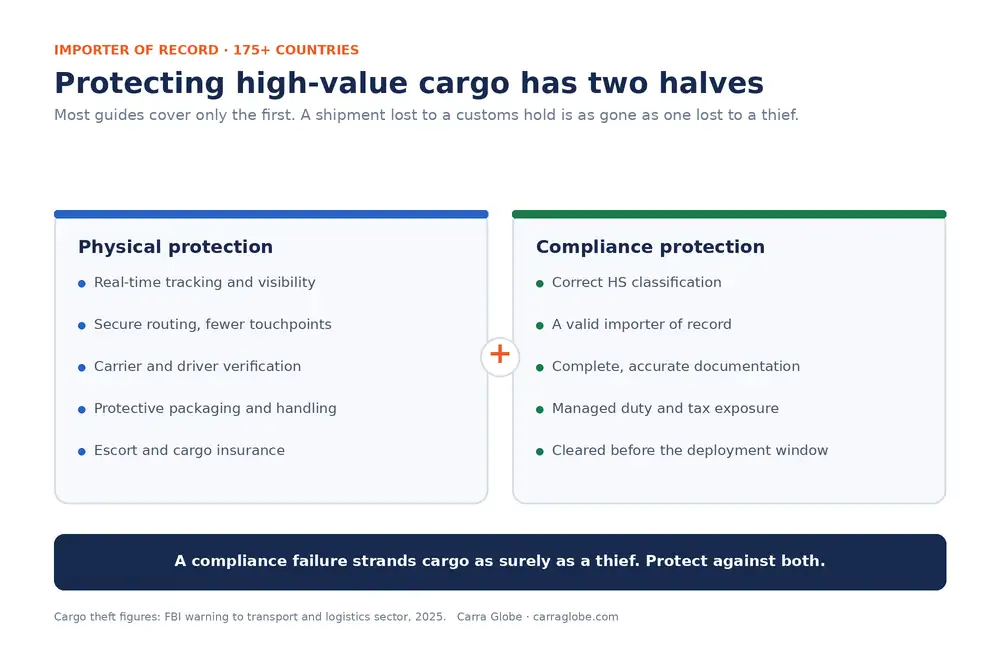
The Common Thread: Fewer Handoffs, Clear Accountability
Look at both halves together and a single principle runs through them. Every uncontrolled handoff is a potential point of failure. When cargo moves between a forwarder, broker, carrier, local agent, customs filer, and warehouse, each party needs a clearly defined responsibility. The strongest operating model is not necessarily one party legally liable for everything; it is one coordinated plan with clear ownership for routing, security, customs, insurance, and escalation.
That is the real logic behind coordinating protection. When one partner coordinates the routing, the handling, the importer-of-record role, the documentation, and the clearance, the seams between them close. The physical and compliance risks stop being handled by different people who each assume someone else covered the gap. Protection can be coordinated as one operating process instead of several disconnected workstreams, and the shipment stops falling through the cracks between them.
How Carra Globe Protects High-Value Tech Cargo
Carra Globe coordinates high-value technology hardware movements into 175+ countries across both protection workstreams. We coordinate secure routing and handling for sensitive equipment, act as your importer of record so the goods have a compliant route in, manage the documentation and classification that keep them moving through customs, and handle duties and taxes under Delivered Duty Paid terms where suitable, subject to the destination’s rules. The aim is simple: your cargo reaches its destination whole, on time, and cleared, protected from the thief and from the hold alike.
Frequently Asked Questions
How do you protect high-value cargo?
Through two layers: physical protection (tracking, secure routing, carrier vetting, protective packaging, escorts) and compliance protection (correct classification, a valid importer of record, complete documentation, and managed duty exposure).
High-value tech needs both, because a shipment can be lost to a customs hold as easily as to a thief.
What is the biggest risk to high-value tech shipments?
It depends on the lane and the shipment. Cargo theft increasingly targets enterprise computing hardware, while compliance failures can create serious delays, storage costs, and deployment losses on international import routes.
The relevant risk is the one your route, cargo, and timing make most expensive. The safest approach treats both as real and closes both gaps before dispatch.
Why is IT hardware targeted for cargo theft?
Because it has high resale value in concentrated shipments. Organized groups have shifted from consumer electronics to enterprise computing hardware, which is more valuable per pallet and easier to resell.
That shift makes visibility and carrier verification especially important for technology importers.
Can a customs hold really cost as much as theft?
Yes. A held shipment accrues storage, misses its deployment window, and ties up the capital invested in the goods. For time-critical technology projects, the delay can cost more than the hardware.
Unlike theft, a compliance hold is almost always preventable with the right preparation.
Does an importer of record help protect cargo?
In the compliance sense, yes. An importer of record gives goods a legally authorised route into a country where you have no entity, carrying the customs declaration, classification, and duty exposure.
It does not replace physical security, but it closes the compliance gap that strands shipments.
Disclaimer: this guide is educational and does not constitute legal, security, or insurance advice. Cargo risk and protection measures vary by route, commodity, and destination, and regulations change over time. Confirm the current requirements and appropriate protections for your specific shipment with a qualified partner before shipping.