
Every logistics explainer walks you up the same ladder: 1PL, 2PL, 3PL, 4PL, 5PL, more outsourcing at each rung. That part is easy, and most guides stop there. But if you move high-value goods across borders, the ladder leaves out the one question that can create a serious customs problem: when your cargo reaches a foreign customs authority, which of these tiers is legally responsible for it?
The answer surprises people: the PL tier itself does not determine the importer of record. A provider may separately act in that role where the applicable law allows it and meets the required conditions.
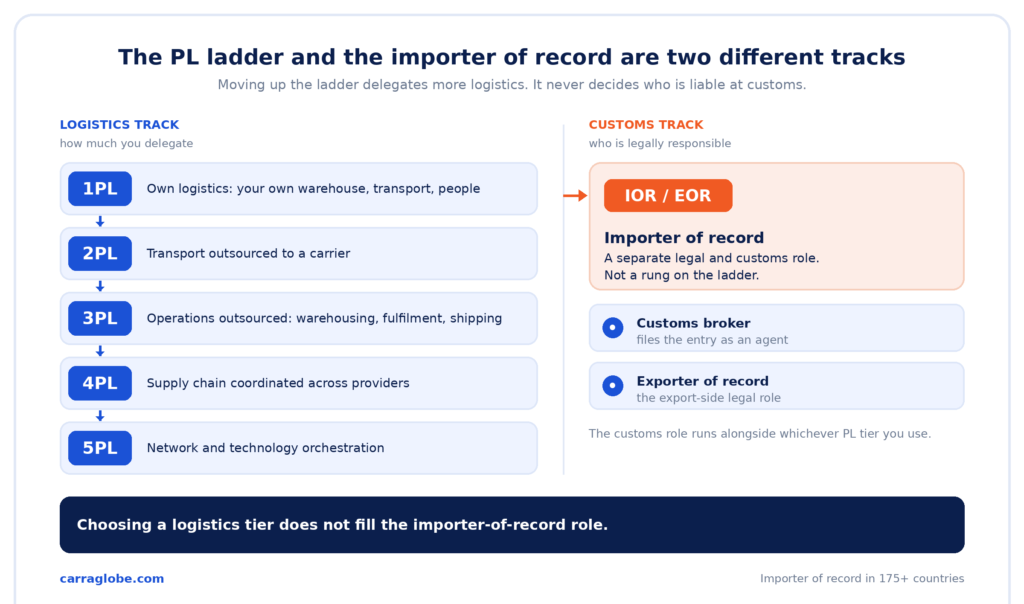
This guide explains the five tiers, then shows where the importer of record fits, because it does not sit on the ladder at all. It sits beside it, and that distinction is where cross-border shipments succeed or stall.
Key takeaways
- 1PL to 5PL measures how much logistics you outsource, not who is liable at customs.
- The importer of record is a legal role defined by customs law, not a rung on the logistics ladder.
- A 3PL can manage your warehouse and shipping and still leave the importer-of-record role unfilled.
- Logistics tier is not the same as legal liability. Confirm in writing whether your provider acts as the legal importer, or only moves the goods.
- 6PL and 7PL are non-standard marketing terms for further automation, not settled industry classifications.
Terminology note: 1PL to 5PL are industry operating-model terms, not universal customs-law classifications. Importer-of-record status is a separate legal question governed by the destination country.
1PL to 5PL Explained: What Each Logistics Tier Means
PL stands for party logistics. The number in front tells you how much of the logistics work you have handed to someone else. At 1PL you do everything yourself; at 5PL a technology-led provider orchestrates broader networks across multiple providers on your behalf. The tiers in between are steady steps from control toward delegation.
The terms are widely used but not globally standardised, so the actual contract and services matter more than the label. Industry bodies such as the Council of Supply Chain Management Professionals document and use them in their reference materials.
The Five Tiers at a Glance
Here is the whole ladder in one view. Find where your business sits today, then read the section that matches.
| Tier | What it does | You keep control of | Typical user | Does the tier determine IOR status? |
|---|---|---|---|---|
| 1PL | The goods owner manages its own logistics with internal resources | Everything | A manufacturer running its own warehouse and deliveries | No¹ |
| 2PL | An external transport provider, often asset-based, performs outsourced movement and sometimes basic related services | Everything except transport | A shipper booking ocean or air freight directly | No |
| 3PL | Multiple outsourced logistics functions: transport, warehousing, fulfilment, inventory | Strategy and supplier relationships | A brand outsourcing day-to-day logistics | No² |
| 4PL | Coordinates your whole supply chain, often several 3PLs | Strategic objectives and governance | A company coordinating many providers or markets | No³ |
| 5PL | Technology-led orchestration of wider logistics networks | Strategic outcomes and governance | A large enterprise with complex global flows | No⁴ |
The rule to remember: the PL ladder describes how logistics responsibilities are organised, and the importer-of-record role identifies the party responsible for the customs obligations applicable to the import. They are parallel tracks, not the same track.
1PL: When You Are the Logistics
At first-party logistics, the business manages its logistics directly using its own internal resources, which may include its own warehouse, transport, or drivers. The appeal is total control. The limit is that everything sits on your balance sheet, from the capital tied up in vehicles to a network that reaches only as far as you can build it. The 1PL model works until volume or distance outgrows it, and that is usually the moment a business starts looking outward for help. Example: a manufacturer that delivers to regional customers using its own warehouse and its own trucks.
2PL: The Asset-Based Carrier
Step up to second-party logistics and you bring in a carrier that owns the transport: a shipping line, an airline, a haulage firm. You outsource the movement of goods and keep everything else, warehousing and fulfilment included, in-house. In common usage, 2PL generally refers to outsourced transport, often through an asset-based carrier, though some sources also include basic storage or related services. Example: a manufacturer that owns its warehouse but hires an ocean carrier to move its containers.
One caution on language. People often reach for the term freight forwarder here, but a forwarder arranges transport rather than owning it, so it is not the same thing as an asset-based 2PL carrier. More broadly, the PL labels are useful operating-model shorthand rather than a universal legal classification, so providers may describe their own services differently.
3PL: Outsourced Operations
Third-party logistics is the tier most people mean when they say they have outsourced logistics. A 3PL typically performs multiple outsourced logistics functions, which can include transportation, warehousing, fulfilment, inventory management, distribution, reverse logistics, and related value-added services, and may use carriers and forwarders inside its service. Because providers bundle different services under the 3PL label, the actual scope should be checked against the contract rather than inferred from the label alone.
That breadth is exactly why the customs question matters: a 3PL can run your operations beautifully and still not be the party customs holds responsible for your import, so the label alone tells you little about who is liable at the border. Example: an e-commerce company that sends its inventory to a fulfilment provider that stores, picks, and ships orders.
4PL: The Supply-Chain Coordinator
A fourth-party logistics provider typically coordinates the client’s wider supply chain, often managing several 3PLs and designing or optimising the network, while characteristically owning few or no physical assets of its own. The client typically retains its strategic objectives while the 4PL coordinates providers, processes, and supply-chain decisions around those objectives.
A 4PL makes sense when managing multiple suppliers, markets, or 3PLs has become a full-time job. Example: an enterprise running several warehouses, carriers, and 3PLs, all coordinated by one lead provider. It buys you oversight, but it does not change who signs for the goods at a foreign border, which is still a separate question.
3PL vs 4PL: What Is the Difference?
The 3PL-versus-4PL question is the one most people actually arrive with. The short version: a 3PL executes logistics; a 4PL coordinates it. Here is the fuller comparison.
| 3PL | 4PL | |
|---|---|---|
| Primary role | Executes logistics operations | Coordinates the supply chain |
| Warehousing | Often directly | Usually via a 3PL |
| Transportation | Often directly | Coordinates providers |
| Owns assets | May own warehouses and fleet | Usually limited or none |
| Multiple providers | May use them | Commonly manages several |
| Strategic planning | Some | A major component |
| Technology and visibility | Operational systems and shipment visibility | Cross-provider orchestration, analytics, and network optimisation |
| Importer of record | Not automatic | Not automatic |
5PL: Network-Level Integration
Fifth-party logistics is not a universally standardised legal or industry classification. The term is commonly used for technology-led, network-level orchestration: a provider that uses data, automation, and aggregated volume to plan and optimise logistics across multiple supply chains and providers at once. A 5PL often bundles the demand of several clients or 3PLs to secure better rates and build a more automated, data-driven network. Example: a technology-driven operator orchestrating multiple supply chains and providers across a large network.
It is most commonly associated with large or complex multi-provider networks, though the label is also used more broadly by technology-led logistics providers. Note that 3PL is a relatively established term, while 4PL and 5PL are broader operating-model labels with less universal standardisation. You will occasionally see 6PL and 7PL for more automated models, but these are not widely standardised.
Importer of Record · 175+ countries
Will your Importer of Record survive the new CBP standard?
Carra Globe acts as a US-present Importer of Record with the domestic assets, bonding, and compliance history the 2026 rules demand, so your goods keep clearing while the market adjusts. Explore how we help:
Free tools: HS Code Finder|Volumetric Weight Calculator|Pallet Calculator
Reviewing your IOR before December 2026? Tell us the lane and the hardware, we will confirm and quote.
Get a compliance quoteWhere the Importer of Record Actually Fits
Here is the distinction that is often overlooked. The importer of record and the exporter of record are not rungs on the PL ladder. They are legal roles, and they run alongside whichever tier you use, not above it and not below it.
Neither a 3PL nor a 4PL automatically becomes the entity a customs authority holds responsible for declaring the goods, paying the duties and taxes, and meeting the destination country’s import requirements. Some large integrated 3PLs and forwarders do offer importer-of-record services, but that is a separate legal function with its own eligibility requirements (local establishment, registration, licensing, or bonding, depending on the jurisdiction). Do not assume your 3PL includes it, confirm in writing.
For imports, the importer of record is the relevant customs role. Exports can involve a separate exporter-of-record role, though the exact responsibilities and terminology depend on the jurisdiction.
The logistics contract can allocate responsibilities between the parties, but it does not by itself establish who is legally eligible to act as importer of record under the destination country’s customs law. Authorities such as U.S. Customs and Border Protection set out who may act in that role, which is why a provider can sit high on the PL ladder and still leave it unfilled.
A customs broker may file the entry as an agent, but using one does not remove the importer of record’s responsibility for the entry and for duties, taxes, and fees. In the United States, CBP is explicit on this. The importer of record can depend on the entry structure and is not always a separate third-party company: it may be the owner, purchaser, or another eligible party.
The broker may also carry its own obligations under customs law and the brokerage agreement, so confirm which party is the importer of record, who files the entry, and how responsibility is allocated.
To keep the roles straight, here is who does what.
| Role | Main function |
|---|---|
| Importer of record | The party identified under applicable customs law as responsible for the import entry and associated obligations |
| Customs broker | A licensed agent that handles customs business on the importer’s behalf |
| 3PL | Operational logistics: warehousing, fulfilment, transport |
| 4PL | Supply-chain orchestration across providers |
| Carrier | Physical transportation of the goods |
The practical consequence: your PL tier and your importer-of-record arrangement are two separate decisions. You can be a 4PL-coordinated global operation and still have no one authorised to import your servers into Brazil. The logistics ladder does not, by itself, determine who answers to customs.
What Executive Order 14411 Could Mean for Foreign Importers of Record
The gap between a logistics tier and the importer-of-record role is drawing sharper regulatory attention in 2026, at least for shipments into the United States. Executive Order 14411, “Strengthening Customs Enforcement,” issued on 3 June 2026, directs the Department of Homeland Security and CBP to revise importer-of-record eligibility and enforcement rules, including requirements affecting foreign importers of record and conditions for formal and informal entries.
It also directs changes concerning bonding or sufficient domestic tangible assets, disclosures, good standing, vetting, and a CTPAT-related condition for eligible foreign importers of record, involving validation where eligible or filing through a CTPAT-validated licensed broker, subject to CBP implementation.
These are directed rulemaking steps, not requirements that all took effect on the signing date.
The order sets out a phased timeline. Certain disclosure, mitigation, and transparency measures fall on 90-day tracks, while the major importer-eligibility, good-standing, registry, and vetting changes are directed within 180 days. A separate 45-day step concerns recommendations for legislation, not implementation of the importer rules themselves.
The potential practical effect for the PL-versus-IOR question is significant: a foreign logistics provider that currently acts as your importer of record may face different eligibility or bonding conditions once the revised rules are implemented, depending on how they are finalised and on the provider’s eligibility. The gap between logistics tier and legal liability is exactly where that risk sits. We cover the detail in our guide to the 2026 customs enforcement Executive Order and IOR rules.
Policy note: the US importer requirements described here reflect the position as of August 2026. Implementation is proceeding through rulemaking and may change.
Signs Your PL Provider Has Left the Customs Gap Open
A 3PL or 4PL can run your logistics well and still leave the import question unanswered. Here is how to identify whether the customs role still needs to be arranged:
- You are shipping into a country where your business has no registered legal entity.
- Your provider operates in that market but will not, or cannot, act as the legal importer.
- A shipment is stuck because no entity is named as the importer of record on the declaration.
- You are moving regulated products, such as medical devices, telecom equipment, or dual-use technology, where the destination may impose additional importer, licensing, registration, or product-compliance requirements.
- Your provider is a foreign entity that no longer qualifies as an importer of record under tightened eligibility rules.
Recognise two or more of these and the importer-of-record question stops being a background detail. It becomes the next thing to solve, whatever your PL tier. Our guide on importer of record vs customs broker explains how the role differs from the other parties in the chain.
Shipping high-value tech into a market where your provider will not act as the importer? That is the exact gap Carra Globe fills, in 175+ countries. Talk to us about your lane →
How to Decide If You Need a 3PL, a 4PL, or an Importer of Record
- No local entity in the destination? Check whether the country permits non-resident importing, then determine which eligible party, such as your business, an authorised distributor, or another permitted importer structure, must be named for the shipment.
- Your 3PL or 4PL will not act as the legally recognised importer? Confirm whether the destination permits a non-resident importer, consignee, distributor, licensed broker, or dedicated IOR structure, then appoint the eligible party before shipment.
- Importing regulated or controlled technology (medical devices, telecom equipment, dual-use hardware)? Confirm the legally recognised importer, certificate holder, licence holder, authorised representative, and end-user requirements, and use an importer of record with sector expertise where that structure is permitted.
- A foreign company importing into the US while EO 14411 is being implemented? Check whether the applicable informal-entry, bonding, domestic-asset, disclosure, and CTPAT-related requirements affect your entries, and confirm the current position with your customs broker.
Questions to Ask Your Logistics Provider
Before you sign, these questions close the gap between the logistics tier and the customs role:
- Will you act as importer of record, and in which countries?
- Under whose legal entity is that role held?
- Who files the customs entry, and who is responsible for classification?
- Who pays the duties and taxes, and who handles a customs examination?
- Who manages import permits and product-specific compliance?
- What happens if the shipment is rejected or held?
- Is the importer-of-record role included in the quoted logistics price, or separate?
If the answer to any of these is unclear, the customs role has not been settled, whatever the logistics tier.
How Carra Globe Helps
Carra Globe fills the role the PL ladder leaves open. Whatever logistics tier you run, we act as your importer of record or exporter of record across 175+ countries, carrying the customs declaration, the classification, and the duty and tax exposure so your high-value technology hardware has a compliant, accountable route across the border. Eligibility and requirements vary by jurisdiction, and we confirm what applies before shipment.
For deliveries where you want duties handled up front, Delivered Duty Paid terms can make the cost side more predictable. Worth noting: DDP is an Incoterms rule that defines the agreed delivery and cost responsibilities between seller and buyer. It does not by itself establish every customs-role requirement, so the importer-of-record arrangement is confirmed separately. You keep your logistics setup; we help close the customs gap.
Frequently Asked Questions
What is 1PL?
First-party logistics (1PL) means the goods owner manages its own logistics using internal resources, such as its own warehouse and directly controlled transport.
It describes an operating model, not a customs status: the company may also be its own importer of record where the destination permits it.
What is 2PL?
Second-party logistics (2PL) means hiring a transport provider, typically asset-based such as a shipping line, airline, or haulier, to move the goods while you keep the rest of your logistics in-house.
Using a 2PL carrier does not decide who the importer of record is: that stays a separate customs question.
What is 3PL?
Third-party logistics (3PL) means outsourcing multiple logistics functions to one provider, which can include transport, warehousing, fulfilment, inventory management, and related services.
A 3PL runs operations, but it is not automatically the importer of record. Some 3PLs offer that role separately where they are eligible.
What is 4PL?
Fourth-party logistics (4PL) means one provider coordinates your whole supply chain, often managing several 3PLs, while you retain your strategic objectives and governance.
A 4PL may coordinate an importer of record, but the tier itself does not establish who holds that legal role.
What is 5PL?
Fifth-party logistics (5PL) is commonly used to describe network-level integration, where a technology-led provider plans and optimises logistics across multiple supply chains using data, automation, and aggregated demand.
The term is less standardised than 3PL, and network integration does not by itself establish importer-of-record status.
What is the difference between 1PL and 3PL?
1PL means you handle logistics yourself with your own resources. 3PL means you outsource day-to-day logistics, such as warehousing, fulfilment, and shipping, to a specialist provider.
Neither model, on its own, decides who is the importer of record at customs.
Can a freight forwarder act as my importer of record?
Only if it is eligible and formally appointed. A freight forwarder arranges transport and documentation, but acting as importer of record is a separate legal role with its own conditions, which vary by country.
Door-to-door service does not automatically include the importer-of-record role, so confirm it in writing.
What is the difference between 3PL and 4PL?
A 3PL runs your day-to-day logistics: warehousing, fulfilment, and shipping. A 4PL sits above that, coordinating your whole supply chain and often managing several 3PLs.
In short, a 3PL operates the logistics; a 4PL manages the operators, usually without owning physical assets. Neither automatically becomes your importer of record.
What is the difference between 4PL and 5PL?
A 4PL coordinates one company’s supply chain and manages multiple logistics providers. A 5PL operates at a broader, technology-led network level, using data, automation, and aggregated demand to optimise multiple supply chains or provider networks.
Neither tier automatically determines importer-of-record status.
Is a 3PL the same as a freight forwarder?
No. A freight forwarder arranges and books transport but rarely owns warehousing or runs fulfilment. A 3PL takes on the broader operations, storage, fulfilment, and distribution, and may use forwarders within its service.
The forwarder is one tool a 3PL may use, not a synonym for it.
Does using a 3PL or 4PL automatically make it the importer of record?
No. The logistics model does not by itself establish importer-of-record status. A provider may separately offer the role where legally permitted and eligible, but it is not automatic.
If your provider does not hold that status and you have no local entity, you may need an eligible importer-of-record arrangement, depending on the destination country’s rules and the structure of the transaction.
Which PL tier is best for shipping high-value tech internationally?
It depends on your volume and markets: a 3PL suits outsourced operations, a 4PL adds coordination across many markets. Whichever tier you choose, separately confirm who acts as importer of record in each destination.
The tier and the customs role are two decisions, not one.
Can one provider handle both my logistics and my customs compliance?
Sometimes. Some providers pair logistics with importer-of-record or trade-compliance services; others handle only one side. Because it varies by provider and market, get it in writing.
The question to ask: will this partner act as the legal importer or exporter, or only move the goods?
Can a 3PL act as my importer of record?
Sometimes. A 3PL can act as importer of record where the destination’s laws permit it and the provider meets the applicable eligibility, registration, licensing, bonding, and other requirements. Many do not offer it at all.
Those that do treat it as a separate service from their logistics tier, so confirm the arrangement in writing.
What does PL stand for in logistics?
PL stands for party logistics. The number in front (1PL to 5PL) indicates how much of the logistics work is outsourced, from doing everything yourself at 1PL to a fully integrated network provider at 5PL.
It describes the degree of delegation, not who is legally responsible at customs.
What changed for foreign importers of record in 2026?
Executive Order 14411 (June 2026) directs DHS and CBP to pursue changes affecting foreign importer-of-record eligibility, entry requirements, disclosures, vetting, and bonding, phased over 90- and 180-day tracks.
Implementation is proceeding through rulemaking, so confirm the current position before relying on a foreign-IOR structure into the US.
What do 6PL and 7PL mean?
They are occasionally used for even more automated or fully outsourced logistics models beyond 5PL, but they are not standardised industry terms.
They are not widely standardised industry classifications and are often used as marketing terminology.
Sources and Further Reading
- U.S. Customs and Border Protection: importer of record and customs broker guidance (cbp.gov).
- Federal Register: Executive Order 14411, “Strengthening Customs Enforcement” (3 June 2026) (federalregister.gov).
- Council of Supply Chain Management Professionals: logistics terminology and definitions.
Disclaimer: this guide is educational and does not constitute legal advice. Logistics models and customs requirements vary by provider, country, and product, and change over time. Confirm the right arrangement for your specific shipment and destination with a qualified partner before shipping.