
A vendor gets a Brazilian data centre enquiry and someone mentions REDATA. Federal taxes suspended on qualifying imported equipment: import duty, PIS, Cofins, IPI. On a container of servers those numbers are substantial, and the quotation suddenly looks very different.
Then the shipment arrives and the taxes are assessed in full.
Nothing went wrong procedurally. The regime exists and the numbers were real. The problem is who the benefit belongs to, which is the part almost nobody explains before a quotation goes out.
Carra Globe acts as importer of record in Brazil, so we have a commercial interest in your answer. What follows is written to be usable whether or not you ever speak to us.
What is Brazil REDATA?
Brazil REDATA is a special tax regime for data centre services in Brazil, suspending certain federal taxes on qualifying equipment for authorised projects. Enacted as Law No. 15.504/2026 on 15 September 2026.
Four categories are covered: PIS/Pasep and Cofins on revenue, the importation contributions PIS/Pasep-Importação and Cofins-Importação, IPI, and Import Tax. On an inbound shipment the relevant ones are the importation contributions, IPI and Import Tax.
Where the applicable conditions are met, the suspension converts to a zero rate. Suspension and exemption are not the same thing, and the difference matters if conditions are later missed.
Stacked together on a large deployment, the difference is not a rounding error. Government estimates put the tax expenditure at around R$5.2 billion in 2026, falling to roughly R$1 billion in each of the two following years. Those are estimates of revenue the state expects to forgo, not money paid to participating companies.
REDATA is now law
This changed very recently, and anyone working from older material will have the wrong picture.
REDATA was first established by Provisional Measure No. 1.318/2025, which lapsed on 25 February 2026 without being converted into law. The same content was reintroduced as Bill 278/2026, approved by the Chamber of Deputies on 24 February 2026 and by the Federal Senate on 1 September 2026.
The President sanctioned it on 15 September 2026 as Law No. 15.504/2026, published in an extra edition of the Official Gazette the same day. A related complementary law, No. 237/2026, was sanctioned alongside it with a partial veto. REDATA exists as enacted law rather than as a proposal.
Being law is not the same as being fully operational. Habilitation and cohabilitation are granted by the Receita Federal under a procedure that still depends on federal regulation. Sustainability criteria, eligible energy sources, verification periods and the exclusion procedure all remain to be defined.
Who can actually hold it
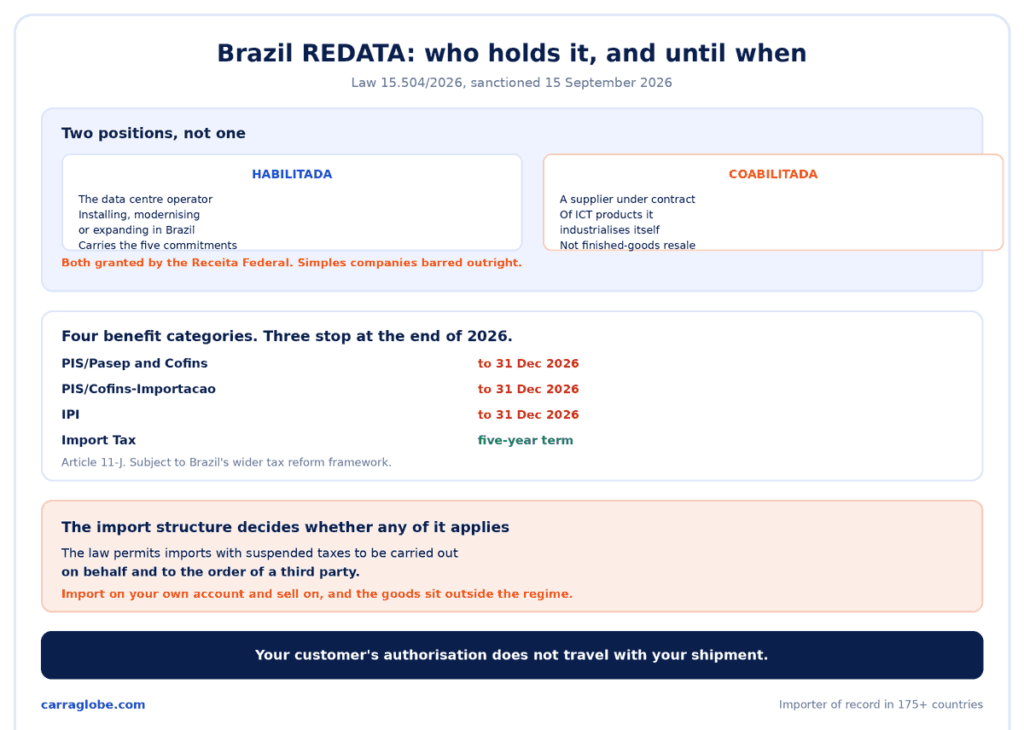
The law creates two positions, not one, and the difference decides where your shipment sits.
| Position | Who it covers |
|---|---|
| Habilitada | A company implementing a data centre installation, modernisation or expansion project in Brazil, meeting the commitments |
| Coabilitada | A company with a contractual link to supply ICT products industrialised by it, for incorporation into the habilitated party’s fixed assets |
Both are granted by the Receita Federal, and both require federal tax regularity and no CADIN registration. If the contractual link behind a cohabilitation ends, the cohabilitation ends with it.
Companies under the Simples regime are barred outright. That matters commercially, because Simples is the simplified tax regime for micro and small enterprises, which is where a good many local IT resellers and integrators sit. If your Brazilian partner is on Simples, they cannot be your route into the regime whatever the contract says.
Read the cohabilitation wording carefully, because it is narrower than vendors hope. It covers products industrialised by the supplier and used in making an ICT product for the habilitated party’s fixed assets. That is a manufacturing input position. Reselling finished hardware into a REDATA project is not what the provision describes.
So your customer’s authorisation does not travel to you. Whether you have a route of your own depends on what you actually supply and how the contract is built, and that is a question for Brazilian advisers rather than a logistics call.
The import structure the law expressly permits
This is the provision most relevant to anyone arranging the shipment, and it is a single sentence in Article 11-C.
Import operations with suspended taxes may be carried out on behalf and to the order of a third party. The statute says so directly, which means the suspension does not require the authorised company to handle its own import. The structure needs aligning with the habilitated or cohabilitated entity and the qualifying transaction, because the sales invoice alone does not establish entitlement to the suspension.
That single provision is why the import structure is worth designing rather than defaulting. Get it wrong and the goods arrive outside the regime. Our note on importer of record in Brazil covers the general position on who may be named.
The same shipment, two structures
A vendor in Germany is selling racks of servers to a Brazilian operator that holds habilitation. Same hardware, same buyer, same port.
| Structure | Where it lands |
|---|---|
| Vendor imports on its own account, clears the goods, then sells them to the operator in Brazil | The import was made by a party with no position under the regime. The acquisition the operator makes is a domestic purchase of already-imported goods |
| The habilitated operator is the acquiring party, with the import carried out on its behalf and to its order | The import is made by an entity the suspension covers, in the form the statute contemplates |
Nobody did anything wrong in the first row. It is an ordinary import followed by an ordinary sale, and it is how a great many vendors ship. It just puts the goods outside a regime the customer had already qualified for.
Whether the second row delivers the suspension still depends on the product lists, the conditions and the implementing rules. The point is narrower: the first row forecloses it before any of those questions get asked.
Not every server qualifies
Assume nothing from the phrase “data centre equipment”. The scope restrictions are specific, and they are where most of the disappointment will happen.
- The suspension applies exclusively to products listed in an act of the federal Executive. No list entry, no suspension, whatever the equipment is.
- Import Tax suspension is narrower still. It applies only to electronic components and other ICT products without equivalent national production, and only where listed.
- IPI suspension excludes listed products industrialised in the Manaus Free Zone, the northern manufacturing zone that already carries its own long-standing electronics tax incentives. The exclusion prevents stacking one regime on the other.
- The lists can only be widened. Once issued, those acts may be changed only to add goods, which is unusually favourable drafting.
So classification decides more than the duty rate here. It decides whether the regime touches your shipment at all, which our overview of HS codes for electronics covers in general terms.r.
The REDATA timing problem: 2026 against the five-year term
REDATA is widely described as a five-year regime. The law says that, and then immediately qualifies it in a way that matters enormously.
Article 11-J gives the benefits a five-year term, but its sole paragraph states that the benefits relating to PIS/Pasep and Cofins, the importation contributions, and IPI produce effects only until 31 December 2026. That is subject to the constitutional amendment and complementary law driving Brazil’s wider tax reform. On the face of the statute, three of the four benefit categories have an effects period ending on 31 December 2026.
Import Tax, the fourth category, is not in that list. Read literally, the duty suspension runs on the five-year term while the contribution and IPI benefits fold into the tax reform transition at the end of 2026.
What replaces them from 2027 is a question for the reform legislation rather than for this law. If you are planning a deployment across 2026 and 2027, that boundary is the single most important date in the regime and it is worth confirming with Brazilian advisers before you build a schedule around it.
Three questions before you quote
- Is your customer actually habilitada, or do they intend to apply? Intention is not authorisation, and the difference is the whole tax line.
- Who will be named as importer of record, and does that party’s position allow the suspension to apply to this acquisition?
- Is the equipment on the Executive list, and for Import Tax purposes, is it without equivalent national production?
Get those three answered before the price goes out. A quotation built on a suspension that turns out not to apply is a margin problem you discover at clearance, and our guide to calculating landed cost covers what the full number looks like without it.
The conditions that can take it away
REDATA is conditional rather than automatic, and the statute sets five cumulative commitments on the habilitated party.
- At least 10% of effective processing, storage and data handling capacity made available to the domestic market
- Sustainability criteria and indicators, to be set in regulation
- Total electricity demand met from renewable or low-emission sources
- A water usage effectiveness index of 0.05 litres per kilowatt-hour or lower, measured annually
- 2% of the value of products acquired domestically or imported under the regime invested in Brazilian research, development and innovation
There is an alternative on the first one. The law allows the domestic supply commitment to be replaced by an additional 10% investment in qualifying research, development and innovation, subject to the statutory conditions and the regulation.
Projects in the North, Northeast and Centre-West regions get the first and fifth commitments reduced by 20%. Habilitated companies must also publish a sustainability report covering the water index and their energy sources.
Failure carries consequences rather than simply ending the benefit. Missing the sustainability, energy, water or investment commitments obliges the habilitated party to pay the suspended taxes with interest and late payment penalties. Missing the domestic supply commitment suspends benefits on new acquisitions, and if unremedied within 180 days the authorisation is cancelled, barring the company and its economic group from rejoining for two years.
The point a cohabilitated supplier should notice. Article 11-E puts the liability on you directly. A cohabilitated company that does not complete the sale and deliver the product to the habilitated party must pay the suspended taxes with interest and late payment penalties. The exposure sits with the supplier, not with the customer.
Which makes this a contract question as much as a customs one. The exposure sits in what you agreed to supply and whether you delivered it, not in how the goods were cleared.
How this sits alongside Brazil’s other routes
REDATA is one option among several, and it is not automatically the best one for a given shipment.
| Route | When it may be relevant |
|---|---|
| REDATA | Qualifying data centre projects and listed products |
| Standard import | Goods or entities outside the regime |
| Third-party importer | Where the structure supports a third party being named |
| Delivered duty paid | Where the customer wants a landed price and no import role |
Brazil is a demanding import market regardless of which route applies. Customs registration, classification and documentation all sit underneath, and our guide to shipping IT hardware without a local entity cover the general position.
How Carra Globe helps
The boundary first. We are not tax advisers and we do not obtain REDATA qualification. That process runs between your customer, its advisers and the Brazilian authorities, and any provider implying otherwise is worth questioning.
- Acting as importer of record where the structure calls for a third party, and telling you plainly where it does not.
- Flagging the structural question early, so the import route is decided with the tax position in view rather than after it.
- Handling the import itself, including classification, documentation and the HS code position that determines which rates apply if the suspension does not.
Where your customer’s qualification means they should be the importer, we will say so, even though that is the answer that does not sell an import service. Our case studies cover comparable deployments and global trade compliance sits underneath the whole service.
Which brings us back to the vendor whose taxes were assessed in full. The regime was real, the customer was habilitada, and the equipment may well have been on the list.
What went wrong was a decision made weeks earlier, when somebody chose the simplest import route without knowing there was a tax position attached to it. That conversation costs nothing before the goods move and cannot be had afterwards.
Quoting on a Brazilian data centre project? Send the equipment list and tell us whether your customer holds REDATA authorisation. We will review the import structure from the customs side and flag what needs confirming with your Brazilian tax advise
Importer of Record · Brazil
We handle the import side. REDATA authorisation is not ours to obtain.
Being clear about the boundary: we are not tax advisers and we do not obtain REDATA habilitation or cohabilitation. That runs between your customer, its advisers and the Receita Federal. What we do is act as importer of record in Brazil and flag the structural question early, so the import route is decided with the tax position in view rather than after it.
- Importer of Record in Brazil
- Shipping to Brazil without an entity
- Brazil free trade zones
- IOR for data centre equipment
- Calculating landed cost
- IOR by country
Free tools HS Code Finder Volumetric Weight Calculator Pallet Calculator
Quoting on a Brazilian data centre project? Send the equipment list and tell us whether your customer holds authorisation. We will review the import structure from the customs side and set out what your Brazilian tax adviser needs to confirm.
Check your Brazil import structureFrequently asked questions
Can a foreign vendor claim REDATA?
Not simply because its customer holds authorisation. The law creates a cohabilitation route for an entity contracted to supply ICT products it industrialises, for incorporation into a habilitated party’s fixed assets.
That is narrower than reselling finished equipment into a qualifying project. For a vendor supplying finished hardware, eligibility and import structure need examining against the enacted law and the implementing rules.
Does REDATA remove the need for an importer of record?
No. Somebody is still named on every import declaration, and Brazil’s customs registration and documentation requirements apply regardless of any tax suspension.
The regime affects what is payable, not whether an import formality exists.
Can Carra Globe act as importer of record under REDATA?
The law permits import operations with suspended taxes to be carried out on behalf and to the order of a third party, so a third-party importer structure is not excluded by the statute.
Whether it works for a given shipment depends on the authorised entity, the transaction and the implementing rules. We will review the customs side and tell you what your Brazilian tax adviser needs to confirm.
Which taxes does it cover?
Import Tax, PIS/Pasep and Cofins, the importation contributions, and IPI, on qualifying acquisitions, converting to a zero rate once the conditions are met.
Note the timing: the law states the contribution and IPI benefits produce effects only until 31 December 2026, subject to the tax reform framework.
Is REDATA in force now?
Yes. Brazil enacted REDATA as Law No. 15.504/2026 on 15 September 2026. Practical use still depends on Receita Federal authorisation and on regulation that is still to come.
Eligible energy sources, among other detail, were left to regulation rather than settled in the law itself.
What happens if my customer loses qualification mid-project?
Benefits are suspended on new acquisitions, and if the breach is not remedied within 180 days the authorisation is cancelled, with a two-year bar on rejoining for the company and its group.
That is a question for your contract and your customer’s advisers rather than for the customs entry.
Sources and verification
- Primary source: Law No. 15.504 of 15 September 2026, amending Law No. 11.196/2005 to institute REDATA. Article 5 provides that it enters into force on publication. Everything above about habilitation, cohabilitation, scope, conversion to zero rate, penalties and the effects period is taken from the statutory text.
- Key provisions: Article 11-A on habilitation and cohabilitation, 11-B on the five commitments, 11-C on the suspended taxes and product scope including the third party import provision, 11-D and 11-E on liability, 11-H on cancellation, and 11-J on the five-year term and the 31 December 2026 effects limit for the contributions and IPI.
- The path: originally Provisional Measure No. 1.318/2025, which lapsed on 25 February 2026. Reintroduced as Bill 278/2026, approved by the Chamber of Deputies on 24 February 2026 and the Senate on 1 September 2026, then sanctioned without vetoes. Complementary Law No. 237/2026 was sanctioned alongside it with a partial veto.
- Still to come: the regulation setting sustainability criteria, eligible energy sources, verification periods and exclusion procedure, and the Executive acts listing qualifying products. Until those are issued, important parts of the regime cannot be applied with full operational certainty.
- This is not tax advice. Authorisation, scope and procedure are matters for Brazilian tax advisers and the Receita Federal.
Disclaimer: This guide is for informational purposes only and does not constitute legal, tax or customs advice. REDATA’s scope, conditions, qualification procedure and enactment status may change, and implementing regulations may alter the position described here. This article reflects publicly available information as at 18 September 2026. Always confirm the current position with a qualified Brazilian adviser and the relevant authorities before relying on any tax treatment.