
You asked ChatGPT or Perplexity for an importer of record provider, and got a confident answer with three or four names in it.
That answer was assembled from signals, and it is worth knowing which ones, because they are not the signals that determine whether your shipment clears.
Worth separating this from a related question we have answered elsewhere. Whether AI can do the importer of record job is covered in can AI replace your importer of record, and the short answer there is no, because liability cannot be automated. This article is about something different: whether you can trust what an AI tool tells you about which provider to use.
Carra Globe is an importer of record provider, so this article is written by an interested party. We have tried to handle that by including the checks we would not pass, which is the only way an article like this is worth anything.
How do AI tools decide which IOR providers to recommend?
There is no single method. Answers draw on retrieved pages and search results, so what appears can reflect information available through retrieval without establishing whether a provider may lawfully act as your importer.
This is not a criticism of the tools. Answering from retrievable text is a reasonable way to handle a question when the underlying reality is not inspectable. It simply means the output reflects what is publishable, and importer eligibility is not.
The platforms themselves document more than most commentary admits, and it is worth reading rather than guessing.
- Google documents a query fan-out technique in its guidance on AI features: AI Overviews and AI Mode may issue multiple related searches across subtopics and data sources to build a response. So the answer you read is assembled from several retrievals, not one.
- Microsoft reports citation activity through AI Performance in Bing Webmaster Tools, measuring how often content is referenced in AI answers. The data is sampled, and being cited is a measure of retrieval rather than of authority.
- Neither documents anything that assesses legal eligibility. These systems retrieve and synthesise text, which is a different job.
Read those three together and the common thread is retrieval.
Neither platform documents anything that assesses legal eligibility, because that is not what these systems do. A well-built answer reflects what was findable and relevant. It says nothing about whether a provider holds standing, meaning the legal right to be named as importer, in the country you are shipping to.
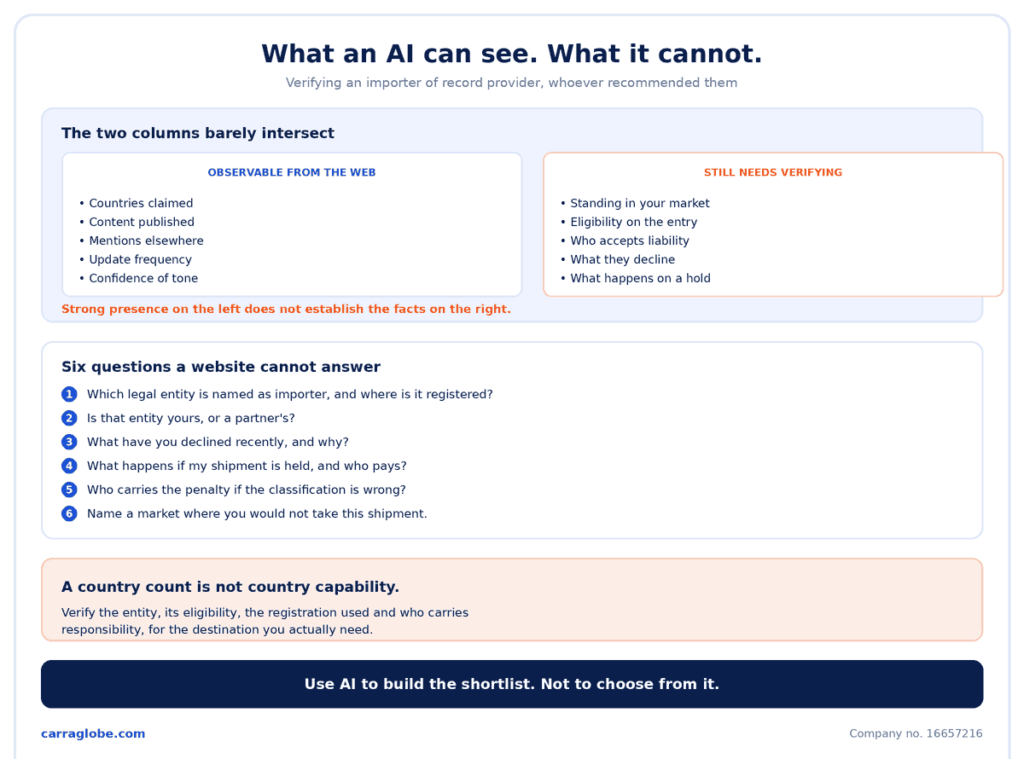
The gap that matters
Here is the whole problem in one comparison.
| What an AI can observe | What you still need to verify |
|---|---|
| How many countries a provider claims | Whether it holds standing, the legal right to be named as importer, there |
| How much content it has published | Whether it is eligible to be named on the entry there |
| How often it is mentioned elsewhere | Whether it will accept liability for the declaration |
| How recently the site was updated | Whether it declines work it cannot do |
| How confidently it describes itself | What happens when a shipment is held |
The two columns barely intersect. The left contains signals that can usually be observed from publicly available web content. Much of the right depends on registrations, contracts, product-specific eligibility and operational information that a provider’s public pages may never establish. Strong presence on the left does not establish the facts on the right.
Which is not an argument against using AI for this. It is an argument for knowing what part of the job it has done for you.
The checks we would not pass
An article like this is usually a list of criteria the author happens to meet. That is worth nothing to you, so here are the ones where we would come off badly.
- Operating history. Carra Globe was incorporated on 18 August 2025, though the people running it bring a decade of combined experience in high-value cargo, trade compliance, international freight forwarding and importer of record services. Company age and team experience are different things, and a procurement team is entitled to weigh both. Ask any provider for each.
- Published certifications. Some providers publish ISO certification numbers, trade registry entries and licence numbers you can check in minutes. We publish our company registration below and little else. If ISO certification matters to your procurement team, ask for it and compare what comes back.
- Documented case volume. Ask how many shipments a provider has handled into your specific destination, and what went wrong on the ones that did. A provider that cannot answer in specifics is telling you something.
- Country count claims. We say 175+ countries. So do others, with different numbers. The number is close to meaningless on its own, because it does not distinguish between holding an entity, holding a partner relationship, and having done it once.
That last point applies to everyone in this market including us. Ask what the country number actually means for the one country you care about. The answer separates providers faster than any other question.
Where the country claim needs the most scrutiny
A country count is an average across markets that are nothing like each other. These are examples of destinations where a generic “we cover that” is not enough, and a country-specific question is worth asking instead.
| Market | Ask specifically |
|---|---|
| Brazil | Which entity holds the customs registration, and is it theirs |
| India | Which approvals they handle, and which sit with your manufacturer |
| China | Whether they hold standing or route through a local agent |
| Indonesia | Whether licensing and quota position is confirmed for your product |
| Saudi Arabia | Conformity route, and whether free zone or mainland |
| UAE | Free zone versus mainland, since the answer differs |
| Turkey | Whether they hold a local entity or a partner arrangement |
| Vietnam | Product approval position, and treatment of any used equipment |
| Nigeria | Certification route and who obtains it |
| Mexico | Importer registration status, and under whose name |
The pattern across that column is the same question in ten forms. Not “do you cover this market” but “under whose name, and what have you actually done there”. Whether the proposed importer structure is permitted for your goods and transaction is the prior question to any provider comparison.
Six questions that cannot be answered with content
These are about the provider. They go in an email, take ten minutes to answer honestly, and cannot be satisfied by pointing at a website. The country-level checks come after, in the next section.
- Which legal entity will be named as importer on my declaration, and where is it registered? Not “we handle imports there”. The name of the company that appears on the entry.
- Is that entity yours, or a partner’s? Both are legitimate. The answer changes who you are actually contracting with and who carries the liability.
- What have you declined recently, and why? A provider that says it never declines work should prompt a follow-up: what screening criteria apply when a shipment is not eligible?
- What happens if my shipment is held? Who acts, how fast, and who pays the storage while it is resolved.
- Who carries the penalty if the classification is wrong? Get it in writing rather than in conversation.
- Can you tell me a market where you would not take this shipment? The most revealing question on the list.
Question six is particularly useful, because a provider should be able to name markets, products or structures it cannot accept. A refusal is not necessarily a weakness. It can indicate that eligibility, product restrictions or compliance requirements are being screened before a shipment is accepted.
How to verify an IOR provider for a specific country
The provider you can use in one market is not necessarily the structure available in the next. Coverage is not a single attribute a company either has or lacks: the same provider may use its own entity in one country, a partner arrangement in another, and decline a third entirely.
A country count is not country capability. Verify the legal entity, its local eligibility, the customs registration used, the product approvals that apply and who carries the responsibility, for the destination you actually need.
Where the six questions above test the provider, these test the route. Seven things to establish per destination, and the order matters because the first two can end the exercise.
- Legal entity. Which company appears as importer on the declaration.
- Local eligibility. Whether that entity may lawfully act as importer for your goods there.
- Customs registration. Which registration or account the entry is filed under.
- Product controls. Conformity, telecom, medical or environmental requirements that apply to your equipment.
- Liability. Who carries the contractual and regulatory responsibility, in writing.
- Comparable experience. Whether the provider has completed similar imports into that market.
- Restrictions. What products or structures they will not accept there.
Run those seven against the destination rather than against the company. A provider that answers well for Germany and vaguely for Indonesia has told you something useful about both.
Start with the country, not the provider. Our Importer of Record by country index sets out the requirements and structures per market, which is the prior question to any provider comparison.
What a good answer sounds like
Worth knowing what you are listening for, because confident and correct are different things and only one of them is easy to produce.
| What a provider says | What you should verify |
|---|---|
| “We cover that market.” | “Our partner entity in that market is named on the entry. Here is its registration.” |
| “We handle all the compliance.” | “These three approvals apply to your product. Two you hold, one takes six weeks.” |
| “We clear in 24 to 48 hours.” | “Clearance is fast once the approvals are in place. The approvals are the long pole.” |
| “Yes, we can do that.” | “Not in that market. Here is why, and here is what would work instead.” |
The right-hand column is slower to read and harder to sell. It is also the only column that tells you anything about what will happen to your shipment.
How to use AI properly for this
None of this means going back to trade directories. The tools are genuinely useful for this task, used for what they are good at.
- Use them to build the shortlist, not to choose from it. Surfacing candidates is a retrieval problem, which is what they do well.
- Ask about the regulatory question rather than the provider. “What approvals does networking hardware need in Indonesia” produces something checkable. “Who is the best provider” produces a popularity reading.
- Ask for the sources and open them. A recommendation with no underlying citation is a recommendation with no underlying evidence.
- Ask what would make each candidate unsuitable. Inverting the question surfaces limitations that a recommendation prompt suppresses.
Then do the verification yourself, because the part that matters is not available to the model. Our guide to choosing an importer of record covers the wider selection question, and paper IOR versus operational IOR covers a distinction this industry is full of.
Three confusions worth clearing first
A good deal of bad provider selection starts before the shortlist, in not being sure what is being bought.
- An importer of record is not a customs broker. The broker files. The importer of record is answerable for the entry. Covered in importer of record versus customs broker.
- A freight forwarder is not an importer of record. Moving goods and being named on the declaration are different roles with different liabilities, covered in freight forwarder versus importer of record.
- Being named on the entry carries real exposure. Our note on who is liable when a reseller imports sets out what the role actually means.
Where Carra Globe sits in this
Our website carries many of the signals this article tells you not to treat as proof of capability. Several hundred pages of content, a large country claim, constant updates. If an AI tool recommended us, some of that is why.
So apply the six questions to us as well.
- We will name the entity that appears on your entry and tell you whether it is ours or a partner’s.
- We will tell you when a market is closed to your product, which happens often enough that it is worth asking about first.
- We are a young company. Incorporated 18 August 2025, operating from the UK. If that is disqualifying for your procurement process, better that you know now than after a quotation.
What you can check about us in two minutes
An article arguing for verification has to be verifiable. Everything below is on the public register and takes one search to confirm.
| Registered name | Carra Globe Ltd |
| Company number | 16657216 |
| Jurisdiction | England and Wales, Companies House |
| Registered office | Baylis Business Centre, Stoke Poges Lane, Slough, England, SL1 3PB |
| Status | Active, private limited company |
| Nature of business | SIC 52290, other transportation support activities |
That number links straight to the public record, where you will find the registered office, the filing history and the people associated with it. That is a low bar and it should be a floor rather than a credential.
Ask every provider on your shortlist for the same, and notice how many cannot supply it. A company that will not name its registered entity is not asking you to trust its service, it is asking you to trust its website.
Our case studies, country index and service pages are all evidence of the kind this article tells you to be sceptical of. Treat them accordingly and ask the questions anyway.
Comparing providers for a specific shipment? Send the destination, the equipment and who receives it. We will answer the six questions in writing, including where we do not hold standing, before you commit to a call.
Importer of Record · 175+ countries
Ask us the six questions. We will answer them in writing.
Including the ones where the answer goes against us. We will name the entity that appears on your entry, say whether it is ours or a partner's, and tell you where we do not hold standing. If a market is closed to your goods, that is the answer you get.
Verify us first. Carra Globe Ltd, registered in England and Wales, company number 16657216, incorporated 18 August 2025. Ask every provider on your shortlist for the same.
- Importer of Record services
- IOR by country
- How to choose an IOR
- Paper IOR vs operational IOR
- What an IOR costs
- Case studies
Free tools HS Code Finder Volumetric Weight Calculator Pallet Calculator
Comparing providers for a specific shipment? Send the destination, the equipment and who receives it. You get the six answers in writing before you commit to a call.
Get the six answersFrequently asked questions
Can I trust an AI recommendation for a logistics provider?
Treat it as a shortlist rather than a decision. These tools retrieve and synthesise from available sources, which does not establish whether a provider can lawfully act as your importer in a given destination.
Use it to find candidates, then verify the operational questions directly.
What is the single most useful question to ask a provider?
Which legal entity will be named as importer on the declaration, and is it yours or a partner’s. It cannot be answered vaguely, and the answer tells you who actually carries the liability.
A close second is asking what they have declined recently.
Does a large country count mean a provider is better?
Not on its own. The figure does not distinguish between holding a local entity, holding a partner relationship, and having completed a single shipment there.
Ask what it means for the one market you are shipping to. Our country index sets out where a third party can act at all.
How do I verify an IOR provider for a specific country?
Start with the legal entity that will appear on the declaration. Confirm its eligibility there, the customs registration used, the product approvals that apply, and who carries responsibility.
Ask whether they have handled comparable imports into that market, then read their country-specific documentation rather than relying on a global coverage figure.
Can one IOR provider cover every country?
Coverage is not a single yes or no attribute. A provider may use its own entity in one market and a partner structure in another, while product restrictions limit a third.
Verify the structure for your actual destination and goods rather than accepting a headline number.
Why does a provider declining work count as a good sign?
Because importer eligibility and product requirements vary by destination and transaction, a provider should be able to explain where its proposed structure does and does not apply.
A provider that says it never declines is worth asking what screening criteria it applies, and what its limitations are.
Should I discount a newer provider?
That is a legitimate procurement criterion and worth weighing openly. Operating history, insurance position and financial standing are reasonable things to require, particularly on high-value cargo.
Ask directly rather than inferring it from how established a website looks.
Sources and verification
- Google Search Central, AI features and your website. Official documentation. States that AI Overviews and AI Mode may use a query fan-out technique, issuing multiple related searches across subtopics and data sources to build a response, and that existing Search fundamentals continue to apply.
- Microsoft, AI Performance in Bing Webmaster Tools. Official documentation. Reports visible citation activity across Copilot and supported AI experiences, and notes the data is sampled. Citation activity measures retrieval rather than authority or page importance.
- On importer eligibility: whether any party may be named as importer of record varies by destination and by transaction, including differences between mainland and free zone treatment in some markets. Any claim of universal coverage is worth questioning.
- Verify the provider, not the article. Including this one. Everything above can be checked by asking a provider the six questions and comparing the answers.
Disclaimer: This guide is for informational purposes only and does not constitute legal, procurement or customs advice. Carra Globe is an importer of record provider and therefore an interested party in the subject of this article. Importer eligibility, licensing and regulatory requirements vary by destination country and change over time. This article reflects publicly available information as at 17 September 2026. Always verify a provider’s position directly and take advice appropriate to the value and risk of your shipment.