
Your customer won’t be importer of record. The purchase order is signed, the delivery date is agreed, and two weeks before the equipment ships their operations lead sends a short email: we cannot be the importer of record on this.
It reads like an obstacle. It is usually a reasonable position, arrived at for reasons your customer may not have explained.
This is about the moment before anything ships. If your goods are already at a border, that is a different problem and our note on customs holds on IT shipments covers it.
What do I do if my customer won’t be importer of record?
Find out which of the four common reasons applies, because the route differs. Then import through your own entity, appoint a third party eligible in that market, or restructure the sale.
What does not work is asking again. Pressing it tends to escalate the question to a legal or tax team, who will confirm the no in writing.
Why customers refuse, and which reasons are legitimate
Almost all of them are legitimate, and the vendors who lose these deals are generally the ones who argue. Worth identifying which one you have, because two of the four can be solved without changing the import structure at all.
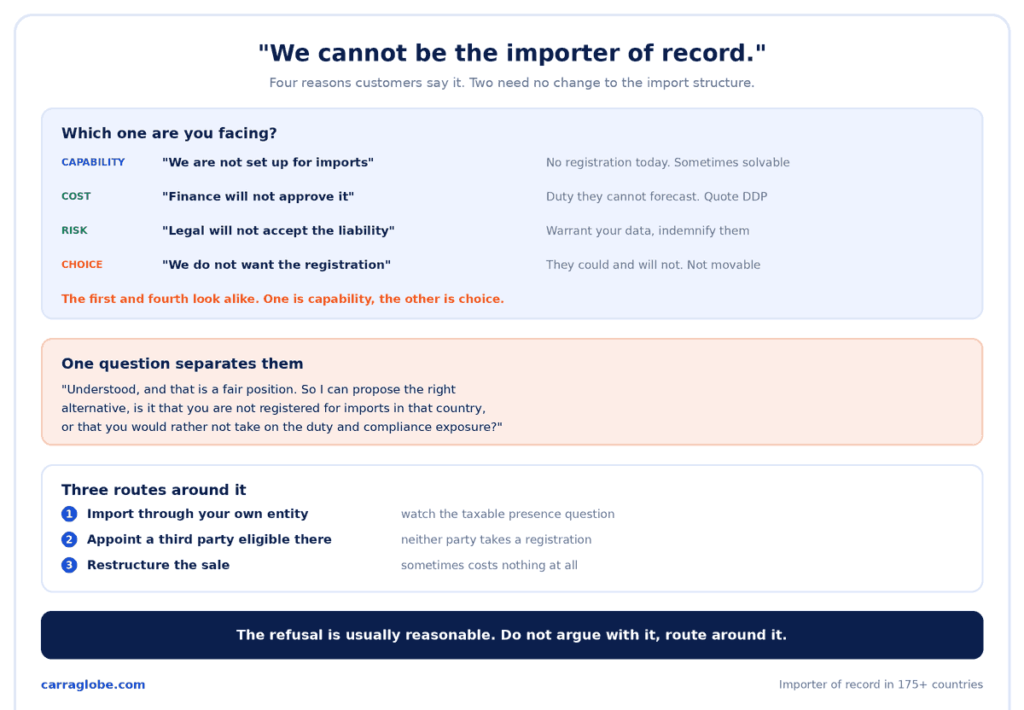
Note that the first and fourth look alike and are not. One is capability, the other is choice, and only one of them can be moved by offering to help.
| What they say | What is usually behind it |
|---|---|
| “We are not set up for imports” | Capability. They have no customs registration today. Sometimes solvable by helping them get one, if the volume justifies it |
| “Our finance team will not approve it” | Cost. Duty and import tax exposure they cannot forecast, on goods they have already agreed a price for |
| “Legal will not accept the liability” | Risk. The importer answers to the customs authority for a classification and value that you produced, not them |
| “We do not want the registration” | Choice. They could register and have decided not to. A customs account brings ongoing obligations and a compliance record they hold indefinitely |
The fourth reason is the one vendors underestimate. Registering as an importer is not a form you fill in for one delivery. In many markets it creates a standing account with filing duties, record-keeping obligations and a compliance history attached to that company’s name. A customer declining to open one for a single consignment of switches is not being difficult. They are declining to acquire a permanent obligation for a temporary reason.
Two of these have answers that do not involve restructuring anything.
Finance cannot forecast the duty. Quote on delivered duty paid terms and the exposure becomes a single number in your price. Their objection was never to the role, it was to an open-ended cost, and the term closes it.
Legal objects to the liability. This one is negotiable because the objection is really about data rather than about the role. The importer answers for a classification and a customs value that you produced. So put that in the contract: warrant that the classification, the declared value and the supporting documents are accurate, and indemnify them against penalties arising from errors in what you supplied.
That is often enough. A legal team refusing open-ended liability for somebody else’s data will frequently accept the role once the data risk sits with the party who created it. What it does not do is remove their obligations to the customs authority, so be clear that you are allocating cost between you rather than moving the legal role.
The question to ask before you propose anything
One question separates the four reasons, and it takes a sentence.
Send this
“Understood, and that is a fair position. So I can propose the right alternative, is it that you are not registered for imports in that country, or that you would rather not take on the duty and compliance exposure? Both are solvable, just differently.”
It accepts the refusal rather than contesting it, signals you have a route so they do not go quiet, and the answer tells you which route to propose.
The three routes around it
Import through your own entity. Clean where you already have one in that market, and administrative rather than structural.
Where you do not, weigh three things before setting one up for a deal. An entity that imports and sells locally can create a taxable presence, which is a tax question rather than a customs one and worth asking your advisers about first. The customs registration brings ongoing filing and record-keeping duties that outlast the shipment. And the setup cost has to be measured against a market you intend to keep selling into, not against one order.
Appoint a third party who is eligible there. The usual answer where you have no local presence and your customer will not act. Somebody who already holds standing in that market is named on the entry, and neither you nor your customer takes on a registration. Our page on importing without a local legal entity sets out how that works.
Restructure the sale. Sometimes the cleanest fix is commercial rather than logistical. Selling to a local distributor who imports in their own name, or shipping to your own facility in-market and selling domestically from there, changes who the importer is without anyone doing anything they objected to.
Check eligibility for the destination before settling on any of them. Not every market allows a foreign seller or a third party to act as importer, and that can rule out route two before you propose it. Our IOR by country index sets out the position.
What changes for the customer, and what does not
Be straight with them about this. Overselling it is how the arrangement unravels later.
| Their concern | What a third-party importer changes |
|---|---|
| No customs registration | Resolved. The registration sits with the appointed party, not with them |
| Duty and tax exposure | Resolved where the terms include them in a landed price. Confirm this in the contract rather than assuming |
| Liability for the entry | Moves to the party named on it, though the accuracy of the classification and value still depends on the data you supply |
| Their own compliance record | Unaffected. They are receiving goods, not importing them |
| Product approvals and certifications | Unchanged. These attach to the product and the market, and no import structure removes them |
That last row matters. An import structure settles who is answerable for the customs entry. It does not make an uncertified product compliant, and a customer who thinks it does will be unhappy later.
The version of this that is not solvable
Occasionally the refusal is not about registration or liability. It is that the shipment should not happen.
A customer who declines because the product needs an approval it does not have, or because the destination raises a control question, is telling you something useful.
Appointing a third party does not fix that. It puts a party on the entry who is now answerable for a product that should not have been imported, and it leaves you as the party who supplied it knowing there was a question. Both of you carry exposure, and a provider who understood the position would decline the shipment rather than take it.
So ask directly whether there is a product or destination reason behind the no. Most of the time there is not. When there is, that is the conversation to have instead.
How Carra Globe helps
This is a large part of what we are called about, usually with a delivery date already agreed.
- Acting as importer of record across 175+ countries, so your customer receives goods rather than importing them, and neither party takes on a registration.
- Confirming eligibility for the destination first, because route two does not exist everywhere and it is better to know that before you propose it.
- Quoting delivered duty paid where the block is finance, so the duty exposure your customer could not forecast becomes a number in your price.
- Telling you where the sale simply needs restructuring, which sometimes costs nothing and needs no third party at all.
Where your customer could import and is only hesitant, we will say so. Talking a reluctant customer into it is often cheaper than any structure, and our note on importer of record versus consignee is a useful thing to send them.
That email from the operations lead is not the end of the deal. It is the point at which the import structure gets decided deliberately rather than by default, which is usually a better outcome than the version where nobody asked.
Deal stalled on this? Send the destination, the equipment and what your customer actually said. We will tell you which of the three routes fits, and whether it is available in that market.
Importer of Record · 175+ countries
Deal stalled because your customer will not import? There are three ways round it.
Send us the destination, the equipment and what your customer actually said. We will tell you which route fits and whether it is available in that market. If your customer could import and is only hesitant, we will say that instead.
- Importer of Record services
- Importing without a local entity
- IOR by country
- Importer of record vs consignee
- Delivered Duty Paid
- How to choose an IOR
Free tools HS Code Finder Volumetric Weight Calculator Pallet Calculator
Delivery date already agreed? That is when most of these reach us. Tell us the market and the blocker, and we will confirm whether a third-party importer is even permitted there before you go back to your customer.
Unblock this shipmentFrequently asked questions
Can I be the importer of record for my customer?
Only where you are eligible to act as importer in that country. Some markets require the importer to be locally established or registered, which a foreign seller may not satisfy. Where you cannot, an appointed third party who already holds standing there is the usual route.Is my customer allowed to refuse?
Yes. Nobody can be made the importer of record without agreeing to it, and the role carries real obligations to the customs authority rather than being an administrative formality. Treat the refusal as a fact to work around rather than a position to argue with.What if my customer will not pay the import duty?
That is a commercial question rather than a customs one. Quoting on delivered duty paid terms puts the duty inside your price, so the customer pays a single agreed figure. Our guide to comparing DDP quotes covers what to confirm before offering it.Does using a third-party importer affect my customer’s compliance record?
Generally not, where they are the consignee rather than the importer. The entry, the registration and the record sit with the party named as importer. That distinction is usually the reassurance a hesitant customer actually needs.Will this delay the shipment?
It depends whether the appointed party already holds standing in that market. Where it does, the work starts on confirmation. Where standing must be established, you wait on a national process. Outstanding product approvals or registrations can set the real timeline rather than the appointment itself.Sources and verification
- Importer eligibility is national. Whether a foreign seller or an appointed third party may act as importer, and on what conditions, is set by each destination country and changes. Confirm the position for your market before proposing a structure.
- Product approvals are separate. Certification, type approval and producer-responsibility requirements attach to the product and the market. No import structure removes them.
- Terms decide the duty. Who bears duty and import tax follows the agreed Incoterm and contract rather than the identity of the importer of record. Settle both explicitly.
Disclaimer: This guide is for informational purposes only and does not constitute legal, customs or contractual advice. Importer eligibility, registration requirements and product approval obligations vary by destination country and change over time, and the right structure depends on the facts of the specific transaction. This article reflects publicly available information as at 8 September 2026. Always confirm the position for your goods and destination with a qualified adviser or the relevant customs authority.