
Exporter of Record in the Philippines
The Philippines exports electronics, garments, machinery, and mineral products to the United States, Japan, China, and the EU. Outbound cargo moves through the Manila International Container Terminal (MICT) and Cebu International Port for sea freight and through Ninoy Aquino International Airport (NAIA) for air cargo. To act as a legal Exporter of Record in the Philippines, an entity must hold SEC registration, a BIR Tax Identification Number (TIN), and active BOC Client Profile Registration System (CPRS) accreditation. A foreign company without these credentials cannot file an Export Declaration and cannot sign as the legal exporter. Exports are zero-rated under Section 106(A)(2) of the NIRC, with input VAT refundable through BIR. The Strategic Trade Management Office (STMO) issues export licences under Republic Act 10697.
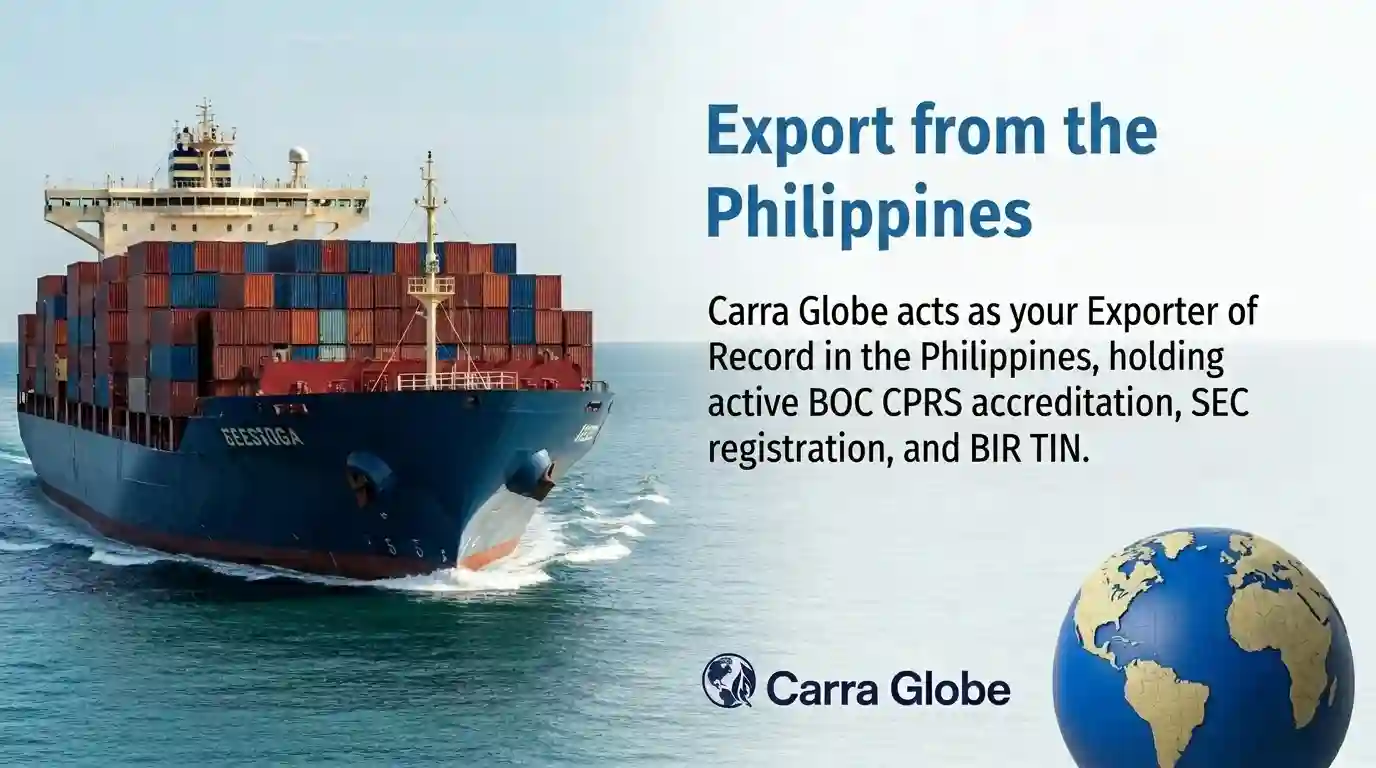
Carra Globe acts as your Exporter of Record in the Philippines, holding active BOC CPRS accreditation, SEC registration, and BIR TIN. Carra Globe manages the Export Declaration, STMO licences, VAT zero-rating, ATIGA and RCEP origin certificates, and end-user certificates for EAR-controlled goods. For cargo movement, Carra Globe integrates freight forwarding into every third-party EOR Philippines solution.
What is an Exporter of Record in the Philippines
An Exporter of Record in the Philippines is the BOC-accredited legal entity named on the Export Declaration (ED), the Philippines’ official export customs document, carrying full accountability for export compliance under the Customs Modernization and Tariff Act (CMTA), Republic Act 10863. The Bureau of Customs (BOC) processes all export declarations through its Client Profile Registration System (CPRS) and assigns each shipment a selectivity channel for inspection. The EOR is legally responsible for export classification, export licence compliance, VAT zero-rating documentation, certificate of origin accuracy, and restricted party screening. A foreign company without SEC registration and BOC CPRS accreditation cannot file an Export Declaration, making a Philippine-registered EOR a legal requirement. Read our guide on what is an Exporter of Record before shipping goods from Philippine territory.
Why Foreign Companies Cannot Export from the Philippines Without an EOR
BOC’s Client Profile Registration System requires a valid SEC registration number, BIR TIN, and proof of Philippine legal personality before granting CPRS accreditation. A foreign company without Philippine incorporation holds none of these and therefore cannot submit an Export Declaration through BOC’s systems. Attempting to export without CPRS accreditation means BOC rejects the shipment at the port of exit before any selectivity channel is assigned. Beyond the customs barrier, the Strategic Trade Management Office issues strategic goods export licences only to CPRS-accredited entities, meaning a foreign company cannot independently obtain clearance for electronics, chemicals, or goods on the Philippines’ Strategic Goods List under RA 10697.
What Carra Globe Manages as Your EOR in the Philippines
- Export Declaration filing: Carra Globe files the ED through BOC’s CPRS using active SEC registration and BIR TIN before cargo departs
- STMO export licence management: Carra Globe submits applications to the Strategic Trade Management Office for strategic and dual-use goods and tracks approvals against departure dates
- VAT zero-rating and BIR refund: Carra Globe prepares BIR input VAT refund documentation to recover VAT paid on production inputs used in export goods
- Certificate of origin issuance: Carra Globe issues ATIGA Form D for ASEAN-bound shipments, RCEP Form RC for Australia, China, Japan, South Korea, and New Zealand, and REX self-certification statements for EU-bound exports
- Restricted party screening: Carra Globe screens all consignees against the BIS Entity List, Denied Persons List, and OFAC sanctions lists
- Re-export controls: Carra Globe confirms EAR classification on US-origin components and obtains BIS or DDTC licences where required
- CITES permits: Carra Globe coordinates DENR wildlife export permits for controlled species including sea turtles, corals, and ornamental fish

Common Export Holds & Fines in the Philippines: How Carra Globe Protects Your Cargo
The most frequent causes of export holds at MICT and Cebu port follow a consistent pattern: BOC CPRS accreditation lapsed or suspended, Export Declaration filed with incorrect HS code, STMO export permit absent for strategic goods, ATIGA Form D unsigned or rules of origin unsatisfied, RCEP Form RC missing for RCEP partner-bound shipments, DENR CITES permit absent for wildlife-derived goods, EAR-controlled US-origin components not screened, PEZA Export Clearance Certificate missing for zone-registered exporters. Every one results in cargo held at port with escalating storage charges under BOC authority.
Carra Globe prevents these by verifying compliance before cargo departs: confirming active CPRS accreditation, validating HS classification against the STMO Strategic Goods List, completing ATIGA and RCEP origin qualification, securing DENR permits before cargo reaches the terminal, and screening all consignees against BIS and OFAC restricted party lists before the Export Declaration is filed.
Philippines Export Compliance Framework (2026)
Export Declaration System and Customs Authority
The Bureau of Customs (BOC) governs all outbound customs processing in the Philippines under the Customs Modernization and Tariff Act (CMTA), Republic Act 10863. Every Export Declaration is filed through BOC’s Client Profile Registration System (CPRS), with BOC assigning each shipment a green, yellow, or red selectivity channel. The official BOC portal is customs.gov.ph. For Philippines import compliance under BOC, see our Importer of Record in the Philippines page.
Export Licences and Strategic Goods Controls
The Strategic Trade Management Office (STMO), under the Department of National Defense (DND), administers export controls for strategic and dual-use goods under Republic Act 10697 (Strategic Trade Management Act of 2012). The STMO’s Strategic Goods List covers conventional arms, dual-use electronics, chemicals, biological agents, and nuclear-related items aligned with the Wassenaar Arrangement, Australia Group, Missile Technology Control Regime (MTCR), and Nuclear Suppliers Group (NSG). Exporters apply for STMO End-User Certificates and export permits through the DTI Strategic Trade portal, with processing taking 15 to 30 business days for standard applications.
VAT Zero-Rating and Export Tax Reclaim
Section 106(A)(2) of the National Internal Revenue Code (NIRC) zero-rates all goods exports at 0% VAT. The registered exporter credits input VAT paid on goods, materials, and services used in export production against output VAT, or claims a cash refund through BIR under Revenue Regulations No. 1-2023, with standard claims processed within 90 days. The Philippines does not apply export duties to electronics, garments, or processed food. Certain metallic mineral exports including nickel ore and chromite attract a 4% export tax under the Philippine Mining Act of 1995, Republic Act 7942.
Re-Export Controls on Foreign-Origin Goods
Any goods incorporating US-origin components with an Export Control Classification Number (ECCN) remain subject to the Export Administration Regulations (EAR), administered by the Bureau of Industry and Security (BIS). The Philippines is a BIS-designated Country Group B country, meaning most EAR99 goods require no licence but controlled ECCNs require BIS review before re-export to restricted destinations. Items on the US Munitions List (USML) are subject to ITAR and require DDTC (Directorate of Defense Trade Controls) authorisation regardless of US content percentage.
Certificate of Origin and Trade Agreement Compliance
The Philippines participates in multiple preferential trade agreements requiring certified certificates of origin. ATIGA Form D covers exports to ASEAN member states under the ASEAN Trade in Goods Agreement. JPEPA Form JPI covers exports to Japan under the Japan-Philippines Economic Partnership Agreement (JPEPA), in force since 2008. The Philippines participates in the EU Generalised Scheme of Preferences Plus (GSP+), with exporters self-certifying origin under the Registered Exporter (REX) system for EU-bound shipments. The Regional Comprehensive Economic Partnership (RCEP), in force since 2022, covers exports to Australia, China, Japan, South Korea, and New Zealand under RCEP Form RC certificates of origin.
Export Documents Required in the Philippines
- Export Declaration (ED): filed through BOC CPRS using exporter SEC registration and BIR TIN
- Commercial invoice: exporter TIN, full goods description, HS code, declared value, Incoterms, country of origin
- Packing list: gross and net weights, dimensions, contents per package
- Bill of Lading or Airway Bill: must match the Export Declaration in all material particulars
- ATIGA Form D or RCEP Form RC: preferential tariff claims for ASEAN and RCEP partner-bound shipments
- JPEPA Form JPI: Japan-bound exports claiming preferential rates under the Japan-Philippines Economic Partnership Agreement, in force since 2008
- REX self-certification statement: EU-bound exports under GSP+
- STMO export permit and End-User Certificate: strategic and dual-use goods under RA 10697
- PEZA Export Clearance Certificate: required for finished goods leaving a PEZA registered economic zone, confirming the export completes the zone’s customs bond obligation
- DENR wildlife export permit: goods derived from CITES-listed species
- Phytosanitary certificate from DA-BPSB: agricultural and plant-based export products
- PDEA export authorisation: pharmaceutical precursors and controlled substances under RA 9165
EOR vs Shipper of Record in the Philippines: Key Differences
These are two distinct legal roles under Philippine customs law, and confusing them creates compliance failures at the port of exit.
- Exporter of Record: the BOC CPRS-accredited entity legally named on the Export Declaration, carrying full liability for export compliance, licence accuracy, and VAT zero-rating documentation under the CMTA
- Shipper of Record: the party identified on the bill of lading or airway bill as the physical sender of cargo
- Who BOC holds accountable: the EOR, not the Shipper of Record, on every outbound shipment
- Practical application: a foreign company can appear as Shipper of Record while Carra Globe acts as EOR, maintaining full legal compliance without requiring Philippine entity registration
For companies importing goods into the Philippines, see our Importer of Record in the Philippines page.
Get in Touch
Carra Globe EOR Services in the Philippines
Carra Globe’s Philippines EOR service covers the full export compliance chain from origin to border: Exporter of Record, Importer of Record, Delivered Duty Paid, freight forwarding by sea from MICT and Cebu and by air from NAIA and Clark, white glove delivery for high-value electronics and medical device shipments, warehouse logistics at bonded facilities near MICT and PEZA export zones, and global trade compliance covering restricted party screening and export classification across 175+ countries.
Carra Globe’s EOR network extends across key export markets: Brazil, Colombia, USA, Taiwan, China, Germany, UAE, Japan, Mexico, Australia and UK. For Philippines import compliance, see our Importer of Record in the Philippines page.
Frequently Asked Questions: Exporting from the Philippines
What is the difference between an Exporter of Record and a customs broker in the Philippines?
A customs broker (licensed under the Customs Brokers Act of 2004, Republic Act 9280) files the Export Declaration on behalf of the EOR but carries no legal liability for export compliance under the CMTA. The EOR is the BOC CPRS-accredited entity that carries full legal accountability, and Carra Globe acts as the EOR while coordinating the licensed customs broker under one accountable structure.
Can a foreign company export from the Philippines without registering locally?
A foreign company cannot export from the Philippines without SEC registration and BOC CPRS accreditation, as BOC rejects any Export Declaration filed by an unaccredited entity. Carra Globe holds both registrations and acts as the legal EOR on every shipment, enabling export from the Philippines without incorporating a local entity.
How does VAT zero-rating work on exports from the Philippines?
Section 106(A)(2) of the NIRC zero-rates all goods exports at 0% VAT, with the registered exporter claiming input VAT back through a BIR cash refund application under Revenue Regulations No. 1-2023. BIR processes standard claims within 90 days, and Carra Globe manages the full refund documentation as part of the EOR Philippines service.
Do US EAR or ITAR controls apply to goods exported from the Philippines?
EAR applies to goods incorporating US-origin components with an ECCN above the 25% de minimis threshold for most destinations. The Philippines is a Country Group B nation under BIS classification, meaning controlled ECCNs require BIS review before re-export to restricted destinations. ITAR applies to US Munitions List items regardless of US content percentage and requires DDTC authorisation for any transfer.
How long does export customs clearance take in the Philippines?
BOC’s green channel clears the Export Declaration within 4 to 8 hours, yellow channel documentary review takes 8 to 24 hours, and red channel physical inspection takes 24 to 72 hours at MICT and Cebu port. STMO strategic goods licences add 15 to 30 business days before the Export Declaration can be filed.
Does the Philippines IMMEX equivalent the PEZA scheme affect who acts as Exporter of Record?
PEZA-registered manufacturers export finished goods under a customs bond system that requires the PEZA-registered entity to appear on the Export Declaration as the legal exporter. A foreign company without PEZA registration and BOC CPRS accreditation cannot fulfil this role, making a third-party EOR essential for foreign principals sourcing finished goods from PEZA zone manufacturers. Carra Globe holds the required registrations to act as EOR on PEZA-compliant export flows.
What is the difference between ATIGA Form D and RCEP Form RC for Philippines exports?
ATIGA Form D covers exports to the ten ASEAN member states under the ASEAN Trade in Goods Agreement and is issued by the Bureau of Customs or authorised issuing bodies. RCEP Form RC covers exports to the same ASEAN states plus Australia, China, Japan, South Korea, and New Zealand under the Regional Comprehensive Economic Partnership, in force since 2022. For Japan-bound shipments, exporters can choose between RCEP Form RC and JPEPA Form JPI depending on which delivers the lower applicable duty rate at the Japanese port of entry.
Can Carra Globe act as both Exporter of Record and Importer of Record for Philippines shipments?
Carra Globe manages the full trade compliance cycle, acting as EOR for outbound shipments from the Philippines and as IOR for inbound goods entering the Philippines. Companies running warranty return flows, where units exported to overseas buyers return for repair, can use Carra Globe as EOR on the outbound leg and as IOR on re-import, maintaining one compliance provider across the full round-trip under the CMTA.
What happens if a shipment leaves the Philippines without a valid Exporter of Record?
BOC can retroactively penalise the shipper under the CMTA for export without a valid declaration, with penalties including fines and suspension of CPRS accreditation. STMO can additionally impose penalties under Republic Act 10697 for unlicensed export of strategic goods, including criminal liability for wilful violations. Any preferential tariff claims under ATIGA or RCEP at the destination country also become void without a valid EOR-signed certificate of origin.
How long does it take to set up an EOR arrangement in the Philippines with Carra Globe?