
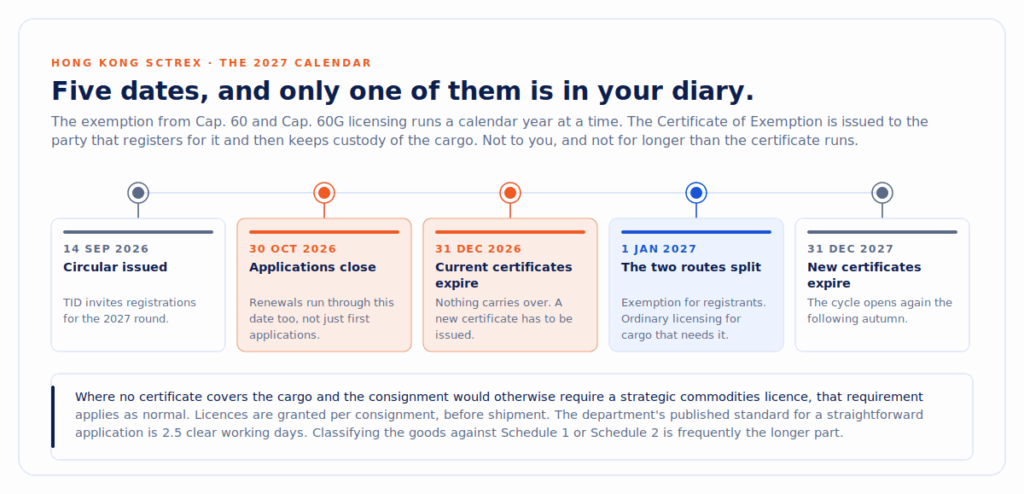
Hong Kong’s Trade and Industry Department is taking registrations for the 2027 round of the Air Transhipment Cargo Exemption Scheme for Specified Strategic Commodities, usually shortened to SCTREX, and applications close on 30 October 2026. If your cargo moves strategic commodities through Hong Kong International Airport by air, or you handle cargo that does, that is a date worth putting somewhere you will see it.
The short version. Registration closes on 30 October 2026 for exemptions running through 2027. A Certificate of Exemption held now expires on 31 December 2026 and does not roll over. Renewal is a fresh application, not a formality. Miss it, and cargo that would have qualified falls back on the licensing route.
Carra Globe provides importer of record, exporter of record, delivered duty paid and freight forwarding services, so we have a commercial interest in your answer. What follows is written to be usable whether or not you ever speak to us.
What the exemption actually removes
Registrants are exempted, subject to conditions, from the licensing requirements that would otherwise apply under the Import and Export Ordinance, Cap. 60, and the Import and Export (Strategic Commodities) Regulations, Cap. 60G, for air transhipment cargo of specified strategic commodities. What it leaves untouched is everything else. The department states that controls imposed by other legislation are not affected, and that registrants should observe the controls other departments maintain.
For data centre and networking hardware that has a practical consequence. You still have to check the export controls on data centre hardware and any encryption import restrictions on network equipment that apply at the destination. The Hong Kong exemption settles a Hong Kong question and nothing further down the lane.
Several conditions govern the exemption. Three of them decide, before any of the rest matter, whether a given consignment is in scope at all.
- Schedule 1, but not Schedule 2. The scheme covers Schedule 1 specified strategic commodities except products listed in Schedule 2. Schedule 2 products sit outside the SCTREX exemption whoever the registrant is, and they are not thereby uncontrolled. Under the separate transit rules they need an import licence inbound and an export licence outbound.
- Genuinely in transit, and in the registrant’s own hands. The cargo has to remain within the confines of the cargo transhipment area of Hong Kong International Airport, pending onward flights. The conditions also require that physical custody stays with the person registered under the scheme at all times, and that no further processing or substitution of the cargo takes place in Hong Kong.
- Conditions, and checking afterwards. Registrants are bound by the registration conditions and are subject to post-shipment verification.
The department also publishes a list of products ineligible for SCTREX, introduced as giving some specific examples rather than a complete account. A product missing from it is not thereby eligible. The list tells you what is definitely out, not what is safely in.
Both schedules turn on technical specification rather than on what a product is called. That is the same discipline that decides HS codes for electronics and tech equipment, and the same place where an incorrect HS code on a high-tech import starts costing money. The difference here is that getting it wrong removes an exemption rather than changing a duty rate.
What it means if you ship rather than handle
Most readers of this page will not be the registering party. You are the one whose equipment moves through Hong Kong, and the question you actually have is whether this costs you anything. It can, in two ways.
The first is lead time. The department puts the fallback plainly, which is that transhipment of strategic commodities not granted exemption under the scheme must be covered by valid import and export licence. Those licences are granted per consignment on a pre-shipment basis rather than held in advance, and the published processing standard for a straightforward application is two and a half clear working days. The classification work that has to happen before you can lodge one is frequently the longer part.
The second is the assumption itself. Transhipment through Hong Kong is routinely treated inside a multi-country IT equipment deployment as though it were a non-event. For Schedule 2 goods the exemption was never available in the first place. For Schedule 1 goods it depends on a registration held by a company that is not you, renewed on a deadline you do not control, in a year you may not have asked about.
It also matters what happens after Hong Kong. A transhipment is a leg, not a destination, and the import that follows carries its own requirements. Where the cargo lands in China, Taiwan, Singapore, Japan or South Korea, the importer-side position in that market is a separate question from the Hong Kong exemption, and it is usually the one with the longer lead time.
The useful action is small. Ask the airline, ground handler or freight forwarder responsible for your Hong Kong transhipment two things. Whether it holds a current Certificate of Exemption and has applied for 2027, and whether this particular cargo falls inside the scheme’s scope at all. The first question is about the party and the second is about your goods, and a yes to one does not give you the other. In October both are still open. In January only the answers matter.
How to check whether your handler is on the list
You do not have to take anyone’s word for it. The department publishes a list of valid registrants. Circular No. 1/2026, issued on 2 January 2026, named the 22 companies registered under the scheme as at 1 January 2026.
Twenty-two is a small number for an airport that size. The 2026 list runs to four airlines, the main terminal and ground handling operators, and a dozen or so forwarders and integrators. Cargolux, China Airlines, Japan Airlines and Korean Air appear. So do Hong Kong Air Cargo Terminals, Asia Airfreight Terminal and Cathay Pacific Services, alongside DHL, FedEx, UPS, Expeditors, Kintetsu World Express, Geodis and Flexport.
Being on the list is not the same as being your importer. SCTREX registration says a company may move exempt transhipment cargo through the airport. It says nothing about whether that company can be named on an import entry at destination, which is the distinction drawn in how a freight forwarder differs from an importer of record.
If your Hong Kong handler is not on that list, it is not registered. That is worth establishing while you are still planning the lane rather than after the cargo is booked.
One limit is worth understanding. The 2026 list tells you who was registered as at 1 January 2026. It does not establish who will hold a valid certificate for 2027. So the list settles the first of those two questions and leaves the second one open.
Who registers, and the three groups that get caught out
The circular invites carriers and parties involved in handling air transhipment cargo at Hong Kong International Airport, giving the airlines, ground handling agents and freight forwarders as examples rather than as a closed list. The test is handling, not ownership. Owning the cargo does not by itself put a shipper among the handling parties the circular identifies, so the registration normally sits with the party moving the goods through the airport.
Existing registrants who assume it carries over. Certificates of Exemption held by current registrants are valid only up to 31 December 2026. Continuing into 2027 requires renewing the registration and obtaining a new certificate. There is no automatic continuation, and the renewal goes through the same 30 October cut-off as a first application.
Anyone registered under the other transhipment scheme. The department runs a separate Transhipment Cargo Exemption Scheme covering pharmaceutical products, reserved commodities and rough diamonds. Registration under that one does not carry across. A party already holding it must apply separately under this scheme to get the strategic commodities exemption.
Agents who cannot evidence the appointment. Applicants appointed by other airlines are asked to provide copies of agency agreements or letters of appointment, and to be ready to prove the relationship to Customs and Excise officers on request. If those papers sit with a counterparty rather than with you, start collecting them now. It is the same evidence problem that a power of attorney for customs exists to solve, and it is rarely quick to fix in the last week.
Breaching a condition of exemption is an offence, and the circular puts a figure on it. Circular No. 4/2026 warns that a registered person who contravenes or fails to comply is liable to a fine of HK$500,000 and imprisonment for two years. Suspension, revocation and refusal to renew sit alongside that as separate consequences. This is not a form to complete casually.
How to register before the deadline
The application form is Appendix III to the circular. Completed forms and supporting documents go to the Licensing Section of the Strategic Trade Controls Branch, either in person at Room 1324, 13th floor, Trade and Industry Tower, 3 Concorde Road, Kowloon City, or by email, where the fillable form needs an authorised digital signature. Both routes close on 30 October 2026.
Two things are worth doing before you submit. Check that each section of the form is supported by the documents it asks for, because Customs and Excise officers may carry out further verification of what you have provided. And if you act as an agent for an airline, attach the agency agreement or letter of appointment rather than referring to it.
A successful application produces a Certificate of Exemption valid up to 31 December 2027.
How Carra Globe works with this
We are not the registering party for SCTREX. The Certificate of Exemption is issued to the eligible carrier or handling party that registers for the scheme, and the conditions then require that party to keep physical custody of the cargo throughout. An airline, a ground handling agent or a freight forwarder registers in its own name.
Where we are useful is before that question arises. Carra Globe works through importer-side registrations and local importing structures appropriate to the goods and destinations it accepts, its own in some markets and established local structures in others, and approvals falling outside the available structure are flagged before a delivery date is agreed.
On a Hong Kong routing that means establishing early whether the equipment is controlled under the strategic commodities schedules at all, and if so, which one. That answer decides whether the exemption is relevant to you, and it turns on the technical specification rather than the product name.
If you are routing strategic commodities through Hong Kong in 2027 and do not yet know your handler’s position, send us the lane and the technical specification per model. We will work through which strategic commodities controls look likely to apply, what the routing then depends on, and where a formal classification needs to be settled before anyone relies on an exemption. Reach us at info@carraglobe.com.
Where Hong Kong is one leg of a wider rollout, the destination rules decide the date more often than the transit does. Our notes on IT hardware import rules by country and on a first shipment into a new country cover the ground that usually sets it.
Strategic Commodities · Hong Kong Transhipment
Send us the lane and the specification. We will tell you whether the exemption applies at all.
The Certificate of Exemption is issued to the carrier or handling party that registers for the scheme, and the conditions require that party to keep physical custody of the cargo throughout. We are not that party, and neither are you. What we can work through quickly is the question that comes first. Whether your equipment is controlled under the strategic commodities schedules at all, and if it is, which schedule it sits in. That answer decides whether your handler's registration matters to you, and it is the one most routing plans never establish.
- ITAR and EAR compliance
- AI and GPU import compliance
- Importing NVIDIA H200 servers
- China rare earth export controls
- Trade diversion and IOR compliance
- Asia air cargo capacity
- Exporter of record in China
- Exporter of record in Taiwan
- Exporter of record in Japan
- IOR for AI servers and GPU clusters
- IOR for data centre equipment
- Shipping AI servers internationally
- Resolving a customs hold
- IOR by country
- EOR by country
Free tools HS Code Finder Volumetric Weight Calculator Pallet Calculator
Routing strategic commodities through Hong Kong in 2027? Send the lane and the full technical specification per model. We will come back on the schedule your goods fall under, what the routing then depends on, and which approvals the destination needs in place before the goods move.
Check my routingFrequently asked questions
When does SCTREX registration close?
Applications for the 2027 round close on 30 October 2026. A successful application produces a Certificate of Exemption valid up to 31 December 2027.
Does my existing certificate carry into 2027?
No. Certificates held by current registrants are valid only to 31 December 2026. Continuing into 2027 requires renewing the registration and obtaining a new certificate.
Does SCTREX cover Schedule 2 goods?
No. The scheme covers Schedule 1 commodities except products listed in Schedule 2. Schedule 2 products are outside the SCTREX exemption regardless of registrant status. In transit they still need import and export licences.
Can a shipper register instead of its forwarder?
Not under the categories the current circular identifies. It invites carriers and parties handling air transhipment cargo at the airport, giving airlines, ground handling agents and freight forwarders as examples. Registration follows handling, not ownership.
I am registered under the other transhipment scheme. Is that enough?
No. The scheme covering pharmaceutical products, reserved commodities and rough diamonds is separate. A separate application under this scheme is needed for the strategic commodities exemption.
How do I know if my freight forwarder is SCTREX registered?
The department publishes it. Circular No. 1/2026 named the 22 companies registered as at 1 January 2026. That tells you who held it then, not who has renewed for 2027.
What happens if nobody in the chain is registered?
Where the consignment would otherwise require a strategic commodities licence, that requirement applies as normal. Licences are granted per consignment before shipment, with a published standard of two and a half clear working days.
Adjacent ground: importer of record in Hong Kong, Hong Kong as an IOR hub for IT equipment and reducing import duty in Hong Kong.
Sources and verification
The regulatory and procedural statements above come from the Trade and Industry Department’s published material, read on 9 October 2026. Two observations are ours rather than the department’s. That classification work is frequently the longer part of preparing a licence application, and that Hong Kong transhipment is routinely treated inside a routing plan as a non-event.
- The deadline circular: Strategic Trade Controls Circular No. 4/2026, reference TRA CR 1015/41, 14 September 2026. Source of the 30 October 2026 closing date, the application route and address, the certificate running to 31 December 2027, the expiry of existing certificates and the need to renew, the separate pharmaceutical, reserved commodities and rough diamonds scheme, and the agency agreement evidence.
- Who may register: the same circular at paragraph 3, which invites carriers and parties handling air transhipment cargoes at Hong Kong International Airport, including the airlines, ground handling agents and freight forwarders. The word including is why this article treats those three as examples and not as a closed list.
- The limits and the penalty: the same circular at paragraph 8, for controls imposed by other legislation not being affected, and at paragraph 10 for the fine of $500,000 and imprisonment for 2 years, alongside revocation, suspension and refusal to renew as separate consequences.
- The list of registrants: Strategic Trade Controls Circular No. 1/2026, 2 January 2026, for the 22 companies registered as at 1 January 2026, and for the statement that transhipment of strategic commodities not granted exemption must be covered by valid import and export licence.
- The scheme and its scope: the SCTREX scheme page, for Schedule 1 except Schedule 2, for cargo remaining within the cargo transhipment area pending onward flights, and for registrants being bound by conditions and subject to post-shipment verification.
- The conditions of exemption: Appendix II, Conditions of Exemption, for physical custody remaining with the registered person at all times and no further processing or substitution in Hong Kong.
- Schedule 2 in transit: Specific Arrangement for Respective Types of Goods, for articles in transit normally sitting outside licensing control except Schedule 2, which needs an import licence inbound and an export licence outbound.
- The ineligible products list: some specific examples of products that are ineligible for the SCTREX. The department’s own description of it as examples is why this article treats it as showing what is excluded rather than what is included.
- The licensing standard: Strategic Commodities Control FAQ, for licences granted on an individual consignment and pre-shipment basis, and for straightforward cases requiring no more than 2.5 clear working days.
- Verification note. Checked on 9 October 2026. This article describes the Hong Kong scheme only. Classification of a product against Schedule 1 or Schedule 2 depends on its technical specification, and that assessment sits with the importer or licence applicant rather than with a carrier or supplier. Confirm the position with the department or a qualified adviser before relying on an exemption.
Disclaimer: This guide is for informational purposes only and does not constitute legal, customs or trade compliance advice. Licensing, exemption and classification requirements depend on the specific product, its technical specification, the parties involved and the routing, and they change. The position described is as at 9 October 2026. Confirm the current position with the competent authority or a qualified adviser before acting.