
Importer of Record in China
You can’t import into China without a registered Chinese entity. No Customs Registration Code means no declaration. No declaration means no clearance. And no entity means your goods sit at the port while storage charges accumulate.
Companies that need to ship to China without a local entity use Carra Globe as a third-party IOR China partner. We provide the importer of record through our in-country importing structure: a locally registered entity holding the Customs Registration Code. We also coordinate the product approvals your shipment needs (CCC certification, SRRC and NAL approvals, NMPA registration, GACC food facility registration and GB labelling) under one workflow. Entity details are shared during onboarding.
We file at Shanghai, Shenzhen, Guangzhou, Tianjin, Beijing, and every major Chinese customs post.
Need coverage across the region too? We provide the same IOR service in Hong Kong, Singapore, Japan, South Korea, India, Indonesia, Malaysia, Thailand, Vietnam, Philippines, and across the Middle East.
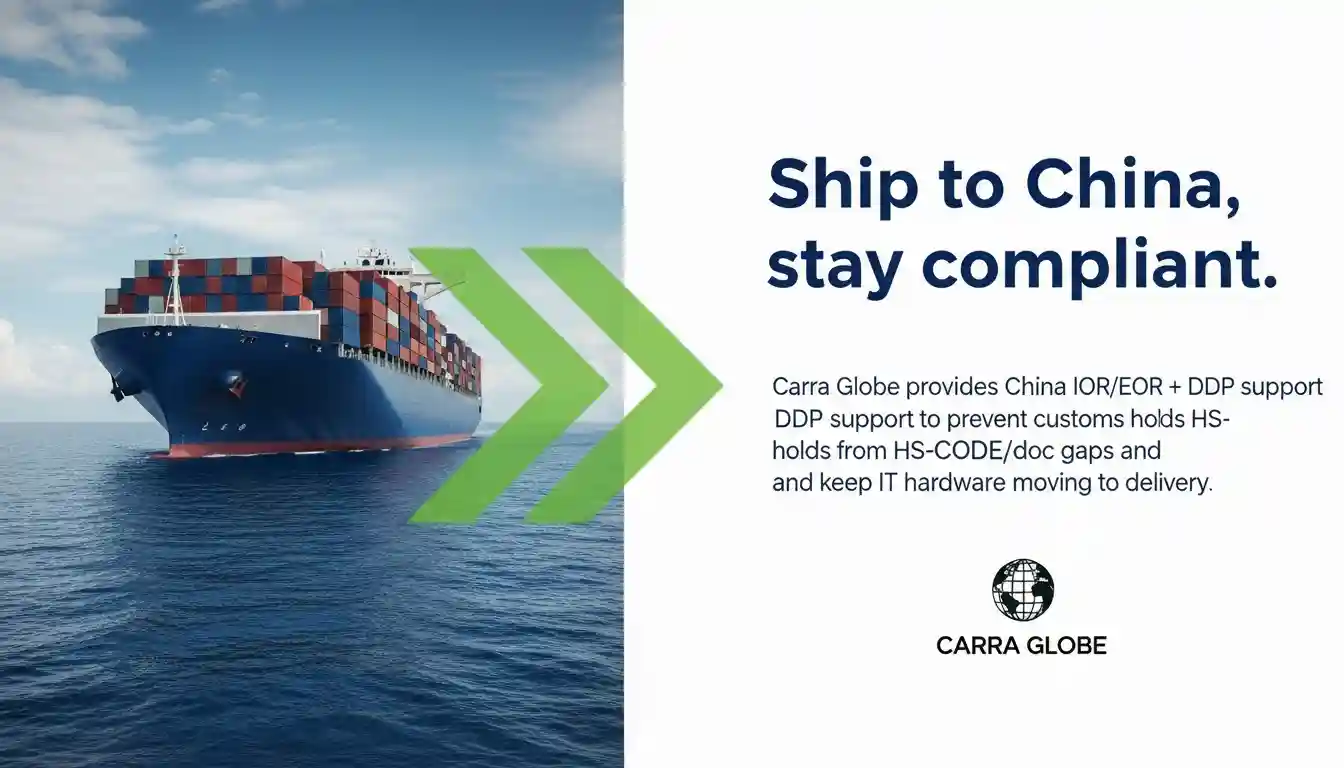
What an Importer of Record Does in China
The Importer of Record is the entity that owns the shipment at the border. They file the Import Declaration with GACC, pay all duties and import VAT, and carry full legal responsibility under China’s Customs Law.
Only a Chinese-incorporated entity with a valid Customs Registration Code can do this. A foreign DDP seller can’t file. A freight forwarder without a registered entity can’t substitute. And a consignee without the right business licence can’t legally clear the goods even if they’re the end buyer.
Carra Globe provides the importer of record through its in-country importing structure: a locally registered entity holding the Customs Registration Code and VAT general taxpayer status. Entity details are shared during onboarding. Whether you need to import IT equipment to China for deployment in Shanghai, Beijing, or Shenzhen data centres, or move data centre hardware China-wide across the hyperscale market, we give you full import clearance capability without you setting up a subsidiary.
Can a foreign company import into China without a local entity?
Usually, yes. Carra Globe acts as importer of record in China through its in-country importing structure, so a foreign seller, integrator or end user does not need its own registered company there.
Whether a specific shipment can go ahead still depends on the product, its approvals and the parties involved. We check those before the goods leave origin and confirm the route in writing.
China import at a glance
| Customs authority | General Administration of Customs of the People's Republic of China (GACC) |
|---|---|
| Importer registration | A Chinese-registered entity with customs registration (Customs Registration Code) issued by GACC; foreign companies cannot declare directly |
| Import VAT / GST | 13% on imported goods; 9% for certain necessities such as agricultural products (PwC Tax Summaries, China: Other taxes) |
| How duty is calculated | CIF value (customs value including freight and insurance to the port of import) |
| Wireless and telecom approval | SRRC radio type approval (MIIT) for most radio equipment; qualifying micro-power short-range devices exempt; MIIT Network Access Licence (NAL) for equipment connecting to public telecom networks, granted after SRRC |
| Product safety and standards | China Compulsory Certification (CCC), administered by CNCA under SAMR, for catalogue products including IT and telecom equipment |
| Medical devices | NMPA registration certificate for Class II and III devices; NMPA filing for Class I; foreign manufacturers appoint a Chinese legal-entity agent |
| IT equipment duty | Many IT products covered by the WTO Information Technology Agreement enter at 0% MFN; check the rate for each HS code. Import VAT at 13% applies on top. |
Checked against official sources on 1 October 2026. Rates and rules change, so confirm the treatment for your exact HS code before shipping.
Why Companies Use Carra Globe as Their Importer of Record in China
China’s import rules don’t leave much room for shortcuts.
You need a registered entity before you can file. You need the right business licence scope before that entity can legally import your product category. And under GACC Announcement 277 (effective May 1, 2025), every declaration must be submitted electronically with sea cargo filed two to three days before arrival.
Beyond the entity layer, the product compliance requirements add real complexity:
- CCC certification is mandatory for 17 product categories and over 100 product types before goods can enter China
- SRRC type approval covers most wireless devices (Wi-Fi, Bluetooth, 4G/5G) and requires testing at an authorised lab in mainland China; some micro-power short-range devices, such as certain NFC and RFID devices, are exempt
- NAL (Network Access License) is required on top of SRRC for any telecom equipment connecting to China’s public network
- NMPA registration with a Medical Device Registration Certificate is required for all Class II and III medical devices
- GACC Decree 280 (which replaced Decree 248 from 1 June 2026) requires overseas food manufacturers to register via the CIFER portal before their products can clear customs
- GB standards mandate Simplified Chinese labelling on every imported commercial product
China also runs 23 active FTAs including RCEP, CAFTA 3.0, and ChAFTA that cut duties significantly on qualifying goods. But each one requires the correct Certificate of Origin and rules-of-origin compliance to work.
This end-to-end approach to China customs compliance is what separates a specialist third-party IOR China partner from a forwarder who just files the declaration.
When You Need IOR Services in China
IOR services become essential when you need freight forwarding to China integrated with GACC declaration filing, CCC certification, SRRC and NAL approvals, and NMPA registration all under one workflow.
You specifically need a third-party Importer of Record when:
- Your company has no registered Chinese entity or Customs Registration Code
- Your consignee or end user can’t legally act as the importing party
- Your Incoterms are DDP, meaning one party must own all customs costs and compliance responsibilities
- Your products require CCC, SRRC, NAL, or NMPA approval before customs release
- You’re shipping regulated IT, telecom, medical, or food cargo and need a compliance-led importer who gets it right from the start
Who does what in a China import
| Role | What it means |
|---|---|
| Importer of record | Named on the import declaration and responsible for it, for duties and taxes, and for meeting import rules. Carra Globe's in-country importing structure takes this role. |
| Customs broker or declarant | Prepares and files the customs entry as authorised. Filing the entry does not make the broker the importer. |
| Consignee | The party named to receive the goods. Being the consignee does not by itself make a company the importer. |
| End user | Uses the equipment and supplies end-use details for screening. It may still need its own site or sector permissions. |
| DDP seller | Pays the agreed delivery costs under Delivered Duty Paid. DDP does not make a seller without local registration the legal importer. |
| Freight forwarder | Books and moves the goods. It does not take on the importer's legal duties. |

Common Hold Triggers in China & How Carra Globe Prevents Them
Most delays aren’t random. They come from the same avoidable mistakes:
- No Customs Registration Code, or business licence scope doesn’t cover the goods
- CCC mark missing or certificate expired
- SRRC or NAL approval missing for wireless or telecom equipment
- NMPA MDRC not obtained before medical devices arrive
- GACC Decree 280 (formerly Decree 248) registration missing for food products
- Simplified Chinese labels absent or non-compliant with GB standards
- Wrong HS code triggering GACC valuation reassessment
- Certificate of Origin missing or non-compliant, forfeiting the FTA preferential rate
- Invoice value below GACC’s fair market benchmark
Carra Globe checks for each of these before your cargo moves. We verify entity scope, certification status, labelling compliance, and COO documentation at origin, not at the port.
China Rules & Regulations (2025-2026 Compliance Framework)
- China Customs: customs.gov.cn (GACC)
- Certification: cnca.gov.cn (CCC/CNCA)
Which approvals apply to your equipment
Approvals attach to the exact model and what it does, not to a category name. One product can need more than one.
| Equipment | Approval to check |
|---|---|
| Servers, storage and wired switches (no radio) | China Compulsory Certification (CCC), administered by CNCA under SAMR, for catalogue products including IT and telecom equipment |
| Wi-Fi access points, routers, firewalls with wireless, laptops and anything with a radio | SRRC radio type approval (MIIT) for most radio equipment; qualifying micro-power short-range devices exempt; MIIT Network Access Licence (NAL) for equipment connecting to public telecom networks, granted after SRRC |
| Medical and diagnostic equipment | NMPA registration certificate for Class II and III devices; NMPA filing for Class I; foreign manufacturers appoint a Chinese legal-entity agent |
| Used or refurbished equipment | Check before shipping. Some markets restrict used IT equipment or add conditions. We confirm the rule for your exact items. |
Entity, Customs Registration & Import Licensing
Every commercial importer in China must be a registered Chinese legal entity with a Customs Registration Code from GACC. That code goes on every commercial invoice and every declaration.
The entity’s business licence must specifically cover the product categories being imported. If the licence doesn’t list your goods, the entity can’t legally import them regardless of who owns the Customs Registration Code. The entity also needs VAT general taxpayer registration to settle import VAT and reclaim it as input tax credit.
Importing certain sensitive categories (chemicals, pharmaceuticals, food, agricultural products, used machinery) also requires additional ministry permits before any declaration can be filed.
Customs Declaration & GACC
Every commercial shipment needs an Import Declaration filed electronically through GACC’s system. The declaration must include the 10-digit Chinese HS code, quantity, CIF value, country of origin, and any controlled goods codes.
Under GACC Announcement 277 (May 1, 2025), sea cargo declarations go in two to three days before arrival. Air cargo declarations go in after flight departure.
GACC sorts every shipment into one of three channels:
- Green: automatic release
- Yellow: documentary review
- Red: documentary review plus physical inspection
Misdeclare the value or HS code and GACC will flag it; they benchmark every import against a live valuation database. Get it wrong and you’re looking at penalties, reassessment, and delays.
Import Duties, VAT & Tax Structure
China calculates all import taxes on CIF value. Three layers apply:
Import duty averages 7.5% MFN across all categories, ranging from 0% to 65%. Most consumer goods sit between 0% and 25%.
Import VAT is 13% for most goods calculated on CIF value plus duty. Agricultural and certain food products qualify for a reduced 9% rate. Registered VAT taxpayers reclaim import VAT as input tax credit, which makes it cash-flow neutral for businesses with active VAT registration.
Consumption Tax applies to specific categories at rates that vary by product: for example, tobacco from 11% up to 56% (plus per-unit amounts on some products), alcohol 10% to 20% or a fixed amount per tonne, high-end cosmetics 15%, and passenger cars 1% to 40% depending on engine size and type.
China import duties in 2026 range from 0% for most IT hardware under the ITA agreement to 25%+ for textiles, plus the 13% import VAT on top. Getting your HS code right and your FTA Certificate of Origin in order makes a real difference to landed cost.
Cross-border e-commerce imports under CNY 5,000 per transaction qualify for simplified tax at 70% of standard rates, but only for B2C personal imports. Commercial B2B shipments pay full duties regardless.
China’s bonded zones and Free Trade Zones offer duty deferral, VAT advantages, and processing trade exemptions for businesses managing regional supply chains.
Schedule a Free Consultation With Our Experts
Send us the hardware list. We will come back with the compliance route, the landed cost, and a realistic timeline.
CCC: China Compulsory Certification
CCC (China Compulsory Certification, also called 3C) is a hard market access requirement. Without it, your goods can’t enter China.
CNCA under SAMR administers CCC across 17 product categories and more than 100 product types. The categories that trigger mandatory CCC include:
- IT equipment: computers, printers, servers
- Telecom terminals: phones, routers, modems, switches
- Audio and video products
- Electrical wires and cables
- Household appliances, lighting, power tools
- Low-voltage switchgear assemblies
- Motor vehicles and parts
- Toys and safety glass
Since January 2024, CCC certificates are issued electronically. The CCC mark must be physically affixed to each individual product before it ships.
Getting CCC means testing at a CNCA-accredited Chinese lab and passing an initial factory audit with ongoing annual surveillance after that.
New categories are being added through 2025–2026: lithium-ion batteries and e-bike charging devices (November 2025), fire protection products (July 2025), explosion-proof lamps (May 2025), and EV charging equipment (August 2026).
SRRC & NAL: Wireless and Telecommunications Equipment
If your product transmits radio signals, it generally needs SRRC type approval before it enters China. Micro-power short-range devices that meet MIIT’s published technical limits are exempt.
Wi-Fi, Bluetooth, 4G, 5G and satellite devices all require SRRC; some NFC and RFID devices qualify for the micro-power exemption. Testing must happen at an MIIT-authorised laboratory inside mainland China. Foreign test reports aren’t accepted. Approved products get a CMIIT ID that must be labelled on the device.
If the device also connects to China’s public telecommunications network phones, modems, routers, switches, PBX systems it additionally needs a NAL (Network Access License). NAL is issued only by MIIT’s NAL Certification Centre. Since January 2024, NAL labels are generated through the MIIT portal.
CCC also applies to several telecom and IT categories. When a product needs all three approvals, obtain SRRC before NAL: the NAL application relies on the SRRC certificate and test results.
One important deadline: SRRC certifications for 2.4 GHz, 5.1 GHz, and 5.8 GHz band devices issued under pre-2023 rules had to be updated by December 31, 2025.
NMPA: Medical Device & Pharmaceutical Registration
Every Class II and III medical device needs a Medical Device Registration Certificate (MDRC) from NMPA before it can be sold or imported commercially in China.
Foreign manufacturers without a Chinese entity must appoint two local representatives:
- A local Agent: manages registration, communicates with NMPA, and appears on the MDRC (the manufacturer still owns the certificate)
- An After-Sales Service Provider: handles post-market vigilance and service
Before applying, you need home-country approval: a Certificate of Free Sale (CFS) or Certificate to Foreign Government (CFG). Class II and III devices also require testing at an NMPA-certified Chinese lab and in most cases, local clinical trial data.
Exemptions exist for devices with exact Chinese predicates or devices on NMPA’s clinical trial exemption list.
MDRC is valid for five years. Renew through the eRPS system at least six months before it expires. All documentation must be in Simplified Chinese.
NMPA Announcement No. 30 (March 2025) expanded eligibility for domestic production of imported devices: foreign-invested enterprises sharing the same actual controller as the original registrant can now qualify.
GACC Decree 280: Food, Agricultural & Cold-Chain Products
If you manufacture, process, or store food that gets exported to China, you must register with GACC before your products can clear Chinese customs. Registration has been mandatory since 1 January 2022, first under Decree 248 and, from 1 June 2026, under GACC Decree 280, which replaced it.
Registration happens through the CIFER portal and stays valid for five years. The GACC registration number must generally appear on the food packaging
Certain higher-risk categories need a recommendation from your home country’s competent authority, so you can’t self-register for these. Decree 280 revised this list, so check GACC’s current catalogue for your product. They include categories such as meat, dairy and aquatic products.
Everything else can self-register directly via CIFER.
GACC Decree 280, published in October 2025, replaced Decree 248 from 1 June 2026 and changed the registration routes. And GB 7718-2025 (effective March 16, 2027) introduces updated prepackaged food labelling requirements, including digital labels and batch code formats.
GB Standards & Simplified Chinese Labelling
Every product you sell commercially in China needs Simplified Chinese labelling that meets the relevant GB (Guobiao) national standard.
At minimum, your label needs: product name, Chinese importer name and address, country of origin, net content, manufacturing and expiry dates, storage conditions, and usage instructions.
GB 7718 covers food. Separate GB standards cover electronics, cosmetics, medical devices, chemicals, and toys. Labels must be on the product before customs clearance. Arrive without compliant labelling and your goods get held.
China's FTA Network & Certificates of Origin
China has signed 23 FTAs covering 30 countries and regions. The ones most relevant to importers shipping into China:
- RCEP: Form RCEP COO, covers ASEAN + Australia, Japan, South Korea, New Zealand. In force January 2022. The world’s largest FTA by trade volume.
- ACFTA / CAFTA: Form E COO, covers ASEAN. CAFTA 3.0 Upgrade signed October 2025, adding digital economy and green economy chapters.
- ChAFTA: Form CHAFTA COO, covers Australia
- China-South Korea FTA: Form CSFTA COO
- China-New Zealand FTA and China-Switzerland FTA
- CEPA: covers Hong Kong and Macao. Supplement II effective March 2025.
To claim a preferential rate, you need the right COO format filed with the declaration. Miss it or get it wrong and you pay full MFN duty. Anti-circumvention rules are actively enforced.
China Import Documents Checklist
- Commercial Invoice: product description, quantity, CIF value Incoterms, country of origin, 10-digit HS code, Customs Registration Code of the Chinese importer
- Packing List
- Bill of Lading (sea) or Airway Bill (air)
- Import Declaration: filed electronically via GACC under Announcement 277
- Certificate of Origin: Form RCEP, Form E, Form CHAFTA, or applicable FTA format
- Insurance Certificate
- CCC Certificate + CCC mark on each unit: all mandatory CCC-category products
- SRRC type approval certificate + CMIIT ID label: wireless and RF devices that are not exempt micro-power devices
- NAL certificate: telecom equipment connecting to China’s public network
- NMPA MDRC: Class II and III medical devices
- NMPA drug registration certificate: pharmaceuticals and biologics
- GACC Decree 280 CIFER registration number on packaging: overseas food manufacturers
- Inspection and Quarantine Certificate issued by GACC (which absorbed the former CIQ bureaux in 2018): animals, plants, food, agricultural products
- Phytosanitary Certificate: plants, seeds, plant-based products
- Simplified Chinese labels per applicable GB standard: all commercial goods
- Import Licence: chemicals, dual-use goods, controlled categories
- CITES permit: protected species
- ISPM 15 fumigation certificate: wooden packaging and pallets
Restricted & Sensitive Goods in China
Carra Globe’s IOR services are tailored to industries that rely on precision, speed, and reliability.
IT Hardware & Data Centre Equipment
Most IT hardware clears at 0%–5% MFN duty. Peripherals and consumer electronics typically sit at 5%–15%.Import VAT is 13% across the board. Most wireless-enabled devices need SRRC type approval: laptops, routers, access points and Bluetooth peripherals. Add NAL on top if the device connects to China's public network. CCC applies to IT equipment, audio/video products, and power supplies.
Telecommunications & Radio Equipment
Up to three approvals apply: SRRC + NAL + CCC.All testing must happen inside mainland China; foreign test reports aren't accepted. The CMIIT ID label is mandatory on every approved device. SRRC certificates for 2.4 GHz, 5.1 GHz, and 5.8 GHz bands required updating by December 31, 2025. When all three approvals are needed, obtain SRRC first: the NAL application builds on the SRRC certificate.
Medical Devices & Diagnostics
NMPA MDRC is required for all Class II and III devices before commercial import. Foreign manufacturers must appoint two local representatives: a local Agent (appears on the certificate, manages the registration) and an After-Sales Service Provider. Home-country approval (CFS or CFG) is mandatory before you apply. Most Class II and III devices also require Chinese lab testing and local clinical data. The MDRC lasts five years. Renew via eRPS at least six months before expiry.
Cosmetics & Personal Care.
Ordinary cosmetics require NMPA notification before import.Special-use products (sunscreen, hair dye, whitening agents, permanent wave solutions, freckle treatments) need full NMPA registration. Simplified Chinese labelling is mandatory across all categories. Consumption tax of 15% applies to high-end cosmetic products.
Chemicals & Hazardous Materials.
MEE permits and relevant ministry approvals are required before shipment. China RoHS compliance is mandatory for electrical and electronic equipment. CITES permits apply where protected species are involved.
Food & Beverages
GACC Decree 280 (which replaced Decree 248 from 1 June 2026) registration via CIFER is mandatory, and the registration number must generally appear on the food packaging. Certain higher-risk categories (such as meat, dairy and aquatic products) require a competent authority recommendation from your home country. You can't self-register for these. GACC inspection and quarantine checks happen on arrival. GB 7718 labelling applies now. Updated GB 7718-2025 rules take effect March 16, 2027. Cold-chain products need complete temperature documentation across the full transit chain.
China Customs Clearance Lead Times
China customs clearance timelines depend on GACC’s channel assignment (green clears automatically, yellow requires documentary review, red triggers documentary plus physical examination) and on whether all certifications and permits were secured before arrival.
- Standard commercial cargo, green channel: 1 to 2 working days from declaration filing
- Yellow channel (documentary review): 2 to 4 working days
- Red channel (documentary plus physical): 4 to 8 working days
- Restricted goods pending permit or quarantine: additional 5 to 15+ working days
- CCC certification (new application): 2 to 4 months including factory audit and testing
- SRRC type approval (new application): 4 to 8 weeks at MIIT-authorised Chinese laboratory
- NAL certification (new application): 6 to 12 weeks including MIIT review
- NMPA Class I filing: approximately 4 weeks
- NMPA MDRC, Class II registration: 12 to 24 months
- GACC Decree 280 food facility registration: timing varies by registration route and product category
- Cosmetics notification (ordinary): 3 to 5 working days; special-use registration 12 to 24 months
Carra Globe checks the product approvals, documents and importer route before cargo leaves origin, so problems are fixed at origin rather than at the border. Clearance time still depends on the product, its approvals and any customs inspection; typical ranges are in the lead times section.
What we check before we accept a China shipment
- The exact product, model and what it does
- HS classification, origin and customs value for each line
- Which approvals are needed and who holds them
- The parties, the end user and the intended use
- Commercial terms, and who pays duty and tax
- The documents needed for filing
We decline shipments that are prohibited, sanctioned, counterfeit, misdeclared or deliberately undervalued. We hold a shipment until any missing approval or document is in place.
Get in Touch
Carra Globe services in China
Carra Globe provides Importer of Record (IOR) services in China, Exporter of Record (EOR), DDP shipping, GACC customs declaration management, CCC certification coordination, SRRC and NAL type approval management, NMPA medical device registration, GACC Decree 280 food facility registration, GB standard labelling compliance, HS code classification, FTA Certificate of Origin preparation, freight forwarding by air and sea, global trade compliance, warehouse logistics, bonded zone and Free Trade Zone coordination, and white glove delivery and installation across mainland China including Shanghai, Shenzhen, Guangzhou, Beijing, and Tianjin.
Carra Globe supports multi-country Asia-Pacific rollouts from a single IOR engagement: Hong Kong, Singapore, Japan, South Korea, India, Malaysia, Indonesia, Vietnam, Philippines, and Thailand alongside China. For equipment sourced from the EU, UK, or USA, we manage full export compliance at origin and China import execution under one coordinated workflow.
Our China services include DDP shipping to China with full duty and import VAT settlement, China customs clearance coordination across all major ports, China freight forwarding by air and sea, and CCC, SRRC, NAL, and NMPA approval management across your full product portfolio.
Frequently Asked Questions: China IOR & DDP Shipping
Can a foreign company be the importer of record in China?
No. Only Chinese-incorporated entities holding a valid Customs Registration Code issued by GACC can file import declarations and act as importer of record. A foreign DDP seller cannot file the declaration, and a consignee without a registered Chinese entity cannot clear goods at a Chinese port. Carra Globe provides the importer of record through its in-country importing structure: a registered Chinese entity holding a Customs Registration Code. Entity details are shared during onboarding.
What taxes will I pay on imports into China?
You’ll pay three layers. Import duty averages 7.5% MFN; most consumer goods sit between 0% and 25%. Import VAT is 13% on CIF plus duty (9% for agricultural and food products). Consumption Tax applies to specific categories: for example, tobacco from 11% up to 56%, alcohol 10% to 20% or a fixed amount per tonne, high-end cosmetics 15%, and passenger cars 1% to 40%. Registered VAT taxpayers reclaim import VAT as input tax credit, making it cash-flow neutral.
Which products need CCC certification?
CCC is mandatory for 17 product categories and over 100 product types, including IT equipment, telecom terminals, audio and video products, electrical wires, household appliances, lighting, motor vehicles, toys, and safety glass. Every covered product needs a valid CCC certificate and the physical CCC mark before it can enter China commercially. Certificates have been issued electronically since January 2024.
What's the difference between SRRC, NAL, and CCC?
SRRC covers most devices that transmit radio signals: it’s about spectrum compliance. NAL covers telecom equipment that connects to China’s public network: it’s about network interoperability. CCC covers product safety and EMC for specific categories. A smartphone, for example, needs all three. Obtain SRRC before NAL, because the NAL application builds on the SRRC certificate.
How does medical device registration work in China?
You need an NMPA Medical Device Registration Certificate before any Class II or III device can enter the market. Foreign manufacturers must appoint a local Agent (who manages the registration and appears on the certificate) and an After-Sales Service Provider. You also need home-country approval (CFS or CFG), Chinese lab testing, and usually local clinical data. The certificate lasts five years. Renew via eRPS six months before it expires.
How does China's FTA network reduce import duties?
China’s 23 FTAs cover 30 countries. The ones that move the most volume: RCEP (Form RCEP: ASEAN, Japan, South Korea, Australia, New Zealand), ACFTA/CAFTA (Form E: CAFTA 3.0 signed October 2025) and ChAFTA (Form CHAFTA for Australia). To claim the preferential rate, you need the right COO filed with your declaration. Get the form wrong or miss rules-of-origin compliance and you pay full MFN duty. Carra Globe handles COO preparation and validation for every active scheme.
Can I ship goods to China without a registered Chinese entity?
No. GACC requires a Chinese-incorporated entity with a Customs Registration Code for every commercial declaration. There is no non-resident importer mechanism. Companies that need to ship to China without establishing a WFOE use an Importer of Record. Carra Globe provides the importer of record through its in-country importing structure, where a registered Chinese entity files on your behalf, giving full China customs clearance capability without a local subsidiary.
What are the current duty rates for IT equipment imported to China in 2026?
Most IT hardware enters at 0%-5% MFN under WTO ITA commitments; peripherals 5%-15%. VAT 13% on CIF plus duty. China import duties 2026 for RCEP-qualifying goods from Japan, South Korea, Australia, New Zealand, and ASEAN benefit from annual preferential step-downs, but only with a compliant Certificate of Origin.
How does DDP shipping to China work and what does the seller owe?
The seller bears all duties, 13% VAT, consumption tax, and every regulatory obligation: CCC, SRRC, NAL, NMPA, GB labelling, Decree 280 food facility registration. The seller must hold a Chinese entity or engage an IOR. Freight forwarding to China under DDP requires coordination between origin logistics and Chinese-side IOR to ensure all certifications are confirmed before cargo departs.

Official sources
- General Administration of Customs of the PRC (GACC)
- Certification and Accreditation Administration (CNCA, CCC)
- Ministry of Industry and Information Technology (MIIT: SRRC, NAL)
- National Medical Products Administration (NMPA)
- USDA FAS: GACC reorganisation, CIQ merged into GACC (2018)
Last reviewed: 1 October 2026
Update policy: reviewed every quarter and after major customs, tax or product-rule changes
Corrections: info@carraglobe.com
This page gives general operational information as at 1 October 2026. It is not legal or tax advice. Requirements depend on the exact product and transaction and may change. Customs and regulatory authorities make the final decisions.