
Nobody asks this question early. It arrives once the booking is confirmed, or once the aircraft has already left, when somebody in the chain works out that there is no legal importer waiting at the other end. The tone is usually apologetic and the question is always the same, which is whether this can still be fixed.
Often it can. Appointing an importer of record is not the slow part of an import. The slow part is whatever the destination requires before it will let the goods go, and that work has its own schedule which does not care when the cargo was booked. This piece sets out which of those requirements can still be met late, which cannot, and the handful of markets where the honest answer is that the compliance work needed to import legally had to start before the shipment was booked, and sometimes before the purchase order.
Carra Globe provides importer of record and exporter of record services, so we have a commercial interest in your answer. What follows is written to be usable whether or not you ever speak to us.
The short answer. There is no universal cut-off. In many destinations an importer of record can still be appointed after booking and often while the shipment is in the air, and where the goods, destination and documents support proceeding Carra Globe may be able to approve the appointment the same day. It becomes too late when the destination required an application, approval, licence or registration before shipment, before loading or before release, and that requirement has not been met.
Before anything else, find your row. What you can still change depends almost entirely on where the cargo is.
| Where the shipment is | Still open to you | Already fixed |
|---|---|---|
| Before the purchase order | Destination, product choice, certification route and importer structure are all normally still in play. | Few shipment-specific commitments exist yet, though project deadlines and supplier constraints may already bind. |
| Before freight is booked | Invoice detail, consignee, classification and importer structure can usually still be settled. Shipment-level gaps are easiest to fix here. | The product and configuration may already be commercially committed once the order is placed. |
| Collected, not yet departed | Documents can usually still be corrected. A consignee change may require a carrier or forwarder amendment, rebooking or another operational change. | Advance filings may already be lodged on some lanes. |
| In the air or on the water | Appointment is often still possible and the declaration can usually be built. | Pre-loading filings, and any approval the destination required before shipment. |
| Held at destination | What is available depends on the customs status. Document amendment, a further approval, storage, re-export or return may be options. | The existing entry and customs status may constrain what can be changed. Changing the importer may need a permitted amendment, a withdrawal or a new entry, and may not be available as proposed. |
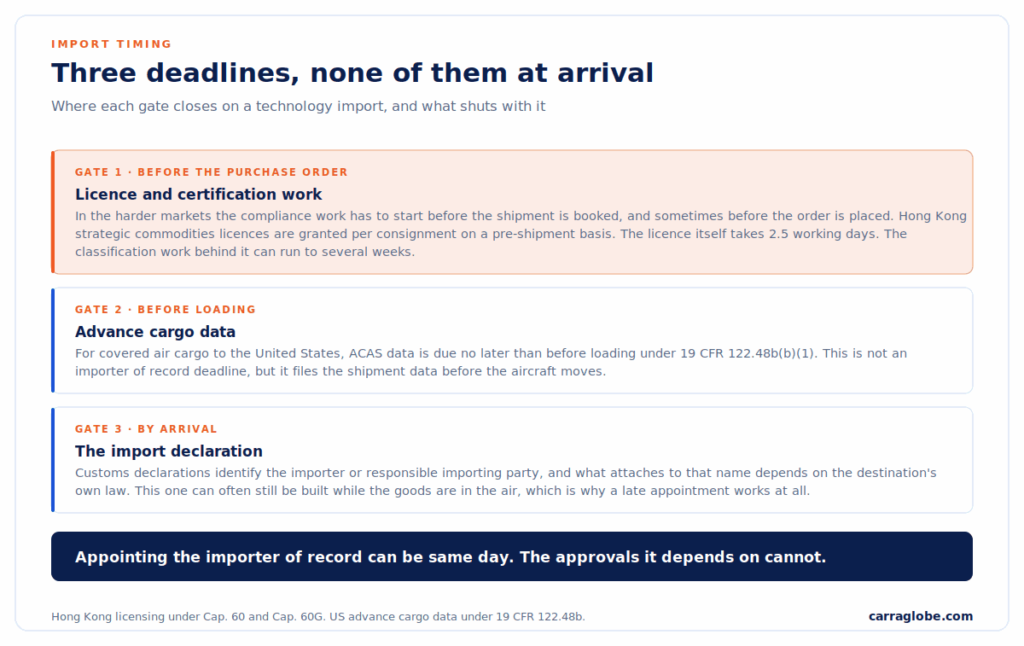
Three clocks can run at once, and none of them waits for arrival
Most people picture a single deadline sitting at arrival. Several clocks can apply, they start at different moments, and the earliest applicable one is what decides whether a late appointment is still possible.
The first is the advance data clock. For covered air cargo bound for the United States, Air Cargo Advance Screening data must be submitted as early as practicable and, under 19 CFR 122.48b(b)(1), no later than prior to loading of the cargo onto the aircraft, subject to that rule’s own scope.
This is not an importer of record deadline and nothing in it asks you to name one. It matters because key shipment information is filed before the aircraft moves, so changes to the shipment information afterwards may require the filing to be updated, which the rule requires of the original filer where submitted data changes, along with coordination with the carrier and the broker.
The second is the declaration clock. Customs declarations identify the importer or responsible importing party, and the obligations attaching to that name depend on the destination’s own law. This is the clock most people mean when they ask the question. In many markets the declaration can still be prepared while the goods are in transit, although that is not a universal rule, because some systems require pre-arrival information, registration or clearance steps earlier than that.
The third is the licence and approval clock. Where the destination requires a permit, certification or type approval before import or release, that requirement can stop the goods being lawfully released, and in some markets the paperwork is tied to the consignment rather than to the importer. This is usually the clock that moving faster cannot solve, and it is where a late appointment most often fails.
Hong Kong is the case where early is not a preference
Hong Kong has a reputation as the easy one. It is a free port, duty is not the issue, and the assumption that follows is that technology hardware walks in. For a good deal of equipment that is broadly right. For some network, communications and security equipment it can be badly wrong, and it is the clearest example we see of a market where appointing late does not work.
Control runs through the Import and Export Ordinance (Chapter 60) and the Import and Export (Strategic Commodities) Regulations (Chapter 60G), with licensing administered by the Trade and Industry Department and enforcement by the Customs and Excise Department.
The Schedules to those Regulations decide what needs a licence. Schedule 1 carries the Munitions List and the Dual-use Goods List, and the dual-use list is long, reaching, among much else, high performance computers, sophisticated communication systems, high speed and high density integrated circuits and single mode optical fibre. Those are not exotic categories. Depending on its technical characteristics, a piece of modern data centre or network equipment can fall inside them.
Three features of that system matter to anyone whose cargo is already moving.
- Licensing follows the consignment, not a standing importer status. Licences are granted on an individual consignment and pre-shipment basis, and there is no bulk licence covering future shipments in advance. Two things qualify that. An approved import licence may cover part shipments within its six-month validity, and an Approval-in-Principle arrangement eases the process for frequent applicants without replacing the licence. Never assume a licence issued for an earlier shipment covers the goods moving now.
- The carrier is the gate. Carriers must receive a valid import licence from the importer before releasing the goods, and must return that licence to the Trade and Industry Department together with a copy or extract of the relevant manifest within fourteen days after importation. Failing to do so is an offence. For goods that need a strategic commodities licence, do not plan on release first and licensing afterwards.
- Transit and transhipment are not the same category. Articles remaining in transit are normally outside licensing control, except for Schedule 2 goods, which need an import licence for the inbound journey into Hong Kong and an export licence for the outbound one. Be careful with encryption. The department’s FAQ names encryption equipment within Schedule 2 and its articles in transit page does not, but neither page is the instrument. Schedule 2 controls by technical specification, so check the product against the Schedule itself. Air transhipment is separate again, with its own exemption scheme for registered airlines, ground handling agents and freight forwarders.
There is a further trap for anyone who has checked the lists and relaxed. Hong Kong also applies end-use control, so goods that are not caught by the Schedule 1 and Schedule 2 lists may still require a licence where they are intended for use connected with nuclear, chemical or biological weapons. Clearing the list is not the same as clearing the regime.
Why a two and a half day licence can need more than a month of preparation
Here is the part that surprises people, and it is the reason a late Hong Kong appointment is difficult rather than merely tense. The Trade and Industry Department’s own service standard is that straightforward licence applications take no more than two and a half clear working days to process, with complicated cases taking longer, and processing is free. On the authority’s side this is fast.
The longer part sits before that. An application goes in with the technical specifications, and a classification has to be settled on them. Whether a given switch, router, firewall or appliance falls inside Schedule 1 or Schedule 2 turns on its actual technical characteristics, including any encryption capability. The manufacturer is often the best source of that detail, but the assessment, and responsibility for it, sits with the importer or licence applicant rather than with the supplier.
In our experience, prising a full specification out of a vendor’s compliance team can take several weeks on equipment nobody has shipped into Hong Kong before, and we have seen unfamiliar kit take more than a month. Much of that work becomes hard to finish once the cargo is in the air, because the technical information the assessment depends on has to come from the manufacturer or another authoritative source, not from the airport.
The practical rule for Hong Kong. If the equipment has encryption functionality or another security capability that may fall inside the controlled specifications, and nobody has yet confirmed its classification, treat the compliance review as a pre-order task rather than a pre-shipment one. The licence is quick. The homework the licence depends on is not.
Hong Kong is the sharpest version of a pattern rather than a special case. Markets that run type approval or certification per model have the same shape, in that the authority’s own processing time is rarely the problem and the vendor documentation behind it usually is. Our note on encryption import restrictions for network equipment covers that category across other destinations, and the Hong Kong importer of record page sets out how the market works when it is planned properly.
What a same day appointment actually covers
On our own operational records we clear more than fifty shipments a month across our destinations. A small and consistent slice of those arrive as emergencies, where the cargo is already moving and the import side has to be built around it.
In the last twelve months we accepted forty-nine urgent in-transit requests. On an internal operational estimate, pending a full audit, those came from somewhere between fifty-five and seventy-five approaches, so a minority had to be declined. We mention that gap deliberately. We decline them for much the same reason every time. The destination required something to be in place before the goods moved, and no amount of speed on our side can create it afterwards.
Forty-nine urgent in-transit requests accepted in twelve months is a substantial number, and it is still not all of them. Read it as a reason to ask early rather than as a guarantee that late will be fine.
What makes a late request workable is almost never our onboarding speed. It is whether the equipment has moved into that destination before, whether its certification position is settled, and whether anyone can produce the technical documentation quickly. Where all three hold, same day onboarding is often possible, though that is not the same thing as same day customs release. Where none do, a few extra days would not fix the underlying problem.
Where the answer is simply no
Some destinations fall outside the importer-side approvals available through our structures at any notice, early or late. Ethiopia is currently one of them. That is a statement about what we can do rather than about Ethiopian law, and we would rather say it at the enquiry than discover it around a delivery date. A provider that never names a market it cannot serve is telling you something about how it will behave when your shipment is the awkward one, which is a point we make at more length in paper importer of record versus operational importer of record.
For IT and technology hardware the picture across the destinations we accept is better than that suggests. Compliance in this industry is delivered through in-country partners rather than from a single head office. Our operations team estimates that an established importer-side route for IT equipment exists in approximately ninety-five per cent of the destinations we currently accept, through in-country partner relationships, built on a team whose combined freight forwarding and importer of record experience predates the company by about a decade. The remainder are flagged before a delivery date is agreed, which is the only treatment of them that is any use to you.
What to send if the cargo is already moving
If you are reading this with a shipment in the air, the fastest route to an answer is to send everything below in one message rather than to ask whether we can help. The first thing any provider has to establish is whether the import can lawfully be completed under the destination’s customs, licensing and product control rules, and that cannot be assessed without the detail.
- The air waybill or bill of lading number, and where the goods are right now.
- The commercial invoice, with values, and the HS codes if anyone has settled them.
- The full technical specification per model, not the marketing datasheet. Encryption capability, radio or wireless function and any network management module are technical characteristics that can be decisive in the classification and licensing assessment.
- The end user, the delivery address and what the equipment will be used for. End-use declarations are a real requirement in several markets, not a formality.
- Any certification already held for the destination, and in whose name it is held.
- Where the goods have travelled, and whether they have been entered, transhipped or declared in any customs territory en route. Previous customs treatment can affect the analysis on some movements, so it is better known at the start.
If the shipment has already landed and been stopped, the sequence changes and the first job is to establish who is holding it and why.
- Confirm who actually has the goods, whether that is the carrier, customs, a licensing authority or a bonded warehouse. The answer determines who can release them.
- Leave the cargo where it is. Do not instruct delivery, return or re-export until the customs position is understood, unless the carrier or the authority requires otherwise.
- Hold off changing the consignee or the named importer until the entry structure has been checked, because that change can create a problem of its own.
- Establish whether the issue is a missing importer, a missing licence, classification, valuation or a product approval. The remedy and the deadline differ for each.
Once that is clear, the route out depends on which of those it is. Our guide to resolving a customs hold on IT shipments deals with that situation, and how long customs clearance takes sets out realistic timings once goods are in the system.
The answer to how late is too late is later than most people fear and earlier than the difficult markets allow. Once this shipment is dealt with, the question worth asking is which of your destinations has a compliance clock that starts before booking, before shipment, or even before the purchase order. For a rollout that is the difference between a schedule that holds and one quietly set by whichever market has the longest approval. Our guide to a first shipment into a new country covers the planning version, and the importer of record country directory sets out what individual markets require.
How Carra Globe works with this
Carra Globe acts as importer of record, exporter of record and dpp for IT hardware, data centre equipment, medical devices, aerospace and telecoms across 175+ countries. We work through importer-side registrations and local importing structures appropriate to the goods and destinations we accept, our own in some markets and established local structures in others. Where an approval falls outside the structure available to us, we say so before a delivery date is agreed rather than afterwards.
Onboarding runs the same day once there is an approval to proceed, which is why urgent shipments are worth asking about rather than writing off. What we will not do is accept a shipment into a market where the compliance work needed could not have been completed in the time available. Send the lane, the equipment and the technical specification to info@carraglobe.com and you will get a straight answer on whether it can be done, including when it cannot.
Importer of Record · Cargo Already Moving
Tell us where the cargo is. We will tell you if it is still fixable.
Onboarding is rarely the constraint. Where the goods, destination and documents support proceeding, we may be able to approve an appointment the same day. What decides a late shipment is whether the destination required an application, approval, licence or registration before the goods moved, and that is a question we can answer quickly from the lane, the equipment and the technical specification. Where the answer is no, you will hear that too, before a delivery date is agreed.
- Importer of record services
- Exporter of record services
- Resolving a customs hold
- Customs hold on servers
- First shipment into a new country
- Importer of record in Hong Kong
- Encryption import restrictions
- How long customs clearance takes
- Multi-country deployment
- IOR for data centre equipment
- How to choose an importer of record
- Paper IOR vs operational IOR
- IT hardware import rules by country
- IOR by country
- EOR by country
Free tools HS Code Finder Volumetric Weight Calculator Pallet Calculator
Cargo already booked or in the air? Send the air waybill, the commercial invoice and the full technical specification per model. We will come back on whether the destination permits it, what is still open, and where an approval needed to exist before the goods moved.
Check my shipmentFrequently asked questions
Can an importer of record be appointed while the shipment is in transit?
Often yes. Same day onboarding may be possible once approval is given, but it does not cure a licence, certification or pre-loading requirement that was missed earlier.
Why is Hong Kong harder than other markets for late appointments?
Where goods fall under Hong Kong’s strategic commodities control, an import licence is needed before release. The classification work behind it can take weeks, so leaving it until the shipment moves can be too late.
Does equipment only transiting Hong Kong need a licence?
It can. Goods remaining in transit are generally outside ordinary licensing, subject to Schedule 2 and end-use controls. Air transhipment is separate, with its own registration-based exemption for qualifying cargo and registered parties.
What single document speeds up an urgent request most?
The full technical specification per model, showing encryption, radio and network management functions. It gives the compliance team what it needs to assess classification and licensing, and speeds up an urgent review.
Are there markets where a late appointment is never possible?
Ethiopia is currently outside the importer-side approvals available through our structures, which is our position rather than a statement of Ethiopian law. Others are workable but may need approvals started before shipment, sometimes earlier.
Adjacent ground: customs holds on servers, multi-country deployment and IOR for data centre equipment.
Sources and verification
- The Hong Kong regime: Hong Kong Trade and Industry Department, Strategic Commodities Control, Frequently Asked Questions, checked 7 October 2026. Legal basis at question 2. The four Schedules, the treatment of articles in transit and end-use control at question 4. Question 5 covers the individual consignment and pre-shipment basis, the absence of a general bulk licence, part shipments and the carrier obligation. The published processing standard of no more than two and a half clear working days at question 7. Licensing control generally at Import and Export Control on Strategic Commodities.
- The import licence itself: Hong Kong Trade and Industry Department, Import Licence, features and conditions, for the six month validity and part shipments within it, and guidance for carriers, for the obligation to receive a valid import licence before releasing the goods and to return it with a manifest extract within fourteen days.
- The Approval-in-Principle arrangement: Listed as a current facility, “Check Licences Under Approval-in-Principle Arrangement for Bulk Users”, on the Hong Kong Trade and Industry Department Strategic Commodities Control index, checked 7 October 2026. That a licence is still issued under the arrangement is shown by the department’s own specimen import licence, which carries an Approval-in-Principle Agreement number alongside an import licence number and records that the licence is granted in reliance on the application and the relevant Approval-in-Principle Agreement.
- Articles in transit: Hong Kong Trade and Industry Department, Articles in Transit, for transit goods being outside licensing control except Schedule 2, and for Schedule 2 goods in transit requiring “an import licence (in respect of the inbound journey of the consignment entering Hong Kong) and an export licence (in respect of the outbound journey leaving Hong Kong)”. Checked 7 October 2026.
- The two Schedule 2 descriptions: the department describes Schedule 2 differently on two of its own pages. The FAQ at question 4 gives the fuller description and names “encryption equipment” within Schedule 2. The Articles in Transit page gives an otherwise identical sentence that omits it. Neither page is the instrument. Schedule 2 to the Regulations is, and it controls by technical specification. Both pages read on 7 October 2026.
- Air transhipment: Hong Kong Trade and Industry Department, Air Transhipment Cargo Exemption Scheme for Specified Strategic Commodities, for the registration-based exemption and the exclusion of Schedule 2 goods, read with Strategic Trade Controls Circular No. 4/2026, which invites registration from “the airlines, ground handling agents and freight forwarders”. Checked 7 October 2026.
- The United States advance data deadline: 19 CFR 122.48b, Electronic Code of Federal Regulations. Paragraph (b)(1) for Air Cargo Advance Screening data on covered cargo being due as early as practicable and no later than prior to loading. Paragraph (b)(2) for the duty on the party who submitted the initial filing to update it where submitted data changes or more accurate data becomes available. Checked 7 October 2026.
- Carra Globe operational figures: Same day onboarding once approval to proceed is given, more than fifty shipments cleared per month, and Ethiopia outside the importer-side approvals available through our structures. Supplied by Carra Globe operations on 7 October 2026.
- Verification note. Checked on 7 October 2026. Two qualifications. The forty-nine accepted urgent requests is a firm figure, while the fifty-five to seventy-five range of approaches and the ninety-five per cent coverage figure are internal operational estimates pending audit, and are presented as estimates in the body text for that reason. And the licensing positions cited here are Hong Kong and United States rules. Every other market sets its own approvals, lead times and importer eligibility, so the destination should be confirmed before a movement is promised to a customer.
Disclaimer: This guide is for informational purposes only and does not constitute legal, customs or trade compliance advice. Licensing and certification requirements depend on the specific product, its configuration, the importer, the intended end use and the destination, and they change. The position described is as at 7 October 2026. Confirm the current position with the competent authority or a qualified adviser before acting.