
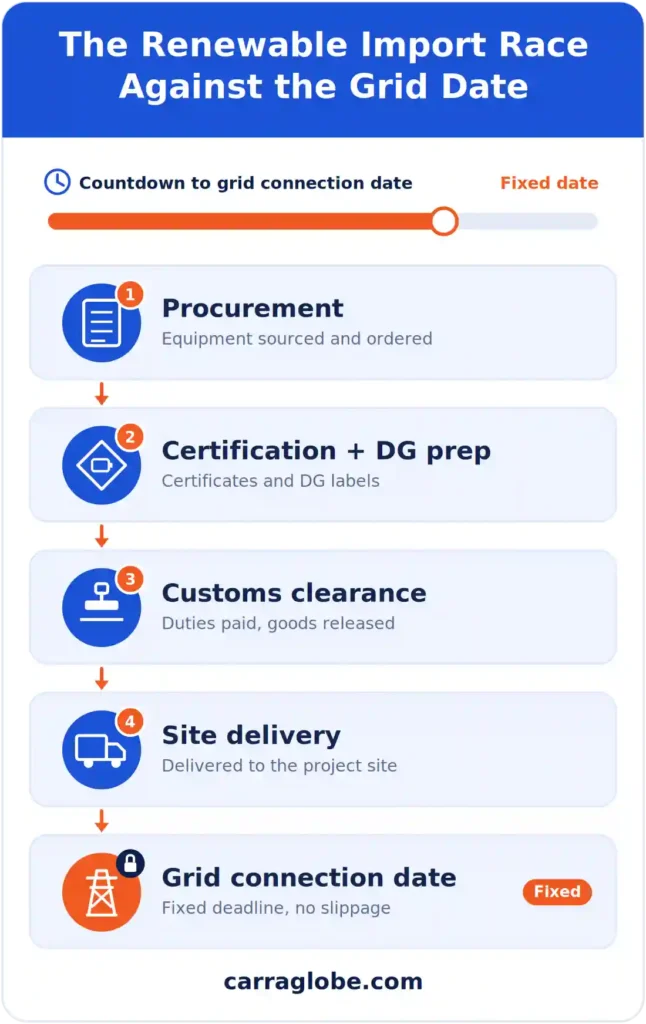
A renewable energy project lives or dies by its connection date. The grid slot is booked, the financing is modelled against it, and the power purchase agreement assumes it. Yet the equipment that has to be in the ground by that date, the solar modules and inverters, the battery storage systems, and the wind turbine components, is some of the most certification-heavy and transport-sensitive cargo in existence. When a container of inverters or a battery storage unit is held at customs, the connection date does not move to accommodate it. The project absorbs the delay. The entity responsible for getting that equipment cleared and delivered on time is the importer of record for renewable energy equipment, and as deployment accelerates worldwide, that role has become central to whether a project energises on schedule.
This page is for renewable energy developers, EPC contractors, solar and storage installers, and the procurement and project teams responsible for landing equipment on site. It covers why renewable energy equipment is uniquely demanding to import, why battery storage in particular carries extra rules, how requirements shift from country to country, and why a single coordinated importer of record protects both compliance and the connection date.
An importer of record for renewable energy equipment is the entity legally responsible for importing solar, battery storage, and wind hardware into a destination country: managing classification, duties, electrical and safety certification, customs clearance, and delivery to site. For multi-country portfolios, a single coordinated IOR keeps compliance consistent and equipment arriving to the construction schedule.
Why an Importer of Record for Renewable Energy Equipment Is Different
Importing renewable energy hardware is not like importing general goods. The equipment carries a combination of pressures that ordinary commercial imports rarely face all at once, and they are worth understanding before a single container ships.
- The connection date is fixed and everything is measured against it. Grid connection windows, power purchase agreements, and project financing all hinge on a date. A customs delay on a critical component is not a scheduling nuisance, it can push energisation and trigger liquidated damages, financing penalties, or power purchase agreement breaches downstream.
- The equipment is electrical and certification-heavy. Solar inverters, battery systems, and grid-tie equipment must meet the destination country’s electrical safety, grid-code, and electromagnetic compatibility standards. Certification that satisfies one market does not automatically satisfy another.
- Battery storage brings dangerous-goods rules. Lithium-ion battery energy storage systems are classed as dangerous goods for transport, which adds packaging, labelling, documentation, and handling requirements on top of the standard import process.
- Classification drives duty, and trade defence measures are common. Solar cells, modules, and related equipment are among the most heavily scrutinised goods in global trade, subject to anti-dumping and countervailing duties in several markets, with classification (HS codes such as 8541.43 for solar modules, 8504.40 for inverters, or 8507.60 for lithium-ion batteries) governed by published tariff schedules such as the US Harmonized Tariff Schedule. Correct classification and origin determination are a material cost and risk lever.
- The cargo is high-volume and project-sequenced. A utility-scale project means many containers arriving in a sequence that matches the construction programme, delivered to a site rather than a warehouse. Timing and coordination matter as much as clearance itself.
Put those together and a renewable energy import asks far more of an importer of record than a standard shipment. If you are new to the role itself, our explainer on what an Importer of Record is and does sets out the fundamentals before we get into the specifics.
Battery Storage: Where Renewable Imports Get Hardest
If there is one part of a renewable project that most often complicates an import, it is battery energy storage. The growth of grid-scale storage has been one of the defining trends in energy, and the equipment sits at the intersection of two demanding regimes at once: electrical certification and dangerous-goods transport.
Lithium-ion batteries, including the LFP (lithium iron phosphate) chemistries that dominate modern BESS (battery energy storage systems), are regulated as Class 9 dangerous goods in international transport, which means storage systems carry strict requirements for packaging, labelling, documentation, and carrier acceptance. A battery storage shipment that is not correctly classified under the right UN number (UN 3480 for batteries shipped alone, UN 3481 when packed with or in equipment), supported by UN 38.3 transport-test documentation, and packaged for dangerous-goods handling can be refused by the carrier before it even moves, or held on arrival. On top of that, the system has to meet the destination country’s electrical safety and grid standards like any other grid-connected equipment. We cover the transport side in detail in our guide to lithium battery customs clearance.
The practical consequence is that battery storage imports need to be planned earlier and more carefully than almost any other part of a renewable project. The importer of record has to manage the dangerous-goods compliance and the electrical certification together, because a gap in either one stops the shipment. This is precisely the kind of dual-requirement cargo where a generalist freight booking falls short and a specialist importer of record earns its place.
Importing solar, battery storage, or wind equipment against a fixed grid-connection date? Carra Globe acts as your importer of record and coordinates certification, dangerous-goods compliance, and delivery to site, so your equipment arrives on schedule.
The Country-by-Country Reality for Renewable Energy Equipment
Renewable capacity is being built across many markets at once, and each one brings its own certification regime, duty treatment, and trade-defence picture for solar, storage, and wind equipment. The same inverter clears smoothly in one country and stalls in the next over a certificate or an origin question. The tables below show how much shifts from market to market. Each links to the detailed importer of record requirements for that country.
Europe and the Americas
| Market | Key Compliance Reality for Renewable Equipment |
|---|---|
| United States | UL safety standards, FCC requirements, intense AD/CVD enforcement on Southeast Asian solar imports, and tightened importer scrutiny in 2026 |
| Germany | EU CE marking, grid-code compliance, and one of the largest solar and storage markets in Europe |
| Spain | EU conformity and grid-connection requirements, with a fast-growing utility-scale solar pipeline |
| United Kingdom | UKCA or accepted CE marking, grid and safety standards, and strong offshore wind and storage demand |
| Brazil | INMETRO certification for electrical equipment and detailed import licensing, with rapid solar growth |
| Mexico | National standards compliance and import requirements, with a significant renewable buildout |
Asia-Pacific and Middle East
| Market | Key Compliance Reality for Renewable Equipment |
|---|---|
| India | BIS certification for solar and electrical equipment, import licensing, and one of the world’s largest renewable programmes |
| Australia | National electrical safety and grid standards, with strong rooftop and utility-scale solar and storage demand |
| Japan | National electrical safety standards, PSE marking for applicable equipment, and rigorous documentation |
| South Korea | National certification requirements for electrical and battery equipment, with a growing storage market |
| Saudi Arabia | SASO and SABER conformity before import, with major solar investment under national energy programmes |
| UAE | Conformity and import approvals plus free zone routing that can defer duty and VAT, and a fast-expanding solar market |
The universal bottleneck: across all markets, the most common delays come from missing or incorrect electrical certification, dangerous-goods non-compliance on battery shipments, and origin or classification errors that collide with anti-dumping measures. On equipment tied to a fixed connection date, any one of these is expensive.
What the Right Importer of Record for Renewable Energy Equipment Does
Secures Electrical and Grid Certification Before Shipping
The work that prevents a hold happens before the equipment moves: confirming that inverters, modules, and storage systems meet the destination country’s electrical safety, grid-code, and EMC requirements, with the certification documented and in place. A provider who understands renewable equipment treats this as the foundation, because grid-connected hardware that fails a conformity check at the border does not clear no matter how urgent the connection date.
Manages Dangerous-Goods Compliance for Battery Storage
For battery energy storage, the importer of record manages the dangerous-goods side, correct classification, packaging, labelling, and UN-certified documentation for lithium-ion transport, alongside the electrical certification. Handling both together is what keeps a storage shipment from being refused by the carrier or held on arrival.
Classifies Equipment and Manages Trade-Defence Exposure
Solar and related equipment sit under active anti-dumping and countervailing duties in several markets, so classification and origin determination carry real cost and risk. A capable importer of record verifies the tariff classification and origin position carefully, controlling duty exposure and avoiding the disputes that delay clearance. Our landed cost guide helps you model the full duty position into your project budget.
Delivers to Site on the Construction Programme
For a live project, clearing customs is only part of the job. The importer of record coordinates timed delivery to the project site in sequence with the construction programme, so high-volume equipment arrives when the build needs it rather than ahead of capacity to receive it. Our warehousing and logistics support helps stage equipment where project sequencing demands it.
Why One Importer of Record Across Your Portfolio Wins
When you are building renewable capacity across several countries, you face a choice: appoint a different provider in each market, or consolidate your importer of record across all of them. For high-volume, certification-heavy equipment on fixed connection dates, consolidation almost always wins.
| Dimension | Single Coordinated IOR | Patchwork of Local Providers | Risk to Connection Date |
|---|---|---|---|
| Compliance standard | One consistent standard across every market | Varies by provider; the weakest sets your risk | Inconsistent clearance risks a slip at the weakest site |
| Certification oversight | Coordinated view of conformity and DG compliance | Fragmented; gaps appear between countries | A missing certificate holds equipment past energisation |
| Accountability | One party answerable for the whole portfolio | Each provider sees only its own market | No owner of the delivery picture when cargo is held |
| Dangerous goods handling | Battery DG compliance managed consistently across markets | Depends on each provider’s DG capability | A DG documentation gap holds a storage shipment |
| Schedule | Clearance and delivery sequenced to the build | Each site on its own uncoordinated clock | Out-of-sequence arrival disrupts the programme |
The deeper point is schedule control across a portfolio where every project has the same certification-heavy equipment on the critical path. When a different provider handles each country, no single party owns the delivery picture, and the weakest link sets the risk for the whole portfolio. When you evaluate a provider, the questions are specific to this sector: can it manage electrical and grid certification in each market, handle dangerous-goods compliance for battery storage, classify equipment correctly against anti-dumping exposure, and deliver to a live site on schedule? The depth of the role is set out in our guide to importer of record requirements.
2026 Has Raised the Stakes
This was already demanding work, and it is more so now. Through 2026, US customs enforcement has tightened, with the June 3, 2026 Customs Enforcement Executive Order raising the bar on importer of record bonding, good standing, and the treatment of foreign importers. For renewable programmes importing high-value equipment at scale, and especially solar equipment already under trade-defence scrutiny, the identity and standing of your importer of record is under more scrutiny than before. Higher bonding requirements and scrutiny on foreign importers of record particularly affect large-scale solar and storage importers already navigating trade-defence measures. An import structure that scraped through last year is a liability this year, and the margin for error on a renewable energy import has never been thinner.
Frequently Asked Questions
Do I need an importer of record to import renewable energy equipment?
In most countries, yes, particularly if you do not have a local legal entity. The importer of record is legally responsible for the import, and for renewable energy equipment that responsibility includes electrical and grid certification, dangerous-goods compliance for battery storage, classification, duties, and coordinated delivery to site. An importer of record lets you import into a market without establishing your own entity there.
For portfolios spanning several countries, a single importer of record across all markets is the more reliable model, because it keeps certification and schedule oversight consistent rather than fragmented across separate local providers.
Why is battery storage harder to import than solar panels?
Battery energy storage uses lithium-ion cells, which are regulated as dangerous goods for transport. That adds packaging, labelling, documentation, and carrier-acceptance requirements on top of the electrical and grid certification every grid-connected product needs. A storage shipment has to satisfy both regimes at once, so a gap in either one can stop it.
This is why battery storage imports need to be planned earlier and managed more carefully than most renewable equipment. An importer of record handles the dangerous-goods and electrical compliance together rather than leaving a gap between them.
How do anti-dumping duties affect importing solar equipment?
Solar cells, modules, and related equipment are subject to anti-dumping and countervailing duties in several markets, which can add significant cost depending on classification and country of origin. Incorrect classification or an unclear origin position can trigger disputes, delays, and unexpected duty liabilities that damage a project’s economics.
A capable importer of record verifies classification and origin carefully so your duty position is accurate and defensible from the start, rather than surfacing as a problem after the equipment has shipped.
Can one importer of record handle a multi-country renewable portfolio?
Yes, and for multi-country portfolios it is the stronger approach. A single importer of record with presence and renewable-equipment expertise across your markets gives you one consistent compliance standard, coordinated certification and dangerous-goods oversight, and one accountable party, rather than a separate arrangement in each country where gaps and schedule slips appear.
The alternative, a different local provider in each market, means the portfolio runs to a different standard everywhere and the weakest provider sets the risk. For high-value, certification-heavy equipment on fixed connection dates, consolidation is the safer model.
The connection date does not wait for the equipment that is stuck in customs, and with renewable hardware carrying heavy certification, dangerous-goods rules, and trade-defence exposure, getting the import right is now part of protecting the schedule itself. For renewable energy developers, EPC contractors, and installers moving equipment across borders, Carra Globe acts as importer of record and handles Delivered Duty Paid shipping across more than 180 countries, coordinating certification, dangerous-goods compliance, classification, and timed site delivery. If you are building in one market or many, talk to our team about mapping the compliance before you ship.