
Most goods clear customs on duty and documentation. Telecom equipment clears on something else entirely: type approval. Before a base station, a router, an antenna, or almost any device that transmits a signal can be imported and switched on, it usually has to be certified by the destination country’s telecommunications regulator, and that approval, not the duty, is what most often holds the shipment. For network operators and vendors rolling out infrastructure across borders, the entity that has to navigate this is the importer of record for telecom equipment, and the role demands an understanding of radio and spectrum certification that ordinary freight handling simply does not have.
This guide is for telecom operators, network equipment vendors, systems integrators, and the procurement and rollout teams responsible for landing network hardware on site. It explains why telecom equipment is uniquely certification-bound, why type approval is the real gate, how requirements differ across markets, and why a single coordinated importer of record protects both compliance and the rollout schedule.
An importer of record for telecom equipment is the entity legally responsible for importing network and radio hardware into a destination country: managing type approval, radio and spectrum certification, classification, duties, customs clearance, and delivery to site. Because telecom devices need regulator approval before they can be imported and operated, the role requires specialist certification expertise, not standard freight handling.
Why an Importer of Record for Telecom Equipment Is Different
Importing telecom hardware is not like importing general goods, because the certification layer sits in front of everything else. These are the realities that define the job before a single unit ships.
- Type approval comes before import. Any device that transmits radio frequency, from a base station to a Wi-Fi access point, generally needs type approval or certification from the destination country’s telecom regulator before it can be imported and operated. Without it, the shipment is held and the equipment cannot be switched on.
- Spectrum rules vary by country. Radio equipment must operate within the frequency bands the destination country permits, and those bands differ from market to market. A device approved for one country’s spectrum allocation may not be legal in the next.
- Approvals are often held in the importer’s name. Like other conformity regimes, telecom type approvals are frequently tied to the importer of record, which means switching providers can mean re-certifying.
- Rollouts run to tight schedules. Network deployments, especially 5G and fibre rollouts, run against coverage commitments and regulatory deadlines. A shipment held on a missing approval can delay an entire rollout phase.
- The hardware is high-volume and distributed. A network build means equipment arriving at many sites, often across a country, in sequence with the deployment plan rather than at a single warehouse.
Put those together and a telecom import asks far more of an importer of record than a standard shipment. The certification burden is closest to what we describe for connected devices in the Gulf in our importer of record in the GCC guide, but telecom equipment makes that certification the central problem rather than one requirement among many.
Type Approval: The Gate That Holds Telecom Shipments
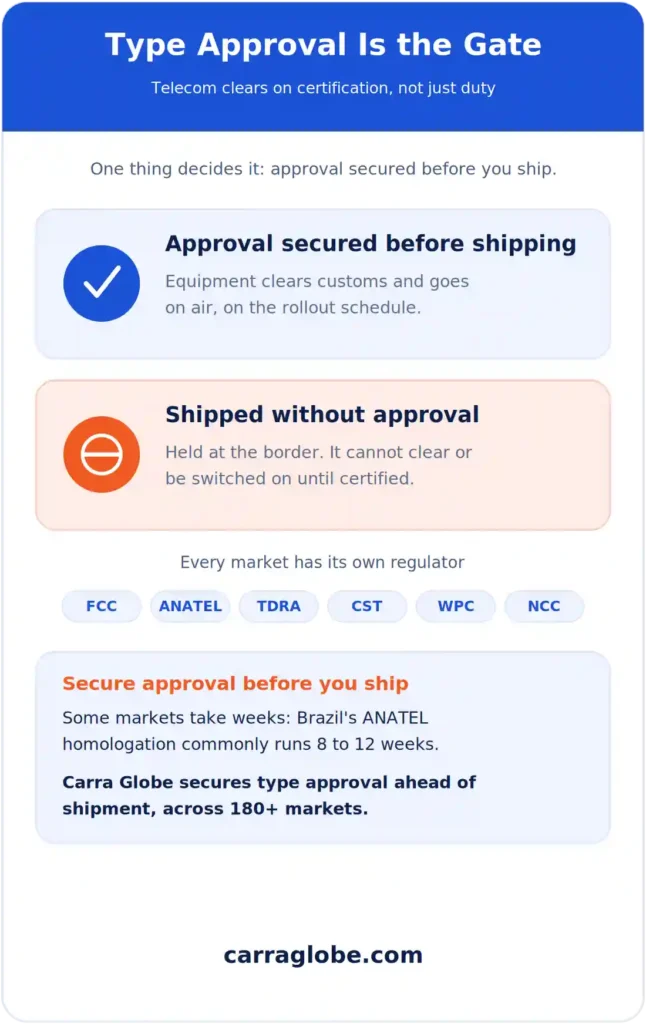
If there is one thing that determines whether a telecom shipment clears, it is type approval. Most countries require that radio and telecommunications equipment be certified against national technical standards before it can be imported, sold, or connected to a network. In the United States, for example, the FCC requires radio frequency devices to hold equipment authorisation before they can be imported or marketed. The certification confirms the device operates within permitted frequency bands, meets power and emission limits, and will not interfere with other services.
The practical consequence is that the approval has to be secured before the equipment arrives, not after. A shipment of radio hardware reaching the border without the regulator’s type approval already in place is held, and in many markets it cannot be released until the certification is granted. In some markets that approval is slow: Brazilian ANATEL homologation, for example, commonly runs to around 8 to 12 weeks because of mandatory in-country testing at accredited Brazilian labs and a designated certification body review before homologation, and several markets require a locally registered entity to even hold the certification. For a rollout on a deadline, that gap is the difference between hitting a coverage milestone and missing it.
This is why telecom imports cannot be treated as standard freight. The freight is straightforward. The type approval and spectrum certification are where the expertise is required, and where an importer of record without telecom experience will get caught out. An importer of record who understands the certification manages it ahead of the shipment, so the equipment clears rather than waiting at the border for an approval that should have been secured weeks earlier.
Rolling out network equipment across borders and facing type approval in every market? Carra Globe acts as your importer of record and coordinates certification, classification, and delivery to site, so network hardware clears and arrives on the rollout schedule.
The Country-by-Country Reality for Telecom Equipment
Telecom networks are built market by market, and each one has its own regulator, its own type-approval process, and its own spectrum rules. The same base station faces a different approval path in every country. The tables below set out the headline position in key markets, each linking to the detailed importer of record requirements for that country.
Europe, Americas, and Asia-Pacific
| Market | Key Compliance Reality for Telecom Equipment |
|---|---|
| United States | FCC equipment authorisation for radio devices, tightened importer scrutiny in 2026, and strict labelling requirements |
| Germany | The EU Radio Equipment Directive (RED) and CE marking, including the mandatory RED cybersecurity requirements (Articles 3.3 d, e, f) in force since 1 August 2025, ahead of the Cyber Resilience Act from December 2027 |
| United Kingdom | UKCA or accepted CE marking under UK radio equipment rules, post-Brexit import procedures |
| Brazil | ANATEL homologation, commonly around 8 to 12 weeks due to mandatory in-country testing, requiring a locally registered certificate holder |
| India | WPC Equipment Type Approval (ETA) for radio plus mandatory TEC certification (MTCTE) for telecom gear, requiring in-country testing at approved Indian labs |
| Japan | National radio certification and rigorous documentation for telecom equipment |
Middle East, Africa, and Emerging Markets
| Market | Key Compliance Reality for Telecom Equipment |
|---|---|
| UAE | TDRA type approval for radio and telecom devices, plus conformity and free zone routing to weigh |
| Saudi Arabia | CST type approval and SABER conformity before import, with major network investment underway |
| Nigeria | NCC type approval for telecom equipment, with import documentation and licensing requirements |
| Indonesia | SDPPI certification for telecom and radio devices, with detailed import controls |
| Vietnam | National type approval and conformity certification, with a fast-growing network market |
| Kuwait | CITRA telecom approval and conformity, as set out in our Kuwait telecom guide |
The universal bottleneck: across every market, the most common delay comes from telecom equipment arriving without the regulator’s type approval already secured. Classification and duty matter, but it is the radio and spectrum certification that holds the shipment, and it is the step most often underestimated.
The Gulf markets in particular combine telecom type approval with broader conformity regimes, which we cover in depth in our guides to Kuwait telecom import rules and the wider GCC import structure.
What the Right Importer of Record for Telecom Equipment Does
Secures Type Approval Before the Equipment Ships
The work that prevents a hold happens before the hardware moves: confirming that each device has the destination regulator’s type approval, that it operates within the permitted spectrum, and that the certification is documented and in place. A provider who understands telecom treats this as the foundation, because radio equipment that reaches the border without approval does not clear regardless of how urgent the rollout is.
Manages Spectrum and Conformity Across Markets
Because spectrum rules and conformity schemes differ by country, the importer of record manages the certification in each market a network spans, ensuring each device is approved for the frequencies it will use. This is what keeps a multi-country rollout from stalling on a device that was legal in one market and not the next.
Classifies Equipment and Manages Duty
Telecom equipment classification governs duty and any sector-specific treatment, and errors on high-value network gear are costly. Base stations, routers, and switches generally fall under HS heading 8517, which covers apparatus for transmission or reception over a network, but the precise subheading and any sector treatment still have to be verified per market. A capable importer of record verifies classification carefully, controlling the duty position and avoiding the disputes that delay clearance. Our landed cost guide helps you model the full cost into your rollout budget, and the risks of getting classification wrong are set out in our guide to the cost of incorrect HS codes.
Delivers to Site on the Rollout Schedule
For a network build, clearing customs is only part of the job. The importer of record coordinates delivery to many sites in sequence with the deployment plan, so equipment arrives where and when the rollout needs it. Our white glove delivery and warehousing support help stage and distribute equipment across a national footprint
Why One Importer of Record Across Your Network Build Wins
When you are deploying a network across several countries, you face a choice: a different provider in each market, or one importer of record across all of them. For certification-bound equipment on rollout deadlines, consolidation wins.
| Dimension | Single Coordinated IOR | Patchwork of Local Providers | Risk to Rollout Schedule |
|---|---|---|---|
| Type approval oversight | Coordinated across every market | Fragmented; gaps appear between countries | A missing approval holds a rollout phase |
| Compliance standard | One consistent standard everywhere | Varies by provider; the weakest sets the risk | Inconsistent clearance risks a slip |
| Certification continuity | Held consistently as you expand | Tied to each provider; lost if you switch | Re-certification delays new market entry |
| Accountability | One party answerable for the network | Each provider sees only its own market | No owner of the picture when a site is held |
The deeper point is that a network rollout has the same certification-bound equipment on the critical path in every market. When a different provider handles each country, no single party owns the type-approval picture, and the weakest link sets the risk for the whole rollout. When you evaluate a provider, the questions are specific to telecom: can it secure type approval in each market, manage spectrum and conformity certification, classify network equipment correctly, and deliver to many sites on schedule? The depth of the role is set out in our guide to importer of record requirements, and the wider discipline in our global trade compliance service.
2026 Has Raised the Stakes
This was already demanding work, and it is more so now. Through 2026, US customs enforcement has tightened, with the June 3, 2026 Customs Enforcement Executive Order raising the bar on importer of record bonding, good standing, and the treatment of foreign importers. Telecom equipment also sits close to national-security scrutiny in many markets. In the US, the FCC has moved to prohibit equipment authorisation for hardware on its Covered List on national-security grounds, with rules tightening from late 2025, so the origin and security of network hardware face growing attention. For network programmes importing equipment at scale, the identity and standing of your importer of record matters more than ever, and an import structure that scraped through last year is a liability this year. Much of this network hardware also flows into data centre and edge sites, which connects to our guide on the importer of record for data centre equipment.
Frequently Asked Questions
Do I need an importer of record to import telecom equipment?
In most countries, yes, particularly if you do not have a local legal entity. The importer of record is legally responsible for the import, and for telecom equipment that responsibility includes securing type approval and radio certification, classification, duties, and coordinated delivery to site. Given how central type approval is, a specialist importer of record with telecom experience is strongly advisable.
For networks spanning several countries, a single importer of record across all markets is the more reliable model, because it keeps type approval and certification consistent rather than fragmented.
What is type approval and why does it matter for importing telecom equipment?
Type approval is the certification a country’s telecom regulator requires before radio and network equipment can be imported, sold, or connected to a network. It confirms the device operates within permitted frequency bands and meets emission and interference limits. Without it, the equipment is held at the border and cannot be legally operated.
It matters because it has to be secured before the equipment arrives, not after. Type approval, not duty, is the step that most often holds a telecom shipment, which is why it has to be managed ahead of the import.
Why does telecom equipment need separate certification from general electronics?
Because telecom equipment transmits radio frequency and connects to networks, it has to meet spectrum, emission, and interference rules that general electronics do not. Telecom regulators certify that a device will operate only within permitted bands and will not interfere with other services, which is a separate process from general product safety conformity.
This is why a device can hold a general safety certificate and still be refused import: the telecom type approval is a distinct requirement, and it is the one most often overlooked for connected and radio equipment.
Can one importer of record handle a multi-country network rollout?
Yes, and for multi-country rollouts it is the stronger approach. A single importer of record with telecom expertise across your markets gives you coordinated type approval, one consistent compliance standard, and one accountable party, rather than a separate arrangement in each country where approval gaps and schedule slips appear.
The alternative, a different local provider in each market, means the rollout runs to a different standard everywhere and the weakest provider sets the risk. For certification-bound equipment on rollout deadlines, consolidation is the safer model.
Telecom equipment clears on certification, not just on duty, and the type approval that lets a network device operate is exactly where shipments get held. For operators, vendors, and integrators rolling out network hardware across borders, Carra Globe acts as importer of record and handles Delivered Duty Paid shipping across more than 180 countries, coordinating type approval, certification, classification, and delivery to site. If you are building a network in one market or many, talk to our team about mapping the certification before you ship.