
Most import rules ask you to declare what something is. This one asks you to prove what it is not.
That single inversion is why the Uyghur Forced Labor Prevention Act catches technology importers who thought it was somebody else’s problem, and why the importer of record is the party expected to assemble and present the evidence when it does.
Carra Globe provides importer of record and exporter of record services, so we have a commercial interest in your answer. What follows is written to be usable whether or not you ever speak to us.
The presumption, and which way it points
Does UFLPA apply to electronics and servers? Yes, it can. It turns on whether goods were mined, produced or manufactured wholly or in part in the Xinjiang Uyghur Autonomous Region, or by an entity on the UFLPA Entity List. The words “in part” are why hardware needs tracing: polysilicon, a cell or an aluminium part several tiers down can be where a listed entity sits, and the final assembler will not tell you.
Under the Act, goods mined, produced or manufactured wholly or in part in the Xinjiang Uyghur Autonomous Region, or by an entity on the UFLPA Entity List, are presumed to be made with forced labour and prohibited from entry.
No finding has to be made against you first. The trigger is where the goods were made, or that a listed entity produced them, and that entity need not be a company you buy from directly. The presumption applies at importation.
Rebutting it means satisfying CBP “by clear and convincing evidence, that the good, ware, article, or merchandise was not mined, produced, or manufactured wholly or in part by forced labor”. That is a high civil standard, applied to a negative proposition about a supply chain you may not own.
What satisfies it is affirmative: documented tracing that shows where the material came from, not a statement that nothing is wrong.
This is the part that catches people. The Act creates a statutory rebuttable presumption, so where it applies the importer supplies the evidence that rebuts it. The shipment stays detained while that evidence is assembled, which is a race between your file and the admissibility timetable.
Why technology hardware is exposed through its inputs
Ask most IT importers whether they handle goods from Xinjiang and the honest answer is no. They buy servers, switches, storage and power equipment from established manufacturers with recognisable names. But checking the brand or the final assembler does not answer the question on its own.
Look at what the August 2026 additions actually name. The notice ties specific entities to specific materials: one in the “research, production, and sales of polysilicon and monocrystalline silicon”, one that “produces lithium carbonate” from regional brine, one that “sources high-purity aluminum and electronic aluminum from suppliers located in the XUAR”, one that “sources titanium from the XUAR through a XUAR-based titanium producer”, and three in gold mining and smelting.
Cotton, textiles and tomatoes sit alongside them.
None of those are finished goods. Electronic aluminium and monocrystalline silicon do not arrive at your dock with a label on them. They arrive inside equipment bought from a manufacturer whose name you recognise.
The phrase that does the work in the statute is “wholly or in part”. A finished product is not automatically outside it because the covered material is one component several tiers upstream, and our note on lithium battery customs clearance covers the other question about the same cell: not whether it travels safely, but where the material inside it came from.
The list is moving outward, not just getting longer
On 3 August 2026 the Department of Homeland Security added forty-three entities to the UFLPA Entity List, taking it to one hundred and eighty-seven. That was the largest single expansion since the list began, and the headline number is the less interesting part.
The statute builds the Entity List from four separate lists of entities, at clauses (i), (ii), (iv) and (v) of section 2(d)(2)(B). Clause (iii) sits between them but requires a list of products rather than entities, which is why the consolidated register is built from four lists, and why the notice itself frames the Entity List around “clauses (i), (ii), (iv), and (v) of section 2(d)(2)(B)”.
Four of the forty-three went on under subsection (ii), covering entities working with the regional government to recruit or transfer labour. Forty-one went on under subsection (v), which covers “facilities and entities, including the Xinjiang Production and Construction Corps, that source material from the Xinjiang Uyghur Autonomous Region”.
Those two counts come to forty-five listings rather than forty-three entities, because two additions appear on both sub-lists. That matters if you screen against one sub-list rather than the consolidated register.
Read that subsection again. It turns on where an entity sources its material, not where it sits. A supplier can be listed because of its sourcing while operating nowhere near the region, which means a map of your supply chain by geography will not tell you whether you are exposed.
For a technology importer that is the practical shift. Checking that your tier-one manufacturer is outside Xinjiang no longer answers the whole question.
What rebutting it actually requires
CBP does not accept an assurance. Its published expectation is that importers apply “due diligence, effective supply chain tracing, and supply chain management measures”, and respond “completely and substantively to CBP requests for information”.
In practice that can mean tracing a specific consignment through multiple tiers towards the raw material and the production sites, with documentation supporting each handover that is relevant to the review, for goods that may have changed hands several times before they reached you. It is a records exercise, and the records belong to other companies.
A file that does the work runs in one direction: from the consignment backwards. Each relevant handover needs a record behind it, and the tracing has to run far enough upstream to reach the materials and production sites that matter to the review, rather than stopping at the last company you recognise.
None of that can begin at the border. A detained shipment is not the moment to discover that your supplier cannot name its own smelter, and the general operational playbook in our guide to resolving a customs hold on IT shipments does not reach this, because this hold is not a documentation error you can correct and resubmit
What belongs in the file
That is the direction. This is the inventory. CBP publishes no fixed list of documents, so treat it as evidence that strengthens a file, and check it against what you hold rather than what you assume a supplier could produce.
- The bill of materials. Model by model, to component level, because the finished unit on its own will not tell you which parts need checking. Most resellers do not hold one, which makes it the first thing to ask the manufacturer for.
- Manufacturing and assembly sites. Identified at site level rather than by country.
- Sub-supplier records. Your supplier’s own purchase documentation for the high-risk inputs, rather than its assurance about them.
- Material sourcing evidence. Where the polysilicon, cells, aluminium, titanium or gold came from, and from which production site where the supplier can evidence it.
- Transport and chain of custody. Records connecting the stages, so the file reads as one chain rather than a set of unrelated documents.
- Screening results. Dated checks against the current Entity List for every party in the chain you can name.
- Translations. English versions of records held in another language, which CBP can ask for.
One thing in that list is not a document. Decide, before a consignment moves, who on your side coordinates a response if a shipment is detained. And a supplier declaration can support the file. It should not be the file.
Who has to answer the notice
A notice of detention is issued under 19 CFR 151.16(c) to “the importer or other party having an interest in such merchandise”, and CBP provides the UFLPA attachment to importers. So the paperwork may land with a broker or agent as well as with you.
What does not move is the responsibility for demonstrating admissibility. It stays with the importer rather than passing to the manufacturer or the end customer who ordered the equipment.
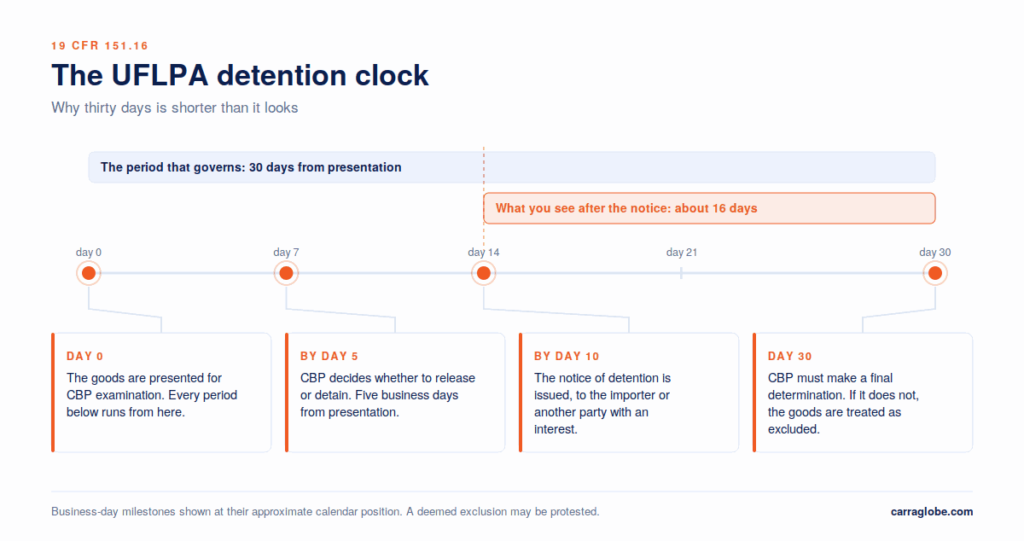
The timetable does not start where people assume. Under 19 CFR 151.16, CBP decides whether to release or detain within five business days of the goods being presented for examination, then issues the detention notice within five business days of that decision.
So the thirty days that matters runs from presentation for examination, not from the notice. It is CBP’s own deadline to determine admissibility, or “such longer period if specifically authorized by law”.
Rebuttal is not the only outcome. If no final determination is made in that period, the regulation treats it as a decision to exclude the goods. A deemed exclusion can be protested, but that is slower than answering while the goods are still detained. Evidence you are still gathering late in the period arrives after the question has been answered for you.
So this is an import structure question, not a procurement one. The importer of record is responsible for the entry and for making sure a complete response is made, within a timetable it does not set, using evidence it has to obtain from third parties. It sits alongside the wider direction of United States import enforcement policy, which keeps asking the importer of record to carry more.
An entity that exists to be named on an entry cannot run that exercise. If a third party is your importer of record, the commercial arrangement has to give it access to the evidence and the authority to answer, which is the distinction we set out in paper IOR versus operational IOR.
The same problem, the opposite burden, in the EU
If you ship into both markets, the two regimes are not variations on a theme. They are built the other way up from each other.
Regulation (EU) 2024/3015 will prohibit placing products made with forced labour on the Union market. It entered into force on 13 December 2024 and enters into application on 14 December 2027, so it is law today but not yet an operative import control. That gap is the planning window.
When it does apply, it will not work through a rebuttable presumption of the UFLPA kind. The burden of establishing forced labour sits with the lead competent authority, while the operator carries information and cooperation duties.
Recital 47 states the intention plainly, that the lead competent authorities “should bear the burden of establishing whether forced labour has been used at any stage of the production, manufacture, harvest or extraction of a product”. Chapter III builds the investigation that way round.
There is a sting in it, and it is the part worth planning around now rather than in 2027. Article 20(2) lets the authority establish a violation “on the basis of any other facts available” where it could not gather the evidence, and it names the situations: an operator that refuses the request without a valid justification, misses the prescribed time limit without one, or supplies incomplete or incorrect information to block the investigation.
You are not asked to prove a negative. You are asked to answer, and not answering is its own answer.
| United States, UFLPA | European Union, Regulation 2024/3015, from 14 December 2027 | |
|---|---|---|
| What triggers it | Goods mined, produced or manufactured wholly or in part in the region, or by a listed entity | A risk-based assessment and a preliminary phase, then a formal investigation if there is a substantiated concern |
| Who carries the burden | The importer, from the point of importation | The lead competent authority, although operators must still answer its information requests |
| The standard | Clear and convincing evidence that forced labour was not used | The authority must establish that it was |
| If you stay silent | The presumption stands and the goods do not enter | The authority may establish a violation on any other facts available |
| The time you get | CBP must determine admissibility within thirty days of presentation for examination, or the goods are treated as excluded | Thirty working days to answer in the preliminary phase, then thirty to sixty working days set by the authority once an investigation opens |
| How long it runs | No fixed end: a deemed exclusion can be protested, which is a separate and slower route | The authority endeavours to decide or close within nine months of opening the investigation |
| Who has to answer | The importer of record, even where a broker or agent handles the correspondence | The economic operator under investigation |
There are two clocks, because a preliminary phase runs before any investigation: thirty working days to answer under Article 17(2), then thirty to sixty working days set by the authority under Article 18(4) once an investigation opens. An extension needs a justification, and no fixed number of extra days is prescribed.
Article 20(1) then has the authority aim to decide or close within nine months. That is time to produce a file. It is not time to build one from nothing.
The practical consequence is that the same tracing file does different work in each market. In the United States it is the evidence that can support the release of a detained consignment. In the European Union it is what lets you answer an investigation before the authority has to rely on whatever other information it can gather.
What to settle before the goods move
- Map the inputs, not just the vendors. Exposure can sit upstream as well as in the companies you buy from, so a list of your manufacturers does not answer the question on its own.
- Screen by entity, against the current list. It changed substantially in August 2026, and it reaches entities that source from the region as well as entities in it.
- Ask your supplier what it can evidence. Not whether it complies. Whether it can produce tracing documentation to the raw material, and how fast.
- Decide who answers a detention notice. Settle it when the import structure is agreed, because the timetable belongs to CBP.
- Keep the file before you need it. Evidence assembled in advance can be timestamped, cross-checked and reconciled across the chain. Evidence produced in a hurry cannot.
How Carra Globe works with this
We provide importer of record and exporter of record services for technology hardware across 175+ countries, alongside DDP customs clearance, warehousing and delivery to site.
Being clear about the boundary: we are not your forced labour auditor, and we do not certify a supply chain as clean. What we do is make sure the party named as importer is one that can hold a file and answer a notice, and that the question has been asked before a consignment is committed rather than after it is detained.
Four things let us look at a lane: the destination and the goods with model numbers, where the hardware is manufactured and assembled, what you already hold by way of supplier declarations or tracing documentation, and whether this is a one-off or a programme that repeats.
Carra Globe already holds the importer-side licences, certifications and approvals its local importing structures require for the goods we handle, so your cargo moves without delay at the border. Where a shipment needs an approval outside that scope, we say so before a delivery date is agreed rather than after the goods land. That applies whether this is a first shipment into a new country or one leg of a longer programme.
Importer of Record · Forced Labour Enforcement
Decide who answers the notice before anything ships.
Being clear about the boundary: we are not a forced labour auditor and we do not certify a supply chain as clean. Nobody can promise you a border outcome on a page about goods being detained. What we can do is settle the part that is decided before the goods move: which entity can be named as importer in each destination, whether that entity can actually hold a file and answer a request, and whether your commercial arrangement gives it the access and the authority to do so.
- Importer of record services
- Exporter of record services
- Paper IOR vs operational IOR
- Customs holds on IT shipments
- US customs enforcement order
- Certificates of origin for IT hardware
- Supply chain diversification
- Lithium battery customs clearance
- IT hardware import rules by country
- IOR by country
- DDP customs clearance worldwide
- First shipment into a new country
- Multi-country deployment
- IOR for technology OEMs
- Who is liable when a reseller imports
Free tools HS Code Finder Volumetric Weight Calculator Pallet Calculator
Know your destination and your hardware? Tell us both. We will tell you which entity can be named as importer there, what that entity is able to answer if a consignment is held, and which parts of your supply chain documentation need requesting from the manufacturer now rather than on day twenty of a thirty day clock.
Check who answers for my laneFrequently asked questions
Does UFLPA only apply to goods from Xinjiang?
No. It also covers goods produced wholly or in part by entities on the UFLPA Entity List, and one sub-list reaches entities that source material from the region rather than operate in it.
Can my supplier’s declaration rebut the presumption?
On its own, rarely. CBP expects supply chain tracing and a complete substantive response, measured against a clear and convincing evidence standard, not an assurance that nothing is wrong.
Who receives the notice if a third party is my importer of record?
The importer of record is responsible for the response. A broker or agent may receive and handle the correspondence on its behalf, depending on the arrangement, but the responsibility does not move.
Does a finished product assembled elsewhere avoid it?
Not by itself. The statute reaches goods mined, produced or manufactured wholly or in part in the region or by a listed entity, so assembly elsewhere does not resolve what happened upstream.
Does the EU work the same way as UFLPA?
No, it is built the opposite way up. From 14 December 2027 the burden sits with the competent authority, though an operator that fails to answer its requests can still be decided against.
Can a certificate of origin rebut a UFLPA presumption?
No. A certificate of origin documents customs origin for the purposes that require it. It does not by itself show whether the goods or their inputs were made with forced labour.
Adjacent ground: certificates of origin for IT hardware, supply chain diversification and IT hardware import rules by country.
Sources and verification
- The statute: the Uyghur Forced Labor Prevention Act, Public Law 117-78, for the rebuttable presumption and the clear and convincing evidence standard, and for section 2(d)(2)(B), whose subsection (v) covers “facilities and entities, including the Xinjiang Production and Construction Corps, that source material from the Xinjiang Uyghur Autonomous Region”.
- The August 2026 expansion: the Department of Homeland Security notice published on 3 August 2026, Federal Register document number 2026-15628, for the addition of forty-three entities “two of which appear on two separate sub-lists”, the four added to the subsection (ii) list and the forty-one added to the subsection (v) list, the named entities tied to polysilicon and monocrystalline silicon, lithium carbonate, high-purity and electronic aluminium, titanium, gold, cotton and tomatoes, the total of one hundred and eighty-seven entities, the framing of the list around “clauses (i), (ii), (iv), and (v) of section 2(d)(2)(B)”, and the goods listed, which include polysilicon, lithium carbonate, aluminium, titanium, gold products, cotton and textiles.
- The detention notice: 19 CFR 151.16(c), for the notice of detention being issued to “the importer or other party having an interest in such merchandise”, for the five business day decision and notice periods, and for the failure to make a final determination within thirty days of presentation for examination being “treated as a decision by CBP to exclude the merchandise”.
- What CBP expects: CBP’s UFLPA guidance, for the requirement to apply due diligence, effective supply chain tracing and supply chain management measures, to respond completely and substantively to requests for information, and for the UFLPA attachment to the notice of detention being provided to importers.
- The European Union position: Regulation (EU) 2024/3015 on prohibiting products made with forced labour on the Union market, which entered into force on 13 December 2024 and applies from 14 December 2027. Recital 47 for the lead competent authorities bearing the burden of establishing whether forced labour has been used. Article 17(2) for the thirty working day response in the preliminary phase, Article 18(4) for the deadline of at least thirty and no more than sixty working days once an investigation opens, and Article 20(1) and 20(2) for the nine month target and for establishing a violation “on the basis of any other facts available”.
- Verification note. Checked on 5 October 2026 against the statute, the Federal Register notice of 3 August 2026, CBP UFLPA guidance and Regulation (EU) 2024/3015. Two qualifications. The Entity List changes without notice to importers, so the count and composition cited here are those published on 3 August 2026 and should be checked against the current list before shipping. And the Department of Homeland Security statistics pages were not reachable at the date of writing, so this page cites no detention volumes or sector rankings.
Disclaimer: This guide is for informational purposes only and does not constitute legal, customs or trade compliance advice. Carra Globe does not audit supply chains or certify goods as free of forced labour. Admissibility depends on the goods, the supply chain and the evidence available, and the position described is as at 5 October 2026. Confirm the current position with the competent authority or a qualified adviser before acting.