
Almost every guide to importer of record services is written for the same reader: an enterprise rolling out its own hardware into its own offices or data centres. Ship the servers, clear customs, deploy them, done. That reader has a real problem, but it is not your problem. If you are a technology OEM, your hardware is not something you are deploying to yourself. It is your product, and it is going to your customers, in many countries, often on the same launch date.
That single difference changes almost everything about how importer of record has to work for you, and it is the reason most generic IOR advice quietly fails the companies that need it most.
This guide is about the OEM’s version of the problem: what happens when the thing crossing the border is a product line rather than a project, when the consignee is your customer rather than your own subsidiary, and when a border delay damages your brand rather than just your timeline. It sets out the four ways an OEM’s import reality differs from a deployer’s, a framework for judging whether your import model can actually support a global product, and how the importer of record function fits into an OEM’s go-to-market.
Importer of Record for Technology OEMs: At a Glance
- An OEM ships a product, not a project: the same model repeats across every customer and every market, so a fix that works once has to work a thousand times, reliably.
- The consignee is usually your customer, not your own entity: that removes the option most deployers rely on, using a local subsidiary as importer, and puts your customer’s experience on the line at the border.
- Launch is simultaneous, not sequential: a global product launch needs many markets cleared at once against a fixed date, not one country sorted at a time.
- Certification is a product-line question, not a one-off: type approvals and conformity marks have to be planned as a property of the product, and re-planned as the product changes.
- The flow runs both ways: warranty, RMA, and reverse logistics mean goods come back across borders too, and a return carries the same compliance questions as the original import, in reverse.
- There is a quick way to tell if your model is ready: the five-question product-ready import test below scores your setup as built for a product or bound to a project. Any “no” is a place a single customer order can stall.
The Deployer’s Problem vs the OEM’s Problem
The importer of record requirement itself is the same for everyone. In most countries the importer must be a locally recognised legal or fiscal entity that holds the right registrations, presents the documentation, answers customs queries, stands behind the classification, and ensures the product approvals are in place. If no suitable importer structure exists, the shipment stalls, regardless of who is shipping. That much is common ground.
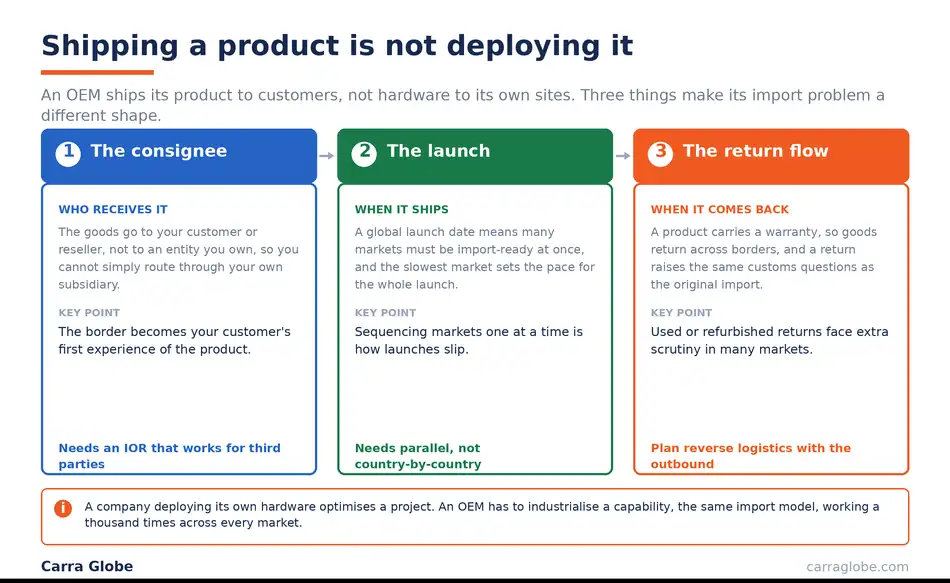
What differs is the shape of the need. A company deploying its own hardware is solving a bounded problem: get this equipment into this facility once. It can often use its own local entity as importer, control the destination, and treat each market as a separate task. An OEM is solving a repeating, distributed problem: get this product to whichever customer buys it, in whichever country they are in, every time, without ever controlling the destination and frequently without any local entity of its own to lean on. The deployer optimises a project.
The OEM has to industrialise a capability. Everything below follows from that distinction.
Importer of Record · 175+ countries
Importing IT or high-value hardware? We can be your Importer of Record.
Carra Globe acts as your Importer of Record so you can ship into markets where you have no local entity. We carry the legal liability, handle certifications and duties, and give you one itemised quote:
Have a shipment in mind? Send us your lane and goods, we will confirm and quote.
Get a compliance quoteFour Ways an OEM’s Import Reality Is Different
1. Your consignee is your customer, so the border is part of your product experience
When an enterprise deploys to itself, a customs delay is an internal inconvenience. When an OEM ships to a customer, a customs delay is the first impression that customer has of your product, and it happens before they have even opened the box. The consignee is not your subsidiary, so you cannot simply route the shipment through an entity you control.
You need an importer of record structure that can legally receive goods on terms that work for a third-party customer, keep the customer out of a compliance role they never agreed to take on, and make the arrival feel like part of the product rather than a logistics problem you handed them.
For OEMs selling through resellers and distributors, the same logic applies one layer out: your channel partners inherit whatever friction your import model creates.
2. Launch is simultaneous, so markets have to clear in parallel
A deployer can sequence its rollout, one country this quarter, another next. An OEM launching a product usually cannot, because a global launch date means many markets have to be import-ready at the same moment. This is the new product introduction problem, and it is unforgiving: the certification and import readiness for ten or twenty countries all has to land before a single fixed date, and the slowest market sets the pace for the launch. Planning import readiness market by market, in series, is how launches slip.
It has to be planned in parallel, as a single programme, with the long-lead markets identified early and worked first. An importer of record partner that can only move one country at a time is not built for how an OEM launches.
3. Certification is a property of the product, not the shipment
For a deployer importing finished equipment, certification is usually already handled by the manufacturer. For an OEM, the manufacturer is you, so the conformity marks and type approvals are your responsibility, as a property of the product line. Wireless and telecoms hardware needs regional type approvals, coordinated internationally through bodies like the International Telecommunication Union but ultimately enforced country by country; electronics need safety and EMC conformity marks; many markets have their own distinct regime.
There is a subtlety OEMs run into repeatedly: modular certification of a component, a pre-approved wireless module, for example, can carry across some markets and save enormous effort, but other countries do not recognise modular certification and require the final host device to be approved in its own right.
That has to be mapped per market and per product, and re-checked every time the product changes, because a hardware revision or even certain functional changes can affect the certification you rely on. This is where import readiness and product engineering meet, and treating them separately is how OEMs get blocked at the border on a product they thought was cleared.
4. The flow is bidirectional, so reverse logistics is not an afterthought
A deployer rarely ships its hardware back out. An OEM does, constantly, because a product carries a warranty, and warranty means returns. Return merchandise authorisation and reverse logistics are a core part of the OEM operating model, not an edge case.
Here is the point most planning misses: a return shipment carries the same compliance questions as the original import, in reverse. A faulty unit coming back across a border needs classification, documentation, valuation, and often the same permits as when it went out, and used or refurbished equipment frequently faces extra scrutiny, age limits, or proof-of-service requirements in the destination market.
An import model that only thinks about the outbound direction leaves the OEM to discover the reverse problem the first time a customer returns a unit from a difficult market. The outbound and return flows should be designed together, ideally through one operation that sees both directions.
Launching a hardware product into multiple markets at once? Carra Globe can act as your importer of record across every target market, so your customers receive your product cleanly and your launch date holds. We map the long-lead markets first and run them in parallel.
Get a free product-ready import assessment: is your launch model built for scale? →
The Product-Ready Import Test: Can Your Model Support a Global Product?
Here is a simple way for an OEM to judge whether its import model is built for a product rather than a project. Score your current setup against these five questions. Every “no” is a place where a single customer order into a new market can stall, and at OEM scale, one stall becomes a pattern:
| Question | Product-ready | Project-bound |
|---|---|---|
| Can a legal importer be named in a new market without your customer taking on that role? | Yes, via an IOR | No, relies on the customer or a local entity |
| Can you get many markets import-ready in parallel against one launch date? | Yes, run as a programme | No, handled country by country |
| Is certification mapped per product and per market, including modular vs host-device rules? | Yes, planned as a product property | No, checked per shipment |
| Is the return and RMA path designed alongside the outbound path? | Yes, both directions covered | No, reverse logistics unplanned |
| Does one partner see the whole picture across markets? | Yes, unified visibility | No, split across brokers and entities |
A deployer can pass this test with a “no” or two and still succeed, because the stakes are bounded. An OEM cannot, because every weakness is multiplied by every customer in every market. The whole point of the product-ready standard is that it has to hold at scale, not just once.
Why OEMs Separate the Importer of Record From Freight
One pattern worth naming, because sophisticated OEMs converge on it: they separate freight execution from the importer of record responsibility, and often consolidate the IOR, certification, and customs relationships under one partner rather than leaving them scattered. The reason is that a freight provider can move a box to a country, but moving a box is not the same as legally importing it. The value of an importer of record is not the legal shell, since any registered entity can technically be the importer.
The value is the regulatory knowledge, the customs efficiency, and the multi-market coordination that lets a product move from origin to the customer’s hands without preventable delay, and that does the same in reverse when it comes back. For an OEM, that coordination across many markets is worth more than any single country’s clearance, because the OEM’s problem was never one country. It was all of them, at once, repeatedly.
How Carra Globe Works With Technology OEMs
The educational framework above is vendor-neutral. This section is where Carra Globe fits, and it is deliberately separate.
Carra Globe acts as the importer of record and exporter of record for technology companies shipping hardware across 175+ countries, with a focus on IT hardware, data centre equipment, telecoms, medical devices, and aerospace, exactly the regulated, high-value categories where the OEM import problem is hardest.
For a global launch, we hold the importer of record entity in each target market, map the long-lead markets first, and run them in parallel so a single launch date is realistic rather than aspirational. Our global trade compliance team handles the certification mapping, including the modular-versus-host-device question that catches OEMs out.
Our delivered duty paid service means your customer receives the product with duties and taxes handled rather than facing a customs bill they did not expect. Because the flow runs both ways, we design the return and RMA path alongside the outbound one, through the same operation, so warranty returns from difficult markets are planned rather than discovered.
For the deeper technical context, see our guides to IT hardware and data centre trade compliance and the difference between a freight forwarder and an importer of record.
Frequently Asked Questions: Importer of Record for Technology OEMs
What is an importer of record for a technology OEM?
An importer of record for a technology OEM is the local entity that legally imports the OEM’s hardware into a country on the OEM’s behalf.
This lets the OEM sell into that country without requiring its customer or itself to hold local registration. For OEMs specifically, the importer of record must also work when the consignee is a third-party customer, a scenario most generic IOR arrangements are not designed for.
How is IOR for an OEM different from IOR for a company deploying its own hardware?
A deployer imports to its own facilities once, often via its own local entity. An OEM ships its product to customers repeatedly, across many markets at once, usually with no local entity of its own.
That means the OEM needs parallel multi-market readiness, an importer structure that works with third-party consignees, and a planned return path, none of which a single-market deployment requires.
How do OEMs handle a simultaneous global product launch?
By treating import readiness as a single parallel programme rather than a country-by-country task, identifying the long-lead markets early and working them first, since the slowest market sets the launch date.
An importer of record partner that can stand up entities and certifications across many markets at once is what makes a fixed global launch date realistic.
How do you launch a hardware product globally?
Treat every target market as one parallel launch programme: map certification and import readiness for all markets at once, work the long-lead ones first, and name a legal importer in each before the launch date.
The common failure is sequencing markets one at a time, which lets the slowest one slip the whole launch. Parallel readiness and a capable importer of record across markets are what hold the date.
Does modular certification of a component cover the whole product everywhere?
No. A pre-approved module can carry across some markets and save significant effort, but other countries do not recognise modular certification and require the final host device to be approved in its own right.
This has to be mapped per market and per product, and re-checked whenever the product changes, because a hardware revision can affect the certification the OEM relies on.
What is modular certification?
Modular certification is when a component, such as a wireless module, is pre-approved so that products integrating it can rely on that approval instead of re-testing the whole device from scratch.
It can save enormous effort where recognised, but not every country accepts it, and some require the final host device to be approved in its own right regardless of the module’s status.
Why does reverse logistics matter for OEM import compliance?
Because a product carries a warranty, so goods come back across borders, and a return shipment carries the same compliance questions as the original import, in reverse: classification, documentation, valuation, and often the same permits.
Used or refurbished returns can face extra scrutiny or age limits in some markets, so the return path should be designed alongside the outbound one, not discovered later.
What is reverse logistics in international trade?
Reverse logistics is the movement of goods back from the customer to the manufacturer or a repair point, covering warranty returns, RMA, repairs, and end-of-life handling, across borders in the case of international trade.
Each return re-enters a country and carries the same customs classification, documentation, and valuation questions as the original import, which is why OEMs plan it deliberately rather than treating it as an afterthought.
Should an OEM use its freight forwarder as its importer of record?
Not usually. Moving a box to a country is not the same as legally importing it, and sophisticated OEMs separate freight execution from the importer of record responsibility.
The importer of record’s value is regulatory knowledge and multi-market coordination, not the legal shell, so OEMs often consolidate IOR, certification, and customs under one specialist partner.
What is the difference between a freight forwarder and an importer of record?
A freight forwarder arranges the physical movement of goods; an importer of record is the legally accountable entity that ensures the import complies with the destination country’s law and holds the required registrations and approvals.
Moving a box is not the same as legally importing it, so the two roles are distinct. Our guide to the freight forwarder versus importer of record distinction covers this in full.
Do I need an importer of record for every country?
You need one in any country where you lack a local entity with the customs registrations and product approvals to legally import your hardware, which for most global OEMs is most of their markets.
Where you already hold a properly registered and authorised local entity, you may not need a third-party importer of record, but many subsidiaries lack the specific import authorisations required.
How many countries does an OEM need importer of record coverage in?
As many as it sells into, which for a global product can be most of the world, so coverage breadth matters, but coordination across those markets matters more than the raw country count.
The practical question is not how many flags a provider lists, but whether it can run many markets in parallel with unified visibility for a launch.