
It usually arrives as a document question. Do we need a carnet or a bond for this kit? That is the wrong question, and getting the answer wrong leaves companies with duty, penalties and a customs process nobody budgeted for.
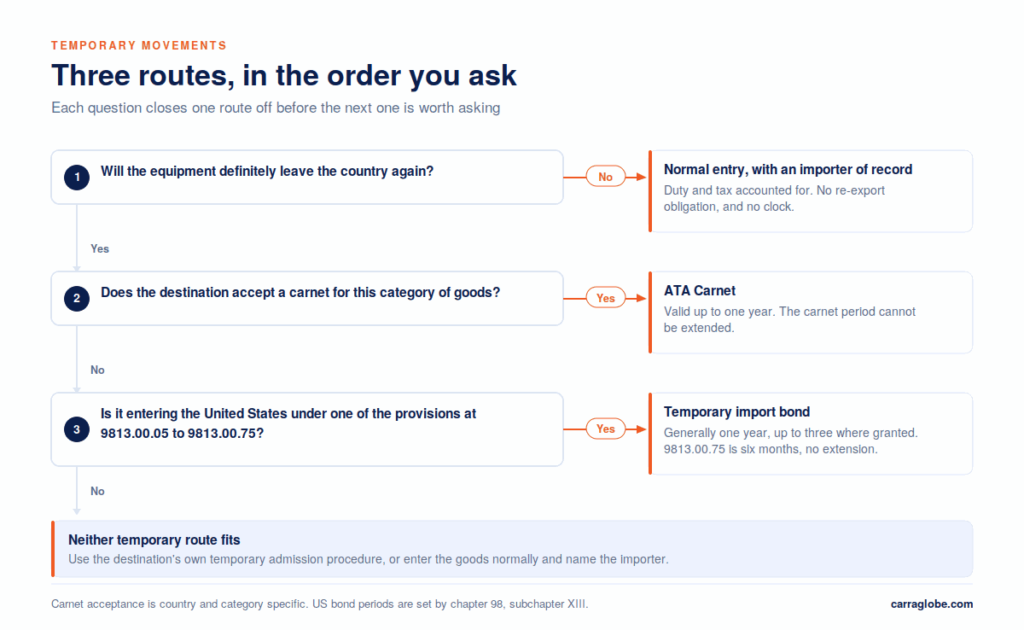
The real question is whether the equipment is coming back. That one decides which routes are open to you at all. The destination, the category of goods and the tariff provisions then decide which of the open ones you can actually use.
Carra Globe provides importer of record and exporter of record services and works with international customs documents, so we have a commercial interest in your answer. What follows is written to be usable whether or not you ever speak to us.
Three routes, and only the normal one is built for a sale
Which should I use for demonstration equipment? A carnet if the destination accepts one for that category of goods and the kit is definitely returning. A US temporary import bond if the goods fall inside one of the fourteen eligible tariff provisions and you need up to three years. A normal entry, with an importer of record, if there is any real chance the equipment is sold, consumed or left behind.
An ATA Carnet is, in CBP’s own description, “an international customs document which allows an individual traveler / business to temporarily export or import goods for commercial purposes to and from a country without having to pay duty or value-added taxes on the goods”. It facilitates the movement. It does not override the destination, which still applies its own rules and still has to accept that category of goods.
Temporary importation under bond is a separate United States mechanism that can serve a similar commercial purpose. It is not the American version of a carnet. It is an entry under chapter 98, subchapter XIII of the tariff schedule, open only to goods that fall inside its own eligibility provisions.
The third route is not a temporary mechanism at all. It is an ordinary import entry, with the applicable duties, taxes and fees handled under the normal import regime and a named importer of record carrying it. People reach for it last and need it more often than they expect.
These are not three interchangeable documents. A carnet is an international temporary admission document. A temporary import bond is a United States entry mechanism. An importer of record is not a procedure at all. It is the party that carries the importer responsibilities on an import entry, and what those amount to depends on the jurisdiction. Comparing them is useful because they answer the same commercial question, not because they are the same kind of thing.
What a carnet covers, and the line it will not cross
A carnet is generally valid for up to one year from issuance, and during that validity the listed merchandise can make repeated temporary movements, subject to each destination’s own admission and stay limits. There are three categories of goods, which are commercial samples, professional equipment, and exhibitions and fairs. Acceptance is country-specific and category-specific, which is the part that catches people out and which we come back to below.
Many technology and engineering items can fall inside these categories. CBP’s own examples of ordinary carnet items name computers, networking devices, tools, audio visual equipment and electronics. A rack of demonstration kit going to a customer site, a test bench going to a trade show, an engineer’s instruments going out and coming back. Each of those can fit the professional equipment or exhibition categories, depending on how the goods are being used.
Goods for sale cannot travel on a carnet. CBP’s guidance says merchandise within those three categories “intended for sale or sale on approval cannot be entered on a carnet, it must be entered as a regular customs entry”. Consumable items, giveaways, disposables and agricultural products are out as well, as are goods for personal use.
Read that against how technology actually sells. A proof of concept that the customer keeps. A loaner that converts to an order. An evaluation unit nobody wants to ship back across an ocean. Each of those is a carnet that has quietly become the wrong document.
If the commercial intention changes after the goods have been admitted temporarily, the fix is not to complete the sale and let the paperwork catch up. Resolve the customs position first, while the temporary admission is still live and the options are still open.
CBP explains the consequence in these terms. If the holder sells, donates or otherwise disposes of goods on a carnet, the national guaranteeing association becomes liable for 110 percent of that country’s import duties and taxes, and then recovers the money from the holder. Where CBP finds fraud in the importation, further penalties follow. The exact figures and procedure sit with the destination’s rules.
Check the country, then check the category
This is where the decision is usually made. Acceptance is often treated as a yes or no by country, when a country can be in the system and still not accept the category your goods fall into. The United States Council for International Business, the national guaranteeing association here, publishes a table that records both.
Counting the entries on its table published in February 2026, one hundred and nine country and territory entries carry an acceptance code. Ninety-two accept all three categories. Seventeen list narrower acceptance. That count is ours, taken from the table rather than stated on it.
A country can accept carnets and not accept your category. Viet Nam, Qatar, the United Arab Emirates, Bahrain and Morocco are listed for exhibitions and fairs only. India, Indonesia and Pakistan take professional equipment and exhibitions but not commercial samples. Thailand takes commercial samples and professional equipment but not exhibitions. A country check on its own is not enough.
Read that against what the goods actually are. A demonstration rack going to a customer site may fall under professional equipment rather than exhibitions and fairs, depending on how it is being used. Taking it to Viet Nam on a carnet is therefore a question about the category first, and the current table lists Viet Nam for exhibitions and fairs only.
Then there are the markets with no entry at all. Nigeria, Kenya, Egypt, Argentina, Colombia, Kuwait, Jordan and Brazil are not listed on USCIB’s current table. For a United States issued carnet, treat that as a reason not to assume the route is available, and check the destination’s current procedure before planning the movement.
Those national procedures vary, and the phrase “temporary import bond” means different things in different places. Our note on temporary import bonds for IT hardware in South Africa works through one national version, which is not the same legal mechanism as a United States bond.
Two things changed in 2026
The carnet is going digital. The global transition to eATA began on 1 June 2026 with a first wave of thirty countries, including every European Union member state, Norway, Switzerland and the United Kingdom.
Under the global framework, holders travelling to those markets are expected to present a digital carnet even where their own issuing country has not implemented it yet. A paper carnet issued before its destination went digital stays valid for its original validity period.
The United States has not completed its own transition, and the interim arrangement is worth knowing because it is a two-document arrangement. USCIB says that while it lasts, a US holder travelling to a digital country carries both a paper and a digital carnet. CBP validates the paper one, and customs inside the digital country uses the digital one only.
Travelling to a country still on paper, the paper carnet is what foreign customs uses, and digital countries keep accepting paper where a digital one cannot be issued for technical reasons. CBP is expected to go digital-only once it transitions, tentatively before the end of 2026, so check USCIB’s current instruction for the specific carnet.
Separately, from 1 October 2026 USCIB began offering direct carnet applications through its own website, alongside its authorised service providers. For anyone planning a movement this quarter, the practical point is that the issuing channel and the document format are both now things to confirm rather than assume.
What a temporary import bond buys, and what it costs
Start with eligibility, because duration is the second question and most coverage leads with it. A temporary import bond is not available simply because a carnet is not. The goods have to fall inside one of the fourteen tariff provisions at subheadings 9813.00.05 through 9813.00.75, which cover things like articles for repair or processing, samples for taking orders, articles for testing, and professional equipment and tools of trade.
If the goods qualify, the bond buys time. The general period is one year, with extensions available under the applicable rules so the total does not exceed three years, which 19 CFR 10.37 expresses as “not more than two further periods of 1 year each”.
The ceiling is not uniform across the fourteen provisions. Articles entered under 9813.00.75, automobiles and bodies imported solely for show purposes, get six months, and the schedule says that period “shall not be extended”. Check the limit against the provision the goods actually enter under rather than assuming three years. On the carnet side 19 CFR 10.37 closes the door entirely, stating that “No extension of the period for which a carnet is valid shall be granted”.
Then there is the cost. 19 CFR 10.31 does not set one number. It sets three, and which one applies turns on the tariff provision, and in one case on who is importing and where the goods originate.
- Double the duties and fees. The general rule, in an amount equal to double what would have accrued on an ordinary consumption entry, or more where CBP states in writing that the revenue needs protecting.
- 110 percent of the estimated duties and fees. For samples solely for use in taking orders under 9813.00.20, motion picture advertising films under 9813.00.25, and professional equipment, tools of trade and repair components for them under 9813.00.50.
- No bond or other security, in specified cases only. Professional equipment, press and broadcasting equipment, cinematographic equipment, articles for sports purposes and articles intended for display or demonstration can qualify, but two conditions apply together. The importer must be a national of Canada or Mexico, or a resident of one of the sixteen agreement partners named in 19 CFR 10.31(f), among them Singapore, Korea, Australia and Chile. And the goods must be originating goods of that country under the HTSUS General Notes the provision cites.
Anyone quoting a temporary movement on the assumption of a double bond may therefore be pricing the wrong number.
The bond amount is not the bond cost. The regulation fixes the amount of security. What you actually pay can include a surety premium on that amount, brokerage, any collateral the surety wants and the usual filing charges. Compare those against the duty on a normal entry, not the bond figure against the duty.
The extension has a deadline behind the deadline. An extension is applied for on CBP form 3173, and the regulation accepts it only where the articles have not already been exported or destroyed and liquidated damages have not already been assessed under the bond. Realise late that you need another year and the extension mechanism may no longer be available to you.
The three routes side by side
| ATA Carnet | Temporary import bond | Normal entry with an importer of record | |
|---|---|---|---|
| Goods must leave again | Yes, re-export | Yes, export or permitted destruction | No |
| How long | Generally up to one year, subject to the destination’s stay limits, and the carnet period cannot be extended | Generally one year, extendable by up to two further one-year periods where granted, to a three year total; 9813.00.75 is six months with no extension | No temporary admission deadline, the goods are imported |
| What qualifies | The three carnet categories, where the destination accepts that category | Only goods inside the fourteen provisions at 9813.00.05 to 9813.00.75 | Goods admissible under the normal import rules |
| Security | Guarantee through the issuing association | Nil, 110 percent or double the duties and fees, depending on the provision. Where a surety bond is required, surety and brokerage costs may apply on top | Applicable duties, taxes and fees under the normal regime |
| Goods intended for sale | Not permitted | Not permitted under the TIB eligibility rules | This is the route for it |
| Consumables and giveaways | Not permitted | Depends on the provision, and many will not qualify | Normal entry |
| Where it works | Participating countries and territories only | Entry into the United States | Markets where the goods are admissible and a compliant entry structure is available |
| If the goods stay | The guaranteeing chain is called for duties and taxes, and recovers from the holder | Liquidated damages and other consequences under the bond | No temporary admission default, the goods were entered for ordinary import |
When the honest answer is to import it properly
Temporary routes avoid ordinary duty exposure where their conditions are met, and a carnet can give duty and tax free admission where the destination accepts it. That is not the same as cheaper, because a carnet carries fees and a guarantee and a bond carries surety and brokerage.
They get expensive when they do not fit. The cost then is duties, liquidated damages, penalties and extra customs work rather than the duty you expected.
Five situations make the temporary route the wrong starting point.
- The evaluation is really a sale with a trial period. If the commercial intention is that the customer keeps it, a carnet is not available and a bond is a detour to the same destination.
- The destination will not take a carnet for this category. The country may be in the system and still refuse the category your goods fall into, so the check has to cover both the country and the category.
- Consumables and spares are travelling with the kit. Consumables, giveaways and disposables are excluded from carnet treatment, and spare parts need their own eligibility check rather than riding along by default.
- The deployment may outlast the clock. Where the stay could exceed the carnet validity or the destination’s permitted period, the extension or regularisation route has to be settled before the deadline, not after it.
- Nobody has decided who closes it out. A carnet or a US bond needs a named party responsible for discharging the admission, normally by re-export or destruction, with the records to prove it.
In each of those, naming an importer of record and entering the goods normally is not the fallback. It is the correct first answer, and the distinction between an importer that exists on paper and one that can actually carry an entry is set out in paper IOR versus operational IOR.
That route carries real obligations rather than just a duty payment. Depending on the jurisdiction, the importer of record is responsible for the declaration, for the applicable duties, taxes and fees, for the records, and for the product, licensing and registration requirements that apply to the goods in that market. If the equipment is exported later, that is a fresh export transaction, not the discharge of a carnet or a bond.
Where the goods genuinely are coming back, the reverse leg has its own requirements, covered in our notes on returned goods and reverse logistics and on exporting equipment for repair.
What to settle before the equipment ships
- Ask what happens if the customer says yes. If the honest answer is that the kit stays, decide that now rather than at the end of a carnet year.
- Check the destination against the list, not against a memory of it. Participation is per country and per category, and some countries accept only some of the three categories.
- Separate the consumables from the equipment. Cables, media, giveaways and spares frequently need a different route from the hardware they accompany.
- Name the party responsible for re-export. Including who holds the documents and who files the extension if the project slips.
- Price the applicable security, not a rule of thumb. Work out which bond tier the goods fall into, add surety and brokerage, and compare that with the duty and tax on a normal entry. The cost you avoid today can arrive later with a penalty attached.
How Carra Globe works with this
We provide importer of record and exporter of record services for technology hardware across 175+ countries, alongside DDP customs clearance, warehousing and delivery to site.
International customs documents are a large part of that work, so the first thing we do with a temporary movement is tell you honestly which of the three routes the destination and the commercial intention actually allow. Sometimes that answer is a carnet, and we will say so.
Four things let us look at a movement. We need the destination and the goods with model numbers, how long the equipment is staying, whether there is any prospect of it being sold or left behind, and who is expected to get it out again.
Carra Globe works through importer-side registrations and local importing structures appropriate to the goods and destinations we accept, our own in some markets and established local structures in others.
Before a movement is committed we identify which licences, certifications and approvals apply to your goods in that market. Where one of them falls outside the structure available for that lane, we say so before a delivery date is agreed rather than after the goods land. That applies whether this is a first shipment into a new country or one leg of a longer programme.
Temporary Movements · Carnets, Bonds and Normal Entry
Tell us where it is going and whether it is coming back.
Being clear about the boundary. We are not trying to talk you out of a carnet, and where the destination accepts one for your category of goods it is usually the cleanest route. What we can do before anything ships is work out which of the three routes the destination, the goods and the commercial intention actually allow, what the period and the security would be, and who would be responsible for closing the movement out at the other end.
- Importer of record services
- Exporter of record services
- Temporary import bonds in South Africa
- Paper IOR vs operational IOR
- Returned goods and reverse logistics
- Exporting equipment for repair
- Emergency spare parts clearance
- Multi-country deployment
- First shipment into a new country
- DDP customs clearance worldwide
- IOR by country
- IT hardware import rules by country
- Freight forwarding services
- White glove delivery to site
- Global warehouse and logistics
Free tools HS Code Finder Volumetric Weight Calculator Pallet Calculator
Demo kit, a proof of concept or loan equipment going out? Send the destination, the goods with model numbers and how long they are staying. We will tell you whether a carnet covers that category there, whether a bond is available and what it would secure, and what changes if the customer decides to keep it.
Check my temporary movementFrequently asked questions
Can you use an ATA Carnet for goods that will be sold?
No. CBP states that merchandise intended for sale or sale on approval cannot go on a carnet and must be entered as a regular customs entry, with the applicable importer of record responsible for it.
How long does a temporary import bond last?
Generally one year, extendable by up to two further one-year periods to a three year total, subject to the provision the goods enter under. Articles under 9813.00.75 get six months with no extension.
Which countries do not accept ATA Carnets?
Brazil, Nigeria, Kenya, Egypt, Argentina, Colombia, Kuwait and Jordan are not on USCIB’s current table. That does not mean no temporary admission procedure exists there, so check the destination’s own rules.
What does a temporary import bond cost?
It depends on the provision. The general rule is double the duties and fees. Professional equipment and tools of trade under 9813.00.50 carry 110 percent, and some originating goods from agreement partners need none.
What happens if equipment on a carnet is not re-exported?
Under CBP’s framework the national guaranteeing association pays 110 percent of that country’s duties and import taxes, then recovers from the holder. Destination procedures can differ, and fraud brings further penalties.
Can consumables and spares travel on a carnet?
Consumables, giveaways and disposables are excluded from carnet treatment. Spare parts are a separate question and need their own eligibility check, because it depends on the goods, their purpose and the category.
Adjacent ground: emergency spare parts clearance, multi-country deployment and IT hardware import rules by country.
Sources and verification
- The carnet rules: CBP’s ATA Carnet frequently asked questions, for the description of the carnet as “an international customs document”, the one year validity, the three categories of goods, the examples naming computers and networking devices, the exclusion of goods “intended for sale or sale on approval”, the exclusion of consumables, giveaways and disposables, and the 110 percent liability of the national guaranteeing association.
- Which countries and which categories: the ATA Carnet countries table published by the United States Council for International Business, the national guaranteeing and issuing association for the United States, published 6 February 2026 and read on 5 October 2026. The acceptance codes and the counts in this article are taken from that table.
- Digital carnets: USCIB’s update on the global transition to eATA, for the 1 June 2026 start and the first wave of thirty countries, together with USCIB’s eATA questions updated through September 2026, and its eATA question on whether the UK, EU and others process both digital and paper US carnets, for the two-document interim arrangement, for customs inside digital countries using the digital carnet only, and for CBP validating paper until it transitions, tentatively before the end of 2026. Its question on paper carnets issued before a destination went digital confirms those remain valid for their original validity period.
- Issuance: USCIB’s announcement of 1 October 2026, for direct issuance through its own website alongside its authorised service providers.
- The bond: 19 CFR 10.31(f), for the general bond “in an amount equal to double the duties and fees”, for the 110 percent bond on samples under 9813.00.20, advertising films under 9813.00.25 and “professional equipment, tools of trade and repair components for such equipment or tools entered under subheading 9813.00.50”, and for the cases in which “no bond or other security will be required”.
- The period: the Harmonized Tariff Schedule, chapter 98, subchapter XIII, US Note 1, for admission under bond for export within one year, extendable so the total does not exceed three years, and for articles under 9813.00.75 being admitted for six months with that period not extendable.
- The extension: 19 CFR 10.37, for extension “for not more than two further periods of 1 year each”, for application on CBP form 3173 before exportation, destruction or assessment of liquidated damages, and for the rule that “No extension of the period for which a carnet is valid shall be granted”.
- Verification note. Checked on 5 October 2026. Two qualifications. Carnet participation and category acceptance change, and USCIB’s table is dated 6 February 2026, so the counts above move with it and the destination and category should be confirmed against the current table before a movement is promised to a customer. And the bond, eligibility and extension rules cited here are United States rules under chapter 98, subchapter XIII, and every other market sets its own temporary admission procedure, security and time limit, and a “temporary import bond” elsewhere is a different legal mechanism.
Disclaimer: This guide is for informational purposes only and does not constitute legal, customs or trade compliance advice. The right route depends on the goods, the destination and the commercial intention behind the movement, and the position described is as at 6 October 2026. Confirm the current position with the competent authority or a qualified adviser before acting.