
A failed server goes back to the manufacturer for a board-level repair. A medical imaging unit returns to its maker for recalibration. A telecoms card is sent across a border under warranty. In each case the equipment leaves, gets fixed, and comes back, and in each case the same expensive mistake is waiting at the return leg. The business assumes it will pay duty on the repair. It pays duty on the entire machine instead, because of a decision that was made, or missed, before the equipment ever left the country.
In brief:
- The relief is arranged at export, not at re-import. Every major market lets you pay duty on the repair rather than the whole machine, but almost all of them require the paperwork before the equipment leaves.
- Outward processing, not returned goods relief. Repaired goods have been processed, so returned goods relief does not apply to them.
- Get it wrong and you pay on full value. Miss the export step and the returning equipment is assessed as an ordinary import at its full worth.
- Duty and tax are separate questions, and in India the tax position is still being decided by the courts.
This is the half of reverse logistics that the reverse logistics conversation skips. Bringing goods back in for repair, returns and recalls is one problem, and we cover it in our guide to reverse logistics compliance. Sending your own equipment out for repair is the mirror image, with a different set of reliefs, and those reliefs share an unforgiving feature: almost all of them have to be arranged at export. Get the export leg wrong and there is no clean way to fix it when the repaired unit lands.
Why Repair Returns Are Treated as an Import at All
You would think your own equipment coming home should not count as an import. It left, it is the same machine, nothing changed hands. Customs does not see it that way. It sees goods crossing a border, and that is an importation unless a specific relief says otherwise.
The reliefs exist to close exactly that gap. Every major customs system has a mechanism that says, in effect, this equipment left, it was only repaired, so charge duty on the repair rather than on the returning machine as if it were new. The mechanisms have different names in different places, but they answer the same question, and they impose the same discipline: you have to tell customs, before the equipment leaves, that this is what you are doing.
Miss that step and the fallback is not a smaller problem. The returning equipment is assessed as an ordinary import. On a machine worth several hundred thousand dollars, the difference between duty on a repair invoice and duty on the full replacement value is the difference between a rounding error and a five-figure bill. It is the same principle that runs through any serious effort to reduce import duty: the saving is designed in before the goods move, not recovered after.
The United States: Two Tariff Lines and a Declaration From the Repairer
Goods sent abroad for repair and returned to the United States are handled under two subheadings of the Harmonized Tariff Schedule. Subheading 9802.00.40 covers articles repaired or altered under warranty. Subheading 9802.00.50 covers articles repaired or altered not under warranty. In both cases, duty is assessed only on the value of the repair, not on the value of the returning article.
According to 19 CFR 10.8(a), the governing regulation is specific about the evidence. Two declarations are required at entry. The first is from the person who actually performed the repair abroad, confirming that the articles received were the same ones exported and were received solely for repair or alteration. The second is from the owner, importer or agent in the United States, confirming that the returning articles are the same ones exported and were sent without benefit of drawback. Under 19 CFR 10.8(d), customs takes a deposit of estimated duty at entry based on the cost of the repair, and under 10.8(b) can demand further proof of the original export, a foreign customs entry, a landing certificate, a bill of lading, before it is satisfied.
One detail in the regulation is easy to miss and worth money. The dutiable value of the repair excludes the value of any US-origin engineering, plans, tooling or components that the American party supplied for the repair. If you ship a failed unit abroad along with a US-made replacement part and the engineering to fit it, that US content does not enter the dutiable base. Only the work performed abroad does.
Trade agreements then remove even the repair duty in several corridors. Under the United States-Mexico-Canada Agreement, goods returned after repair or alteration in Mexico enter free whether or not the repair was under warranty, and goods returned after warranty repair in Canada enter free as well. Free trade agreements with partners including Singapore and Korea provide duty-free treatment under 9802.00.50. The corridor matters as much as the tariff line.
The European Union: Outward Processing, and the Relief That Depends on Why the Repair Was Free
The EU mechanism is the Outward Processing procedure, set out in Articles 259 to 262 of the Union Customs Code, Regulation (EU) No 952/2013. Goods are exported from the customs territory, processed or repaired outside it, and re-imported with relief on the returning value. It is not the same thing as Returned Goods Relief, and confusing the two is the single most common error in this area. Returned Goods Relief is for goods that come back unchanged. The moment a good is repaired, it has been processed, and it belongs under Outward Processing instead. Claiming the wrong one can forfeit the relief entirely.
Outward Processing requires an authorisation, and the export is declared under the procedure that puts the goods into the regime rather than as a plain permanent export. That authorisation is the export-leg discipline the whole article keeps returning to. Without it, the goods leave as an ordinary export and return as an ordinary import.
How much duty is then relieved depends on a distinction that catches people out. Under Article 260 of the Union Customs Code, where the goods are repaired free of charge, because of a warranty obligation or a manufacturing defect, and this can be established to customs, total relief applies and no duty is due on the return. Where the repair is not free, duty is charged, but only on the cost of the processing operation carried out abroad, calculated under the Code’s specific rules rather than on the full value of the machine. So a warranty repair and a paid repair on identical equipment can produce different customs outcomes, and the evidence for which one applies has to travel with the shipment.
There is also a 2026 wrinkle that did not exist a few years ago. The EU Carbon Border Adjustment Mechanism reaches certain steel and aluminium goods, and outward processing does not automatically sit outside it. For equipment with significant steel or aluminium content going out for repair, CBAM obligations are now part of the analysis rather than a separate concern.
The United Kingdom: Where Returned Goods Relief Stops and Outward Processing Starts
The UK inherited the same structure and it deserves stating plainly, because UK guidance makes the boundary explicit. To qualify for Returned Goods Relief, goods must not have been exported in order to be repaired or processed. If repair was the reason for export, Returned Goods Relief does not apply, and the correct route is Outward Processing. A business that exports a unit for repair and then tries to bring it back under Returned Goods Relief has used the wrong mechanism and can lose the relief.
For a UK business sending equipment to the EU, there is a route that removes the advance-authorisation burden. Under the goods provisions of the UK-EU Trade and Cooperation Agreement, and reflected in the Union Customs Code by the article covering repairs under international agreements, goods can be exported for repair and returned without a full outward processing authorisation, with duty and import VAT relieved. It is one of the few places where the paperwork is genuinely lighter, and it applies specifically to the UK-EU corridor.
One further UK point separates duty from tax, and it recurs across every market in this guide. Import VAT relief on returned goods generally requires that the same legal entity exported and re-imported the equipment. Where a different entity brings the repaired unit back, the customs duty may still be relieved while import VAT becomes payable, unless the right to relief is formally transferred. On high-value equipment, the VAT alone can be the larger number, so who is named on each leg is not an administrative detail.
India: Notification 45/2017, the Benefits You Must Give Back, and a Tax Question the Courts Are Still Settling
India relieves re-imported repaired goods under Notification 45/2017-Customs. Duty is charged on the fair cost of the repairs plus insurance and freight, rather than on the full value of the returning equipment. The goods must be re-imported within three years of export, a period that can be extended to five years but not automatically and not without asking.
There is a precondition that surprises exporters. Any export incentive claimed when the equipment first left, drawback, an IGST refund, RoDTEP, or benefits under the EPCG scheme, generally has to be reversed before the repaired goods can come back under the concessional route. The relief on the return is not free-standing. It assumes you have unwound the benefit you took on the way out, and reconciling that is part of planning the repair, not an afterthought at re-import.
Then there is the live question. Notification 45/2017 originally limited the charge to basic customs duty. In 2021, Notification 36/2021 and an accompanying circular sought to add integrated tax, IGST, and cess on the repair value. That triggered years of litigation, almost all of it brought by the airlines over re-imported aircraft and parts. In its 2025 InterGlobe Aviation ruling, the Delhi High Court held Notification 36/2021 unconstitutional insofar as it imposed an additional levy over the IGST already charged on the repair as a service. In July 2025 the Supreme Court dismissed the customs department’s attempt to apply the change retrospectively, with the bench observing that a retrospective levy cannot be enforced through a clarification. The retrospective demand is therefore closed. The broader doctrinal question of prospective IGST on repair value has been decided against the department at High Court level, though a separate long-running government appeal remained pending before the Supreme Court, and the settled body of case law is specific to aircraft rather than to equipment generally, which matters for anyone moving aerospace and defence hardware on the same assumption. The direction of travel is clear. The final word, for goods other than aircraft, is not yet written, and anyone planning a repair re-import into India should treat the tax position as live rather than assume the airline outcome transfers automatically.
The Gulf: Temporary Admission and a Deposit You Get Back
The United Arab Emirates, and the GCC customs framework it sits within, handles equipment sent out and brought back through temporary admission and re-export procedures rather than through a repair-specific tariff line. Machinery and equipment can be imported for repair operations and re-exported, and equipment sent out temporarily can return, with customs duty relieved where the procedure is followed and the documentation matches.
The distinctive feature here is cash. Rather than assessing duty on a repair value, the authorities typically take a deposit or bank guarantee equal to the full duty on the equipment, and refund or release it on proof that the goods were re-exported within the permitted window, commonly six months. The duty may end up at zero, but the working capital is tied up in the meantime, and it is released only against documentation that reconciles exactly to the original movement. An ATA Carnet, where applicable, removes the deposit requirement altogether. The planning question in the Gulf is less about the eventual duty and more about the guarantee and the deadline.
The Five Regimes at a Glance
| Market | Mechanism | Duty is charged on | Arranged at export? |
|---|---|---|---|
| United States | HTSUS 9802.00.40 and 9802.00.50 | The repair value, US-supplied content excluded | Yes, two declarations |
| European Union | Outward Processing, UCC Arts 259 to 262 | The processing value, or nothing if repair is free of charge | Yes, authorisation required |
| United Kingdom | Outward Processing, not Returned Goods Relief | The processing value, lighter route for the EU corridor | Yes |
| India | Notification 45/2017-Customs | Fair cost of repair, insurance and freight, IGST position live | Yes, incentives reversed first |
| Gulf (UAE / GCC) | Temporary admission and re-export | Nothing if re-exported in time, full-value deposit held meanwhile | Yes, deposit and deadline set |
The Pattern: Every Regime Is Decided at the Door Marked Export
Put the five systems side by side and the differences that first seem important turn out not to be. The tariff lines differ. The names differ. The free-repair rules differ. What they share is the one thing that decides the bill.
- United States: the repairer’s declaration and the exporter’s declaration under 9802, with duty on the repair value and US-supplied content excluded.
- European Union: an Outward Processing authorisation and the correct export procedure, with total relief only where the repair is provably free of charge.
- United Kingdom: Outward Processing rather than Returned Goods Relief for anything repaired, with a lighter route specifically for the EU corridor.
- India: Notification 45/2017, export incentives reversed first, re-import inside three years, and a tax position still moving through the courts.
- Gulf: temporary admission with a full-value deposit refunded on timely, exactly-matched re-export.
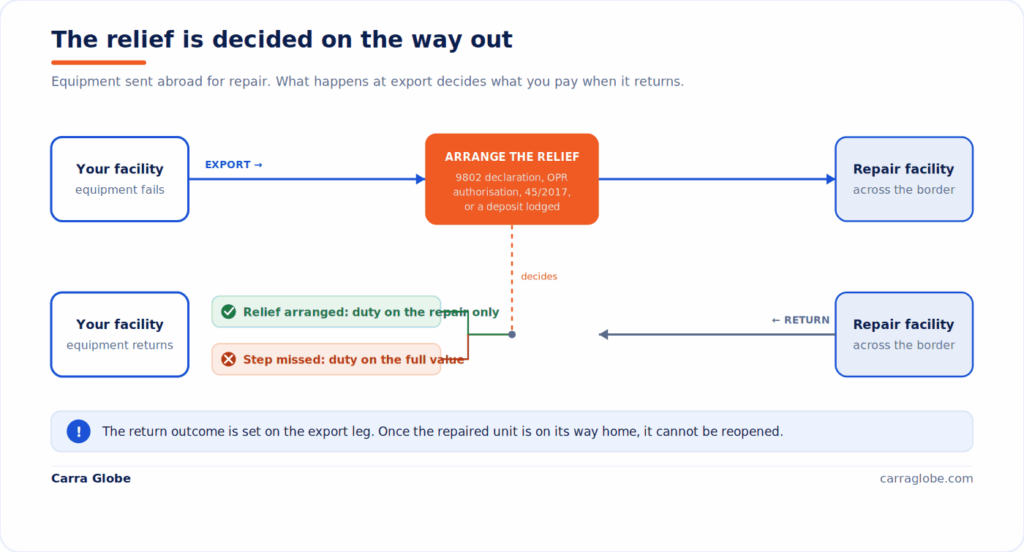
In four of the five, the relief is arranged before the equipment leaves. In the fifth, the deposit and the deadline are set at export too. There is no regime in this list where you can ship first, think about the customs treatment later, and still be sure of the relief. The decision that determines whether you pay tax on a repair invoice or on a replacement-value machine is made at the door marked export, and it cannot be reopened once the repaired unit is on its way home.
This is also why repair returns need both halves of the compliance structure working together. The equipment has to leave correctly, which is an exporter of record question, and it has to return correctly, which is an importer of record question in whichever country the repair depot sits, and the two legs have to be linked by documentation that customs on the return can tie back to the original export. In our experience the linkage is where this most often goes wrong: when one leg is handled by a party who never sees the other, the thread that customs needs on the return is already broken, and the relief goes with it.
Sending equipment across a border for repair, warranty work, or recalibration? The relief that keeps duty on the repair rather than the whole machine is arranged before the equipment leaves, and it depends on the export and the return being linked. Carra Globe acts as both exporter of record and importer of record across 175+ countries, and structures the repair movement so the relief holds at re-import instead of collapsing into a full-value assessment.
What to Settle Before the Equipment Ships
- Identify the relief in the destination and the return market before booking anything. Confirm whether the return runs under 9802, Outward Processing, Notification 45/2017, temporary admission, or an agreement-specific route, because each one dictates what has to happen at export.
- Establish whether the repair is under warranty or paid, and get evidence of it. In the EU that distinction decides between total relief and duty on the processing value. In the US it decides which subheading applies. The proof has to travel with the goods.
- Reverse any export incentives first where the destination requires it. India in particular expects drawback, IGST refunds, RoDTEP or EPCG benefits to be unwound before the concessional re-import, and that reconciliation takes time.
- Fix the identity on both legs. Import VAT and duty relief frequently require the same entity to export and re-import. Decide who is named before shipping, not after the repaired unit arrives.
- Plan the deposit and the deadline in the Gulf and other temporary-admission markets. Budget for a full-value guarantee to be tied up, and diarise the re-export window, because the refund depends on both the timing and an exact documentary match.
- Keep the export and return documentation linked. Whatever the regime, customs on the return has to connect the repaired unit to the original export. That linkage is the relief. Protect it.
Frequently Asked Questions
Do I pay duty on the whole machine or just the repair when equipment comes back?
Just the repair, but only if the correct relief was arranged at export. If it was not, customs can assess the returning equipment as an ordinary import at full value.
The reliefs that limit duty to the repair value almost all require action before the goods leave, which is why the export leg decides the outcome.
Is Returned Goods Relief the right procedure for equipment sent abroad for repair?
No. Returned Goods Relief is for goods that return unchanged. Repaired goods have been processed and fall under Outward Processing instead. Using Returned Goods Relief for a repair can forfeit the relief.
This is the most common mistake in repair returns, because the two reliefs sound interchangeable and are not.
What happens if I ship the equipment for repair without arranging the relief first?
The repaired equipment is generally treated as a normal importation on return, with duty and import tax assessed on its full value rather than on the repair, and the relief usually cannot be applied retrospectively.
On high-value equipment this converts a small repair-based charge into a full-value one, which is the core risk this whole area carries.
Does the same company have to export and re-import the equipment?
Often, yes, for tax relief in particular. Import VAT relief commonly requires the same legal entity on both legs, and where a different entity re-imports, the VAT can become payable even if the duty is relieved.
The right to relief can sometimes be transferred formally, but it should be arranged deliberately rather than discovered at re-import.
What is outward processing relief?
It is a customs procedure that lets goods be exported for repair or processing and re-imported with duty charged only on the value of the work done abroad, not on the full value of the returning goods.
It requires an authorisation and the correct export declaration, so it has to be set up before the goods leave.
How long can goods stay abroad for repair before re-import?
It varies by market. India sets three years, extendable to five on request. The Gulf commonly allows six months under temporary admission. The EU sets a period in the authorisation itself.
Missing the window can forfeit the relief or trigger the full deposit, so the deadline belongs in the plan from the outset.
What happens if I miss the re-export or re-import deadline?
The relief can be lost. In temporary-admission markets the deposit is forfeited or the full duty falls due, and under procedures like Outward Processing a lapsed period can mean the return is assessed as an ordinary import.
Extensions often exist but are rarely automatic, so a slipping repair timeline needs to be raised with customs before the deadline, not after.
What is the difference between HTSUS 9802.00.40 and 9802.00.50?
Both limit US duty to the value of the repair. 9802.00.40 covers articles repaired or altered under warranty, and 9802.00.50 covers articles repaired or altered not under warranty.
The warranty status also affects duty-free treatment under some trade agreements, so it is worth establishing before export.
Is IGST payable when repaired equipment is re-imported into India?
The position is being settled by the courts. A retrospective demand was struck down by the Supreme Court in 2025, and the additional IGST levy was held unconstitutional at High Court level, in litigation concerning aircraft.
Because the settled cases involve aircraft, anyone re-importing other repaired equipment into India should treat the IGST position as live and take current advice.