
Update, 28 July 2026: Much has happened since the ruling. The IEEPA tariffs were struck down on 20 February 2026 and replaced the same week by a 10% Section 122 surcharge, which itself expired on 24 July and was replaced by a Section 301 forced-labour action. The refund process has moved from an open question into a live administrative system, CAPE, now running in three phases, with a hard catch on finally liquidated entries. This guide reflects all of that.
On 20 February 2026, the US Supreme Court struck down the IEEPA tariffs in a 6-3 decision that stands as one of the most consequential trade rulings in a generation. In Learning Resources, Inc. v. Trump, consolidated with Trump v. V.O.S. Selections, the Court held that the International Emergency Economic Powers Act does not authorise the President to impose tariffs. Every tariff imposed under IEEPA since February 2025 was rendered legally void. What followed, the replacement surcharge, the refund machinery, and the compliance obligations that never went away, is what actually matters for importers now, and this guide walks through all of it.
The IEEPA Ruling: At a Glance
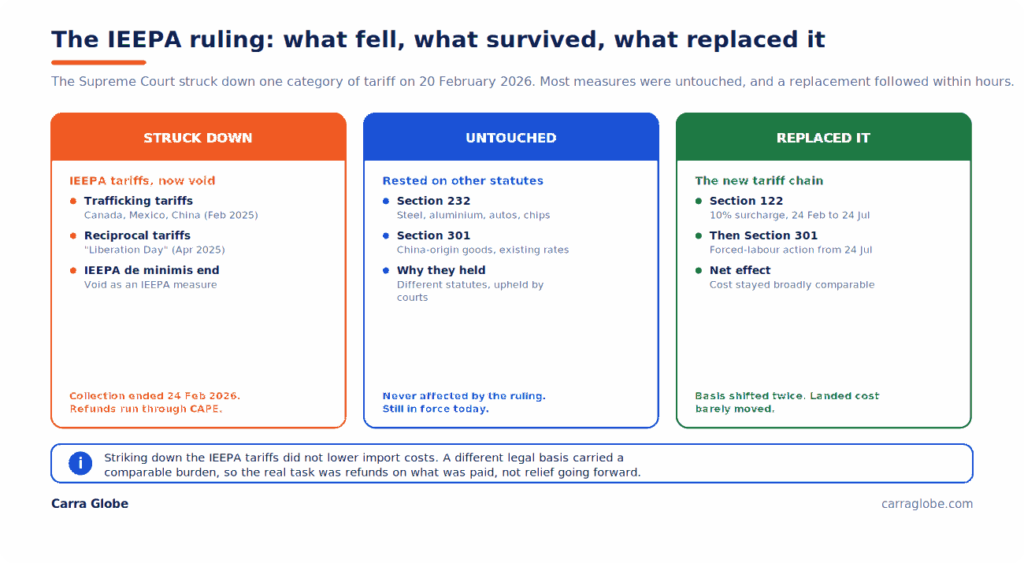
- What the Court held: IEEPA does not authorise tariffs. The tariffs imposed under it since February 2025 are void.
- What it did not touch: Section 232 and Section 301 tariffs, which rest on different statutes, remain fully in force.
- What replaced it: a 10% Section 122 surcharge from 24 February, then a Section 301 forced-labour action from 24 July.
- Refunds: processed through CBP’s CAPE system, now in three phases, not automatic, and with a catch on finally liquidated entries.
- What did not change: every formal US import still needs a named importer of record. The ruling changed the tariff basis, not the entry requirement.
What the Court Actually Held
The case asked one question: does IEEPA give the President authority to impose tariffs? The Court answered no. IEEPA lets the President “regulate importation,” but the Court held that regulating importation is not the same as taxing it, and that when Congress delegates tariff power it does so in explicit terms that IEEPA does not contain. Chief Justice Roberts delivered the opinion of the Court.
The vote was 6-3 on the result, but the reasoning split. The portion resting on the major questions doctrine, which requires clear congressional authorisation for decisions of vast economic significance, was joined only by Justices Gorsuch and Barrett, making it a three-justice plurality rather than a majority rationale. Justice Kagan, joined by Sotomayor and Jackson, concurred in the judgment but reached it through ordinary statutory interpretation rather than the major questions framing. Justices Thomas, Kavanaugh, and Alito dissented, with Kavanaugh writing that historical practice and the ordinary meaning of “regulate” supported the President’s authority. The official opinion is on the Supreme Court website.
A procedural point worth noting, because it is widely misstated: the tariffs fell through the consolidated V.O.S. Selections case, where the Court affirmed the Court of International Trade’s ruling against them. The Learning Resources matter itself was found to belong in the CIT’s exclusive jurisdiction and was dismissed on that basis. The practical outcome was the same, the IEEPA tariffs were struck down, but the vehicle was the CIT-affirmed case.
Two sets of tariffs fell as a result: the trafficking tariffs on Canada, Mexico, and China from February 2025, and the reciprocal “Liberation Day” tariffs on most other countries from April 2025. CBP stopped collecting both at the end of 23 February 2026.
Which Tariffs Fell, and Which Ones Did Not
This is the most misunderstood part of the ruling. Striking down the IEEPA tariffs did not eliminate US tariffs. It eliminated the IEEPA-based ones specifically, and the administration moved within hours to replace them. A large body of trade measures was never affected.
| Tariff | Legal authority | Status |
|---|---|---|
| Trafficking tariffs (Canada, Mexico, China) | IEEPA | Void. Collection ended 24 February 2026. |
| Reciprocal “Liberation Day” tariffs | IEEPA | Void. Collection ended 24 February 2026. |
| IEEPA-based de minimis termination | IEEPA | Void as an IEEPA measure. |
| 10% global surcharge | Section 122, Trade Act 1974 | In force 24 February to 24 July 2026, now expired. |
| Steel, aluminium, autos, semiconductors | Section 232, Trade Expansion Act 1962 | Fully in force. Unaffected by the ruling. |
| China-origin goods | Section 301, Trade Act 1974 | Fully in force. Unaffected by the ruling. |
Section 232 tariffs cover steel, aluminium, copper, automobiles and parts, semiconductors, and lumber, and rest on the Trade Expansion Act of 1962, which courts have consistently upheld. Section 301 tariffs on Chinese-origin goods remained at their existing rates throughout. For the full picture of what replaced the IEEPA tariffs and how those measures have since evolved, see our guides to the Section 122 tariff and the Section 301 tariffs for 2026.
What Replaced the IEEPA Tariffs
The replacement came in two stages, and understanding the sequence matters because it explains why importers saw little relief in landed cost despite the tariffs being struck down.
Within hours of the ruling, a 10% Section 122 surcharge was imposed on imports from all countries, taking effect on 24 February with no gap in collection. Section 122 is a temporary tool, capped at 150 days by statute, and it duly expired on 24 July 2026. Products already subject to Section 232 were exempt from it, to avoid double-stacking, so for steel or aluminium only the Section 232 rate applied, while for Chinese IT hardware already carrying 25% Section 301, the surcharge stacked to an effective rate of roughly 35%.
When Section 122 expired, it was replaced in turn by a Section 301 forced-labour action, effective 24 July at 10% or 12.5% on products of 60 economies, again with Section 232 and USMCA-qualifying goods exempt. So the tariff basis has now shifted twice since the IEEPA ruling: from IEEPA, to Section 122, to Section 301. The through-line is that each replacement has kept overall import costs broadly comparable, exactly as the Treasury signalled it intended.
The tariff basis has changed three times in five months. Is your landed cost keeping up? Carra Globe reclassifies and reprices as each measure changes, acts as importer of record on your entries, and manages the IEEPA refund claim for entries we handled. We operate across 175+ countries.
Where the IEEPA Refund Stands Now
Roughly USD 166 billion in IEEPA duties was collected from about 330,000 importers across more than 53 million entries between February 2025 and February 2026. The Supreme Court declared the tariffs unlawful but did not order refunds or specify how recovery should work, and Justice Kavanaugh’s dissent warned the refund process would be a mess. That has proven accurate.
The Court of International Trade had ruled the tariffs invalid, and on remand the proceedings directed CBP toward refunding duties already collected. To handle the scale, CBP built a dedicated tool, the Consolidated Administration and Processing of Entries (CAPE) system within ACE, which went live on 20 April 2026. CAPE now runs in three phases: Phase 1 for entries not yet finally liquidated, Phase 2 adding certain reconciliation-flagged entries, and Phase 3 for finally liquidated entries. It is not automatic: the importer or broker must file a CAPE Declaration, with active ACE credentials and ACH banking on file.
The critical development, and the one most importers have not registered, is that Phase 3 has been gated by the courts. For entries that finally liquidated, the CIT has so far directed reliquidation only for the roughly 3,700 plaintiffs who filed suit. Importers who never filed at the CIT face real risk of permanent loss on those entries, and the government is appealing even the plaintiff refunds. If a material share of your IEEPA duties sits in finally liquidated entries, this is urgent. Our full guide to the IEEPA tariff refund CAPE portal sets out the phases, the filing steps, and the catch in detail.
Why the Refund Question Is Really a Structure Question
The refund process has worked like an X-ray for import structures. Because CBP refunds only the importer of record named on each entry, companies that used a qualified IOR with their own entity on the entry can file directly. Companies that relied on supplier-managed shipping, informal fulfilment arrangements, or broker-nominated IOR structures cannot, because they are not on the entry.
The lesson runs beyond refunds. The same entry structure that decides refund eligibility also decides who bears liability in a customs audit, who controls the compliance record over its retention period, and who holds negotiating power when duties are disputed. In each case the answer is the importer of record on the entry.
This is why fulfilment providers are not a substitute: major 3PLs operate on execution-only contracts, do not assume importer liability, and do not register as IOR, so a business that leaned on one during 2025 is likely not the named IOR and has no direct path to a refund. For the distinction in full, see our explainer on what an Importer of Record is.
What the Ruling Did Not Change: The IOR Requirement
The ruling changed which tariffs apply. It did not remove the legal requirement for a named importer of record on every formal customs entry, and in one respect it made that requirement more visible, not less. The de minimis suspension is the clearest example: broad Section 321 treatment was suspended in August 2025, pushing millions of parcels into formal entry, and the IEEPA ruling had no effect on it. Formal entry requires a legally recognised importing party, so businesses that once moved volume through de minimis without a formal IOR structure still face holds today. That is a compliance-infrastructure issue the ruling did not touch.
If anything, the environment is more complex than before the ruling, not less. The tariff basis has changed three times, the refund process carries a litigation cliff, and parallel changes in other markets continue to move. A named importer of record on every entry is the fixed point through all of it.
How Carra Globe Supports Importers After the Ruling
Carra Globe operates as Importer of Record and Exporter of Record across 175+ countries, managing DDP customs clearance, freight forwarding, trade compliance, and warehousing for technology companies, hardware distributors, and commercial importers.
Because our clients had their own entity named as IOR on every entry during the IEEPA period, the ruling has left them well positioned:
- They can claim IEEPA refunds directly, and we manage the CAPE process on their behalf.
- As the tariff basis shifted from IEEPA to Section 122 to Section 301, we reclassify and reprice before each purchase order rather than after the goods clear.
- Whatever the next change in the tariff basis, the entry structure that determines refund and audit exposure is already in place.
For the measures that replaced the IEEPA tariffs, see our guides to the Section 122 tariff, the Section 301 tariffs, and the IEEPA refund CAPE portal.
Frequently Asked Questions
Did the Supreme Court really strike down the IEEPA tariffs?
Yes. On 20 February 2026, in a 6-3 decision, the Court held that IEEPA does not authorise the President to impose tariffs. The tariffs imposed under IEEPA since February 2025 were rendered void.
The Court agreed on the result but split on reasoning, and it left the mechanics of refunds to later proceedings rather than ordering them itself.
Do I get an automatic refund of the IEEPA duties I paid?
No. Refunds run through CBP’s CAPE system, which requires the importer or broker to file a CAPE Declaration with ACE credentials and ACH banking in place. Nothing flows automatically.
CAPE runs in three phases by liquidation status, and finally liquidated entries currently need a CIT filing to recover, so the route depends on each entry’s status.
My supplier was the importer of record, not my company. Can I still recover?
Not directly from CBP, which refunds the importer of record on the entry. If your supplier was the IOR, the refund goes to them, and your recovery depends on your contract terms with them.
Review your supply agreement for duty pass-through provisions and raise the refund and any sharing arrangement with the supplier directly.
Are the IEEPA tariffs gone for good, or could they come back?
The IEEPA-based tariffs are void and were not reinstated. They were replaced, first by Section 122 and then a Section 301 action, so the cost did not disappear when the IEEPA basis did.
The lesson for planning is that the legal basis can shift while the cost stays broadly stable, so landed cost needs monitoring regardless of which statute is in force.
What is the difference between IEEPA and Section 301 tariffs?
IEEPA is an emergency sanctions law the Court held does not authorise tariffs. Section 301 is a trade-remedy statute that does, but only after a formal USTR investigation, which makes its tariffs harder to challenge.
That difference is why the IEEPA tariffs fell while the Section 301 measures that replaced them stand: one lacked tariff authority, the other is built on a statute designed for it.
Do I still need an importer of record now that the IEEPA tariffs are gone?
Yes. Every formal US customs entry still requires a registered importer of record. The ruling changed which tariffs apply, not the entry requirement, and the de minimis suspension widened where a formal IOR is needed.
The refund process also showed that only the named IOR can claim, so the structure matters for recovery as well as for clearing goods.
Can a non-resident company import into the US without a US entity?
Yes. A foreign company can import using a CBP Customs Assigned Number instead of a US EIN, plus a customs bond, with a broker or IOR service filing. The IEEPA ruling did not change this.
Section 232 and the current Section 301 measures apply to non-resident importers the same way they apply to domestic ones.
This guide is for informational purposes only and does not constitute legal or customs advice. The tariff measures that replaced the IEEPA tariffs, and the CAPE refund process, are moving and subject to change as CBP and the courts issue further guidance. Always consult a licensed US customs broker or trade attorney before acting on refund eligibility or import structure decisions.