
Update, 28 July 2026: The first of the two 2026 Section 301 actions is now final and in effect. The forced-labour action took effect at 12:01 a.m. Eastern on 24 July 2026, the same moment the Section 122 surcharge expired, at 10% or 12.5% on products of 60 economies. It landed at a lower and flatter rate than many had predicted, not the 25% to 50% range that earlier commentary anticipated. The second investigation, into industrial overcapacity across 16 economies, has not yet produced tariffs and remains the open question for technology importers. This guide reflects both the confirmed action and the pending one.
Section 301 tariffs in 2026 were never a policy discussion. They were a financial event with a hard date attached, and that date was 24 July 2026. On that day, the 10% global surcharge running under Section 122 expired, and a Section 301 action replaced it for most origins. Unlike IEEPA, which the Supreme Court struck down, Section 301 carries no expiry date and no statutory rate cap.
If you import into the United States from China, India, Vietnam, Mexico, the EU, or most of Asia, the tariff structure you operate under now is not the one you operated under in the spring. This is what happened, what it costs, and what you still need to do.
Section 301 Tariffs 2026: At a Glance
- What is in force: a Section 301 forced-labour action, effective 24 July 2026, at 10% or 12.5% on products of 60 economies.
- How it compares: it replaced the flat 10% Section 122 surcharge, so for many importers the change is close to a wash, and a reduction for goods in the exemption annexes.
- Rates by tier: UK, India, Canada and Mexico at 10%; China and Vietnam at 12.5%; EU, Taiwan, Japan, Korea and Switzerland charged net of MFN.
- Exemptions: goods under Section 232, and USMCA-qualifying goods, are excluded.
- Still pending: a separate overcapacity investigation of 16 economies names electronics and semiconductors but has not yet produced tariffs.
Why 24 July 2026 Was the Deadline Every Importer Needed to Understand
The sequence started with the 20 February Supreme Court ruling that struck down IEEPA tariffs. The administration did not wait. Within hours, President Trump signed an executive order imposing a 10% global surcharge under Section 122 of the Trade Act of 1974. Section 122 has two hard limits written into law: the rate cannot exceed 15%, and it cannot last more than 150 days. That clock started on 24 February 2026.
The arithmetic landed on 24 July 2026. That was the date Section 122 expired, and the date USTR targeted to have its first Section 301 action in place. The administration was explicit that Section 122 was a bridge, not a destination. Treasury Secretary Scott Bessent stated in March that tariff rates would return to their pre-SCOTUS levels within about five months, and Section 301 was the mechanism. The first action met that timetable, taking effect the moment the surcharge lapsed.
Section 301 tariffs do not expire the way Section 122 did. Once in place, they can run for years. The businesses that treated the transition as a temporary disruption to wait out are the ones now repricing contracts against a duty that is not going away. For the ruling that set the whole sequence in motion, see our analysis of what the Supreme Court striking down the IEEPA tariffs means for importers.
Section 301 vs IEEPA vs Section 122: The Three Tools in Sequence
To understand why the Section 301 regime is structurally different from what came before, it helps to see the three legal tools the administration used in order.
| IEEPA | Section 122 | Section 301 | |
|---|---|---|---|
| Status | Struck down 20 Feb 2026 | Expired 24 July 2026 | In effect from 24 July 2026 |
| Rate | Country-specific, up to 145% (China) | Flat 10% | 10% or 12.5% (forced-labour action) |
| Duration | Indefinite, until struck down | 150 days maximum | No statutory expiry |
| Rate cap | None found valid | 15% statutory ceiling | No statutory cap |
| Basis | Emergency powers | Balance of payments | Unfair trade practices |
The shift from Section 122 to Section 301 was not merely a legal technicality. It replaced a flat, universal, temporary surcharge with a country-specific duty that carries no sunset. That changes the economics of import decisions, though, as it turned out, the first action landed far below the levels the original China Section 301 tariffs reached.
The Two 2026 Section 301 Investigations: One Landed, One Is Pending
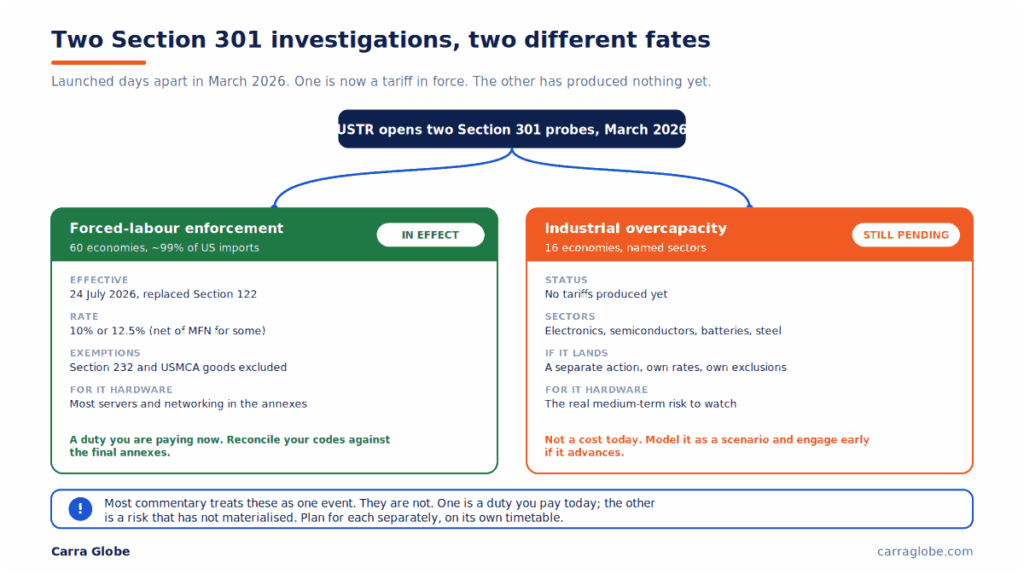
On 11 and 12 March 2026, USTR launched two separate Section 301 investigations that together cover 76 countries and economies. This is the single most important thing to get right about the 2026 picture: they are two different actions on two different timetables, and only one has produced tariffs so far. Full details are on the official USTR Section 301 investigations page.
Investigation 1: Industrial Overcapacity Across 16 Economies (still pending)
USTR is investigating 16 trading partners for producing more manufactured goods than their domestic markets can absorb. The targeted sectors include electronics, semiconductors, batteries, EV components, steel, aluminium, chemicals, and industrial machinery. The economies are China, the European Union, India, Japan, South Korea, Vietnam, Taiwan, Mexico, Indonesia, Malaysia, Cambodia, Thailand, Bangladesh, Singapore, Switzerland, and Norway.
This investigation has not yet resulted in tariffs. It is the one that matters most for technology importers, because it names electronics and semiconductors directly, and if it produces a duty it would be a separate action from the forced-labour one, carrying no obligation to repeat that action’s exemptions. If you source electronics, IT hardware, industrial equipment, or metal components from any of these economies, this is the pending risk to watch.
Investigation 2: Forced Labour Enforcement Across 60 Economies (in effect)
The second investigation is broader, and it is the one that produced the tariff now in force. USTR found that 60 economies, representing over 99% of US imports by value, had failed to impose or effectively enforce a prohibition on goods made with forced labour. The final action took effect on 24 July 2026 at 10% or 12.5%, not the higher figures earlier commentary had floated.
The rate an economy pays depends on its own forced-labour regime. Economies that ban such imports, or committed to a ban, pay 10%; the rest pay 12.5%. The United Kingdom, India, Canada, and Mexico sit in the 10% tier. China and Vietnam pay 12.5%. For a limited set of major partners, including the European Union, Taiwan, Japan, South Korea and Switzerland, the rate is charged net of the existing MFN duty, so it is capped rather than stacked.
Goods already under Section 232, and USMCA-qualifying goods, are exempt. We cover the detail in our guide to the Section 301 investigations, and the IT-hardware angle in our analysis of the Section 301 electronics exemption.
What the Section 301 Tariffs Actually Cost
The forced-labour action that took effect on 24 July is simpler to model than many feared: 10% or 12.5% depending on origin, with the MFN cap for certain major partners and the Section 232 and USMCA exemptions. For a great many importers, the move from the flat 10% Section 122 surcharge to a 10% or 12.5% Section 301 duty is close to a wash, and for those whose goods fall in the exemption annexes it is a reduction.
The larger cost risk sits in the pending overcapacity investigation, and the benchmark for that risk is the existing China Section 301 regime. When USTR imposed the original China tariffs in 2018, rates ran from 7.5% to 25% across thousands of categories. After the 2024 review, strategic sectors rose sharply: semiconductors to 50%, electric vehicles to 100%, solar cells to 50%. Those rates are in force on China-origin goods today, and they show what a sector-specific Section 301 action can reach if the overcapacity investigation produces one.
To see the range, take a USD 500,000 shipment of servers and networking from Vietnam. Under the forced-labour action, if the goods are not in the exemption annexes, a 12.5% duty is USD 62,500. If a future overcapacity action placed Vietnamese electronics at 25%, that same shipment would carry USD 125,000; at 50%, USD 250,000. The forced-labour duty is the known cost today. The overcapacity investigation is the scenario to model against.
Businesses using DDP terms need particular care. Under Delivered Duty Paid, the party responsible for delivery takes on all duties at destination. If your DDP contracts were priced against the 10% Section 122 rate, confirm how the 24 July change affects them, and stress-test them against a possible overcapacity action on your product categories.
Not sure how the new duty lands on your corridors? Carra Globe runs full duty exposure analysis across active trade corridors, models the forced-labour action and the pending overcapacity scenario, and reviews DDP contracts for who absorbs a rate change. We act as importer of record across 175+ countries.
The Section 301 Exclusion Process
Section 301 actions include an exclusion mechanism, and it is worth understanding for the pending overcapacity investigation even though the forced-labour comment window has closed. The process is not automatic and not guaranteed, but it is real and has worked for thousands of product categories.
During the original China proceedings, USTR accepted comments from importers and industry explaining why specific product categories should be excluded. Those that submitted well-structured comments, backed by evidence that the tariff would cause economic harm without meaningfully affecting the practice being targeted, won product-specific exclusions worth millions in duty.
For the forced-labour action, the comment period closed on 6 July and the final exemption annexes are now set. For the overcapacity investigation, the comment mechanism remains the lever: if that action advances and your goods fall in a targeted category, a detailed, evidence-based submission is one of the highest-leverage steps available. It is not a process to improvise, so get trade compliance or counsel working on it as soon as a proposed action appears.
Claiming Your IEEPA Refund
Running alongside the Section 301 process is a separate and time-sensitive one: IEEPA duty refunds. After the Supreme Court struck down the IEEPA tariffs, CBP was directed to re-liquidate affected entries, and it built a dedicated tool, the Consolidated Administration and Processing of Entries (CAPE) system within ACE, which went live on 20 April 2026. CAPE is now the primary channel, and it is not automatic: a refund requires action.
To claim through CAPE, the importer of record or its broker files a CAPE Declaration through the ACE portal, and the account must have active ACE credentials and ACH banking details on file, since CBP no longer issues paper cheques. The current phase covers unliquidated entries and entries within 80 days of liquidation, with later phases extending to more. CBP recalculates the duty without the IEEPA lines and issues a consolidated refund with interest, so this is a filing to make, not a payment to wait for.
For entries that have finally liquidated and fall outside the CAPE phases, the position is harder: CBP has indicated that importers who did not file their own claim at the Court of International Trade may not be eligible for a refund absent a further court order. A protest within 180 days of liquidation remains the route for entries still inside that window. The practical step is the same either way: pull the liquidation dates on every entry that carried IEEPA duties, because the right channel and the deadline both depend on that date. Your IOR provider or freight forwarder should hold them.
What Importers Should Do Now
- Map every import corridor against both investigation lists. Check each sourcing country against the 16-economy overcapacity list and the 60-economy forced-labour list. Economies on both, including China, Vietnam, India, Mexico, and the EU, carry the highest risk, because a second action could follow the first. Prioritise high-volume corridors.
- Reconcile your position under the forced-labour action. Confirm the correct rate and any exemption for each product line and origin under the Chapter 99 provisions now in force, so current entries are classified correctly. Our landed cost guide sets out the full duty stack.
- Check your HS classification. Section 301 duties apply at the HS-code level, and the exemption annexes are code-specific. A misclassification can mean paying a duty you are exempt from, or missing one you owe. Check every active code against the annexes and the investigation notices.
- File IEEPA protest claims on liquidated entries now. Every entry liquidated with IEEPA duties has a 180-day protest window from its liquidation date. Pull those dates and file before each expires. Entries that pass the anniversary without a protest are permanently ineligible.
- Review DDP contracts. Any DDP contract running past 24 July needs reviewing for who absorbs the duty change. Silence on rate changes is not neutral, it is a liability. Our Trade Compliance team works through active DDP contracts with clients.
- Watch the overcapacity investigation. This is the pending risk for electronics and industrial goods. If it produces a proposed action, the comment window and any exclusion process become the levers to engage early, not after rates are set.
How Carra Globe Supports Importers Through Section 301 Changes
We have managed import programmes through multiple tariff cycles across 175+ countries. The businesses that come out ahead treat tariff change as an operational event to plan for, not a policy story to monitor from a distance. Our services support importers at every stage:
- Importer of Record: we act as the legal importer on your US and global shipments, absorbing customs liability and ensuring correct duty application as rates change across 175+ countries.
- Global Trade Compliance: HS classification, duty exposure analysis, DDP contract review, and customs audit support across all active corridors.
If you import from any of the 76 economies under Section 301 investigation and do not yet have a plan for the action in force or the one still pending, speak to our team.
Frequently Asked Questions About Section 301 Tariffs 2026
What are the Section 301 tariff rates in 2026?
The forced-labour action in effect from 24 July 2026 is 10% or 12.5% depending on the origin’s forced-labour regime. A separate overcapacity investigation covering 16 economies has not yet produced tariffs.
Certain major partners are charged net of MFN duty, and goods under Section 232 or qualifying for USMCA are exempt. Existing China Section 301 duties, ranging up to 100% on some categories, remain separate and in force.
My goods come from Vietnam, not China. Am I affected?
Yes. Vietnam pays 12.5% under the forced-labour action in force, unless the specific goods are in the exemption annexes. Vietnam is also named in the pending overcapacity investigation, which targets electronics directly.
Many businesses shifted sourcing from China to Vietnam after 2018. The 2026 investigations target that shift, so diversifying away from China alone is no longer sufficient risk mitigation.
Can I get my goods excluded from Section 301 tariffs?
The forced-labour exemptions are now set in the final annexes, by HTS code. For the pending overcapacity investigation, an exclusion process would open if a proposed action is published.
Check whether your specific HTS codes appear in the forced-labour annexes, and prepare to engage early if the overcapacity action advances.
How do the 2026 tariffs interact with existing China Section 301 duties?
China’s existing Section 301 duties, from 7.5% to 100% by category, remain in force. The new forced-labour duty of 12.5% applies in addition, and a future overcapacity action could add a further layer.
For China-origin goods, model the existing Section 301 rate plus the new forced-labour duty, and watch the overcapacity investigation for any further increase.
I am not based in the US. Do these tariffs affect my business?
Yes, directly. Section 301 duties are paid by the US importer of record. If you sell into the US, the cost lands on your buyer or the IOR, and may pass back to you.
Understanding your IOR structure and who bears tariff liability is essential. See our guide on how Importer of Record services work.
What is the deadline to file an IEEPA refund protest?
For a liquidated entry, a protest is generally due within 180 days of liquidation under 19 U.S.C. 1514. CAPE, the primary refund channel, currently covers unliquidated entries and those within 80 days of liquidation.
Entries that have finally liquidated outside those windows may need a court claim, so pull every liquidation date now, since the deadline and the channel both depend on it.
Did Section 301 replace Section 122 on 24 July?
Yes. The forced-labour Section 301 action took effect at 12:01 a.m. Eastern on 24 July 2026, the moment Section 122 expired, at 10% or 12.5% on 60 economies.
The separate overcapacity investigation could add further tariffs later, and Section 232 actions in sectors such as semiconductors run in parallel, so plan for tariff continuity at potentially higher rates rather than a tariff-free window.
The handover the market expected on 24 July happened, but not at the scale many feared: the forced-labour action landed at 10% or 12.5%, close to a wash for many importers and a reduction for those in the exemption annexes. The real open question is the overcapacity investigation, which names electronics and semiconductors and has not yet produced a duty.
The importers who handle this well are the ones who reconcile their position under the action in force and keep modelling the one still pending. If you would like that done across your corridors, Carra Globe acts as importer of record across 175+ countries and can help you put it in place.