
Update, 28 July 2026: The CAPE refund system has expanded well beyond its original launch. Phase 1 opened on 20 April 2026 for entries not yet finally liquidated. Phase 2 followed on 29 June, adding certain reconciliation-flagged entries. Phase 3, for finally liquidated entries, began rolling out in late July, but with a critical restriction: it is available only to importers who have filed suit at the Court of International Trade. This guide reflects all three phases and the litigation that shapes who can recover what.
On 20 April 2026, US Customs and Border Protection launched the CAPE portal inside the ACE Secure Data Portal. CAPE stands for Consolidated Administration and Processing of Entries. It is the primary mechanism through which importers and customs brokers file IEEPA tariff refund claims for duties paid on goods imported between April 2025 and February 2026. Roughly USD 166 billion in IEEPA duties were collected from over 330,000 importers across more than 53 million entries during that period.
CAPE processes refunds in bulk rather than entry by entry, and it now operates in three phases covering progressively harder categories of entry. This guide covers the phase structure, how to file, the mistakes causing rejections, and the litigation cliff that determines whether finally liquidated entries can be recovered at all.
IEEPA Refund: At a Glance
- What CAPE is: CBP’s consolidated refund tool in ACE, for IEEPA duties paid April 2025 to February 2026.
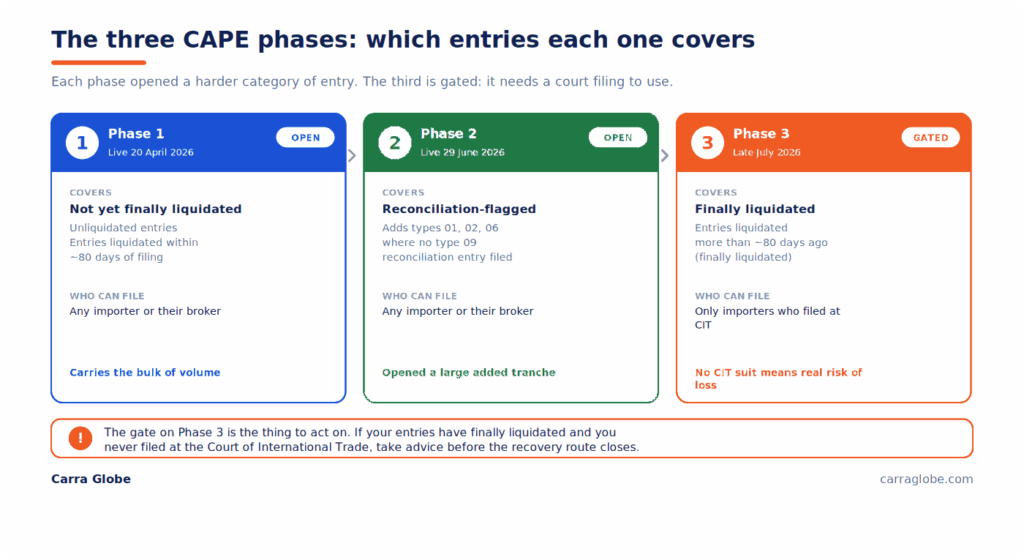
- Phase 1 (live 20 April): unliquidated entries and entries within about 80 days of liquidation.
- Phase 2 (live 29 June): adds certain reconciliation-flagged entries with no reconciliation entry filed.
- Phase 3 (late July): finally liquidated entries, but only for importers who have filed at the Court of International Trade.
- The catch: importers who never filed a CIT suit risk permanent loss of refunds on finally liquidated entries.
Why CBP Built the CAPE Portal
On 20 February 2026, the US Supreme Court ruled in Learning Resources, Inc. v. Trump that IEEPA does not authorise the President to impose tariffs, and CBP stopped collecting IEEPA duties. The Court of International Trade then directed CBP to refund IEEPA duties already collected, an obligation reaching not just the original plaintiffs but importers who paid on covered entries. For the ruling itself, see our analysis of how the Supreme Court struck down the IEEPA tariffs.
The scale made entry-by-entry processing impossible, so CBP built CAPE as a batched mechanism. Instead of a separate protest or correction for each of potentially thousands of entries, an importer uploads a single CSV file listing eligible entry numbers. ACE processes the batch, removes the IEEPA Chapter 99 codes, recalculates duties, and issues a consolidated refund with interest. Official guidance is on the CBP IEEPA Duty Refunds page, updated as new phases and guidance are released.
The Three CAPE Phases, and What Each Covers
CAPE rolled out in phases, each opening a harder category of entry. Knowing which phase an entry falls into is the first step, because it determines both whether you can file and, for the hardest category, whether you needed to have filed a lawsuit first.
| Phase | Live from | Covers | Key restriction |
|---|---|---|---|
| Phase 1 | 20 April 2026 | Unliquidated entries, and entries within about 80 days of liquidation | Entries liquidated longer ago fall outside it |
| Phase 2 | 29 June 2026 | Adds reconciliation-flagged entries (types 01, 02, 06) with no type 09 filed | Does not capture reconciliation entries already liquidated beyond 80 days |
| Phase 3 | Late July 2026 | Finally liquidated entries (liquidated more than 80 days ago) | Only for importers who filed suit at the CIT |
Phase 1 has carried the bulk of the volume, processing millions of entries in its first weeks and moving billions in approved refunds to the Treasury for payment. Phase 2 opened a large additional tranche of reconciliation entries on 29 June. Phase 3 is the consequential one for anyone whose entries liquidated months ago, and it comes with the restriction that reshapes the whole refund picture.
The Finally Liquidated Entry Catch: Why a CIT Filing Mattered
This is the most important development since CAPE launched, and it is the part most refund guides have not caught up with. For entries that had already finally liquidated, meaning liquidated more than 80 days before refund processing began, CAPE Phase 3 is the route. But the government’s consistent position has been that CBP cannot reliquidate a finally liquidated entry without a court order directing it.
In mid-July 2026, the CIT began issuing reliquidation orders in the roughly 3,700 refund cases before it, directing CBP to reliquidate plaintiffs’ finally liquidated entries without regard to IEEPA duties. The operative word is plaintiffs. Those orders reach the importers who filed suit at the CIT. The government has appealed even that to the Federal Circuit, arguing CBP lacks authority to refund non-litigants’ finally liquidated entries at all.
The practical consequence is stark. An importer who filed a CIT case is positioned to recover through Phases 1, 2, and 3 combined, regardless of liquidation status. An importer who did not file, and whose entries finally liquidated outside the Phase 1 and 2 windows, faces real risk of permanent loss unless a broader court order or class relief changes the picture. If a material share of your duties sits in finally liquidated entries and you have not filed at the CIT, take advice quickly rather than wait for a phase that may never reach you.
Unsure which phase your entries fall into, or whether a CIT filing still helps? The answer turns on the liquidation date of each entry and whether you filed suit. Carra Globe compiles eligible entry lists, confirms phase eligibility by liquidation date, and prepares CAPE Declarations. We act as importer of record across 175+ countries.
CAPE Phase 1 Eligibility Rules
Phase 1 remains the entry point for most claims. Its rules are specific, and understanding the scope before filing prevents rejected declarations.
- Qualifying entries: unliquidated entries on which IEEPA duties were paid, and entries liquidated within about 80 days of the CAPE Declaration submission date. The window is a rolling one based on your filing date, incorporating a short buffer. Entries liquidated longer ago fall to Phase 3.
- IEEPA Chapter 99 requirement: every entry in the declaration must contain at least one dutiable IEEPA Chapter 99 HTS code. An entry with no such code is rejected at entry-level validation.
- Who can file: only the Importer of Record named on the entry, or the licensed customs broker who filed the entry summary, can submit a declaration. A third-party consultant or accountant cannot file unless they are the broker of record.
- Interest included: CBP adds statutory interest automatically under 19 U.S.C. 1505(c), running from the original payment date. For the quarter beginning 1 January 2026 the overpayment rate was 7% for non-corporate filers and 6% for corporate filers.
Entries Still Excluded From CAPE
Even with three phases live, some categories remain outside CAPE and are handled through the courts or later guidance:
- Entries designated on a drawback claim (Type 47 drawback entries).
- Entries covered by an open protest, for which there is currently no CAPE refund procedure.
- Entries subject to AD/CVD where Commerce liquidation instructions are pending.
- Entries with no liquidation status in ACE, and type 03 entries pending liquidation.
- Warehouse entries (types 21 and 22), which since 7 July 2026 are no longer accepted on a declaration; warehouse withdrawals (types 31, 32, 34, 38) are still accepted, with refunds processed on reliquidation of the associated warehouse entry.
Step by Step: How to File a CAPE Declaration
Step 1: Confirm ACE access and add the Importer sub-account
Log into the ACE Secure Data Portal at cbp.gov. You need an active account with an Importer sub-account to see the CAPE tab. If you only have a Broker or Filer sub-account, add an Importer sub-account first. Without the correct sub-account type, the CAPE tab does not appear.
Step 2: Set up ACH refund banking, separately from payment ACH
This is the most common and most avoidable mistake. The account you use to pay CBP is not the account CBP refunds to; they are separate setups. Add refund banking through the ACH Refund Authorisation tab in your Importer sub-account. CBP stopped issuing paper cheques on 6 February 2026, so without ACH refund banking on file when your declaration is accepted, the refund sits at CBP until you fix it. Do this before you file.
Step 3: Compile your eligible entry numbers
Use ACE Reports to pull every entry that paid IEEPA duties between April 2025 and February 2026, and sort them by liquidation date to see which phase each falls into. Confirm each contains a dutiable IEEPA Chapter 99 code. The CSV needs entry numbers only, no invoices or documents.
Step 4: Prepare and upload the CSV
The declaration is a CSV using the CBP template, limited to 9,999 entries; split larger filings across multiple declarations. Do not file through the Automated Broker Interface, which is not used for CAPE, and do not attempt a Post Summary Correction, which CBP has explicitly prohibited for IEEPA refunds. Upload through the CAPE tab in the ACE Portal web interface only.
Step 5: Monitor the two validation rounds
ACE runs two sequential checks. File-level validation confirms the submitter is the IOR or filing broker and the CSV is correctly formatted; a failure rejects the whole declaration, but you can download the validation result, fix it, and resubmit. Entry-level validation then checks each entry for an IEEPA Chapter 99 code and for duplicates; here only the failing entries are rejected and the rest continue. Download the entry-level results to see exactly which failed and why.
Step 6: Track status and receive payment
Once accepted, ACE strips the IEEPA Chapter 99 codes and schedules the entries for liquidation or reliquidation, with unliquidated entries typically liquidating around 45 days after acceptance. Refunds are consolidated by IOR and generally issued within 60 to 90 days of acceptance, with the clock starting at acceptance rather than submission. Monitor the REV-603 Trade Refund report for payments issued, the REV-613 ACH Rejected Refunds report for any that bounced on banking errors, and the REV-615 Trade CAPE Detail Refund Report, which CBP introduced specifically for CAPE refunds and which populates once refunds are issued.
Five Mistakes Causing Rejections and Delays
- Filing without ACH refund banking. The most common cause of held refunds: CBP has the money but cannot pay it electronically. Set up ACH in the Importer sub-account before your first declaration.
- Misjudging which phase an entry is in. Entries liquidated beyond the roughly 80-day window are not Phase 1 eligible, and if finally liquidated they need Phase 3, which requires a CIT filing. Sort by liquidation date before you file rather than mixing categories blindly.
- Attempting PSC or ABI. Both are prohibited for IEEPA refunds. Post Summary Corrections are explicitly barred, and ABI submissions are rejected. The CAPE tab in ACE is the only route.
- Including entries without a Chapter 99 IEEPA code. These fail entry-level validation, catching entries where the goods were not subject to IEEPA duties or the code was later removed. Validate every entry against your ACE records first.
- Overrunning the 9,999-entry limit. A declaration above the limit is rejected; large volumes must be split into multiple declarations, planned before filing.
Why the Importer of Record Receives the Refund
CBP pays the IEEPA refund to the Importer of Record on the original entry, not to the buyer of the goods, a downstream distributor who absorbed the duty through pricing, or a freight forwarder who arranged the shipment. The IOR is the entity CBP recognises as responsible for the duty, so it is the entity CBP refunds.
If you bought from a US distributor who was the IOR, you have no direct claim against CBP, and any share of the refund depends on your contract with that distributor. For the underlying role, see our explainer on what an Importer of Record is, and for the distinction from a broker, our guide to importer of record versus customs broker.
If you used a specialist importer of record service during the IEEPA period, the refund flows to that IOR entity, so confirm with your provider whether they have filed CAPE Declarations for the entries they managed and how they pass refunds through to you.
How Carra Globe Supports the CAPE Refund Process
Carra Globe acted as Importer of Record for clients importing into the United States during the IEEPA period and manages the CAPE refund process for those entries.
For clients who used their own IOR entity, our Global Trade Compliance team provides end-to-end declaration support:
- Compiling eligible entry lists and sorting them by liquidation date to confirm which phase each falls into.
- Preparing the CSV in the correct CBP format and validating it against the phase criteria before submission.
- ACH refund banking setup so payment reaches the right entity without delay.
For the wider tariff picture, see our guides to the SCOTUS IEEPA ruling and the Section 122 tariff that replaced the IEEPA duties.
Frequently Asked Questions: IEEPA Tariff Refund CAPE Portal
How many CAPE phases are there, and what does each cover?
Three. Phase 1 covers unliquidated entries and those within about 80 days of liquidation. Phase 2 adds certain reconciliation-flagged entries. Phase 3 covers finally liquidated entries, but only for importers who filed at the CIT.
Phase 1 launched 20 April, Phase 2 on 29 June, and Phase 3 began rolling out in late July 2026.
Can I still get a refund if my entries have finally liquidated?
Through Phase 3, but the courts have so far directed reliquidation only for plaintiffs who filed at the CIT. Importers who never filed suit risk permanent loss on finally liquidated entries.
If a material share of your IEEPA duties sits in finally liquidated entries and you did not file, take advice quickly rather than wait for a further phase.
What happens if I miss the CAPE filing window for my entry?
It depends on liquidation status. An unliquidated entry can still be filed as it stays Phase 1 eligible. An entry that finally liquidates moves to Phase 3, which currently requires a CIT filing to recover.
There is no single calendar deadline for CAPE itself, but the longer an entry sits, the more likely it liquidates into the harder Phase 3 category, so filing sooner protects the easier route.
What is the 80-day window in CAPE Phase 1?
Phase 1 covers unliquidated entries and entries liquidated within about 80 days of your declaration date, with a short buffer. It is a rolling window based on your filing date, not a fixed calendar cut-off.
Entries liquidated longer ago are finally liquidated and fall to Phase 3, so filing sooner keeps more entries inside the Phase 1 window.
Can my customs broker file the CAPE Declaration for me?
Yes, if the broker is the one who filed your original entry summaries. They file through their own ACE account, up to 9,999 entries per declaration, but only for entries they filed.
Ensure Power of Attorney coverage is in place and ACH refund banking is set correctly so the refund reaches the right entity.
Can I amend a CAPE Declaration after submitting it?
No. Once CBP accepts a CAPE Declaration it cannot be amended, and each entry can appear on only one accepted declaration. To add omitted entries, file a new declaration for them.
Because of this, validate and organise your entry list carefully before uploading, since errors mean a fresh declaration rather than an edit.
How long does a CAPE refund take?
CBP generally issues refunds within 60 to 90 days of accepting the declaration, with the clock starting at acceptance, not submission. Unliquidated entries typically liquidate around 45 days after acceptance, with the refund following review.
Entries with compliance concerns take longer. Monitor the REV-603 report in ACE for confirmation of payment.
What if I paid IEEPA duties through my supplier but was not the IOR?
CBP refunds the Importer of Record on the entry, not downstream buyers who absorbed the duty. If your supplier was the IOR, your claim is against them under your contract, not against CBP.
Some US companies are voluntarily sharing refunds with buyers and others are not, so check your supply agreement and raise it with the supplier directly.
This guide is for informational purposes only and does not constitute legal or customs advice. CAPE phase scope, eligibility, interest rates, timelines, and the litigation over finally liquidated entries are moving and subject to change as CBP and the courts issue further guidance. Always consult a licensed US customs broker or trade attorney before filing CAPE Declarations or pursuing CIT proceedings.