
As tariff volatility and tightening enforcement reshape Western trade lanes, more multinational shippers are looking to the Gulf. The six states of the Gulf Cooperation Council are investing heavily in technology, infrastructure, healthcare, and energy, and demand for compliant import structures across the region has risen sharply. But the GCC is not a single market with a single rulebook. Each state has its own customs authority, its own conformity regime, and its own rules on who may act as the importer. Getting that structure right is the work of the importer of record in the GCC, and it is rarely as simple as appointing one provider and shipping.
This guide is for IT vendors, equipment manufacturers, healthcare and energy suppliers, and the logistics and procurement teams expanding into the Gulf. It explains what an importer of record does in the GCC, why a local presence is usually required, how the requirements differ across the six states, and what to put in place before shipping. The aim is practical: to help you move goods into the region compliantly without building your own entity in every country.
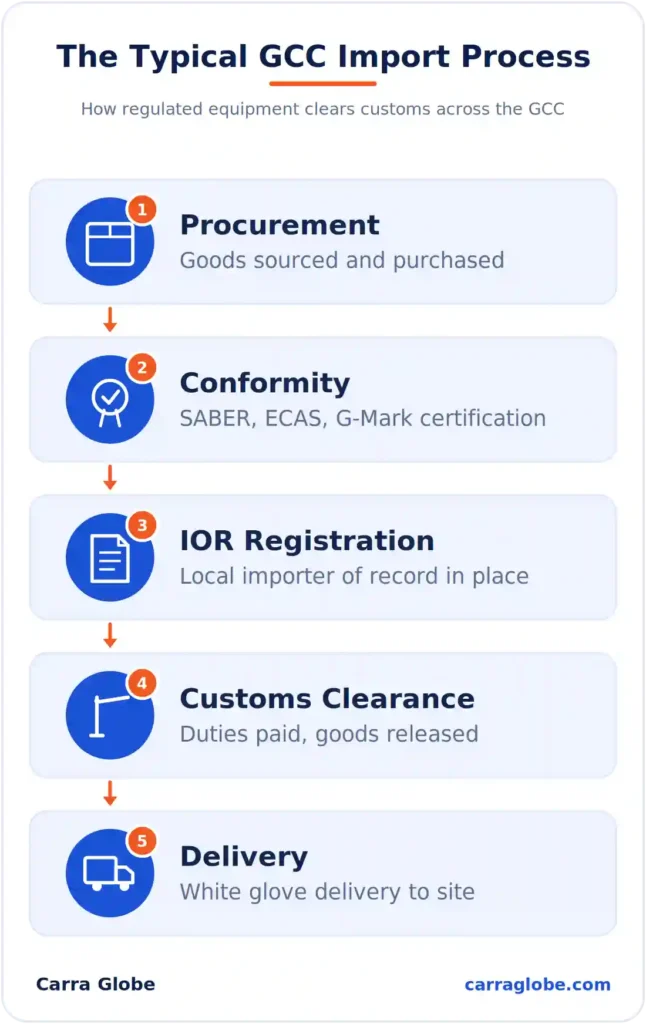
An importer of record in the GCC is the locally registered entity legally responsible for importing goods into a Gulf state: holding the import and customs registration, securing product conformity certification, and clearing the goods. Because most GCC states require the importer to be locally established, a specialist IOR lets a foreign company import without setting up its own entity.
Why an Importer of Record in the GCC Is Usually Required
In most GCC states, a foreign company cannot simply ship goods in and clear them under its own name. The importer of record must be a locally registered entity holding a valid commercial registration and an importer or customs code with the national authority. This is the structural reason a local importer of record matters: without an established local importer, the goods have no party entitled to clear them.
On top of that registration sits a conformity layer. Most GCC states require regulated products, particularly electronics, electrical equipment, and anything with wireless capability, to be certified against national standards before they can be imported and sold. The certification is frequently held in the importer’s name, which ties conformity directly to the importer of record. If you are unfamiliar with the role itself, our explainer on what an Importer of Record is and does sets out the fundamentals before we get into the country detail.
The practical upshot is that importing into the GCC is a two-part problem: the import registration that lets a party clear goods, and the product conformity that lets those specific goods enter. A specialist importer of record carries both, which is why so many companies expanding into the region appoint one rather than building local entities from scratch.
The Six GCC States: How Importer of Record Requirements Differ
The GCC operates a customs union with a common external tariff, generally five percent on most goods, and a shared customs territory in principle. In practice, each state administers its own customs authority, conformity scheme, and registration requirements, and the differences matter. The table below sets out the headline position in each, with each linking to the detailed importer of record requirements for that country.
| State | Key IOR and Conformity Reality | Common Bottleneck |
|---|---|---|
| Saudi Arabia | SABER platform with Product and Shipment Certificates of Conformity under SASO, plus CST type approval for wireless devices; a locally registered importer required | SCoC not uploaded to SABER before shipment departs |
| UAE | MoIAT (formerly ESMA) and Emirates Conformity Assessment (ECAS) for regulated goods, TDRA approval for wireless devices, and free zone versus mainland routing to weigh | Missing TDRA approval on a wireless device |
| Qatar | Customs registration and conformity requirements administered nationally, CRA approval for wireless devices, and import licensing tied to a locally established importer | No locally established importer on the customs file |
| Kuwait | KUCAS conformity scheme for regulated products and a locally registered importer holding the customs file | Product not certified under KUCAS before arrival |
| Oman | Customs registration and conformity requirements, TRA approval for wireless devices, and import clearance tied to a locally established importer of record | Conformity or TRA approval missing at clearance |
| Bahrain | Customs registration and conformity requirements, with a growing role as a regional logistics and data centre entry point | Incomplete conformity documentation at entry |
The pace of reform varies too. Qatar and Oman have both modernised their customs systems recently, as covered in our guides to Qatar customs reforms for IT hardware and the Oman ASYCUDA system for faster IT imports, while Bahrain free zone rules for tech equipment reflect its growing role as a logistics gateway.
The universal pattern across the GCC: a foreign company almost always needs a locally registered importer of record to clear goods, and regulated products need national conformity certification, often held in the importer’s name, before they can enter. The customs union does not remove the need to satisfy each state’s own requirements.
Expanding into the Gulf and unsure how to structure your imports? Carra Globe acts as your importer of record across the GCC, holding the local registration and conformity certification so your goods clear without you building an entity in every state.
The Conformity Layer: Where GCC Imports Most Often Stall
If there is one thing that catches companies out when importing into the GCC, it is conformity certification. The customs registration is necessary, but it is the product conformity that most often holds a shipment at the border. Saudi Arabia is the clearest example. Under the SABER platform run by the Saudi Standards, Metrology and Quality Organization, every regulated product needs a Product Certificate of Conformity, and every individual shipment needs a Shipment Certificate of Conformity uploaded before the goods depart origin. A shipment arriving at Dammam or Jeddah without a valid certificate in the system is held, which immediately starts daily port demurrage charges accumulating while the clearance window slips. For companies weighing entry routes, our guides on Saudi free zone customs rules for tech imports and importing IT equipment into Saudi Arabia without a local entity go deeper on the Kingdom specifically.
The other states run their own versions. The UAE uses MoIAT (formerly ESMA) conformity and the Emirates Conformity Assessment Scheme (ECAS), with TDRA approval required separately for any device with wireless capability. The UAE also offers a free zone route that can defer duty and VAT until goods enter the mainland, which is a major draw, though it changes how the importer of record is structured. For high-value equipment, this often pairs with white glove delivery in the UAE for the final leg to site. Kuwait runs the KUCAS scheme. Across the region, anything with Wi-Fi, Bluetooth, cellular, or other radio capability typically needs a separate telecommunications or type approval on top of the general conformity certificate, as our guide to Kuwait telecom import rules illustrates for that market. For IT hardware, networking equipment, and connected devices, that second approval is frequently the step that is missed.
Because these certificates are commonly issued in the importer’s name, they do not transfer cleanly if you switch providers mid-programme. The conformity history is tied to the importer of record, so a fragmented approach can mean starting the certification process again. This is a strong argument for a single, consistent importer of record across your GCC markets rather than a different local agent in each.
What a Strong Importer of Record in the GCC Does
Holds the Local Registration in Each State
The foundation is a locally registered entity in each target state, holding the commercial registration and importer or customs code that entitle it to clear goods. A capable importer of record provides this presence across the region, so you do not have to incorporate in each country to import there.
Secures and Holds Conformity Certification
The importer of record manages the national conformity process, SABER and SASO in Saudi Arabia, MoIAT in the UAE, KUCAS in Kuwait, and the equivalent elsewhere, and holds the resulting certificates. It also coordinates the separate telecommunications type approvals that wireless devices require, so connected equipment clears rather than stalling on a missing radio approval.
Classifies Goods and Manages Duty
The GCC customs union applies a common external tariff, generally five percent, and has moved to a 12-digit HS code structure, so correct classification still governs duty, exemptions, and any sector-specific treatment. The importer of record verifies classification and manages the duty position, and our landed cost guide helps you model the full cost into your pricing.
Keeps Conformity History Consistent Across the Region
Because certification is tied to the importer, a single provider across your GCC markets keeps the conformity history intact and consistent rather than scattered across local agents. For a multi-country regional rollout, that continuity is what prevents repeated certification work and keeps shipments moving.
Why One Importer of Record Across the GCC Beats Local Agents in Each State
When you expand across the Gulf, you face the familiar choice: a different local agent in each state, or one importer of record across the region. For the GCC specifically, consolidation has a particular advantage, because the conformity certificates that govern market access are held in the importer’s name.
| Dimension | Single Regional IOR | Local Agent in Each State |
|---|---|---|
| Compliance standard | One consistent standard across all six states | Varies by agent; the weakest sets your risk |
| Conformity certificates | Held consistently, history intact across markets | Tied to each agent; lost if you switch |
| Accountability | One party answerable for the whole region | Each agent sees only its own state |
| Conformity continuity | One unbroken certification history as you grow | Restart certification when you change agent |
| Expansion | Add states without rebuilding the structure | A new arrangement and relationship each time |
The deeper point is continuity. In a region where market access is tied to certificates held in the importer’s name, switching agents or running a different one in each state risks fragmenting the very documentation that lets your goods enter. A single importer of record holds that picture together. When you evaluate a provider, the questions are specific to the region: does it hold genuine local registration in each target state, can it manage SABER, MoIAT, KUCAS, and the telecommunications approvals, and can it keep your conformity history consistent as you expand? The depth of the role is set out in our guide to importer of record requirements, and for controlled technology, our guide to ITAR and EAR compliance for global IT hardware covers the export-control layer that often accompanies Gulf tech imports. The wider picture is in our global trade compliance service.
What to Put in Place Before Shipping Into the GCC
- Map your target states and their requirements. List each GCC state you intend to enter, the products going to each, and the conformity scheme that applies. The requirements differ enough that a single regional assumption will catch you out
- Confirm conformity certification first. For each regulated product, establish the national conformity requirement (SABER and SASO, ESMA, KUCAS, and so on) and the separate telecommunications approval for any wireless device. This is the gate that most often holds shipments
- Appoint a locally registered importer of record. Confirm that your importer of record holds genuine local registration in each target state, not just a regional sales presence. The registration is what entitles it to clear your goods
- Get classification and duty right. Confirm the customs classification of each product against the GCC common external tariff and any exemptions, so your landed cost is accurate from the start
- Plan for consistency as you expand. If you intend to grow across several Gulf states, structure your importer of record arrangement so conformity history and compliance stay consistent rather than fragmenting market by market
Frequently Asked Questions
Can a foreign company import into the GCC without a local entity?
In most cases only through a locally registered importer of record. Most GCC states require the importer to be a locally established entity holding a commercial registration and customs code, so a foreign company without its own local entity needs a specialist importer of record to clear goods on its behalf. This lets you import without incorporating in each state.
For companies entering several Gulf markets, a single importer of record across the region keeps the structure and conformity certification consistent rather than fragmented across separate local agents.
Does the GCC customs union mean one clearance works for all six states?
Not in practice. The GCC operates a customs union with a common external tariff, generally five percent, but each state administers its own customs authority, conformity scheme, and importer registration requirements. Goods must still satisfy the specific rules of each state you import into, including its own product conformity certification.
This is why a regional importer of record with genuine registration in each target state matters. The customs union simplifies the tariff, but it does not remove the country-by-country compliance work.
What is SABER and why does it matter for importing into Saudi Arabia?
SABER is the Saudi online conformity platform. Regulated products need a Product Certificate of Conformity, and each shipment needs a Shipment Certificate of Conformity uploaded to SABER before the goods depart origin. A shipment arriving without a valid certificate in the system is held, so the certification has to be in place before shipping, not on arrival.
Because the certificates are issued in the importer’s name, the importer of record manages and holds them. This ties conformity directly to the importer and is a key reason to keep a consistent importer of record for the Saudi market.
Do wireless devices need extra approval to import into the GCC?
Yes. Across the GCC, devices with Wi-Fi, Bluetooth, cellular, or other radio capability typically need a separate telecommunications or type approval on top of the general product conformity certificate. In the UAE this runs through the TDRA, in Saudi Arabia through the CST, and other states have their equivalents.
For IT hardware, networking equipment, and connected devices, this separate approval is frequently the step that is overlooked, and missing it holds the shipment even when the general conformity certificate is in place.
The Gulf is one of the most active import markets in the world right now, but its appeal comes with a compliance structure that rewards getting the importer of record right from the start. For companies expanding across Saudi Arabia, the UAE, Qatar, Kuwait, Oman, and Bahrain, Carra Globe acts as importer of record across the region, holding the local registration and conformity certification and keeping your compliance consistent as you grow. To map your GCC import structure before you ship, talk to our team.