
The difference between DDP vs DAP comes down to one thing: under DDP (Delivered Duty Paid) the seller clears customs and pays the import duty in the destination country, while under DAP (Delivered At Place) the buyer does. Both terms put the seller in charge of transport and transit risk, so that single split at the border is what drives every cost, risk, and customer-experience consequence that follows. Choosing wrong is what leaves a shipment stranded at customs or a customer hit with a surprise bill at the door. This guide explains what separates the two, when each makes sense, and the operational trap that catches sellers who choose DDP without realising what it requires.
This is for e-commerce operators, supply chain managers, exporters, and cross-border sellers who have to pick a term and live with the consequences. We will keep the definitions tight and spend most of the time on the decision that actually matters: who should carry the import, and what it takes to carry it well.
DDP (Delivered Duty Paid): the seller pays the duty, clears customs, and delivers the goods fully cleared. DAP (Delivered At Place): the seller delivers to the destination, but the buyer clears customs and pays the import duty and tax. Both put the seller in charge of transport and transit risk; they differ only at the import step.
Which should you use? DDP is usually better for e-commerce and for buyers without import experience, because it gives a clean all-inclusive price with no surprise charges. DAP suits experienced importers who prefer to control clearance themselves. The catch with DDP is that you must be able to clear customs in the destination country, which sellers without a local entity solve by appointing an importer of record.
DDP vs DAP: The Core Difference in One Line
Both terms are part of the Incoterms 2020 rules published by the International Chamber of Commerce, and both put the seller in charge of transport to the named destination. Under both, the seller arranges and pays for carriage, and bears the risk of loss or damage in transit. The split happens at the border of the destination country.
Under DAP, the seller delivers the goods to the named place but the buyer is the importer: the buyer clears customs, pays the import duty and any VAT or tax, and takes on the import formalities. Under DDP, the seller goes one step further and takes all of that on: the seller clears customs in the destination country, pays the duty and tax, and delivers the goods fully cleared. DDP is the maximum obligation an Incoterm can place on a seller. DAP stops just short of it. Everything else about the two is essentially the same.
| Responsibility | DDP (Delivered Duty Paid) | DAP (Delivered At Place) |
|---|---|---|
| Transport to destination | Seller | Seller |
| Risk in transit | Seller | Seller |
| Export clearance | Seller | Seller |
| Import customs clearance | Seller | Buyer |
| Import duty and VAT/tax | Seller | Buyer |
| Importer of record | Seller (or its appointed IOR) | Buyer |
| Unloading at destination | Buyer | Buyer |
If you ship technology or high-value equipment specifically, our deeper guide on which Incoterm protects tech shipments, comparing DDP, DAP, and CIF, goes further into the equipment-specific considerations. This page stays on the core DDP-versus-DAP decision that applies to any cross-border shipment.
What Each Term Means in Practice
DAP: Simpler for the Seller, Risky for the Buyer Relationship
DAP is attractive to sellers because it keeps them out of the destination country’s import process. You deliver to the named place, and the buyer handles clearance and duty. For a seller who does not want to deal with foreign customs or pay duties upfront, that simplicity is the appeal.
The catch is what it does to the buyer experience. Under DAP, customs will often hold the shipment until the buyer is identified and pays the duty. If the buyer was not expecting a bill, you get surprise charges, delays while payment is arranged, and in the worst case a refused delivery. For a business buyer with their own customs broker this is manageable. For a consumer or a buyer without import experience, it is where deliveries go wrong.
DDP: A Clean Experience for the Buyer, More Exposure for the Seller
DDP flips it. The seller absorbs the duty and clearance, builds those costs into the price, and the buyer receives the goods with nothing left to pay. For e-commerce and for any seller who cares about a predictable, all-inclusive price, this is the better experience. It eliminates the surprise charge, reduces refusals, and gives the buyer one clear delivered cost.
The exposure sits with the seller. To ship DDP you must be able to clear customs and pay duty in the destination country, and that is harder than it sounds, which brings us to the trap.
Want to ship DDP but have no entity in the destination country? Carra Globe acts as your importer of record and handles Delivered Duty Paid clearance and delivery, so you can offer a duty-paid experience without setting up locally.
Importer of Record · 175+ countries
Importing IT or high-value hardware? We can be your Importer of Record.
Carra Globe acts as your Importer of Record so you can ship into markets where you have no local entity. We carry the legal liability, handle certifications and duties, and give you one itemised quote:
Have a shipment in mind? Send us your lane and goods, we will confirm and quote.
Get a compliance quote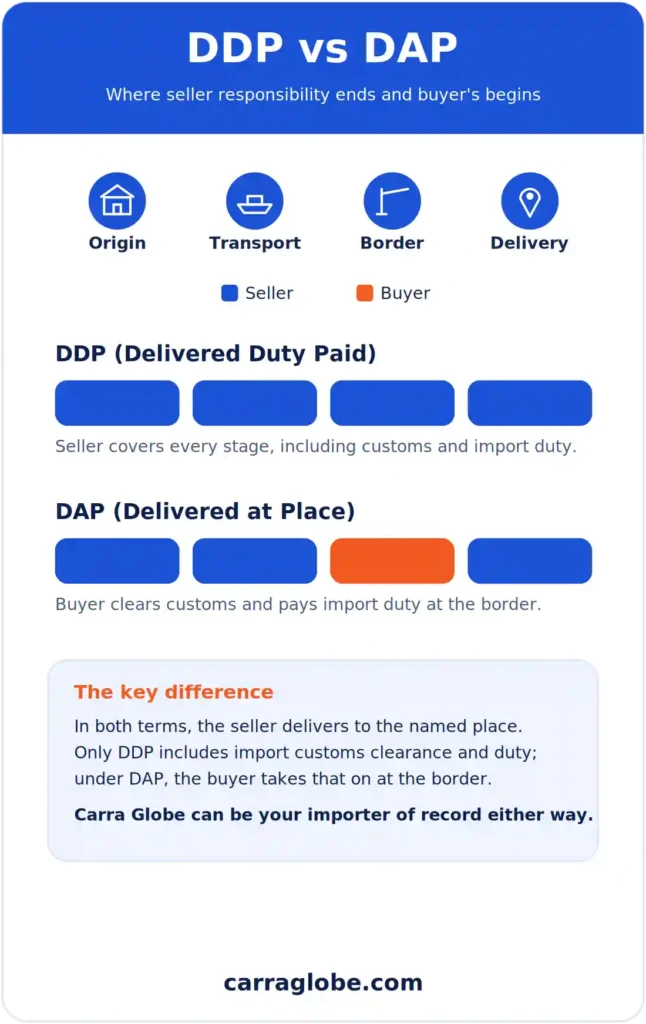
The DDP Trap Most Sellers Miss
Here is the part that the standard DDP-versus-DAP explainer leaves out, and it is the part that matters most. Choosing DDP on the contract does not, by itself, make a smooth delivery happen. Incoterms define who is financially and legally responsible. They say nothing about whether you are actually able to execute that responsibility.
To clear goods as the importer in most countries, you need to be a recognised importer in that country, which usually means a local entity, a tax registration, and sometimes a power of attorney. A foreign seller agreeing to DDP without that footprint can find it cannot legally act as the importer of record at all. The term on the invoice says DDP, but the operational reality is that no one is positioned to clear the goods. The shipment stalls precisely where DDP was supposed to make it smooth.
This is the difference between DDP as a contract term and DDP as a physical delivery. Sellers who successfully ship DDP without global entities do so by appointing a local importer of record to legally clear the goods and pay the duty on their behalf. The importer of record is what turns DDP from a promise on paper into a delivered shipment. If you are new to the role, our explainer on what an importer of record is and does covers the fundamentals, and the distinction from a broker is set out in importer of record vs customs broker.
DDP vs DAP: When to Use Each
The right term depends on who is better placed to carry the import, and on how much the buyer experience matters to you. As a practical guide:
- Use DDP when the buyer is a consumer or lacks import experience, when you want a clean all-inclusive price and a delivery with no surprises, when you sell cross-border e-commerce, or when protecting the customer experience and conversion matters to your business.
- Use DAP when the buyer is an experienced importer with their own customs capability, when the buyer prefers to control clearance and duty in their own country, or when you genuinely cannot act as importer in the destination and have no importer of record to do it for you.
- Use DDP with an importer of record when you want the DDP experience but lack a local entity in the destination, which is the most common situation for sellers expanding into new markets.
One financial note that often tips the decision: under DDP you have to calculate the duty and tax accurately and build it into your price, so the landed cost has to be right. Our guide to calculating landed cost helps you model that before you commit to a DDP price.
Why DDP Is Becoming the Default in 2026
The DDP-versus-DAP balance has shifted recently, particularly for anyone shipping into the European Union. With the removal of the EU low-value import exemption, parcels now need a designated party to handle the duty and clearance, and a DAP parcel with no arranged importer can be rejected and returned rather than simply billed. We cover that change in our guides to the EU parcel tax from July 2026 and the EU de minimis change and the importer of record.
The practical effect is that DDP, executed through a proper importer of record, is becoming the safer default for cross-border sellers who want their goods to clear reliably. DAP still has its place for experienced importers, but the cost of getting it wrong, a returned parcel or a held shipment, has risen. For the mechanics of clearing DDP shipments worldwide, see our overview of DDP customs clearance.
Frequently Asked Questions
What is the main difference between DDP and DAP?
The main difference is who handles import clearance and pays the duty. Under DDP (Delivered Duty Paid) the seller clears customs and pays the import duty and tax in the destination country. Under DAP (Delivered At Place) the buyer does. Both terms put the seller in charge of transport and transit risk; they differ only at the import step.
That single difference drives everything else. DDP gives the buyer a clean, all-inclusive delivered price, while DAP leaves the buyer to handle clearance and duty on arrival.
Is DDP or DAP better for e-commerce?
DDP is generally better for e-commerce. It gives the customer one all-inclusive price with no surprise charges at the door, which reduces refused deliveries and protects conversion. Under DAP, customers can face unexpected duty bills on arrival, leading to delays, refusals, and a poor experience.
The one requirement is that you must be able to clear customs in the destination country to ship DDP, which sellers without a local entity usually achieve by appointing an importer of record.
Can I ship DDP if I do not have a company in the destination country?
Often not on your own, because clearing goods as the importer usually requires a local entity, a tax registration, or a power of attorney in that country. A foreign seller agreeing to DDP without that footprint can find it cannot legally act as the importer of record. The solution is to appoint an importer of record established in the destination who clears the goods and pays the duty on your behalf.
This is the most common way sellers offer DDP into markets where they have no presence. The importer of record turns DDP from a contract term into a shipment that actually clears.
Does choosing DDP guarantee a smooth delivery?
No. Incoterms like DDP define who is financially and legally responsible, not whether you can operationally execute it. Choosing DDP commits you to clearing customs and paying duty in the destination, but if you are not positioned to do that, the shipment can stall. A smooth DDP delivery depends on having the capability, usually an importer of record, behind the term.
This is the most common misunderstanding in the DDP-versus-DAP decision. The term sets responsibility; the execution depends on having the right party in place to carry it.
DDP and DAP differ by one line, but that line decides who carries the import and how the delivery feels to your buyer. DDP wins on customer experience and, increasingly, on reliability, provided you can actually clear the goods. For sellers who want to ship DDP without building an entity in every market, Carra Globe acts as importer of record and handles Delivered Duty Paid shipping across more than 175 countries, with freight forwarding and white glove delivery where the shipment needs it. If you are deciding between DDP and DAP for a route, talk to our team about which structure fits.