
There is a dangerous half-truth circulating in data centre procurement: that AI servers are duty-free. It is half right, and the other half is what blows up budgets. The base customs duty on a server is, in many markets, genuinely zero, because computers fall under an international agreement that eliminates the tariff. But in 2026 the duty line is the smallest part of the bill. What data centre operators actually pay to land AI hardware is a stack of charges, value-added tax, new sector-specific surcharges, and country-by-country tariffs, that sits on top of a duty rate that often reads as nothing. This guide breaks down AI server import duties as they really work in 2026, so you can budget for the landed cost rather than the headline.
This is for data centre operators, IT procurement and finance teams, hardware vendors, and anyone signing off the budget for imported compute. The goal is simple: replace the comforting myth of duty-free with an accurate picture of what crosses your books when the hardware crosses the border.
AI server import duties in 2026 are often zero at the base rate, because servers classified under Harmonized System heading 8471 are duty-free under the WTO Information Technology Agreement in many countries. But VAT, new Section 232 semiconductor surcharges, and country-specific tariffs can stack on top, so the real cost is the landed cost, not the headline duty.
Why the Headline AI Server Import Duty Is Often Zero
Start with the good news, because it is real. Servers and data processing machines are classified under Harmonized System heading 8471, and under the World Trade Organization’s Information Technology Agreement, most participating countries apply a zero percent most-favoured-nation duty to goods in this category. The United States, the European Union, the United Kingdom, and many other ITA participants treat a correctly classified server as duty-free at the base rate, though this is not universal across every country or every server configuration, and it can be confirmed against the official US Harmonized Tariff Schedule. So when a procurement team is told there is no duty on servers, they are not being lied to. They are being told one true line from a much longer bill.
The classification matters enormously here, because the zero rate depends on the goods sitting in the right place. Servers and most data processing machines fall under heading 8471, while networking equipment such as switches and routers generally sits under 8517, and storage under 8471.70. The duty-free treatment follows the correct code. Put the hardware in the wrong heading, and you can lose the exemption and acquire a duty that was never necessary, which is one reason classification is the most expensive mistake in the whole process, as we explain in our guide to the cost of incorrect HS codes.
AI Server Import Duties: What Actually Stacks on Top in 2026
Here is where the duty-free myth falls apart. The zero base rate is the floor, not the total, and 2026 has added several layers that land squarely on AI hardware. Understanding the stack is the difference between a budget that holds and one that does not.
- Value-added tax or its equivalent. This is the big one operators forget. The EU charges import VAT on the landed value of the goods, at rates that commonly run around 20 percent or more depending on the member state. The UK applies import VAT similarly. VAT is often recoverable by a VAT-registered importer, but it still has to be funded at the border, which is a real cash-flow event on a large hardware order.
- Section 232 semiconductor surcharges. Under a January 2026 Presidential Proclamation, the United States introduced a 25 percent duty on certain advanced semiconductors and derivative products containing logic integrated circuits, reaching articles classified under HTSUS subheadings 8471.50, 8471.80, and 8473.30 where they meet defined technical parameters. Importantly for this audience, the measure carries end-use exceptions, including a notable one for semiconductors used in US data centres above 100 megawatts, so whether a given AI server is actually charged depends on its classification, its technical specification, and its end use.
- Reciprocal and country tariffs. The US tariff landscape in 2026 has been unusually fluid, with reciprocal and country-specific measures whose rates and legal bases shifted during the year following court rulings. Whether any apply to a given shipment depends on origin, timing, and the rules in force on the entry date, so the position should be checked at the time of import rather than assumed.
- Origin-based tariffs. Goods of certain origins, particularly China, can face additional duties that stack on top of everything else. The same server can carry a very different total depending solely on where it was made.
The crucial point is that these layers stack. A server can enter at a zero base duty, then carry import VAT, then a sector surcharge, then an origin tariff, and the total landed cost can move from nothing to a substantial percentage of the hardware value. Budgeting from the headline duty alone is how procurement teams get surprised by a five or six figure bill at the border.
Need the true landed cost of your AI hardware before you commit? Carra Globe acts as importer of record for AI servers and GPU clusters, classifying correctly, calculating the full duty stack, and clearing the hardware across more than 175 countries.
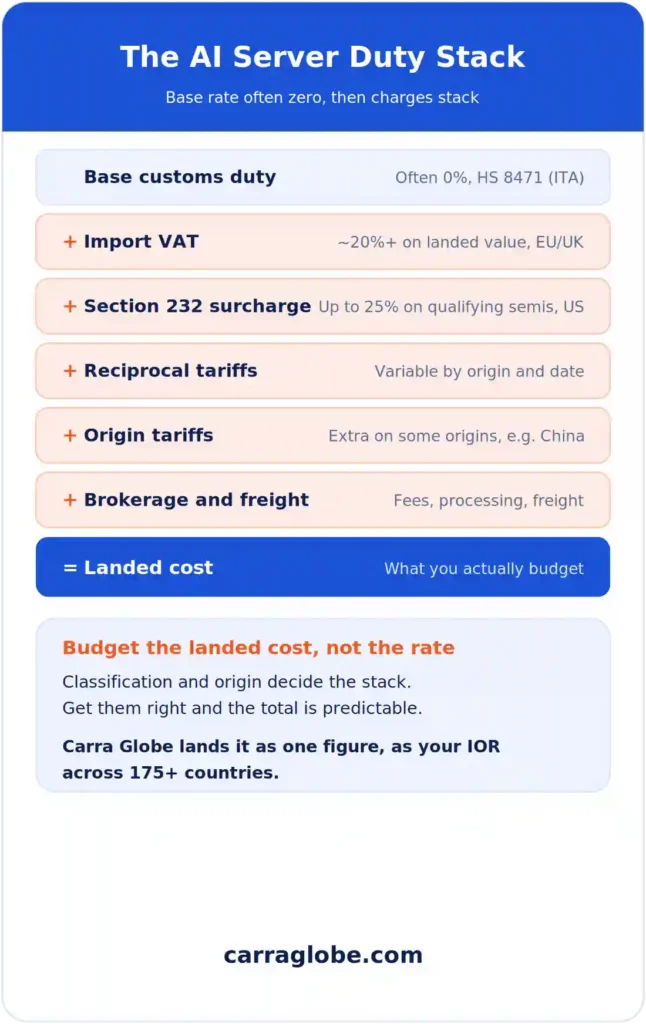
How Much Does It Cost to Import an AI Server? A Worked View
The honest answer to how much it costs is that it depends on three things: where the server was made, where it is going, and exactly how it is classified. But the structure of the cost is consistent everywhere, and it helps to see it as a stack rather than a single number.
| Cost Layer | Typical Treatment for AI Servers in 2026 |
|---|---|
| Base customs duty | Often zero under the ITA for correctly classified servers (HS 8471) |
| Import VAT or equivalent | Applied to landed value in the EU, UK, and many markets; often recoverable but must be funded |
| Section 232 semiconductor surcharge | Up to 25 percent on qualifying semiconductor-containing goods entering the US, by classification |
| Reciprocal or country tariffs | Variable in 2026 by origin and timing, stacking on the base rate |
| Origin tariffs | Additional duties on certain origins, notably China, stacking on top |
| Brokerage, fees, and freight | Customs processing fees, brokerage, and freight added into the landed total |
The number to budget is the landed cost, not the duty rate. To model it before you ship, our landed cost guide walks through building duties, taxes, and fees into a single figure you can plan against.
How Origin Changes the AI Server Import Bill
One factor moves the total more than any other: where the server was manufactured. This is not a minor detail in 2026, because the global production map for AI servers has shifted deliberately, with manufacturing moving out of China and into Taiwan, Mexico, the United States, and parts of Southeast Asia and Europe. That shift is partly a tariff story, and it changes what you pay.
A server of Chinese origin can attract origin-based tariffs that a server assembled in Taiwan or Mexico does not, even when the two are otherwise identical. This is why so much AI server assembly has relocated, and why the origin on your commercial invoice is a cost variable, not just a label. We map the full manufacturing and trade picture in our analysis of AI server trade flows in 2026, which explains why the same hardware can land at very different totals depending on its export node.
For an operator, the lesson is to treat origin as a procurement decision with a cost attached, and to confirm the classification and origin position before committing, because both feed directly into the duty stack. The export-control dimension of this, which governs whether the hardware can move at all, is covered in our guide to ITAR and EAR compliance for IT hardware.
How to Control What You Pay
The duty stack sounds intimidating, but it is controllable. The operators who land AI hardware predictably do a small number of things consistently, before the shipment moves.
- Classify precisely. Confirm the correct HS heading for each item, because the duty-free treatment and the surcharge exposure both depend on it.
- Confirm origin early. Know where the hardware was manufactured and what tariffs that origin attracts, before you sign the purchase order.
- Model the full landed cost. Build VAT, any surcharges, brokerage, and freight into one figure, rather than budgeting from the duty line.
- Use a single accountable importer. An importer of record that handles classification, the duty calculation, and clearance keeps the cost predictable and the entry compliant.
AI Server Landed Cost Checklist
- Base customs duty (often zero under the ITA for HS 8471)
- Import VAT or equivalent on the landed value
- Any Section 232 semiconductor surcharge, by classification and end use
- Any reciprocal or origin tariff in force on the entry date
- Brokerage, customs processing fees, and freight
Done together, these turn the duty stack from a surprise into a line item you control. That is precisely the role of a sector-aware importer of record for AI hardware, set out on our importer of record for data centre equipment page, and the broader enforcement context is in our 2026 importer of record landscape report.
Frequently Asked Questions
Are AI servers really duty-free to import?
Often at the base rate, yes, under the WTO Information Technology Agreement for HS 8471. But VAT, sector surcharges, and origin tariffs stack on top, so the landed cost is rarely zero.
The headline duty being zero is true but incomplete. The number to budget is the full landed cost, which includes tax and any applicable 2026 surcharges, not the base duty rate alone.
What is the HS code for an AI server?
Servers fall under Harmonized System heading 8471, networking under 8517, and storage under 8471.70. The exact subheading determines both duty and surcharge exposure.
Correct classification is what preserves the duty-free base rate and decides whether any 2026 semiconductor surcharge applies, so it is worth confirming precisely rather than assuming.
Why did my AI server import cost more than the duty rate suggested?
Because VAT and 2026 surcharges stack on the base duty. A server can be duty-free at the base rate yet still carry import VAT, a Section 232 surcharge, or an origin tariff.
This is the most common budgeting surprise in data centre procurement. Modelling the full stack before shipping prevents the unexpected bill at the border.
Does where the AI server is made change the import duty?
Yes, significantly. Origin determines which tariffs apply. A server of Chinese origin can attract additional duties that an identical one assembled in Taiwan or Mexico does not.
Origin is therefore a cost variable, not just a label on the invoice. Confirming it before purchase lets you anticipate the duty stack rather than discover it at clearance.
The duty-free headline on AI servers is true at the base rate and misleading as a budget. What a data centre operator actually pays in 2026 is a stack: a zero or low base duty, import VAT, any applicable Section 232 surcharge, and origin tariffs, assembled into a landed cost that turns on classification and origin. Get those right and the number is predictable. Get them wrong and the border is where you find out.
Carra Globe works at that layer, acting as importer of record for AI and data centre hardware, with Delivered Duty Paid clearance that lands the full cost as one figure.
Disclaimer: This guide is for informational purposes only and does not constitute legal, customs, tax, or trade advice. Duty rates, tariffs, VAT, and surcharges vary by country, origin, classification, and date, and change frequently. The 2026 measures described here are summarised from publicly reported information at the time of writing. Always verify current rates with the relevant customs authority or qualified counsel before importing.