
For most of the last decade, the dominant force in cross-border trade was frictionlessness. Thresholds rose, parcels flowed, and the importer of record was a box on a customs form that, for low-value goods, barely mattered. That era is over. Across 2025 and 2026, the world’s largest economies dismantled the duty-free treatment of low-value imports, tightened enforcement on who may import, and pushed the legal and financial weight of compliance back onto a single accountable party. The result is that the importer of record in 2026 has moved from a formality to one of the most consequential decisions a cross-border business makes. This is an analysis of how that shift happened, what it now costs to get it wrong, and where it leaves importers.
The through-line connecting every major trade development of the past eighteen months is the same: accountability is being concentrated, not dispersed. Whether the headline is de minimis, tariffs, export controls, or enforcement, the underlying movement is identical. Someone now has to be clearly, legally, and financially responsible for each import, and the systems that used to blur that responsibility are being removed. Understanding that single pattern explains the whole landscape.
The importer of record in 2026 is the legally accountable party for an import, responsible for classification, duty, and compliance. Its significance has risen sharply because the US, the EU, and others ended duty-free treatment of low-value goods and tightened enforcement, concentrating liability on the importer rather than dispersing it across a frictionless parcel system.
For readers tracking importer of record trends in 2026, the headline shifts in cross-border compliance this year are these:
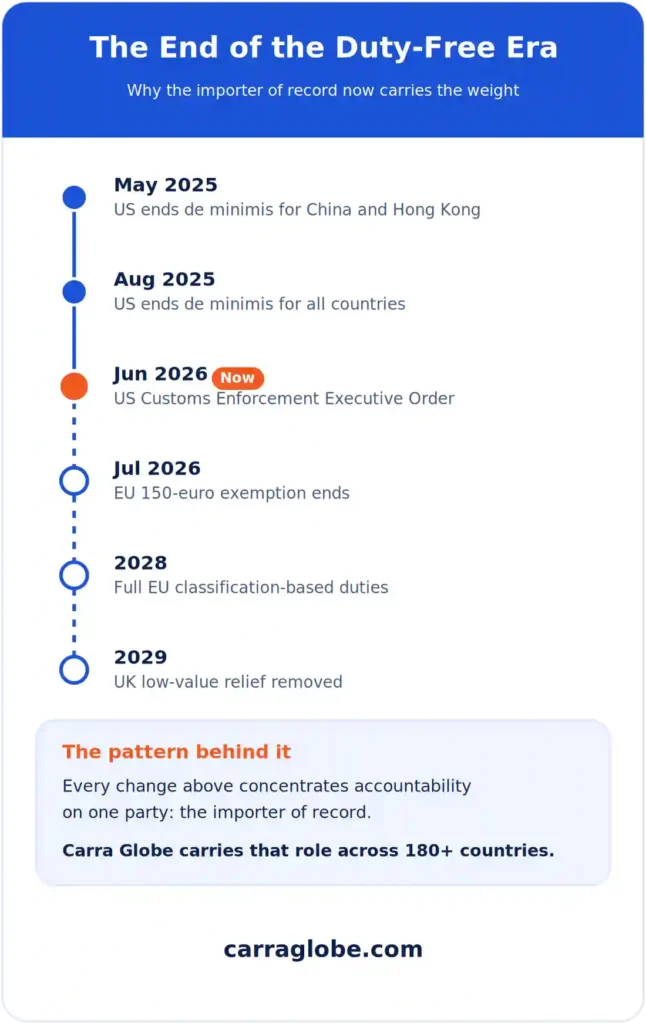
- US de minimis ended. Duty-free treatment for sub-800-dollar parcels was suspended for China and Hong Kong in May 2025 and for all countries in August 2025.
- EU de minimis ends 1 July 2026. The 150-euro exemption is replaced by a transitional duty per item category, with full duties expected by 2028.
- Enforcement tightened. The June 2026 US Customs Enforcement Executive Order raised bonding, good-standing, and foreign-importer requirements.
- Tariffs and controls multiplied. Section 122 and 232 measures, semiconductor export controls, and EU radio cybersecurity rules all raised the stakes on classification.
- Liability concentrated. Across all of these, the question of who is liable for imports in 2026 now points to one accountable party: the importer of record.
The Shift That Defined 2026: The End of De Minimis
The clearest expression of the new era is the collapse of de minimis, the rule that let low-value parcels enter duty-free. The numbers explain why governments acted. More than 1.36 billion low-value parcels entered the United States in fiscal year 2024, and roughly 5.9 billion low-value consignments entered the European Union in 2025, with over ninety percent originating from China. A system designed in a different century to spare customs the cost of processing tiny parcels had become the primary channel for a flood of imports that authorities could neither inspect nor tax.
So they closed it. The United States suspended duty-free de minimis treatment for China and Hong Kong on 2 May 2025, then for all countries on 29 August 2025, ending the 800-dollar exemption that had underpinned a decade of cross-border e-commerce.
The European Union followed: its 150-euro customs duty exemption ends on 1 July 2026, replaced by a transitional flat duty per item category under Council Regulation (EU) 2026/382, ahead of full classification-based duties tied to the launch of the EU Customs Data Hub for e-commerce in 2028, which then scales to a mandatory rollout for all traders by 2038, as set out in the European Commission customs reform. The United Kingdom has confirmed its own relief will be removed by 2029, and Thailand, Romania, and Italy have already introduced their own low-value import charges. This is not a series of national decisions. It is a coordinated global reversal.
The analytical point that most coverage misses is what the end of de minimis does to liability. When a parcel was duty-free, it did not much matter who the importer of record was, because there was nothing to pay and little to get wrong. Remove the exemption, and every one of those parcels now needs a party who is accountable for the duty, the classification, and the customs entry. As one customs authority framed it, low value no longer means low regulatory impact. The end of de minimis did not just add a cost. It created hundreds of millions of new points where an importer of record is now required and where an error now has consequences. We analyse the EU mechanics in detail in our breakdown of the EU de minimis change and the importer of record.
US Versus EU: The Same Direction, Different Mechanics
The US and EU reached the same destination by different routes, and the distinction matters for anyone planning cross-border flows. The US approach was abrupt and total: duty-free treatment was suspended outright, and from day one every shipment, regardless of value, became subject to applicable duties and formal customs treatment. The EU approach is staged: a transitional flat duty per item category from July 2026, then full classification-based duties as the EU Customs Data Hub rolls out, beginning with e-commerce in 2028 and becoming mandatory for all traders by 2038.
The practical effect is that US-bound sellers faced an immediate cliff, while EU-bound sellers face a two-step climb. For e-commerce businesses, both routes end the duty-free model that underpinned cross-border direct-to-consumer shipping. For B2B importers moving commercial volumes, the change is less about the per-parcel duty and more about the tightened enforcement and classification scrutiny that now surrounds every entry. In both cases, the importer of record is the party that absorbs the new complexity.
The Enforcement Turn: Liability Concentrates on the Importer
If the end of de minimis created the new liability, enforcement is what gave it teeth. The same eighteen months saw a decisive tightening of who may act as an importer and what happens when they get it wrong.
Who Is Liable for Imports in 2026?
The short answer is the importer of record, and more squarely than ever before. In 2026 the legally accountable party for an import carries the duty, the classification, the valuation, and the compliance position, and the recent enforcement changes have made that accountability harder to dilute or pass off. Where a frictionless parcel system once spread responsibility so thinly that no one really held it, the current direction is the opposite: liability is being pushed onto one identifiable, answerable importer of record, whose standing the authorities and the filing brokers now actively check.
In the United States, the June 3, 2026 Customs Enforcement Executive Order raised the bar across the board, setting a 180-day implementation window for higher bonding requirements, a demand for minimum tangible domestic assets, good-standing tests, restrictions on foreign importers of record using informal entry, a minimum penalty floor with no mitigation for repeat offenders, and mandatory due diligence by customs brokers on the importers they file for.
Read together, these measures do one thing: they make the identity and standing of the importer of record the gatekeeping question of an import, not an afterthought. We cover the detail in our analysis of the 2026 Customs Enforcement Executive Order.
This is the second pillar of the 2026 landscape, and it reinforces the first. De minimis removal means more imports need an accountable importer. Enforcement tightening means that importer must be more substantial, better documented, and more carefully chosen than before. A structure that cleared goods quietly in 2024 can be a liability in 2026. The direction is unmistakable: the importer of record is being asked to carry more, prove more, and answer for more.
Reassessing who acts as your importer of record across markets in light of 2026’s changes? Carra Globe provides importer of record services across more than 180 countries, carrying the accountable-party role so your imports clear under a structure built for the new enforcement environment.
The Tariff and Control Layer: Why Classification Now Carries Risk
The third force shaping the importer of record in 2026 is the sheer growth in what an import can trigger. Tariffs and controls have multiplied, and each one turns on the same things the importer of record is responsible for: classification, origin, and end use.
On the tariff side, the Section 122 balance-of-payments surcharge, introduced in early 2026, survived a legal challenge and a Federal Circuit stay, and continued to be collected while the litigation ran. Section 232 assessments moved to full customs value. The legal landscape shifted repeatedly as courts weighed the limits of executive tariff power. For an importer, the lesson is not which specific measure applies on a given day, but that the cost of a misclassification or an unclear origin position has risen sharply, because more duties now hang off those determinations.
On the control side, the picture is the same in a different register. Semiconductor manufacturing equipment faces tightening export controls from the United States, the Netherlands, and Japan. The EU’s Radio Equipment Directive made cybersecurity requirements, under the EN 18031 standards, mandatory for connected devices from August 2025. Export-control regimes increasingly reach not just the sale of controlled goods but their servicing and support. In every case, compliance has become more technical and less forgiving, and the importer of record is the party that has to navigate it. The cost of getting classification wrong, once a rounding error, is now a material risk, as we set out in our analysis of the cost of incorrect HS codes.
The Importer of Record in 2026: What It Now Costs to Get Wrong
Pulling the three forces together, the cost of getting the importer of record decision wrong in 2026 falls into four categories. Each was minor in the duty-free era and is now significant.
| Failure | Pre-2025 Consequence | 2026 Consequence |
|---|---|---|
| No designated importer on a low-value parcel | None; the parcel entered duty-free | The parcel is held, billed, or returned to sender |
| Misclassification of goods | Limited; little duty was at stake | Immediate duty liability, penalties, and audit exposure |
| A weak or foreign importer of record structure | Generally accepted | Restricted entry, higher bonding, and enforcement scrutiny |
| Ignoring export or product controls | Often overlooked | Held shipments, denied entry, and compliance penalties |
The table captures the core of the analysis. None of these failures was costly when imports were frictionless and low-value goods were duty-free. All of them are costly now. The importer of record sits at the centre of every row, because it is the party legally answerable for the classification, the duty, the structure, and the controls. For the importer of record, 2026 has turned a formality into the decision that determines whether goods clear at all.
The Structural Response: Consolidation and the Operational Importer
Faced with this, the businesses adapting fastest are converging on two responses. The first is consolidation: replacing millions of individual, consumer-facing duty events with fewer, larger commercial imports cleared by a single accountable importer. The end of de minimis makes the old model, where every parcel was its own micro-import, untenable at scale, and the structural answer is to import in bulk and distribute domestically. This is why bonded warehousing and in-market fulfilment have become strategic rather than operational decisions.
The second response is the shift from a paper importer of record to an operational one. The enforcement turn has made the thin, nominal importer, a name on a form with no real substance, a liability. What the 2026 environment rewards is an importer of record with genuine standing, real compliance capability, and the ability to carry classification, controls, and duty across markets consistently. The distinction between a nominal and an operational importer, which we examine in our comparison of paper IOR versus operational IOR, has gone from a quality preference to a risk question.
This shift is one of the clearer importer of record trends in 2026. As bonding requirements rise and brokers are made to vet the importers they file for, a nominal importer with no domestic substance struggles to meet the bar at all. The operational importer, by contrast, holds real registrations, carries the compliance function in-house, and can demonstrate the good standing that enforcement now demands. The market is, in effect, repricing the importer of record role, paying a premium for substance and penalising the shell. For businesses, the practical question has changed from how cheaply they can name an importer to whether their importer can actually withstand scrutiny.
For businesses operating across several countries, these two responses point to the same conclusion: a single, capable importer of record coordinating compliance across all markets, rather than a patchwork of local arrangements where the weakest link sets the risk. The deeper the regulatory complexity becomes, the greater the advantage of consolidating that complexity under one accountable party. This is the structural logic behind the importer of record model, and the importer of record landscape in 2026 has strengthened it in every category, from data centre equipment to semiconductor tools to consumer goods.
The 2026 Outlook: Where the Landscape Goes Next
The trajectory for the rest of 2026 and beyond is a continuation of the same pattern, not a reversal of it. Three developments are worth watching.
First, the EU’s transition will deepen. The flat transitional duty that begins in July 2026 is a way station, not a destination. Full classification-based duties follow as the EU Customs Data Hub rolls out, starting with e-commerce consignments in 2028 and scaling to mandatory use for all traders by 2038, which will make accurate classification on every parcel mandatory rather than optional. Businesses that treat the 2026 change as the end of the story will be unprepared for the larger change behind it.
Second, enforcement will keep concentrating accountability. The direction of US policy, more bonding, more vetting, more due diligence, more personal and corporate responsibility for the importer, shows no sign of loosening, and other jurisdictions tend to follow the largest market. The importer of record will be asked to prove more, not less.
Third, the gap between businesses that restructured and those that did not will widen. The end of de minimis and the enforcement turn are not equally hard on everyone. They are severe for businesses that built their model on the old exemptions and have not adapted, and manageable, even advantageous, for those that restructured their importing ahead of competitors. The landscape rewards preparation and punishes inertia, and that gap compounds over time.
Frequently Asked Questions
Why has the importer of record become more important in 2026?
Because duty-free treatment of low-value imports ended and enforcement tightened. The US and EU removed de minimis exemptions, so hundreds of millions of parcels now need an accountable, well-standing importer to clear.
The role shifted from a formality to a gatekeeping decision. The underlying pattern across every 2026 trade change is the concentration of accountability on a single legally responsible party, which is precisely what the importer of record is, and it is why the importer of record landscape in 2026 looks so different from the duty-free era.
What changed with de minimis in 2025 and 2026?
The US suspended duty-free de minimis for China and Hong Kong in May 2025, then all countries in August 2025. The EU’s 150-euro exemption ends 1 July 2026, replaced by a transitional per-item duty.
Full EU duties are expected by 2028, and the UK, Thailand, Romania, and Italy are moving in the same direction. The common effect is that low-value parcels now require formal customs treatment and an accountable importer, which is the structural reason the importer of record has become central.
How has enforcement changed for importers of record?
US enforcement tightened sharply in 2026. The June Customs Enforcement Executive Order raised bonding, demanded domestic assets and good standing, restricted foreign importers, set a penalty floor, and mandated broker due diligence.
The effect is that a weak or nominal importer of record structure is now a liability rather than a convenience. This rewards an operational importer of record with genuine standing and compliance capability over a thin paper arrangement, and it is pushing businesses toward more substantial, better-documented importing structures.
What should businesses do in response to the 2026 landscape?
Audit which shipments relied on old exemptions, confirm who acts as importer of record across markets, and assess whether that structure meets the new enforcement bar.
Many businesses are consolidating millions of small parcels into fewer commercial imports and appointing a single capable importer of record across markets rather than a patchwork of local arrangements. The businesses adapting fastest treat the importer of record decision as strategic, not administrative, because in the 2026 environment it determines cost, risk, and whether goods clear at all.
The duty-free, low-accountability era of cross-border trade ended in 2025 and 2026, and it is not coming back. What replaces it is a landscape where a single accountable party carries the weight of classification, duty, controls, and compliance, and where the choice of that party shapes cost and risk across an entire business. For companies navigating this shift, Carra Globe acts as importer of record across more than 175 countries, with Delivered Duty Paid shipping, warehousing and logistics, and global trade compliance built for the new environment. To assess your importing structure against the 2026 landscape, talk to our team.