
An AI operator orders a liquid-cooled GPU cluster, and importing data centre coolant is the last thing on anyone’s mind. The order covers millions of dollars of accelerators, the racks, the cooling distribution units and the fluid. The hardware gets all the attention, and it usually clears customs without drama. The line that can get held, or cannot legally be used in the country at all, is the cheapest one on the order. The coolant.
The short version. A liquid-cooled deployment is two imports on one purchase order. The servers are an IT hardware import. The coolant is a chemical import, and a customs hold on that one line can strand the whole deployment. Direct-to-chip coolant is the easy case. Single-phase immersion oils are PFAS-free but still need handling and paperwork. Most two-phase immersion fluids fall within broad PFAS definitions and face rules that differ by market and are still moving. Classify the fluid separately from the servers, and check it market by market before the design is locked.
Carra Globe provides importer of record, exporter of record, delivered duty paid and freight forwarding services, so we have a commercial interest in your answer. What follows is written to be usable whether or not you ever speak to us.
This is new for most technology importers. Until recently most data centres were air-cooled, and the only fluid on site sat in the chillers. Cooling systems now sit with transformers, switchgear, generating sets and prefabricated modules on the critical path of a data centre build.
Why AI Hardware Forced the Move to Liquid
In short, air cannot carry enough heat away from the densest AI racks.
Air has a low heat capacity. Once a rack draws tens of kilowatts, the fans needed become too large, too loud and too hungry for the power budget. The latest AI accelerators push rack densities well past that point.
It is part of the same wave of data centre and AI hardware imports, driven by the AI server trade flows running through a few manufacturing hubs. Our data center solutions cover the full deployment, from racks to fluid.
There are two main ways to cool with liquid.
- Direct-to-chip. Coolant runs through cold plates mounted on the GPUs and accelerators, without touching the electronics.
- Immersion. Whole servers sit in a dielectric fluid that does not conduct electricity, and heat passes straight into the fluid.
Both work. They differ enormously in how hard they are to import, and the reason is the fluid.
Importing Liquid Cooling for Data Centers: The Fluid Adds a Chemical Import
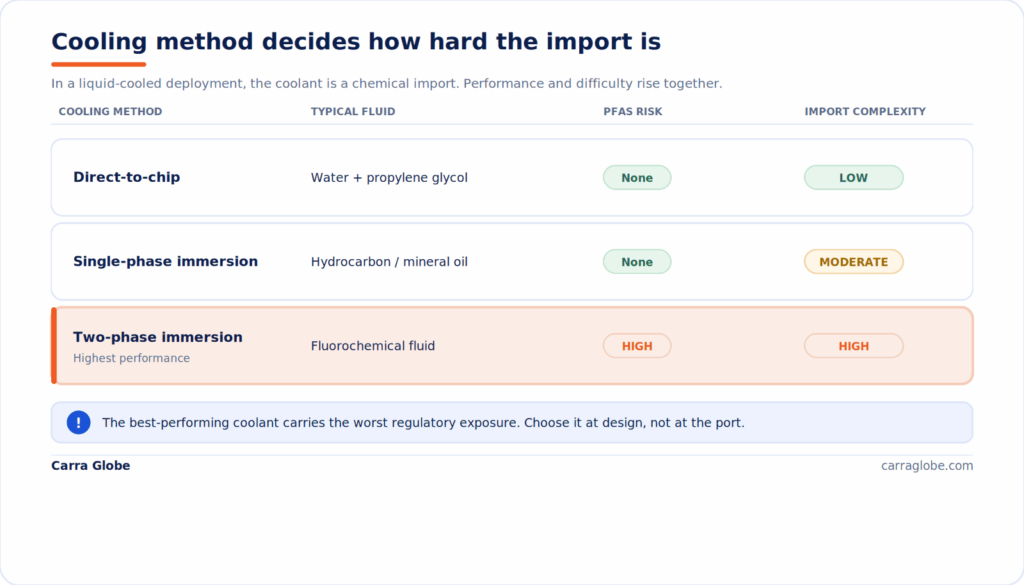
In short, the cooling method decides the fluid, and the fluid largely decides how hard the import is.
- Direct-to-chip, the easy case. Mostly a water and glycol mix, commonly around 25% propylene glycol, the same kind of fluid used in building chiller loops. The Open Compute Project’s September 2026 guidelines define this PG25 blend as 24.5 to 27.5 percent propylene glycol by volume. A conventional blend is not PFAS and is not generally a dangerous good, but confirm the exact formulation’s transport classification on its safety data sheet. The harder work sits with the servers, covered in shipping AI servers internationally.
- Single-phase immersion, the middle case. Mostly synthetic hydrocarbon or highly refined mineral oils, which are PFAS-free and fairly straightforward to move, but still a fluid with handling and documentation requirements. A few single-phase fluids are fluorinated, so check the exact product.
- Two-phase immersion, the hard case. One of the highest-performing options, historically built on engineered fluorochemical fluids. Most of those fall within broad PFAS definitions, and even newer fluids are contested, with Chemours saying its HFO-based fluid should not be classed as PFAS. That is where the border problem lives, so confirm the exact substance.
| Cooling method | Typical fluid | PFAS exposure | Import complexity |
|---|---|---|---|
| Direct-to-chip | Water and propylene glycol blend | None | Low. Familiar industrial fluid, standard SDS |
| Single-phase immersion | Synthetic hydrocarbon or mineral oil | None for hydrocarbon and mineral oils. Check any fluorinated product | Moderate. Handling and documentation needs |
| Two-phase immersion | Engineered fluorochemical fluid | High. Most established fluids fall within broad PFAS definitions | High. Supply shift plus market-by-market PFAS rules |
Cooling performance and import difficulty rise together. The method that handles the most heat is the one in the middle of the regulatory shift.
The PFAS Problem That Reshaped the Whole Market
In short, the main supplier left, and the rules are different in every market and still changing.
On 20 December 2022, 3M announced it would exit all PFAS manufacturing by the end of 2025, citing accelerating regulatory trends and changing stakeholder expectations. In June 2023 it agreed a settlement worth up to $10.3 billion with US public water suppliers over PFAS contamination. 3M says it completed that exit at the end of 2025, removing a major source of the established fluorochemical fluids that made two-phase immersion work.
That hits procurement in two ways.
- New fluids. Replacements from other chemical makers may be recently commercialised, each with its own classification, safety data sheet and open regulatory questions.
- A moving front. The pressure behind the exit is not one ban with one date. It looks different in every market you import into.
European Union
- A universal PFAS restriction proposal covering thousands of substances has been in the REACH process since 2023.
- ECHA published an updated version on 20 August 2025, assessing more sectors and adding options that would allow continued use where risks can be controlled, alongside time-limited derogations.
- Its risk assessment committee adopted its opinion on 2 March 2026. The socio-economic committee’s final opinion is expected by the end of 2026, then the European Commission decides, so treat derogations and transition periods as unsettled until then.
- So a given immersion fluid’s EU status is not a fixed yes or no. It turns on the exact substance, the use and where the process has reached.
United States
- There is no single federal import ban on these fluids.
- EPA’s one-time TSCA section 8(a)(7) PFAS reporting rule has had its deadline moved more than once. Under a rule published on 13 April 2026, the reporting period starts on 31 January 2027, or 60 days after a revised rule takes effect if that comes first.
- In November 2025 EPA proposed exemptions, including for imported articles, and as at 15 October 2026 they were still proposals. The rule’s own definition of an article excludes fluids, so do not assume that exemption covers a coolant.
- State laws add their own reporting deadlines and future bans on intentionally added PFAS, so check the state where the facility is being built as well as the federal position, for example through our US importer of record guide.
Deploying liquid-cooled infrastructure across more than one country? A coolant that is easy to import into one market may be restricted or reportable in another. Carra Globe acts as importer of record for data centre and AI infrastructure across 175+ countries and runs the hardware and the fluid as one compliance workflow.
Plan your liquid-cooled deployment with Carra Globe
What Changes When Your Import Becomes a Chemical Import
In short, even a harmless coolant brings checks dry hardware never had.
- A safety data sheet. Correct, current and available for every fluid.
- A transport classification. Chemistry and flash point decide whether it moves as an ordinary fluid or as dangerous goods, with the packaging, labels and documents that brings, much as lithium batteries carry rules dry hardware does not.
- Market access. Whether the substance is restricted, reportable or needs registration or notification in each destination.
- Volume planning. Filling an immersion deployment takes real volume, which shapes how the fluid ships and sits in warehouse storage.
- Its own tariff code. Assess it separately rather than assuming it follows the servers. Depending on the product it may sit with mineral oils, chemical preparations or antifreeze mixtures, not with the IT hardware.
A customs entry for a liquid-cooled cluster is really two classifications in one, with the servers under their headings and the fluid under its own. Getting that classification right across a mixed shipment is line-by-line work, and our HS code finder is a quick first check.
None of this is insurmountable, but it is unfamiliar to a dry hardware team, and unfamiliarity is how timelines slip. It also comes on top of the certification and export control gates the GPUs already have to pass, and the fire documentation for the cabling in the same hall.
The Decision Is a Procurement Decision, Made Early
In short, the fluid is chosen when the facility is designed, so check it then.
By the time hardware ships, the cooling choice is locked. It sits on the critical path of a data centre construction programme that runs in waves over months. If two-phase immersion carries the most regulatory risk in your market, find out while the design is still on paper, not when the fluid is held at the port.
- Name the exact fluid. “Immersion fluid” is not an answer a regulator accepts. The specific substance decides the safety data sheet, the transport class and the PFAS status, so get it from the cooling vendor first.
- Check it in each destination. A fluid that ships freely into one country may be reportable or restricted in another.
- Classify it separately from the hardware. Confirm whether it is dangerous goods and which tariff heading applies. That gives the true cost and lead time, which the hardware quote leaves out.
- Re-confirm before it ships. On a long build the PFAS rules can move, so re-check a fluid that was compliant at design. This is core trade compliance work, not a logistics afterthought.
The hardware is what the budget is built around, and it is the easier part to bring across a border. The fluid that keeps it running is a chemical, and for the best-performing cooling it sits in a regulatory shift that is still moving. Treat the coolant as its own import from day one.
How Carra Globe Handles Liquid-Cooled Deployments
We act as importer of record for the hardware and the fluid together, and as exporter of record when equipment or fluid leaves again. That covers the AI server and GPU clusters and the coolant on the same purchase order, which is a large part of what an importer of record does on a liquid-cooled build.
Carra Globe works through importer-side registrations and local importing structures appropriate to the goods and destinations it accepts, its own in some markets and established local structures in others. Approvals falling outside the available structure are flagged before a delivery date is agreed. Send the fluid’s name, safety data sheet and destinations to info@carraglobe.com and we will tell you what each market requires.
Frequently Asked Questions
Is importing data centre coolant harder than importing the servers?
Often, yes. Servers are dry electronics with well-understood classifications. Coolant is a chemical that needs a safety data sheet, a transport classification and sometimes PFAS checks that vary by market.
Are all immersion cooling fluids affected by PFAS restrictions?
No. Single-phase hydrocarbon and mineral oils are PFAS-free. The issue centres on fluorochemical fluids used in two-phase immersion. Direct-to-chip water-glycol is not a PFAS concern.
Can a coolant be legal to buy but restricted to use in my country?
Yes. A fluid can be available from a supplier while being restricted or reportable where you are building. Availability and market access are different questions.
Does the coolant need its own customs classification?
Yes. The fluid is classified separately from the servers, often with mineral oils or chemical preparations. A liquid-cooled deployment is effectively two imports on one purchase order.
Is direct-to-chip coolant classed as dangerous goods?
Usually not. Water and propylene glycol blends are not generally dangerous goods, but confirm the transport classification on the supplier’s safety data sheet for the exact product.
Does the US PFAS reporting exemption for imported articles cover coolant?
Unlikely. The rule’s definition of an article excludes fluids, and as at 15 October 2026 the proposed exemptions were not final. Check EPA’s current requirements before importing.
Adjacent ground: export controls on data centre hardware, importing NVIDIA H200 servers and the EU Battery Regulation for importers.
Sources and verification
Sources checked on 15 October 2026.
- EU PFAS restriction. ECHA, perfluoroalkyl chemicals (PFAS), on the universal restriction proposal and its committee opinions. European Commission transition pathways, ECHA publishes updated PFAS restriction proposal, dated 20 August 2025.
- US reporting start date. Federal Register, 13 April 2026, submission period begins 31 January 2027 or 60 days after the forthcoming final rule takes effect, whichever is earlier. 40 CFR 705.3, the definition of article, which excludes fluids.
- US PFAS reporting. EPA, TSCA section 8(a)(7) reporting and recordkeeping for PFAS, the November 2025 proposed exemptions and the April 2026 rule on the submission period.
- 3M exit. 3M’s announcement of 20 December 2022 on exiting PFAS manufacturing by the end of 2025, its statement that it completed the exit at the end of 2025, and its 22 June 2023 settlement with US public water suppliers of up to $10.3 billion, payable over 13 years.
- Contested PFAS status. Data Center Dynamics reporting of Chemours’ statement that it does not believe its HFO two-phase fluid belongs in the PFAS class.
- EU committee dates. RAC opinion adopted 2 March 2026, SEAC draft published 26 March 2026 for consultation to 25 May 2026, final SEAC opinion expected by the end of 2026, as reported by Covington.
- PG25 coolant. Open Compute Project, Guidelines for Using Propylene Glycol-Based Heat Transfer Fluids in Liquid Cooled Racks, September 2026.
Disclaimer: This article is for informational purposes only and does not constitute legal, customs, regulatory or dangerous goods advice. The classification and regulatory status of cooling fluids vary by exact substance, application, jurisdiction and date, and the PFAS landscape is changing. This article reflects the position as at 15 October 2026, so confirm the current transport classification and market access requirements for your specific fluid and destination with the relevant authority, the manufacturer’s safety data sheet or qualified counsel before importing.
Liquid Cooling · Coolant · PFAS
Clear the coolant as carefully as the GPUs it cools.
The servers clear as hardware. The fluid clears as a chemical. So the useful conversation is which exact fluid the design uses, how it classifies for transport and tariff, and whether it is reportable or restricted where you are building. Where an approval sits outside the structure available, you hear that before a delivery date is agreed.
- Importer of record in the Netherlands
- Importer of record in the UK
- Importer of record in Singapore
- Importer of record in the UAE
- Importer of record in Saudi Arabia
- Importer of record in India
- Importer of record in Japan
- Importing without a local entity
- How to choose an importer of record
- Lithium battery customs clearance
- Packaging standards for IT hardware
- Emergency spare parts clearance
- Cargo insurance for IT equipment
- White glove delivery
- EU digital product passport
Free tools HS Code Finder Volumetric Weight Calculator Pallet Calculator
Specifying a liquid-cooled build? Send the fluid name, safety data sheet, volumes and destinations. We will come back on classification, transport and PFAS status market by market.
Check my coolant import