
A hardware company moves production of its networking equipment from Shenzhen to a contract manufacturer outside Hanoi. The tariff maths works and the first Vietnamese-built units ship to the US and the EU. Then a routine customs examination in Rotterdam pulls a unit, and the compliance team finds the new factory swapped the wireless module for one from its own supplier. The certification on file describes a device that is no longer being built.
Moving production to a new country does not, by itself, void a product certification. An FCC authorisation, a CE marking, a BIS registration, or a SABER certificate follows the product design, not the factory address. The certification breaks when the new manufacturer changes the product, and new manufacturers almost always do, because they re-source components from their own suppliers.
The China Plus One shift accelerating through 2026 has made this a live problem. Companies focus on the tariff saving and discover the certification gap at a border, usually in the hands of whoever provides their IOR services. Knowing which parts of a certification travel with the design, and which break when a component changes, is the difference between a clean transition and a shipment sitting in bonded storage while a re-certification runs.
Does Moving Your Factory Void Your Product Certification?
Not on its own. A product certification attaches to a defined product, meaning a specific design, bill of materials and set of test reports. The factory location is not usually part of that definition, so an identical product built elsewhere generally keeps its certification. Some companies wrongly re-test everything after leaving China, while others wrongly assume nothing has changed. What matters is whether the product coming off the new line is the product that was tested, and in practice that is exactly what changes.
The Real Trigger: Your New Factory Re-Sources Components
When a contract manufacturer in Vietnam, India, or Mexico takes over a product previously built in China, it builds it with its own supply chain. The wireless module, antenna, power supply or oscillator comes from suppliers it already uses. Each market also carries its own import and registration requirements that do not transfer from the old Chinese arrangement.
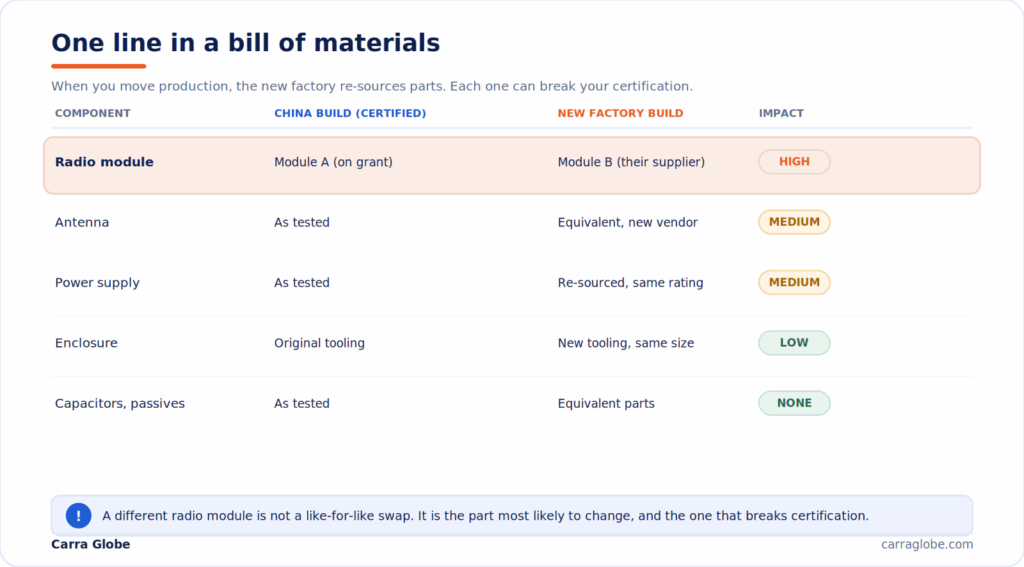
These substitutions are sensible production decisions, made on the factory floor and rarely flagged to the brand owner as a regulatory event. The product still works and still looks identical. It is simply no longer the device on the certificate. The illustrative before-and-after below shows the pattern a bill-of-materials review typically surfaces.
| Component | China build (certified) | New factory build | Certification impact |
|---|---|---|---|
| Wi-Fi / radio module | Module A, on the original FCC grant | Module B, the new factory’s preferred supplier | High. Different radio, likely a new FCC ID |
| Antenna | Antenna spec as tested | Equivalent part, different vendor | Medium. May need a permissive change |
| Power supply | PSU as tested for emissions | Re-sourced PSU, same rating | Medium. Emissions retest may be needed |
| Enclosure | Original tooling | New tooling, same dimensions | Low, if it does not affect emissions or exposure |
| Capacitors, passives | As tested | Equivalent parts | Usually none |
The first row is the one that matters. A different radio module is not a like-for-like swap in regulatory terms, however similar the datasheet, and it is the part a new factory is most likely to change. A component change can also shift the HS classification of the finished product. The quick logic is set out below.
- Factory changes, bill of materials and test configuration identical: certification usually remains valid.
- A component affecting certified parameters changes (radio module, antenna, power supply, RF-path PCB or radio firmware): certification usually needs review, and often a filing.
- The entity holding the certification changes: a formal transfer or a new filing in the new responsible party’s name is usually required.
Product Certification When Moving Manufacturing: What Actually Breaks by Market
| Market | Certification tied to | Pure relocation, identical product | Component change in radio path | Typical re-cert time |
|---|---|---|---|---|
| US (FCC) | Product design | No new FCC ID needed | Permissive change or new authorisation | Weeks for a simple filing |
| EU (CE) | Manufacturer, with importer verification duties | Documentation must still be held and correct | Significant modification can make importer the manufacturer | Varies with retest scope |
| India (BIS) | Product, manufacturer and site | New or amended registration often required | New registration plus in-country testing | Several months, no expedited path |
| Saudi Arabia (SABER) | Product and manufacturer | Certificate must match the new manufacturer | New product certificate needed first | Weeks once documentation matches |
United States (FCC). The FCC equipment authorisation rules tie authorisation to the product, not the site, so an electrically identical device needs no new FCC ID. A new radio module, amplifier, antenna, or a crystal that shifts the frequency range can require a permissive change or a new authorisation, depending on how it affects certified parameters.
European Union (CE). This is where the importer is most exposed. The manufacturer is responsible for conformity, but the importer of a non-EU product must check the conformity assessment was done, keep the EU declaration of conformity for ten years, and ensure the technical documentation can be made available to the authorities. A significant modification, or selling under the importer’s own name, can make the importer the legal manufacturer.
India (BIS) and Saudi Arabia (SABER). Both tie the certificate to the manufacturer, so a move hits harder than in the US. BIS registration is specific to the manufacturer and site, so a new location generally means a new or amended registration with fresh in-country testing, often the longest pole in the tent. Under SABER, a manufacturer change means a new product certificate before shipment certificates can issue. Relocating into China raises the same issue, because CCC and SRRC approvals need in-country testing.
Relocating production and shipping into multiple regulated markets? The party answerable for certification at the border is the importer, not your new factory. Carra Globe acts as importer of record across 175+ countries and maps certification impact against your new bill of materials before the first shipment moves. Carra Globe works through importer-side registrations and local importing structures appropriate to the goods and destinations it accepts, its own in some markets and established local structures in others. Approvals falling outside the available structure are flagged before a delivery date is agreed.
What the Delay Actually Costs
The real cost of getting this wrong is not the certification. It is the delay. If a re-certification in a slow market runs three to six months and you only discover the need when a shipment is examined, the launch slips by the filing time plus the time already lost, plus the time to unwind the held shipment, plus any penalty owed to the customer who was promised delivery. A gap found in planning costs a filing fee and some lab time. The same gap found at a border costs a quarter.
That is why the slowest market in your footprint sets your real timeline. A company shipping into the US, the EU, India, and Saudi Arabia can clear the US side in weeks and still miss launch because an Indian re-registration behind one changed component takes months.
Why the Importer Carries This, Not the Factory
In each of these markets, the party answerable at the border for a compliant import is the one bringing the goods in, the importer of record, not the overseas factory. Neither your old Chinese factory nor your new Vietnamese one is the entity a customs authority or market surveillance body pursues when an uncertified product turns up. That is also why a freight forwarder cannot stand in as your importer of record. The role carries legal accountability a logistics contract does not.
If the new plant swapped a module and nobody updated the FCC filing, it is the importer named on the entry when the shipment is examined. Our guide to the difference between a paper IOR and an operational IOR explains why the quality of that relationship decides whether the problem is caught before shipping, and our analysis of the 2026 CBP customs audit environment shows how actively these gaps are now being found.
The Relocation Compliance Sequence That Prevents This
The failure is almost always one of sequencing. The certification review should run alongside the production move, not after it, because some markets measure re-certification in months.
- Compare the new factory’s bill of materials with the certified one before the first production run. This surfaces most of the risk. Flag every changed component, especially in the radio path, such as modules, antennas, amplifiers and oscillators.
- Classify each change by regulatory impact, not cost. A cheaper equivalent capacitor may be irrelevant; a different wireless module is not. This tells you whether you need a minor filing, a permissive change, or a full re-certification.
- Start the long-lead re-certifications first. If India or another slow market needs re-testing, that clock sets your launch date. Our analysis of the compliance gaps in the shift to Vietnam, India and Mexico sets out typical timelines per market.
- Confirm who legally holds the certification. Certifications are often held by the original manufacturing entity or a holding company rather than the brand owner, so leaving that manufacturer can mean leaving the grant behind. Some markets allow a formal transfer or a Change in ID; others require a fresh filing. Settle this early, because it decides who can act as the responsible party on the import.
- Lock component control into the manufacturing agreement. Require written notice and approval before any component in a certified product changes, so a floor-level substitution becomes a controlled event you know about before it ships.
Frequently Asked Questions
Does moving manufacturing out of China void my FCC certification?
Not by itself. An FCC ID follows the product design, not the factory, so an identical product built in a new location keeps its authorisation. It breaks when the new factory changes a component that affects radio performance.
Do I need to re-certify if I only changed the factory, not the design?
Generally no for the US if the product is genuinely electrically identical. But some markets, notably India under BIS, tie registration to the site itself, so a new location can require a new registration.
Who is liable if a relocated product ships without valid certification?
The importer of record, in most major markets. The party bringing the goods in answers for a compliant import at the border, not the overseas factory.
How long does re-certification take after a manufacturing change?
It varies by market and change size. A US permissive change or Change in ID for an unmodified device can take a couple of weeks. A new BIS registration in India with fresh testing can run several months.
Can I keep the same FCC ID after moving production?
Yes, if the product stays electrically identical. FCC rules let a grantee have the same equipment built by a second party under the existing FCC ID, provided that party is not on the FCC Covered List. Where the grantee entity changes, a Change in ID filing handles it.
Does a CE marking belong to the factory or the importer?
Neither, exactly. CE conformity is the manufacturer’s responsibility, but for non-EU goods the importer must verify it, keep the declaration of conformity for ten years, and can be treated as the manufacturer.
Can contract manufacturers change certified components without telling me?
In practice, yes, unless your agreement prevents it. New factories routinely re-source modules, antennas, and power supplies, so require written notice and approval before any certified component changes.
The move out of China solves a tariff problem cleanly and creates a certification problem quietly. The certificate stops matching reality the moment the new plant builds the product its own way, and it is the importer who answers for the gap. Run the bill-of-materials comparison before the first production run, start the slow re-certifications early, and the relocation clears the border as planned.
Disclaimer: This article is for informational purposes only and does not constitute legal, customs, or regulatory advice. Certification rules, permissive change thresholds, and re-registration requirements vary by product, market, and authority, and change over time. Always confirm the specific requirements for your product and destination markets with the relevant certification body or qualified counsel before relying on an existing certification for relocated production.