
South Korea is one of the most FTA-connected economies on earth, with preferential agreements covering the United States, the European Union, China, ASEAN, and most of its major trading partners. Yet a large share of businesses importing into Korea still pay the full applied tariff on goods that qualify for zero or reduced duty. The reason importers fail to reduce import duty South Korea is almost always one of three failures: the Certificate of Origin was never obtained from the supplier, the wrong preferential agreement was applied to the wrong product corridor, or the goods were misclassified under the 10-digit HSK code.
This guide covers how Korea’s duty structure actually works, every verified legal method to reduce it, the de minimis and clearance rules that catch importers out, what the 2026 updates change, and the compliance requirements that sit alongside duty management in this market. It is educational reference material; the commercial options are kept separate and clearly marked.
One distinction is worth drawing at the outset, because it shapes everything below. Plenty of tools and calculators will tell you what duty rate applies to a shipment into Korea. Very few things can actually reduce it and then execute the entry, because reducing duty in Korea depends on being the party that files the declaration through UNI-PASS, holds or coordinates the KC certification, and is legally positioned to reclaim the VAT. Knowing the rate is the easy part. Being the entity that can act on it, the importer of record on the Korean customs declaration, is where the saving is actually captured or lost.
Reduce Import Duty South Korea: At a Glance
- Most IT hardware is already 0%: servers, networking equipment, and most electronics enter Korea duty-free under the WTO Information Technology Agreement, regardless of origin. The saving is in not overpaying through misclassification.
- The FTA network does the rest: KORUS (US), the Korea-EU FTA, RCEP, and 20-plus bilateral agreements zero-rate or reduce duty on qualifying-origin goods, but only if claimed with a valid Certificate of Origin.
- VAT is 10% on CIF plus duty: recoverable as input tax by a registered Korean entity or qualified importer of record; an upfront cost otherwise.
- De minimis is USD 150, or USD 200 for US-origin goods: a KORUS-linked higher threshold most guides miss.
- The three overpayment traps: unclaimed FTA rates, HSK misclassification, and unused relief or bonded programmes.
How South Korea’s Import Duty Structure Actually Works
Korea assesses duty on the CIF value (cost, insurance, and freight) using the transaction value method, classified under the 10-digit HSK code. The average applied tariff for industrial goods is roughly 8% for non-FTA origins, but this average hides enormous variation: agricultural products can attract rates well above 50%, while most IT hardware enters at 0% under the WTO Information Technology Agreement.
On top of duty, Korea applies a flat 10% Value Added Tax on nearly all imports, calculated on the CIF value plus the duty amount. A Special Excise Tax of 10% to 20% applies to certain luxury and durable goods, but this rarely touches IT and industrial equipment. Tariffs and taxes must be paid in Korean Won within 15 days after goods clear customs, and all declarations are filed electronically through UNI-PASS, the Korea Customs Service’s fully electronic clearance portal.
The party named as importer of record on the declaration pays the import VAT up front and is the party that can later reclaim it as input tax; a foreign business with no Korean entity and no importer of record partner cannot reclaim that VAT, so it becomes a permanent cost.
What HSK classification is, and why it decides your rate
HSK stands for the Harmonized System of Korea. It takes the international 6-digit HS code that every country shares and extends it with four additional national digits, producing a 10-digit code unique to Korea.
That final four digits is where duty outcomes are decided: two products that share the same 6-digit international heading can sit in different 10-digit HSK subheadings with different duty rates and different certification requirements. HSK classification is therefore not an administrative formality but the single technical decision that determines whether a shipment enters at 0% or at a dutiable rate. Getting it right, and being able to defend it if Korea Customs queries the entry, is the foundation every other duty-reduction method rests on.
The Korea FTA Network: Your Biggest Duty-Reduction Lever
Korea has built one of the most extensive free trade agreement networks in the world, with more than 20 active agreements covering the majority of its trade. For any business paying the full applied rate on goods from an FTA partner, the overpayment happens on every single shipment. The most commercially significant agreements are:
- KORUS (Korea-US FTA): in force since March 2012. Korea immediately eliminated duties on nearly 80% of bilateral trade in industrial and consumer goods, with the remaining tariffs fully phased out as of 1 January 2021. Correctly documented US-origin goods now enter duty-free across almost the entire industrial and consumer range.
- Korea-EU FTA (KOREU): in force since 2011, eliminating 98.7% of customs duties across industrial and agricultural sectors. Machinery, chemicals, and consumer electronics of EU origin qualify for zero duty with a valid origin declaration.
- RCEP (Regional Comprehensive Economic Partnership): covers China, Japan, Australia, New Zealand, and all 10 ASEAN nations in a single framework with unified rules of origin. Note that India, though part of the original negotiations, is not a member.
- Korea-China FTA: phased tariff elimination on a large share of goods, significant given China is Korea’s largest trading partner.
- Korea-ASEAN, Korea-India (CEPA), Korea-Australia (KAFTA), and others: a bilateral network reaching most of Korea’s Asia-Pacific partners, each with its own rules of origin.
The recurring failure is not the absence of an agreement, it is the absence of the paperwork. If your supplier has never been asked for a Certificate of Origin or a Statement on Origin, the preferential rate is never claimed at the border and the full applied duty is paid by default. Reviewing FTA eligibility across every active sourcing corridor is the single fastest action that reduces duty without changing anything in the supply chain. Preferential certificates under KORUS, RCEP, the Korea-EU FTA, and CPTPP each have their own documentary rules, so matching the right certificate to the right corridor matters.
What a KORUS origin claim actually requires
KORUS is worth spelling out because its mechanics differ from agreements importers may be used to. There is no prescribed government form, unlike USMCA. Origin is self-certified, in writing or electronically, and the certification can be made by the producer, the exporter, or the importer.
The certification submitted to Korean Customs must contain the data elements set out in Article 6.15 of the agreement: the name and contact details of the certifying person, the importer, the exporter, and the producer; the HS classification and the preference criterion the good meets; and, for a blanket certification covering multiple identical shipments, the period it covers, up to a maximum of 12 months.
Two operational points matter. First, records demonstrating the good qualifies as originating, the bill of materials, the manufacturing process documentation, the certification itself, must be retained for a minimum of five years from the date of importation. Second, Korean Customs can authenticate the claim after the fact, and a declaration later found to be false carries penalties. A KORUS claim is therefore not a box-tick at the border but a documented position you must be able to defend for five years, which is exactly the kind of record-keeping an importer of record maintains as standard.
Korea Duty and Tax at a Glance: The Numbers That Drive Landed Cost
| Element | Rate / Rule | Basis |
|---|---|---|
| Customs duty (industrial, non-FTA) | ~8% average | CIF value, 10-digit HSK code |
| Customs duty (most IT hardware) | 0% under WTO ITA | Regardless of origin, if classified correctly |
| VAT | 10% flat | CIF value plus duty; recoverable by the IOR |
| Special Excise Tax | 10-20% | Luxury and certain durable goods only |
| De minimis (most origins) | USD 150 (CIF) | Below this, duty-exempt in the express regime |
| De minimis (US-origin) | USD 200 | Higher threshold linked to KORUS |
| Payment deadline | 15 days | After clearance, in Korean Won |
| Routine clearance time | 1-3 business days | 5-15 if inspected or documentation incomplete |
The Verified Methods to Reduce Import Duty into South Korea
These are legal duty-reduction methods, claiming rates and reliefs Korean customs law provides for, not avoidance. Each depends on correct documentation and defensible classification.
- Claim the WTO ITA zero rate on IT hardware. Most servers, networking equipment, storage, and computing hardware enter Korea at 0% under the Information Technology Agreement regardless of origin. The task is defensive: classify correctly under the right HSK heading so the zero rate applies and the goods are not bumped into a dutiable category.
- Apply the correct FTA preferential rate with proper origin documentation. Identify which agreement covers your sourcing corridor, confirm the goods meet its rules of origin, and obtain the Certificate of Origin or Statement on Origin from the supplier before the goods ship. This is where the largest recoverable overpayments sit.
- Audit your 10-digit HSK classification. A product classified under a broader or incorrect heading can attract a materially higher rate than the accurate classification. A classification review across your product range frequently surfaces lines that have overpaid for years, and those overpayments may be recoverable.
- Use bonded and Free Economic Zone facilities to defer or avoid duty. Korea operates bonded warehouses and Free Economic Zones that allow duty to be deferred until goods leave the zone for the domestic market, or avoided entirely on goods that are re-exported. For regional distribution staged through Korea, this converts an immediate duty cost into a deferred or eliminated one.
- Structure customs valuation correctly. Duty is assessed on CIF transaction value, so ensuring the declared value reflects only dutiable elements, and that legitimate deductions are applied, keeps the base from being inflated. This is correct structuring, not undervaluation.
- Recover the import VAT. The 10% VAT is recoverable as input tax by the party named as importer of record, provided that party is a registered Korean entity or qualified importer of record. Getting the import structure right turns VAT from a sunk cost into a recoverable one.
Importer of Record · 175+ countries
Importing IT or high-value hardware? We can be your Importer of Record.
Carra Globe acts as your Importer of Record so you can ship into markets where you have no local entity. We carry the legal liability, handle certifications and duties, and give you one itemised quote:
Have a shipment in mind? Send us your lane and goods, we will confirm and quote.
Get a compliance quote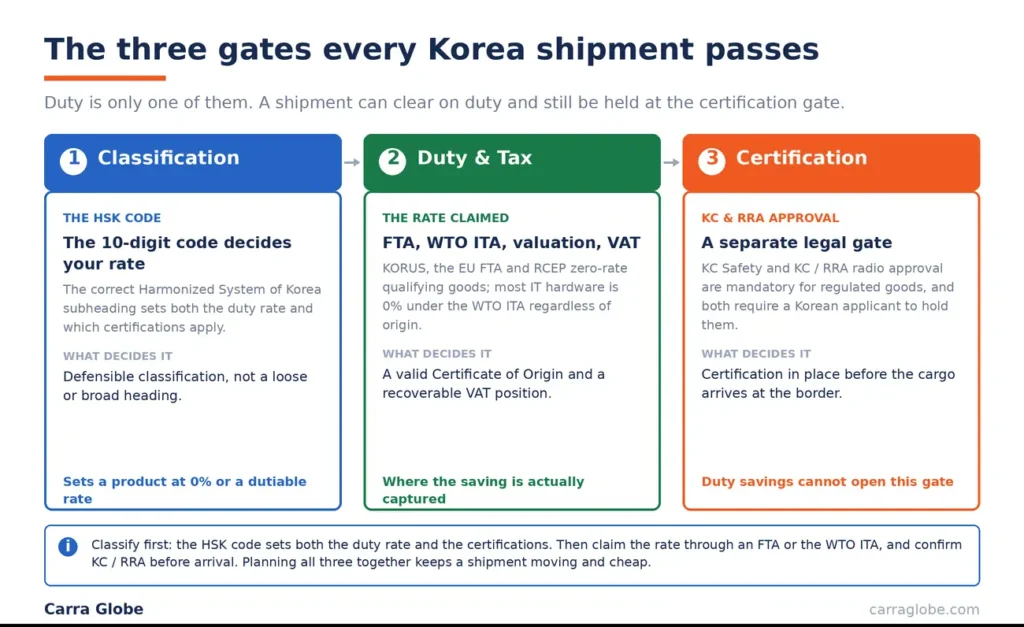
Not sure which of these methods applies to your product corridors? Carra Globe can review your HSK classifications and FTA eligibility across every origin you import from, and identify where you are overpaying.
The Three Gates: How to Think About a Korea Import
Every shipment into Korea has to pass three separate gates, and duty is only one of them. Treating them as one process is why shipments that look duty-optimised still get held.
- Gate 1, Classification: the correct 10-digit HSK code, which fixes both the duty rate and which certifications apply.
- Gate 2, Duty and tax: the FTA claim, the WTO ITA zero rate, valuation, and VAT recovery, everything covered above.
- Gate 3, Certification: KC Safety and KC/RRA approval, a separate legal requirement that duty savings cannot bypass.
A shipment can clear Gate 2 perfectly and still be held at Gate 3. That is the most common and most expensive surprise for first-time importers into Korea, and it is why classification, duty, and certification have to be planned together.
What the 2026 Updates Change
Two developments in 2026 matter for anyone importing regulated hardware into Korea, and both sit on the certification side rather than the duty side, which is why they catch importers who plan only for tariffs. In February 2026, Korea’s Ministry of Science and ICT (MSIT) revised the technical requirements for licence-exempt radio equipment, relaxing and expanding the rules for 6 GHz Wi-Fi devices and introducing new formats for indoor positioning technologies.
Separately, the National Radio Research Agency (RRA) has issued a series of 5G NR technical standards updates covering KC certification, SAR, EMC, and device security, with key enforcement dates running from April 2026 through November 2026.
The practical consequence is that a shipment can clear on duty and still be held if the KC or RRA certification does not reflect the current standard. Korea operates one of the most rigorous type-approval regimes in the world, and enforcement has tightened; non-certified products face rejection at customs. Duty planning and certification planning have to happen together, because a perfect FTA claim does not help if the goods are held for a missing or outdated KC mark. You can confirm the current radio and EMC requirements directly with the National Radio Research Agency.
There is also a wider 2026 backdrop worth being aware of, even though it sits on the US side of the Korea trade relationship rather than the Korean import side this guide focuses on. US-Korea tariff treatment has been unusually turbulent through 2026, with the Supreme Court’s invalidation of the IEEPA tariffs, the Section 122 surcharge that replaced them expiring in July 2026, and KORUS preferences interacting with Section 232 measures on steel, autos, and semiconductors.
If your supply chain moves goods in both directions across the US-Korea corridor, that turbulence affects your landed cost independently of anything on the Korean import side. Our analysis of the Section 122 tariff and the Section 301 measures covers how those US-side layers have resolved.
The Compliance Layer That Sits Alongside Duty
Reducing duty is only half the picture in Korea, because the certification regime is a separate gate that duty savings cannot open. Radio and telecommunications equipment must obtain KC/RRA approval under the Radio Waves Act, administered by the RRA under MSIT, with testing performed at an RRA-accredited laboratory located in South Korea. Electrical safety is administered separately under the KC Safety framework by the Korean Agency for Technology and Standards (KATS), under the Electrical Appliances and Consumer Products Safety Management Act. In 2009 Korea consolidated 140 separate safety marks into the single unified KC mark.
The certification regime therefore runs in parallel with, and independent of, the duty process.
Crucially, both schemes require a Korean applicant or local representative, a foreign company cannot hold the certification directly, and registration runs through the eKCC system with Korean-language documentation. This is the structural reason an importer of record matters in Korea beyond simply paying duty.
Non-resident importers must appoint a licensed Customs Broker (관세사) or engage a third-party importer of record with a registered Korean business address to file declarations at all, and the same local-presence requirement runs through the certification system. The entity that files your customs declaration, coordinates your KC and RRA certifications, and reclaims your VAT is doing the work that makes the duty saving real.
Frequently Asked Questions
How much is customs duty in Korea in 2026?
The average applied duty on industrial goods is roughly 8% for non-FTA origins. Most IT hardware enters at 0% under the WTO ITA, and FTA-origin goods can be zero-rated. A flat 10% VAT also applies.
The headline rate matters less than classification and origin: the same product can be dutiable or duty-free depending on its 10-digit HSK code and whether an FTA claim is made.
What is the de minimis value for Korea customs?
The commercial de minimis is USD 150 on CIF value for most origins, below which goods are duty-exempt in the express regime. For US-origin shipments it is USD 200, a carve-out linked to KORUS.
This applies to low-value parcels, not bulk commercial pallets, which enter formal clearance with full duty and VAT regardless of value. The threshold is assessed per shipment, not per order.
How can I reduce or lower my import duty into Korea legally?
By claiming the FTA rate with a valid Certificate of Origin, applying the WTO ITA zero rate on IT hardware, classifying correctly under the right HSK code, and using bonded or Free Economic Zone facilities.
These are duty-reduction methods Korean law provides for, not avoidance. Undervaluation or misdeclaration is illegal and triggers penalties. Overpaid duty from past shipments may also be recoverable.
How long does customs clearance take in South Korea?
Routine clearance for compliant shipments typically takes 1 to 3 business days through UNI-PASS. Shipments selected for physical inspection, or with incomplete documentation or restricted goods, can take 5 to 15 business days.
Pre-lodging the declaration electronically before arrival is the most effective way to keep clearance at the lower end. A missing KC or RRA certificate can hold goods well beyond these ranges.
What documents are needed for customs clearance in Korea?
A commercial invoice with HS codes, a packing list, a bill of lading or air waybill, and the customs declaration. A Certificate of Origin is needed for an FTA rate; restricted goods need a licence.
Regulated products also need their KC Safety or KC/RRA certification in place before arrival. Incomplete documentation is one of the most common causes of clearance delay and inspection.
Do I need a local entity or customs broker to import into South Korea?
Not a local entity, but non-resident importers must appoint a licensed Customs Broker or a third-party importer of record with a registered Korean address, which files declarations and holds the taxpayer position.
The same local-presence requirement runs through KC and RRA certification, so the customs filing and certification are usually handled together through one importer of record.
How Carra Globe Helps
For companies importing servers, networking hardware, data centre equipment, and other IT infrastructure into South Korea, the duty saving and the compliance requirement are two halves of the same job.
Carra Globe acts as your importer of record in South Korea, managing licensed Customs Broker representation, UNI-PASS filing, FTA origin documentation, HSK classification, KC Safety and KC/RRA certification, and VAT recovery, across 175+ countries.
If you also move goods across the wider region, our Japan, Taiwan, and Singapore desks operate the same way, and our guide to calculating landed cost shows how duty, VAT, and fees combine into your true cost per shipment. To see how the methods here apply to your specific corridors, speak to our trade compliance team.
Official primary sources: the Korea Customs Service (tariff schedule and clearance rules), the UNI-PASS electronic clearance portal, and the National Radio Research Agency (KC/RRA certification).
Disclaimer: this guide is educational and does not constitute legal, customs, or tax advice. South Korea’s tariff schedule, FTA rules of origin, de minimis thresholds, VAT recovery mechanics, and KC/RRA certification requirements change over time and vary by product. Always confirm the current treatment for your specific goods with the Korea Customs Service or a licensed Korean customs broker before making import decisions.