
Here is a situation we see constantly. A US or international company needs to send equipment to Canada, laptops on long-term loan to a client’s staff, demo units, tools that stay the company’s property and are never sold. There is no sale, no invoice value changing hands, so it feels like it should be simple. Then the shipment sits in customs for a week or more, and the company discovers the problem the hard way: even though nothing was sold, the goods triggered Canada’s CARM requirements, and no one was registered to clear them.
This guide explains why loaned and no-sale equipment can still fall within Canada’s commercial-import framework, how CARM registration and Release Prior to Payment requirements apply, what changed to importer liability on 1 January 2026, and how a properly structured third-party importer of record may let you ship into Canada without registering for CARM yourself.
The Short Answer, At a Glance
- No sale does not mean no CARM. Goods imported for business or commercial use are commercial goods, even when they are loaned, not sold, and remain your property.
- CARM is now fully in force. Since 20 May 2025, the importer must generally meet the financial-security requirement in its own right to have goods released before duties are paid; a broker’s bond no longer automatically satisfies that obligation.
- The named importer carries the primary exposure. Under Section 17 of the Customs Act, in force since 1 January 2026, the importer of record is jointly and severally liable with the owner and importer, meaning the CBSA can pursue the named party for the full amount, for all duties, taxes, and reassessments.
- You may not have to be that party. A third-party importer of record can take the named-importer role and carry the CARM registration, the business number, the security, and the primary debt exposure, though you still supply accurate information, valuation, permits, and records.
- The return leg is covered too. If loaned equipment later has to come back out of Canada, an exporter of record can handle the outbound movement.
Why Loaned and No-Sale Equipment Still Triggers CARM
The most common and most costly assumption is that CARM only applies when goods are sold. It does not. The test is not whether money changes hands. The test is whether the goods are commercial.
Under Canadian customs rules, commercial goods are goods imported for sale or for any business, industrial, commercial, or occupational use. A laptop that a company ships to its client’s employee to use for work is a commercial good, even though it is on loan, was never sold, and remains the shipper’s property the entire time. When such goods are imported for business or commercial use, they generally enter through the commercial-import framework, subject to any temporary-importation or other special procedure that may apply.
This is exactly where companies get caught. They treat a no-sale shipment as a formality, ship it under their own name, and only then discover that being named as importer means registering in the CARM Client Portal, obtaining a business number, and posting financial security before the goods can be released. Until that is in place, the shipment waits. In our operational experience, loaned-equipment shipments can be held for a week or more when the importer and release structure are not arranged before dispatch.
What Changed Under CARM, and Why It Matters More Now
For years, importing into Canada was something your customs broker quietly handled. You shipped the goods, the broker cleared them under their business number and their bond, and you paid the invoice. That era has ended, and it ended across three stages worth knowing.
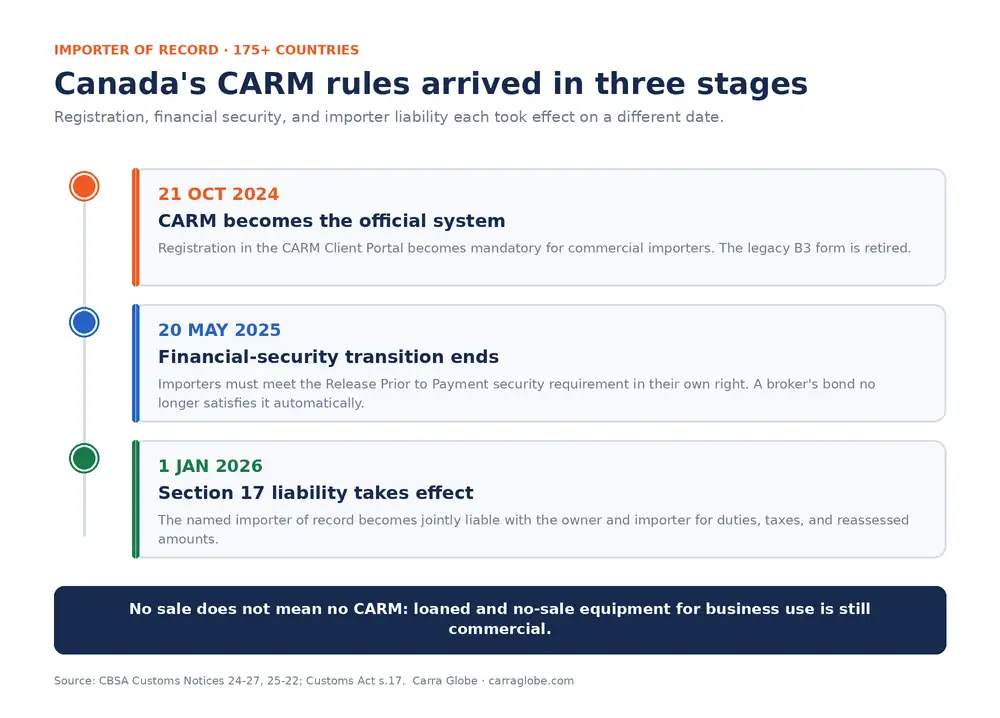
CARM became the official customs-accounting system on 21 October 2024, and registration in the CARM Client Portal became mandatory for commercial importers from that point. The 20 May 2025 milestone then ended the transition period for financial security under Release Prior to Payment. Finally, the 1 January 2026 Section 17 amendments increased the importer-of-record liability exposure. Registration, security, and liability arrived on three different dates, which is part of why the requirements are so easy to misjudge.
The change came in two stages. First, on 20 May 2025, the transition period for financial security ended. From that date, an importer that wants its goods released before duties are paid, under the Release Prior to Payment programme, must generally meet the financial-security requirement in its own right through the CARM Client Portal. An importer can no longer assume that a broker’s business number or security automatically satisfies its own release-prior-to-payment obligation. Brokers can still account for goods and act on an importer’s behalf where permitted; what changed is that the security obligation now attaches to the importer.
Second, on 1 January 2026, amendments to Section 17 of the Customs Act took effect, and this is the more significant change for liability.
Section 17 makes the entity named as importer of record on the Commercial Accounting Declaration jointly and severally liable, together with the owner and importer, for all duties, taxes, and any reassessed amounts. Jointly and severally liable means the Canada Border Services Agency can pursue the named party for the entire amount owed, not just a share of it.
In plain terms, if your company is named as the importer, that legal entity carries the exposure and can be pursued for the full amount, and it can follow the entry if the CBSA reassesses it later. The owner and importer may also share statutory liability depending on how the transaction is structured. This applies identically to Canadian-resident importers and to Non-Resident Importers: being based outside Canada does not reduce the accountability. We cover this shift in more detail in our guide to the 2026 CARM liability changes for the importer of record.
Importer of Record · 175+ countries
Shipping loaned or no-sale equipment to Canada? We can be your Importer of Record.
Carra Globe acts as your Importer of Record in Canada, carrying the CARM registration, financial security, and primary importer-of-record obligations so your shipment clears without the delay. Explore how we help:
Free tools: HS Code Finder|Pallet Calculator|Volumetric Weight Calculator
Have a Canada shipment in mind? Send us your lane and goods, we will confirm and quote.
Get a compliance quoteThe Non-Resident Importer Route, and Why Many Companies Avoid It
Canada does allow a foreign company to import in its own name through the Non-Resident Importer programme. A non-Canadian business can obtain a business number, register in the CARM Client Portal, post financial security, and act as its own importer of record. For a company with steady, high-volume Canadian imports, that can make sense.
For many companies, though, especially those sending a handful of loaned or no-sale shipments a year, the Non-Resident Importer route is more than they want to take on. It means contacting the Canada Revenue Agency for a business number, since a non-resident cannot obtain one through the portal, enrolling in the CARM Client Portal, posting and maintaining financial security that scales with import value, managing monthly statements of account, and keeping import records for six years. If records are held outside Canada, it also means a formal agreement with the Canada Border Services Agency to do so.
That is a lot of standing compliance infrastructure to build for occasional shipments of equipment you are not even selling. This is the point where a third-party importer of record becomes the practical answer.
How a Third-Party Importer of Record Lets You Skip CARM Registration
A third-party import provider can arrange the Canadian entry through a legally permitted structure involving the importer, owner, or a licensed customs broker. The party identified as importer of record on the Commercial Accounting Declaration must be authorised to account for the goods and must accept the applicable CARM, duty, tax, recordkeeping, and reassessment obligations. Because that party holds the named-importer role, the CARM account, security, and primary debt exposure attach to it rather than to you.
In practice, that means the third-party importer holds the business number and the CARM Client Portal registration, posts and maintains the financial security, is the party named on the Commercial Accounting Declaration, and carries the primary Section 17 debt exposure for the entry. You ship the goods; they clear them. You do not register with the Canada Revenue Agency, build a CARM portal account, or post security yourself.
For a company sending loaned or no-sale equipment into Canada a few times a year, this removes the registration burden that caused the delay in the first place. It does not remove your own responsibilities: you still provide accurate product information, a defensible value, any required permits, and your records. The owner and importer can retain underlying obligations regardless of who is named.
It is worth being precise about what this does and does not do. A competent importer of record takes on the named role, the registration, the accounting, and the primary debt exposure. It does not make the underlying compliance disappear: the goods still need correct classification, a defensible value, and any permits that apply, and the owner and importer can still hold obligations of their own. What changes is that a properly authorised party handles the entry and stands behind it, rather than your shipment sitting at the border while you scramble to register.
One practical point: confirm the provider’s Canadian legal structure and which party will actually appear on the accounting document, since not every company marketing IOR services can assume that role for every shipment.
Shipping loaned or no-sale equipment to Canada and want to avoid registering for CARM yourself? Carra Globe can act as your importer of record in Canada, carrying the CARM registration, security, and liability so your shipment clears without the delay. Talk to us about your Canada shipment →
Valuing No-Sale Goods for Customs
One question that always comes up with loaned equipment: if there is no sale, what value goes on the customs paperwork? A declared value is still required, because duties and taxes and the customs declaration are based on it, even when no transaction takes place.
For no-sale goods, the customs value must still be established under the applicable Canadian valuation method. Because there may be no sale for export to Canada, the transaction-value method often does not apply, and the value may instead need to be supported by evidence relating to identical or similar goods, deductive or computed value, depreciation, purchase records, or lease terms, depending on the facts. A fair-market or resale estimate can support that analysis, but it is not automatically the correct value.
The important point is that a no-sale shipment is not a zero-value shipment. Declaring it as such invites problems, so a capable importer of record will help establish and document a defensible value under the right method.
There is also a route worth asking about for goods that will not stay in Canada. Where equipment will be re-exported, it is worth checking whether tariff item 9993.00.00, an ATA Carnet, or another temporary-importation procedure applies. Eligibility depends on the goods, their use, the importer, security, identification, a time limit, and proof of re-export, and CBSA sets this out in Memorandum D8-1-1. Temporary admission can reduce or eliminate duty, but it does not automatically remove every accounting, permit, tax, or CARM obligation.
For permanent imports, our guide on how to reduce import duty into Canada covers the levers that do apply. Because temporary importation can change the cost of a loaned-equipment shipment materially, raise it with your importer of record early. Because it can change the cost of a loaned-equipment shipment materially, raise it with your importer of record early.
Getting the Equipment Back Out: The Return Leg
Loaned equipment has a feature that sold goods do not: it usually has to come back. When a device is on long-term loan and is later replaced or returned, the older unit needs to leave Canada, and that outbound movement has its own requirements.
This is where an exporter-of-record arrangement matters. Just as an importer of record is the party accountable for goods entering a country, an exporter-of-record provider can coordinate the outbound customs and export-control responsibilities for goods leaving it.
The exact legal exporter and filing obligations depend on the origin, destination, goods, and applicable export rules, so for loaned equipment that has to be returned, having a single partner handle both the inbound and the outbound leg keeps the movement clean and the paperwork consistent. If your arrangement involves swapping a new device in and shipping an old one back, plan the return leg at the same time as the inbound, not after the fact.
What to Do Before You Ship to Canada
- Do not assume no sale means no CARM. If the goods are for business or commercial use, they generally enter through the commercial-import framework, subject to any temporary-importation or other special procedure that applies. Confirm the correct route before the shipment moves, not after.
- Decide who the importer of record will be. Either register as a Non-Resident Importer yourself, with everything that involves, or appoint a third-party importer of record who is already set up.
- Establish a defensible customs value for no-sale goods. Use the applicable Canadian valuation method and document the basis. Do not assume zero value is acceptable just because no sale occurred.
- Plan the return leg upfront. If loaned equipment will come back out, arrange the exporter of record role at the same time.
- Check temporary-import relief before choosing a permanent import route. Tariff item 9993.00.00 or an ATA Carnet may reduce or eliminate duty for goods that will be re-exported.
- Confirm any permits or restrictions. Certain equipment needs additional clearances regardless of who imports it. Check before shipping.
How Carra Globe Helps
Carra Globe acts as your importer of record in Canada, carrying the CARM Client Portal registration, the business number, the financial-security and primary importer-of-record obligations, so you can ship loaned, no-sale, or company-owned equipment without registering yourself, while you continue to provide accurate product, valuation, permit, and record information.
For equipment that has to return, we can also act as exporter of record for the outbound leg. Our focus is high-value IT and technology hardware, and we are built for exactly the loaned-device, no-sale, and demo-unit scenarios that trip companies up at the Canadian border. If you want to understand the accountable role more broadly, our guide to the importer of record versus the customs broker explains why the liability cannot simply be handed to a broker.
Frequently Asked Questions
Does CARM apply if I am not selling the goods?
Yes. CARM applies to commercial goods, which include goods imported for business or commercial use, not only goods that are sold. Loaned, demo, and company-owned equipment for business use still triggers it.
The test is the commercial nature of the goods, not whether a sale takes place. A no-sale shipment for business use is still a commercial import.
Can I import into Canada without registering for CARM myself?
Yes, by appointing a third-party importer of record authorised to account for the goods. As the named importer, they carry the CARM registration, financial security, and primary debt exposure.
You still supply accurate information, valuation, permits, and records, and the owner and importer can retain their own obligations, but you avoid building your own portal account and posting security.
Do I need a Canadian business number to ship loaned equipment to Canada?
Only if you act as your own importer of record. A non-resident importer must get a business number from the Canada Revenue Agency. If a third-party importer clears the goods, they hold it instead.
This is the main reason companies sending occasional shipments use a third-party importer rather than registering themselves.
Why did my no-sale shipment get held at Canadian customs?
Almost always because no importer was set up in CARM to release it. Since May 2025, goods are not released before duties are paid unless the importer of record has posted its own financial security.
Treating a no-sale shipment as exempt is the usual cause. The fix is to have a registered importer of record in place before shipping.
What value do I declare for goods that are not being sold?
A declared value is still required. Because there may be no sale for export to Canada, the transaction-value method may not apply, so the value must be established under the applicable Canadian customs-valuation method.
A fair-market or resale estimate may support the analysis but is not automatically correct. A no-sale shipment is not a zero-value shipment: declaring zero invites problems, so establish a defensible basis under the right method.
Who is liable if something is wrong with the customs declaration?
The importer of record named on the Commercial Accounting Declaration. Under section 17(3) of the Customs Act, that party is jointly liable with the owner and importer for duties, including reassessed amounts.
Other statutory parties may also have liability depending on the structure. If a third party is the named importer of record, the primary exposure attaches to them, though the owner and importer can still share it.
Disclaimer: this guide is educational and does not constitute legal or customs advice. CARM requirements and the rules on commercial goods, valuation, and importer liability change over time and depend on your specific circumstances. Confirm your obligations with a qualified trade compliance partner or the Canada Border Services Agency.