
If you move high-value equipment across borders, servers, GPUs, networking hardware, medical devices, you have almost certainly asked a version of this question in 2026: can an AI tool now handle the import side, so I do not need to pay for an importer of record? It is a fair question, and getting the answer wrong is expensive. When an import is misclassified or misdeclared, the consequences land on the importer of record: retroactive duty bills, penalties under 19 U.S.C. 1592, and heightened scrutiny of future shipments. No software absorbs that exposure.
So the honest answer is more useful than the marketing, and it turns on a single distinction most of that marketing skips: the difference between doing the work and being accountable for it.
This guide sets out exactly what AI can do in the import process, what it cannot do, and why, for high-value goods especially, the importer of record role is not a task you can automate away. It is a legal position, and someone still has to hold it.
Can AI Replace Your Importer of Record? At a Glance
- The short answer: no. You can automate a task, but you cannot automate liability. AI can assist with classification and paperwork, but it cannot be the importer of record, because the IOR is the legally accountable party.
- What AI does well: suggesting tariff classifications, extracting data from documents, flagging inconsistencies, and speeding up repetitive research.
- What AI cannot do: hold legal liability, owe a duty of reasonable care to a customs authority, or be the party a government holds responsible when a declaration is wrong.
- A US regulator has drawn the line: in January 2026 ruling HQ H350722, US Customs and Border Protection confirmed AI can suggest a six-digit heading, but the eight or ten-digit code for an actual entry is customs business that must sit with the importer itself or a licensed broker.
- Why it matters most for high-value goods: the higher the shipment value and the more jurisdictions involved, the larger the accountability gap AI leaves, and the more a real importer of record matters.
What an Importer of Record Actually Is
To see why AI cannot replace it, you have to be clear on what the importer of record role is. It is not a logistics label or an administrative step. It is a legal position.
The importer of record is the party legally responsible to the customs authority for an import: for classifying the goods correctly, declaring their value accurately, paying the duties and taxes, filing the right documentation, and complying with every regulation that applies to the goods.
In the United States, the IOR owes customs a duty of reasonable care, and that responsibility is not removed by using a customs broker, a freight forwarder, a supplier, or a software tool to help prepare the information. Those other parties can carry their own separate obligations depending on what they do, but the importer of record remains responsible for the accuracy of the entry. It is, in short, the party that carries the legal consequence of the import.
That single fact, that the IOR is the accountable party, is the reason the role sits outside what any software can do. It comes down to one test, and it is worth remembering: you can automate a task, but you cannot automate liability. Everything else in this guide follows from that line. We explore the related distinction between the two roles most often confused in our guide to the importer of record versus the customs broker.
What AI Genuinely Does Well in the Import Process
It would be dishonest to pretend AI adds nothing here. It adds a great deal, and any modern compliance operation should be using it. Being clear about its real strengths is what makes the limits credible.
- Classification research. AI can read a product description and suggest candidate tariff codes with reasoning, dramatically speeding up the research phase of classification.
- Document extraction. AI can pull data from commercial invoices, packing lists, and transport documents, pre-populating entry fields that once had to be re-keyed by hand.
- Consistency and error-flagging. AI is strong at spotting inconsistencies across documents and catching the kind of repetitive mistakes that slow a filing down.
- Speed at volume. For high-volume, repetitive work, AI handles the routine layer far faster than a person, freeing skilled people for the judgement calls.
Used with proper validation, AI can make parts of the import process faster and can cut repetitive errors. It does not, on its own, guarantee a correct classification or a compliant entry, and for a converged device like a server with encryption or wireless functions, the classification is exactly the kind of judgement call where a confident-looking suggestion can still be wrong. Notice what every one of these strengths has in common: they are all research and preparation. None of them is the act of taking legal responsibility for the result. That is the line.
Put the two side by side and the division of labour is clear:
| What AI does | What the importer of record does |
|---|---|
| Suggests tariff codes | Validates and owns the classification |
| Extracts document data | Reviews and certifies its accuracy |
| Flags inconsistencies | Answers to the customs authority |
| Speeds up research | Holds the legal liability |
Importer of Record · 175+ countries
Importing IT or high-value hardware? We can be your Importer of Record.
Carra Globe acts as your Importer of Record so you can ship into markets where you have no local entity. We carry the legal liability, handle certifications and duties, and give you one itemised quote:
Have a shipment in mind? Send us your lane and goods, we will confirm and quote.
Get a compliance quote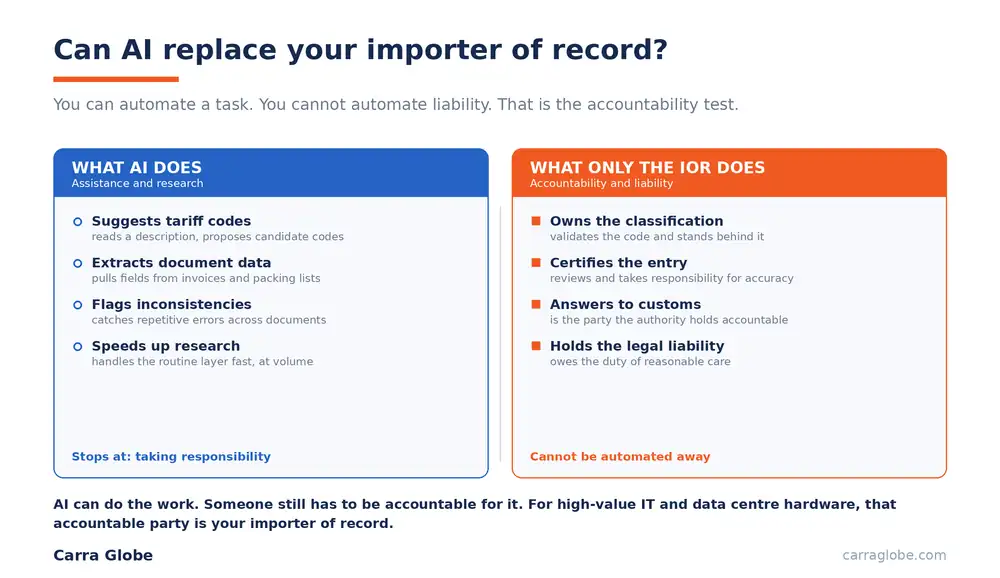
Where AI Stops: The Accountability It Cannot Take
Here is the distinction that the confident marketing around automated customs tools tends to skip. AI can tell you a product is probably classified under a given code. It cannot be the party that answers for that code if a customs authority disagrees.
When AI suggests a classification, a human still has to review it, confirm it, and accept the legal responsibility for it. AI systems reach high accuracy on common products, but high-value hardware is rarely a common product, and “high accuracy” is not the same as “accountable.” A confidence score is not a legal defence.
If a $2 million rack of servers is classified wrongly and a customs authority issues a penalty, “the AI suggested this code” is not an answer anyone can give the government. Someone has to be the party that owed the duty of reasonable care, and that someone is the importer of record.
This is not a theoretical limit. It is where the US regulator has actually drawn the line.
What US Customs Has Said About AI and Customs Business
In January 2026, US Customs and Border Protection issued ruling HQ H350722, and it drew the line at specificity. An AI tool suggesting a six-digit heading is permissible research assistance, because a six-digit code is insufficient for an entry filing. But deciding the eight or ten-digit code for an actual import entry, choosing what information goes on it, or filing it on another party’s behalf, is regulated customs business that must sit with the importer acting for itself, where permitted, or a licensed broker.
So the boundary is not software versus humans. It is authorised assistance versus regulated customs business, which is the same line the accountability test draws. One caveat: HQ H350722 is a US ruling. Canada, the EU, the UK, and other markets define customs representation and importer responsibility differently, so the specifics vary by jurisdiction even though the underlying principle, that a legally accountable party must stand behind the import, holds broadly.
Why This Matters Most for High-Value IT and Data Centre Hardware
For a low-value, simple shipment, the accountability gap AI leaves is small, and the risk of getting it wrong is modest. For high-value technology hardware, the calculation is completely different, and this is where the question really bites.
Consider what a shipment of servers, GPUs, or data centre equipment actually involves. The values are high, so a classification or valuation error is expensive, not trivial, and flows straight through to your total import cost. The goods often need product certifications, encryption clearances, or import licences, which are compliance obligations, not data-entry fields. They frequently move into multiple countries at once, each with its own rules, each needing a legally recognised importer.
And they increasingly sit under export controls and shifting tariffs, where the correct treatment is a matter of judgement, not lookup. Handling those export licensing requirements is part of the same accountable role. Every one of these raises the stakes on the accountable decision, which is exactly the part AI cannot take.
In our experience, the businesses that get into trouble are not the ones that used AI to help classify a product. They are the ones that assumed a tool could carry the whole import, and discovered at the border that no legally accountable importer of record was actually in place. For high-value hardware, that is not just a delay. Depending on the violation and the jurisdiction, it can mean a stalled shipment, additional duty, penalties, detention, or in serious cases seizure.
Importing high-value IT or data centre hardware and weighing whether a tool is enough? Carra Globe acts as your importer of record across 175+ countries, taking on the legal accountability that no automated tool can, while using modern tools to make the process fast and accurate. Talk to us about your next shipment →
The Right Way to Think About AI in Your Import Process
The useful conclusion is not “AI is overhyped” and it is not “AI can replace your importer of record.” Both are wrong. The accurate position is that AI and the importer of record do different jobs, and the smart operator uses both.
- Use AI for the research and preparation layer: faster classification research, document extraction, and consistency checks.
- Keep a legally accountable importer of record for the responsibility layer: the party that owes the duty of care, files the entry, and answers to the customs authority.
- Match the model to the stakes: the higher the value and the more jurisdictions, the more the accountable role matters relative to the automation.
A good importer of record partner already works this way: using the best available tools to be fast and accurate, while being the real, legally recognised party that stands behind your import. The tool is not the alternative to that partner. It is something the partner uses.
How Carra Globe Helps
Carra Globe is built for exactly the point where automation stops and accountability begins.
We act as importer of record, exporter of record and freight forwarding services across 175+ countries, with a particular focus on high-value IT and data centre hardware. That means we are the legally accountable party for your import: classifying the goods, securing the certifications and licences, paying the duties, and standing behind the declaration to the customs authority.
Our global trade compliance team handles the judgement calls that no tool can own, and our delivered duty paid service means the goods arrive with the compliance and duties handled. If you want to understand the accountable role more deeply, our guide to the importer of record versus the customs broker explains where the legal responsibility sits and why it cannot be delegated away.
Frequently Asked Questions: Can AI Replace an Importer of Record?
Can AI replace an importer of record?
No. AI can assist with classification and document preparation, but it cannot be the importer of record, because the IOR is the party legally accountable to the customs authority, and legal accountability cannot be automated.
An AI tool can help do the work, but a legally recognised party still has to hold responsibility for the import.
What can AI actually do in customs clearance?
AI can suggest tariff classifications, extract data from shipping documents, flag inconsistencies, and speed up repetitive research, making the import process faster and more accurate.
These are all research and preparation tasks. None of them involves taking legal responsibility for the declaration, which is the importer of record’s role.
Why can’t AI be legally responsible for an import?
Because customs authorities hold a legally recognised party, the importer of record, accountable for an import, and that party owes a duty of reasonable care that an automated tool cannot bear or answer for.
If a declaration is wrong, the authority pursues the importer of record, not the software that helped prepare it.
Did CBP rule on whether AI can do customs work?
Yes. In a January 2026 ruling, US Customs and Border Protection confirmed that AI can suggest classifications to a general level but cannot conduct customs business, such as filing entry documents.
The ruling drew a clear line between AI assisting the process and AI taking the accountable, regulated actions.
Can I use ChatGPT to classify my imports?
You can use it for preliminary research, but not as your final, filed classification. A legally accountable party must review, confirm, and take responsibility for the code that goes on the entry.
Treat any AI output as a draft to be validated, not a decision. The liability for the classification stays with the importer of record.
If AI files my customs entry, who gets in trouble if it is wrong?
You do, as the importer of record. Liability for a wrong declaration sits with the accountable party, not the tool that prepared it, so the penalties and duty bills fall on the importer.
This is exactly why a legally recognised importer of record has to be in place, whatever software sits behind the scenes.
Do I still need an importer of record if I use AI software?
Yes. AI software does not become the importer of record. Someone still has to be the legally accountable party, and where you have no local entity in the destination country, that role must be arranged.
The software helps that party work faster and more accurately. It does not remove the need for the party itself.
What did CBP say about AI tools in January 2026?
In ruling HQ H350722, CBP said an AI tool may suggest classifications to the six-digit level, but providing the eight or ten-digit code for goods being imported is customs business that requires a licensed party.
It was CBP’s first ruling directly addressing an AI classification platform, and it drew the line at the point of entry-level classification and filing.
Should I use AI or an importer of record for high-value hardware?
Both, for different jobs. Use AI to speed up classification research and document handling, and keep a legally accountable importer of record as the party that files the entry and answers to the customs authority.
For high-value IT and data centre hardware, the accountable role matters more, not less, because the cost of an error is far higher.
Does using an AI tool remove my liability as an importer?
No. Using a tool does not transfer your legal liability, just as using a customs broker does not. If you import, the responsibility for a correct declaration remains with the importer of record.
This is why having a competent, legally accountable importer of record in place matters regardless of which tools are used behind the scenes.
Disclaimer: this guide is educational and does not constitute legal advice. The responsibilities of an importer of record and the rules on customs business vary by country and change over time. Confirm your specific obligations with a qualified trade compliance partner or the relevant customs authority.