
IT hardware import regulations by country are rarely identical, even when the equipment is the same. The same server, router, or laptop can clear customs smoothly in one country and sit blocked for weeks in another. The hardware is identical. What changes is the regulation waiting for it on the other side of the border. A device that ships freely into one market may need a wireless approval, a safety mark, an encryption declaration, or a locally registered importer somewhere else, and the importer who has not checked usually finds out only when the shipment stops.
This guide maps the categories of country-level regulation that catch IT hardware importers out, with real examples of how they work in major markets. It is written for the person moving the equipment, not the certification lab, so it focuses on what actually holds shipments and how to plan around it. It does not replace country-specific advice, but it will tell you which questions to ask before you ship, and where the traps usually sit.
The Short Answer, At a Glance
- Type approval is a common blocker. Wireless and telecom equipment often needs national approval, and Wi-Fi or Bluetooth can trigger it, though some countries exempt certain networking gear.
- Safety and conformity marks are separate from type approval. Many countries require a distinct safety certification, and having one does not cover the other.
- Encryption can draw its own controls. Some products with encryption face declarations, licensing, or registration in some countries, though mass-market features are often exempt.
- Some countries require a local entity or a registered importer. A licensed broker, distributor, or third-party importer of record can help, but the available route depends on the country and the product.
- The categories stack. A single shipment can need type approval, a safety mark, an encryption declaration, and a registered importer at once, which is why country planning matters before dispatch.
Country Snapshot: An Indicative Planning Map
The table below sketches how the categories tend to appear in five major markets. It is a planning aid, not a determination: requirements vary by product, configuration, importer, intended use, and current national rules, so confirm the exact treatment for your equipment before shipment.
| Market | Wireless / type approval | Safety / conformity | Encryption | Local importer |
|---|---|---|---|---|
| India | WPC ETA for specified wireless equipment; TEC for covered telecom products | Product-specific BIS requirements | Product and use-specific review | Local registration and importer requirements may apply |
| Brazil | ANATEL for covered telecom and RF products | INMETRO for covered categories | Product-specific | Local importer and customs registrations commonly relevant |
| China | Product-specific radio and telecom approvals | CCC catalogue and other conformity rules | Commercial-encryption controls for specified products | Importer and product registration requirements vary |
| Saudi Arabia | CST requirements for covered telecom and RF equipment | SASO / SABER for covered products | Product-specific | Local importer or licence structure may be required |
| South Korea | RRA / KC requirements for covered products | KC safety and conformity requirements | Product-specific | Korean applicant or importer may be required |
Importer of Record · 175+ countries
Shipping IT hardware into a market with its own approval rules? We handle the compliance.
Carra Globe confirms the type approvals, conformity marks, encryption requirements and importer arrangements for your destination before the shipment moves, and acts as your Importer of Record where you have no local entity. Explore by market:
Free tools: HS Code Finder|Volumetric Weight Calculator|Pallet Calculator
Not sure what your destination requires? Send us the lane and the hardware, we will confirm and quote.
Get a compliance quoteCategory 1: Type Approval for Wireless and Telecom Equipment
This is one of the most common reasons IT hardware is held at a border. Many countries require radio-frequency and telecom equipment to be approved by a national authority, and the scope is often wider than people expect. If a device contains Wi-Fi, Bluetooth, cellular, or other radio-frequency or telecom functionality, it may require destination-specific type approval or registration. This commonly affects laptops, wireless access points, routers, IoT devices, tablets, and telecom equipment, but not every server or network appliance. The requirement depends on the country, the radio function, the frequency range, the intended use, and any applicable exemption.
Some countries, for instance, specifically exempt networking equipment such as switches, firewalls, and servers from type approval: Pakistan’s telecom regulator lists exactly these as exempt from type approval, so a blanket assumption in either direction is a mistake.
India is a useful example. Specified wireless and RF equipment may require WPC Equipment Type Approval through the Wireless Planning and Coordination wing of the Department of Telecommunications, while covered telecom products may also require TEC certification or other conformity approvals. The applicable route depends on the product’s radio function, technical parameters, intended use, and whether an exemption applies.
Brazil is another: products within ANATEL’s regulated telecommunications and radio-equipment scope generally require approval before commercialisation or lawful use, a scope that reaches routers, IoT devices, and industrial sensors more often than foreign companies expect, though the exact coverage depends on the device and product category. If you are shipping into India or Brazil, treat wireless approval as a live question to confirm per product, not a foregone conclusion.
The practical trap is timing. Type approval is often required before import, sale, connection to a public network, or commercial use, depending on the country and product, and it can take weeks to obtain. An importer who discovers the requirement when the shipment is already in transit has usually left it too late, and the goods wait until the approval exists. This is why the wireless question has to be answered at the planning stage, not at the border.
Category 2: Safety and Conformity Marks
Separate from telecom approval, many countries require a safety or conformity certification, and the two are genuinely different requirements. A device can hold a valid wireless approval and still be blocked for lacking the safety mark, because they are assessed by different bodies against different standards.
China, Brazil, Saudi Arabia, Malaysia, and South Korea each operate product-specific conformity or safety schemes, such as CCC, INMETRO, SABER tied to SASO standards, SIRIM, and KC. China requires CCC certification for products within the applicable compulsory-certification catalogue, while other electronic products may follow different conformity, testing, labelling, or market-access rules, and some products or import scenarios may be exempt. Whether a particular IT product needs a given mark depends on its category, technical features, intended use, importer, and whether an exemption applies.
Each is a separate national scheme with its own testing, documentation, and registration. Shipping into China or Saudi Arabia without the right conformity registration is a common and avoidable hold.
The lesson is not to assume one certificate covers everything. A shipment can satisfy the telecom regulator and still fail the safety regulator, and both may need to be satisfied before the goods can be released, sold, connected, or lawfully used, depending on the destination’s rules. Mapping which marks a given device needs in a given country is part of import planning, not an afterthought.
Not sure which approvals your hardware needs in a specific market? Carra Globe confirms the required certifications before shipment as part of acting as your importer of record. Ask us about your destination →
Category 3: Encryption Controls
Equipment with encryption can attract its own compliance layer on top of type approval and safety marks, but the result is product- and country-specific. Some regimes require a notification, declaration, licence, or registration for specified encryption products, while mass-market products or ordinary enterprise features may be exempt. The controls typically turn on the product function, encryption capability and key strength, mass-market status, end use, end user, and destination, and on whether the rule concerns import, export, sale, use, or registration.
Regimes such as China and the Russia/EAEU bloc are often-cited examples where encryption rules can apply to specific products, but those rules should not be generalised to every country or every device. Firewalls, VPN appliances, cryptographic modules, and specialised security equipment deserve a separate review. If your shipment includes security hardware, treat encryption as its own question for each destination, because a device that moves freely into one country can need an encryption step in the next. Our guide on encryption import restrictions for network equipment covers this category in more depth.
Category 4: Local Entity and Importer-of-Record Requirements
Some countries require a locally registered importer, tax registration, importer licence, or product representative before goods can be brought in. This is not a certification issue; it is a question of who is legally allowed to import. Depending on the country, a foreign company may be able to use a licensed customs broker, an authorised distributor, a local representative, or an importer-of-record provider, but those routes are not available or sufficient in every country or for every regulated product.
Brazil is a well-known example, where importing commercial goods commonly requires a locally established importer with the relevant tax, customs, and import registrations. A third-party importer of record may help in some structures, but certification, importer registration, and product-specific rules must be checked separately, since an importer of record cannot necessarily cure a requirement that the certificate holder, distributor, or end user be a specific local entity. Many markets across Latin America, the Middle East, and Asia have similar expectations.
This is precisely where an importer of record can matter: where the country permits an IOR structure, a third-party importer of record already established in the destination can be the named importer, so a company without a local entity can still ship. It is the difference between having compliant hardware and having a legal route to bring it into the country. Our country pages, from the UAE to Mexico, set out how this works market by market.
Category 5: Restricted and Controlled Technology
A growing category, particularly for high-performance computing, mixes two different legal questions that must be reviewed separately. Advanced computing hardware may face export licensing or end-use restrictions in the origin country, and, separately, import, use, procurement, or deployment restrictions in the destination country. These are not the same thing: the origin exporter may need an export licence even where the destination customs authority imposes no special import licence, and vice versa. This is a fast-moving area, and the rules can change between the time a deal is agreed and the time the hardware ships.
For most standard IT hardware this category does not apply, but for AI servers, GPU clusters, and high-end networking it increasingly does, and getting it wrong carries serious penalties. If your shipment involves controlled compute, the export-control classification and any destination restrictions need to be confirmed early. Our guidance on importer of record for AI servers and GPU clusters covers the compute-specific side of this in detail.
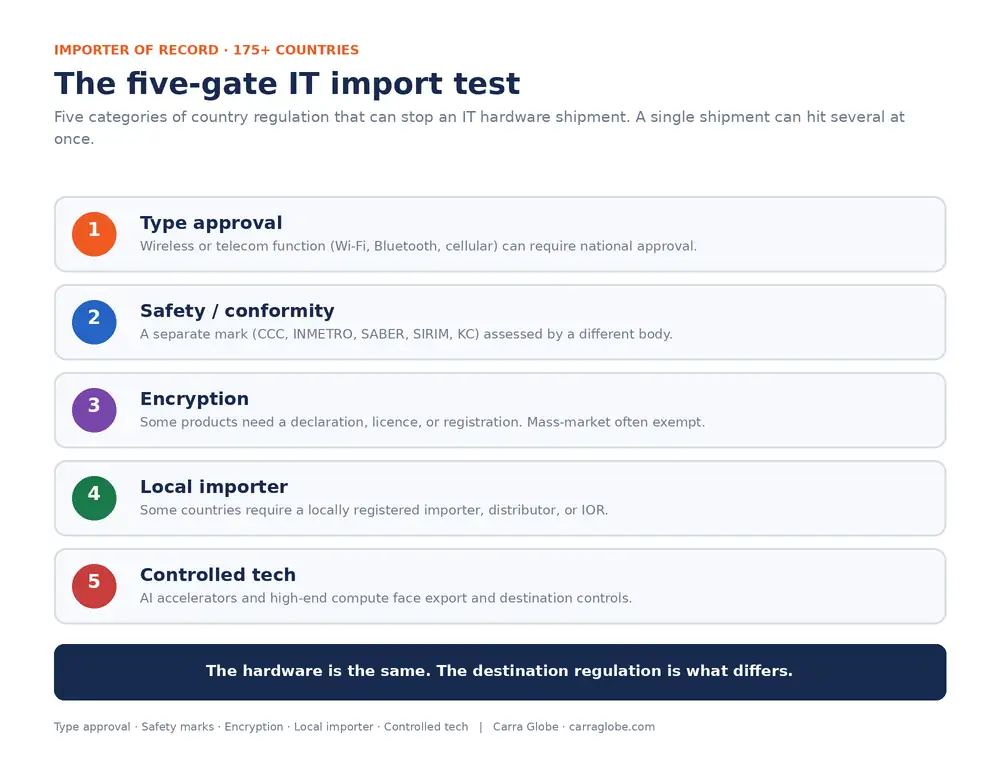
How the Categories Stack: A Realistic Example
Take a shipment of enterprise wireless access points with built-in encryption going into a market like Brazil or India. In one shipment, that hardware can touch four of these categories at once: telecom type approval because it is a wireless device, a safety or conformity mark as a separate requirement, an encryption consideration because of the security features, and a local-entity or importer-of-record requirement because the shipper has no registered presence in the country.
None of these is exotic. Each is a routine requirement administered by separate national customs, telecom, safety, standards, and trade-control authorities. Customs procedures may draw on international frameworks such as those promoted by the World Customs Organization, but product approvals remain country- and regulator-specific.
The problem is that they are assessed by different authorities, obtained on different timelines, and easy to discover one at a time as each becomes the reason the shipment is stuck. Planning treats them as a single checklist per destination before dispatch. Reacting deals with them one border-hold at a time, which is slower and more expensive. This is the core reason country regulation, not the hardware, is usually what determines whether a shipment moves.
What to Confirm Before You Ship to a New Country
- Wireless or telecom approval. Does the device have Wi-Fi, Bluetooth, or cellular? If so, assume type approval is required until confirmed otherwise, and start it early.
- Safety or conformity mark. Check whether the destination requires a separate safety certification such as CCC, INMETRO, SABER, SIRIM, or KC, and do not assume telecom approval covers it.
- Encryption. If the equipment contains encryption, confirm whether the destination requires an import declaration or licence for it.
- Who can be the importer. Confirm whether the country requires a local entity, and if you have none, line up a third-party importer of record.
- Controlled technology. For AI, compute, or advanced networking, confirm the export-control classification and any destination restrictions before committing.
How Carra Globe Helps
Carra Globe imports IT and technology hardware into 175+ countries, and the country-by-country regulation is exactly what we manage. Before a shipment moves, we confirm the type approvals, conformity marks, encryption requirements, and importer arrangements for the destination, and we act as your importer of record where you have no local entity. For deliveries where you want duties and compliance handled end to end, our Delivered Duty Paid service carries the whole process, and our IOR by country directory sets out what each market requires. The aim is that the destination’s regulation is planned for before dispatch, not discovered at the border.
Frequently Asked Questions
Why does the same IT hardware clear customs in one country but not another?
Because each country sets its own import rules. A device may need wireless type approval, a safety mark, an encryption declaration, or a local importer in one market and none of those in another.
The hardware is the same; the destination regulation is what differs. Confirming it per country before shipping prevents the hold.
Does a laptop or server with Wi-Fi need type approval to import?
Sometimes. Many countries require type approval for devices with Wi-Fi, Bluetooth, or cellular, but not all, and some exempt certain networking equipment. The requirement depends on the destination, the radio function, and any exemption.
Type approval, where required, is often needed before import, sale, network connection, or commercial use, and can take weeks, so confirm before dispatch rather than after the goods are in transit.
Is a safety certification the same as telecom approval?
No. They are separate requirements assessed by different bodies. A device can hold a valid telecom approval and still be blocked for lacking the required safety or conformity mark, such as CCC, INMETRO, or SABER.
Check both for each destination, since satisfying one does not satisfy the other.
Can I import IT hardware into a country where I have no local entity?
It depends on the country and product. If the destination requires a locally registered importer and you have none, you may need a third-party importer of record, an authorised distributor, or a licensed broker.
Where the country permits an IOR structure, a properly established third-party importer can be the named importer without you setting up a local company. Product certificates, licence-holder requirements, and end-user restrictions must still be checked separately, since an IOR is not available or sufficient for every regulated product.
Do encryption features change what I need to import IT hardware?
They can. Some countries require a separate import declaration or licence for equipment containing encryption, on top of type approval and safety marks. Security and networking hardware are the usual cases.
Treat encryption as its own question per destination, since a device can move freely into one country and need an encryption step in another.
How far ahead should I check a country’s IT import rules?
Before you commit to the shipment. Where required, approvals may be needed before import, sale, network connection, commercial use, or market placement, depending on the country and product.
They can take weeks, so discovering a requirement in transit usually means the goods wait until it is met. Treat the destination’s requirements as a checklist completed at the planning stage, not at the border.
Disclaimer: this guide is educational and does not constitute regulatory or legal advice. Import requirements for IT hardware vary by country, product, and configuration, and they change over time. Confirm the current requirements for your specific equipment and destination with a qualified trade compliance partner or the relevant national authorities before shipping.