
A pallet of new mining rigs can be worth more than a delivery van full of laptops, and it can sit at the border just as easily. Application-specific integrated circuit (ASIC) miners are high in value, concentrated in origin, and unusually exposed to the two things customs authorities scrutinise most: how the goods are classified and who is legally responsible for them. Get either wrong and a shipment that should have cleared in days can be held for weeks, accruing storage costs while hosting slots sit empty.
This guide explains how to import ASIC miners cleanly. It uses the United States as the most documented example, because US Customs has published detailed classification rulings on mining hardware, then sets out how the same principles apply in other markets. It covers classification (and a common error that misstates duty), tariff exposure, the product-compliance risk that has actually held shipments, and where the importer of record fits. The theme throughout: with mining hardware, the paperwork is the shipment.
Quick Answer
| Question | Short answer (verify per shipment) |
|---|---|
| Example US classification of a complete miner | CBP classified the miners in ruling N297495 under HTSUS 8543.70.9960, not the computer heading 8471 |
| Duty in that ruling | CBP cited a 2.6% general rate for those specific machines; confirm the current rate for your exact code |
| Mining cards and boards | May classify differently as parts, a US court placed certain mining PCBAs under 8473.30.1180 |
| China-origin tariff measures | Additional measures may apply; check the exact subheading, origin, and date before entry |
| Product compliance | FCC or equivalent type-approval questions must be checked per model and configuration |
| Importer of record | Required for the entry; who may act depends on the destination country |
Why ASIC Miners Are a Customs Problem, Not Just a Freight Booking
Three features make mining hardware harder to import than ordinary IT equipment. First, value concentration: a single shipment of current-generation miners can run into the hundreds of thousands or millions of dollars, which puts it into the value band customs authorities examine most closely. Second, origin concentration: a large share of ASIC hardware is manufactured in China, so it commonly lands in the middle of trade measures rather than to the side of them. Third, the goods sit at an awkward classification boundary, close enough to a computer to tempt a duty-free declaration, but treated by several customs authorities as something else.
The same customs principles apply to other high-value technology imports: correct classification, defensible valuation, and a clearly identified responsible importer. Those principles keep a high-value GPU cluster moving, and they apply to a container of miners just as directly. The sections below take each in turn.
How ASIC Miners Are Classified: 8543, Not 8471
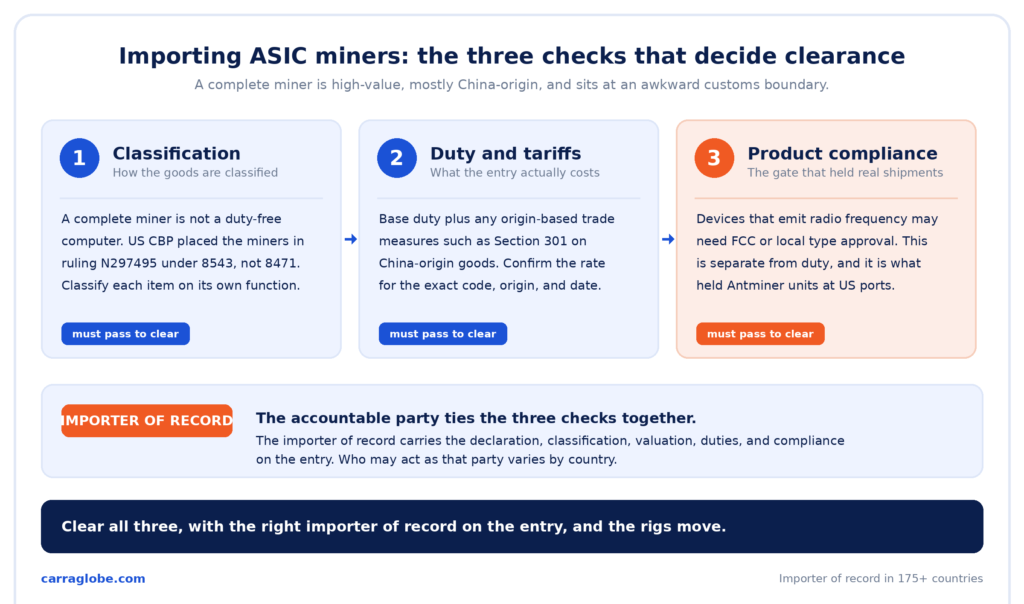
This is the most consequential decision in the entry, and it is where much published guidance is simply wrong. In the United States, Customs and Border Protection has classified certain dedicated cryptocurrency mining machines, including the Antminer S9 and the DragonMint Miner considered in ruling N297495, under HTSUS subheading 8543.70.9960, which covers electrical machines and apparatus having individual functions. CBP rejected the argument that those miners belong in heading 8471, the duty-free heading for automatic data processing machines. The correct classification for any specific miner remains fact-specific and should be confirmed against its configuration and the current tariff schedule.
The reasoning matters, because it tells you how to defend the classification. In ruling N297495, and on reconsideration in H300195, CBP found that these miners are not freely programmable and perform a specific function, hashing, that is not data processing. Under the legal notes to Chapter 84, that combination pushes them out of 8471 and into the residual electrical-apparatus heading 8543. A machine built only to mine is not, in customs terms, a computer.
The classification is model-specific, not a universal rule. Tariff suffixes and product features change, and newer miners with additional functionality can classify differently, so importers must confirm the current ten-digit code and the factual similarity of their model before entry. If you want to see how the same classification precision plays out across servers, GPUs, and networking gear, our HS codes field guide for electronics and the dedicated breakdown of the server heading 8471 show where the boundaries fall.
Do not transfer the miner’s code to its components
A modern mining shipment is rarely just complete miners. It can include hashboards, control boards, printed circuit board assemblies, power supplies, fans, immersion-cooling systems, modular data-centre units, and replacement parts. A complete miner, a hashboard, and a bare circuit assembly may each classify differently, based on the product’s function and condition at the time of import.
This is not a theoretical distinction. In Atlas Power, LLC v. United States (Slip Op. 26-04, 27 January 2026), the US Court of International Trade classified certain cryptocurrency-mining printed circuit assemblies under 8473.30.1180 as parts and accessories of automatic data processing machines, rather than under the residual heading the government proposed, and separately held they did not qualify for the Section 301 exclusions claimed.
The lesson for importers is direct: classify each item on its own function and import condition. Power supplies, controllers, cooling equipment, and networking switches may each classify separately, switches and routers, for example, fall under heading 8517 with their own type-approval considerations, not under the miner’s code.
Duty, Trade Measures, and the End of the Low-Value Route
Classification sets the base duty, but it is not the whole cost. For the specific products covered by N297495, CBP cited a 2.6% general duty rate. That figure is model-specific and dated, so confirm the current rate for the exact ten-digit line before calculating landed cost. Do not treat the 2.6% base figure from that ruling as the complete landed-duty figure for a current shipment.
Because much mining hardware is China-origin, additional trade measures can apply on top of the base duty. Whether a Section 301 or other measure attaches, and at what rate, depends on the exact eight or ten-digit subheading, the country of origin, the effective date, any exclusions, and the measures in force. These change often, so check the current position rather than assuming a static rate. The Office of the US Trade Representative publishes the applicable Section 301 actions by subheading, and our landed cost guide sets out how to build a duty-inclusive figure before you commit to a purchase.
The low-value route that once softened this for smaller buyers has also closed in the United States. The United States suspended duty-free de minimis treatment for shipments valued at 800 dollars or less, and has since moved that suspension from executive-order policy into regulation, with separate legislation setting a statutory end date, so the applicable threshold, entry process, and duty treatment now depend on the current rules and the shipment channel. Do not assume a low-value miner shipment enters duty-free. Our dedicated guide on the 2026 de minimis suspension sets out the verified timeline and what it means for entries.
Need the real landed cost before shipping? Carra Globe classifies the hardware, confirms the duty and trade-measure position, and clears it as your importer of record across 175+ countries. Request a classification and landed-cost review →
The Risk That Actually Held Shipments: Product Compliance
Valuation and classification are the errors most importers worry about. But the enforcement actions that first drew wide industry attention to this risk were about product compliance. Beginning in late 2024, trade-press reporting documented CBP detentions of certain Bitmain Antminer units, including S21 and T21 models, at ports including San Francisco and Detroit, over alleged FCC equipment-authorisation or radio-frequency-compliance concerns. A CBP letter obtained by that reporting described a seizure of a Bitmain S21 Pro mining machine at San Francisco International Airport on 10 January 2025, citing unauthorised, non-FCC-compliant radio-frequency equipment.
Those cases remain the clearest public illustration of the risk, and the underlying compliance principle has not gone away.
Two points deserve care, because the coverage was noisy. First, the model-specific facts should be verified rather than generalised: the reported incidents show why the question must be checked per model, they do not establish that every ASIC miner requires the same approval. Second, the widely repeated explanation that the holds were really about restricted chips from a Chinese supplier was industry speculation, not a confirmed government finding, and the FCC told one outlet it was unaware of any orders to halt the hardware.
The general principle is what matters. Product-compliance rules, including equipment authorisation for devices that emit radio-frequency energy, sit separately from duty and can stop a shipment that is correctly valued and classified.
Whether a given miner or configuration triggers FCC equipment authorisation, a supplier’s declaration, or other requirements depends on the device’s design, its wireless or radio-frequency functionality, and how it is marketed and operated, so it must be checked per model. Equivalent gates exist worldwide, the FCC in the United States, CE marking under the Radio Equipment Directive in the EU, ANATEL in Brazil, SIRIM in Malaysia, and others. Our guide to resolving a customs hold on IT shipments sets out the documentation that gets goods released.
Where the Importer of Record Fits
The importer of record is usually the principal customs-facing party for an entry, responsible for the declaration, classification, valuation, duties, and import compliance. On a shipment of high-value miners, that is not a formality. But responsibility is distributed, not concentrated in one party alone. Depending on the country, product, and transaction, the manufacturer, exporter, carrier, customs broker, importer, owner, and other parties may each carry separate obligations, product regulators may look to manufacturers or distributors, export controls fall on exporters, and a broker filing an entry has its own duties.
What that means in practice: a freight forwarder moves the goods, and a customs broker can file the entry as an agent, but neither automatically becomes the importer of record, and a broker filing on your behalf does not remove your responsibility for the correctness of the entry.
If you are importing into a market where you have no local entity, you either meet the importer requirements yourself or appoint a third party eligible to act. This is the role Carra Globe performs through its importer of record services, and the distinction between the importer of record and the other parties is set out in our guide on the importer of record versus the customs broker.
Financial security follows the same logic. In the United States, the applicable customs bond or security arrangement must be confirmed for the entry structure and importer profile, it should not be assumed that the importer of record personally holds every bond, or that a broker’s arrangement satisfies every requirement.
This matters more in 2026 than a year ago. On 3 June 2026, Executive Order 14411 directed US authorities to revise importer-of-record eligibility and enforcement, including bonding, ownership disclosures, importer designation, foreign-importer treatment, and enhanced vetting, with implementation developed through subsequent regulation and guidance.
A provider that acted as importer last year may face different eligibility conditions once the revised rules take effect. We cover it in our guide to the 2026 customs enforcement executive order, and the wider pattern of classification and valuation checks in our analysis of the CBP customs audit landscape.
What Changes Outside the United States
The US example is the most documented, but the same four questions apply in every market: how the hardware is classified, what duty and trade measures attach, what product-compliance gates apply, and who may act as the legally recognised importer. What changes is the detail, and it changes a great deal.
Classification is only a common starting point. The first six digits of the Harmonized System are shared internationally, but national schedules add their own digits, apply their own legal notes, and issue their own binding rulings. A US ruling does not bind the customs authority of the EU, Brazil, Malaysia, or anywhere else, and another country may place an ASIC miner under a different national subheading entirely.
Duty rates and trade measures differ by country and trade agreement, product-compliance gates differ (FCC, CE under the Radio Equipment Directive, ANATEL, SIRIM, and others), and the importer requirement varies most of all, since many jurisdictions require a locally established entity or a specific registration to act as importer of record. Classification and the importer position must be confirmed in the destination jurisdiction, not carried over from the US.
Because a large share of mining hardware ships from China, the export side matters too. Coordinating a compliant exporter of record at origin alongside the importer at destination keeps both ends of the move accountable. Country-by-country importer requirements are set out across our IOR by country pages, and Delivered Duty Paid terms, handled through our DDP service, can make the landed cost predictable for the buyer, though DDP is a commercial Incoterms rule and does not by itself settle who acts as importer of record.
Before You Ship an ASIC Miner
- Identify the exact model and import condition. Complete miners, hashboards, bare circuit assemblies, power supplies and replacement parts may classify differently.
- Confirm the classification per item in the destination country, and the current ten-digit code, rather than carrying a US ruling across borders.
- Confirm the current duty and any trade-measure exposure for the exact subheading, origin, and date of entry.
- Check the product-compliance position per model, including FCC equipment authorisation in the US or the equivalent type approval elsewhere.
- Confirm who is the legally recognised importer of record, that they still qualify, and how the customs bond or security is arranged.
- Put exact model and configuration language on the commercial invoice and packing list, vague descriptions invite holds.
How Carra Globe Helps
Carra Globe specialises in the international movement and customs compliance of high-value technology hardware. For mining and crypto-hardware shipments, we act as your importer of record or exporter of record across 175+ countries, classify the hardware and its components on their own terms, confirm the duty and trade-measure position before the goods move, check the product-compliance gates such as FCC or CE authorisation, and clear the shipment so it arrives whole and compliant. Eligibility and requirements vary by jurisdiction, and we confirm what applies before shipment.
Need an importer of record for a shipment of miners? Tell us the hardware, the origin, and the destination, and we will confirm the classification, the landed cost, and the compliant route. Get a quote →
Importer of Record · 175+ countries
Classification, duty, compliance: we clear your miners as importer of record.
Carra Globe classifies the hardware, confirms the duty and trade-measure position, checks the product-compliance gates, and acts as your Importer of Record so high-value mining hardware clears cleanly. Explore how we help:
Free tools: HS Code Finder|Volumetric Weight Calculator|Pallet Calculator
Shipping a batch of miners? Tell us the model, origin, and destination, and we will confirm and quote.
Get a compliance quoteFrequently Asked Questions
What is the HS code for a bitcoin ASIC miner?
In US ruling N297495, CBP classified the specific miners considered under HTSUS 8543.70.9960, rejecting the duty-free computer heading 8471. Classification is model-specific, so confirm the current code for your machine and destination. Other countries may apply a different national subheading, so the code must be checked in the destination market.Are ASIC miners duty-free to import?
Not in the US ruling on point. CBP placed the miners considered in N297495 under 8543.70, not the duty-free 8471 heading, so they carried a base duty, and China-origin units can face additional trade measures. The precise rate depends on the exact code, origin, and measures in force on the date of entry.Do mining cards and boards classify the same as a complete miner?
Not necessarily. A complete miner, a hashboard, and a bare circuit assembly can classify differently. A US court placed certain cryptocurrency-mining printed circuit assemblies under 8473.30.1180 as parts, rather than the complete-miner heading. Classify each item on its function and condition at import, not by the shipment it arrived in.Why were Bitmain Antminer shipments held at US customs?
Reported CBP detentions and seizures of certain Bitmain units involved alleged FCC equipment-authorisation or radio-frequency-compliance concerns, with a January 2025 seizure citing non-compliant radio-frequency equipment. The facts are model-specific. Reports linking the holds to restricted chips were speculation rather than a confirmed government finding.Do I need an importer of record to import mining hardware?
Every commercial import needs a legally recognised importer, declarant, or other accountable party under the destination country’s customs law. Many markets call this the importer of record, but the exact role and eligibility vary. If you have no local entity, you may need a third party, authorised distributor, licensed broker, consignee, owner, or another permitted structure. A freight forwarder or customs broker moving or filing the goods does not automatically take on that legal role.Does FCC approval apply to every ASIC miner?
Not automatically. FCC obligations depend on the device’s design, its radio-frequency functionality, and how it is marketed. The reported Antminer seizures show the question must be checked per model. Other markets apply their own equivalent type-approval regimes, which must be checked separately.Sources and Verification
- US complete-miner classification: CBP CROSS ruling N297495 (8 June 2018, Antminer S9 and DragonMint Miner), affirmed on reconsideration in H300195.
- Mining circuit assemblies as parts: US Court of International Trade, Atlas Power, LLC v. United States, Slip Op. 26-04 (27 January 2026), classifying certain mining PCBAs under 8473.30.1180.
- Section 301 measures by subheading: the USTR Section 301 search tool.
- US importer-of-record enforcement: Executive Order 14411, “Strengthening Customs Enforcement” (3 June 2026).
- Reported FCC-related detentions and the January 2025 San Francisco seizure: Blockspace Media reporting (November 2024 and February 2025), which obtained the CBP seizure letter.
- US de minimis treatment: see our dated guide to the 2026 suspension for the verified timeline and primary sources.
Disclaimer: This guide is for informational purposes only and does not constitute legal, customs, or trade advice. Classification is fact-specific, and duty rates, trade measures, and product-compliance rules vary by country, configuration, and date, and change frequently. Always verify the current position with the relevant customs authority, a binding ruling, or qualified counsel before importing or exporting.