
The US de minimis exemption has been suspended. Since August 29, 2025, every commercial shipment entering the United States, regardless of value, regardless of country of origin, and regardless of shipping method, is subject to formal customs entry, 10-digit HTS classification, and full duty payment. The $800 threshold that allowed 1.36 billion packages to enter the US duty-free in fiscal year 2024 no longer applies. As of July 2026 the US de minimis exemption remains suspended, and on June 24, 2026 CBP moved the suspension from executive-order policy into permanent regulation. This guide to the US de minimis exemption suspended in 2026 covers the verified timeline, exactly what the new rules require, who is most affected, and what importers and e-commerce sellers must do to stay compliant.
Update July 2026: CBP Codifies the Suspension and Introduces a New Postal Entry Process
On June 24, 2026, CBP moved the de minimis suspension from executive-order policy into permanent regulation. Two interim final rules now codify the suspension: one covering merchandise arriving by all modes other than international mail (91 FR 37789), and one covering postal shipments (91 FR 37801). For commercial importers shipping by air, ocean, truck, rail, or express, this rule changes nothing in practice: it simply writes the existing suspension into the CBP regulations. The requirement to file a formal or informal entry with a 10-digit HTS code and full duty payment has applied to these shipments since August 2025 and continues unchanged.
The postal rule is the one that introduces something new, and it is aimed specifically at the international mail environment. It creates a new postal informal entry process that takes effect on July 24, 2026, with a further delayed compliance date of October 22, 2026 for shipments subject to partner government agency data requirements or Chapter 98 and 99 duties. Under the new postal process, filers must secure a customs bond before a postal informal entry is accepted, and must transmit a detailed data set including the filer code, bond number, country of origin, full 10-digit HTSUS classification, value, duty rate, total duty owed, carrier, tracking number, and arrival details. This affects postal operators, parcel consolidators, and businesses shipping to US consumers through the international mail network, rather than commercial freight importers. CBP is also running a public comment period on the rulemaking that closes on July 24, 2026.
Separately, CBP has announced a voluntary electronic test known as Entry Type 13 for international mail shipments valued at $2,500 or less, beginning September 22, 2026. The remainder of this guide sets out the full picture of the suspension, who it affects, and what importers must do to stay compliant.
The Verified Timeline: How the US De Minimis Exemption Was Suspended
The de minimis exemption is codified under Section 321(a)(2)(C) of the Tariff Act of 1930. For decades it allowed goods valued at $800 or less to enter the United States duty-free with minimal customs paperwork. The provision was raised from $200 to $800 in 2016 and by fiscal year 2024 covered more than 1.36 billion packages annually, representing over 90% of all cargo entering the US by volume. Approximately 60% of those packages originated from China. The suspension happened in stages:
- May 2, 2025: President Trump signed Executive Order 14256, eliminating de minimis treatment for goods from China and Hong Kong specifically, citing synthetic opioid supply chain concerns
- July 4, 2025: The One Big Beautiful Bill Act is signed into law, terminating the de minimis exemption entirely effective July 1, 2027. This sets a hard statutory end date, separate from the executive-order suspension
- July 30, 2025: President Trump signed Executive Order 14324, “Suspending Duty-Free De Minimis Treatment for All Countries,” extending the suspension to all countries worldwide effective August 29, 2025 at 12:01 AM EDT
- August 29, 2025: Full suspension takes effect. All sub-$800 shipments from all countries lose duty-free treatment. CBP CSMS bulletin 66065494 confirmed that requests for de minimis entry would be rejected from this date
- February 20, 2026: Following the Supreme Court ruling on IEEPA tariffs, Executive Order 14388 continued the de minimis suspension, confirming CBP should keep collecting duties on these shipments. The SCOTUS ruling did not restore de minimis
- February 28, 2026: For international postal shipments, the specific duty collection period ended. From this date, only the ad valorem duty method is permitted for postal carriers and CBP-certified qualified parties collecting duties on international mail
- June 24, 2026: CBP publishes two interim final rules codifying the suspension into the CBP regulations, and creates a new postal informal entry process. The suspension is no longer executive-order policy alone: it is written into regulation at 19 CFR 10.151
- July 24, 2026: The new postal informal entry process takes effect. Public comment period on the rulemaking closes the same day. Full compliance required by October 22, 2026 for postal shipments with PGA or Chapter 98/99 requirements
- September 22, 2026: CBP begins a voluntary electronic test, Entry Type 13, for international mail shipments valued at $2,500 or less
- July 1, 2027: The statutory termination of de minimis under the One Big Beautiful Bill Act takes effect, permanently ending the exemption regardless of any change to the executive orders
Full details of the suspension mechanism and CBP implementation guidance are published in the CBP E-Commerce FAQ, and the codifying rule is published at 91 FR 37789.
What the 2026 Suspension Now Requires
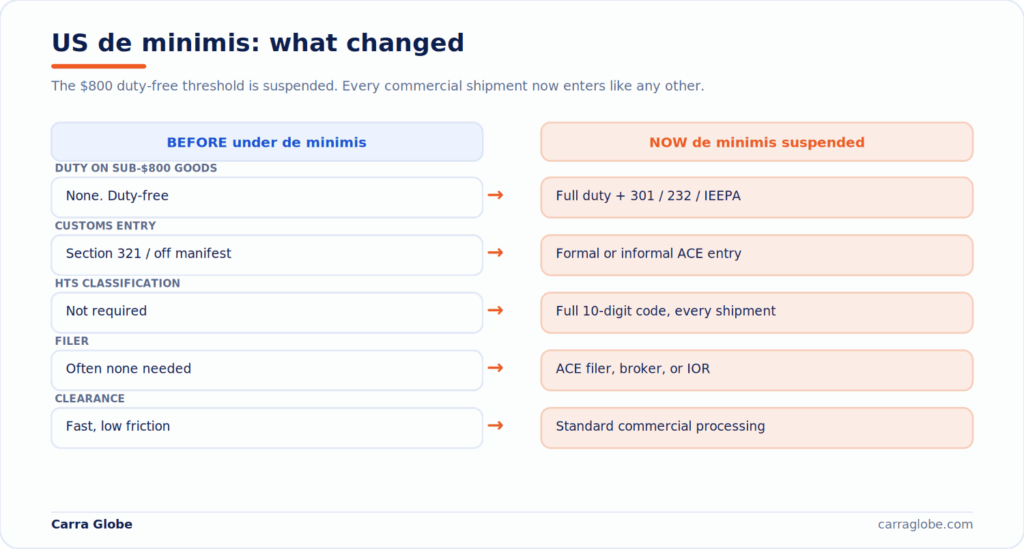
Since August 29, 2025, all commercial goods entering the United States, including those previously processed as simple Section 321 entries, are subject to the following requirements on every shipment regardless of value. The change from the old de minimis process to the current rules is set out below.
| Requirement | Before (under de minimis) | Now (de minimis suspended) |
|---|---|---|
| Duty on sub-$800 goods | None. Duty-free entry | Full applicable duty, plus any Section 301, 232, or IEEPA tariffs |
| Customs entry | Section 321, or release from manifest. Minimal data | Formal (Type 01) or informal (Type 11) entry through ACE |
| HTS classification | Not generally required | Full 10-digit HTSUS code on every shipment |
| Filer | Often none needed | Authorised ACE filer, customs broker, or importer of record |
| Documentation | Bill of lading or manifest | Full entry data, value declaration, and duty payment record |
| Clearance | Fast, low friction | Standard commercial entry processing and cost |
- Formal or informal customs entry through ACE: Every shipment must be formally entered through CBP’s Automated Commercial Environment (ACE) by an authorised filer. This applies to goods valued at $1 as much as goods valued at $799. The streamlined Section 321 entry pathway no longer exists for these shipments, and the release-from-manifest process is no longer available for formerly de minimis goods
- 10-digit HTS classification: Every import must carry a 10-digit Harmonized Tariff Schedule of the United States (HTSUS) code. The code determines the applicable duty rate. Assigning the correct code is mandatory and errors produce duty shortfalls, penalties, or holds
- Full duty payment: Applicable import duties, taxes, and any additional tariff measures must be paid on every shipment regardless of value. For most goods this includes the applicable MFN duty rate plus any Section 301, Section 232, or IEEPA tariffs applicable to the country of origin. For the full breakdown of Section 301 rates and the July 24 deadline, see our guide to Section 301 tariffs 2026.
- Entry type selection: Formal entry (Entry Type 01) is required for shipments valued above $2,500. Informal entry (Entry Type 11) is now the main pathway for commercial shipments valued at $2,500 or less, including sub-$800 shipments that previously used Section 321. The Entry Type 86 Test has been suspended
- For international postal shipments: Duties must be paid by the international mail carrier or by a CBP-certified qualified party acting in lieu of the carrier. From February 28, 2026, only the ad valorem duty method is permitted. From July 24, 2026, the new postal informal entry process applies, requiring a customs bond and a detailed electronic data set
How to Work Out What This Costs You
The rules above tell you what is required. The question most sellers actually have is simpler: how much more will I pay per shipment. The answer depends on three things, and you can work it out in four steps.
Take a worked example. Say you ship a base-metal fashion necklace from India, sold to a US customer for $40, that previously entered duty-free under de minimis.
- Find the 10-digit HTS code. Base-metal imitation jewellery classifies under heading 7117.19. The exact 10-digit code depends on whether the item is a chain or a non-chain piece and its per-piece value. Use the official USITC HTS Search to confirm the precise code for your product, because the code sets the rate.
- Read the general duty rate for that code. The HTSUS lists the base duty rate in the “General” column against the 10-digit code. This is the rate that now applies to your $40 necklace, where before it paid nothing. Read it directly from the HTSUS rather than assuming, because rates vary within the 7117 heading.
- Add any country-of-origin tariffs. This is where origin matters. Goods from India do not currently carry the Section 301 tariffs that apply to Chinese-origin goods, so an India-made necklace is likely to face the base HTSUS rate alone. The same necklace made in China would additionally carry the Section 301 rate for its list, which runs between 7.5% and 25%, stacked on top of the base rate. Origin can be the difference between a modest duty and a substantial one.
- Apply the rate to the customs value. Duty is calculated on the declared customs value, normally the transaction value, not the retail price. Multiply the combined rate by that value to get the duty owed on the shipment. Add the per-shipment entry and brokerage cost, which is a fixed cost that now falls on every parcel rather than being avoided under de minimis.
The single largest variable is country of origin. The same product, at the same value, can face very different landed costs depending on where it was made, because the Section 301, Section 232, and IEEPA measures are all origin-based. For a China-sourced product the stacked rate can be high enough to make the individual-order model unviable, which is why many sellers are re-examining both their sourcing and their fulfilment model. Our Delivered Duty Paid service exists to model this exact calculation, the code, the rate, the origin tariffs, and the per-shipment cost, before you commit to a shipping structure.
Will the De Minimis Suspension Be Reversed?
This is the question every e-commerce seller and cross-border importer is asking. With the US de minimis exemption suspended, the honest answer, based on verified information as of July 2026, is that reinstatement is neither confirmed nor indicated, and the legal ground for a reversal has narrowed considerably.
The suspension has been challenged in court. The Court of International Trade (CIT) stayed proceedings pending the outcome of Federal Circuit litigation over whether IEEPA gives the President authority to suspend a statutory provision like Section 321. However, a critical distinction applies: the SCOTUS ruling in early 2026 on IEEPA tariffs did not reinstate de minimis treatment. The de minimis suspension and the tariff authorities challenged in that case operate under different legal foundations. The SCOTUS ruling on tariffs does not resolve the de minimis question. For the full picture of what the IEEPA ruling means for importers, see our guide to Liberation Day tariffs 2026. Importers and sellers who assumed the SCOTUS ruling would restore the $800 exemption were mistaken.
The June 24, 2026 codification narrows the practical prospect of reversal further. By moving the suspension into the CBP regulations through two interim final rules, CBP has placed the measure on a footing that no longer depends on the outcome of the IEEPA litigation. CBP has stated that it issued the rule under its own statutory authority and would have done so even in the absence of any executive order. A court ruling on IEEPA tariff authority would not, on its own, unwind a rule that CBP has separately codified.
The decisive factor, however, is statutory. The One Big Beautiful Bill Act, enacted on July 4, 2025, terminates the de minimis exemption entirely effective July 1, 2027. This is not an executive action that a court can set aside on IEEPA grounds: it is an act of Congress. Even if every executive order were struck down tomorrow, the exemption ends by operation of statute in 2027. The direction of travel is not toward restoration. It is toward permanent elimination, and businesses should plan on that basis.
Who Is Most Affected by the De Minimis Suspension
The 2026 suspension affects different businesses in different ways. The following categories face the most significant operational and cost impact:
Cross-Border E-Commerce Sellers Shipping Direct to US Consumers
Businesses that ship individual orders directly from overseas warehouses or factories to US consumers at order values under $800 were the primary beneficiaries of the exemption. Their fulfilment model depended on Section 321 entry: no formal customs clearance, no duty, minimal documentation, fast delivery. That model no longer works. Every individual order now requires a formal ACE entry, a 10-digit HTS code, and full duty payment. The administrative cost per shipment and the duty cost per shipment both increase materially. At least 88 national postal operators suspended US-bound parcel acceptance at some point during the transition, unable to implement duty collection infrastructure at the pace CBP required. Japan Post suspended US merchandise shipments for eight months before resuming in April 2026 with a pre-payment duty system in place.
Dropshippers Using Overseas Fulfilment
Dropshipping models that route orders directly from Chinese or other overseas suppliers to US end customers without a US warehouse relied entirely on de minimis for duty-free entry. These shipments now attract the full applicable duty rate plus any applicable IEEPA, Section 301, or Section 232 tariffs. For goods sourced from China, the combined tariff burden is substantial. A dropshipper selling a $50 product that previously cleared duty-free now faces a significant duty cost on each individual order, fundamentally changing the economics of the model.
Fast Fashion and Consumer Goods Platforms
Platforms whose pricing models depended structurally on duty-free entry of sub-$800 goods are the most severely affected. The 2026 policy was explicitly directed at closing what the White House described as enforcement gaps that allowed large-scale importation of low-cost goods with minimal oversight and duty collection. Sub-$800 parcel volume entering the US fell by approximately 54% following the suspension, reflecting the scale of the commercial disruption to business models built around the exemption. The same platforms face a parallel tightening in Europe, where the EU abolished its own €150 duty-free threshold on 1 July 2026, covered in our guide to the EU de minimis changes 2026.
SME Exporters in India, Vietnam, Bangladesh and Other Markets
Small and medium exporters in India, Vietnam, Bangladesh, and other markets that supplied US consumers through e-commerce platforms relying on de minimis have lost duty-free access to the US market for individual orders under $800. India Post suspended US parcel acceptance at one point, with Indian MSME exporters in textiles, jewellery, electronics, and pharmaceuticals particularly exposed. These exporters now face a duty cost on every US-bound parcel.
The way through, for a seller with enough US volume to justify it, is to stop shipping individual orders across the border and instead import in bulk to a US fulfilment location, then ship domestically to customers. A bulk import pays duty once, on one entry, rather than paying a per-shipment entry cost on every parcel. The individual orders that follow never cross a border and never trigger a customs entry at all. For a high-volume seller, the duty and administrative saving from consolidating into a single bulk entry frequently outweighs the cost of holding US stock. This is the structural response the suspension pushes sellers toward, and it is worth modelling before assuming the direct-shipment model is simply finished.
What You Must Do Now
- Establish a compliant US import entry structure immediately. Every commercial shipment entering the US now requires an authorised ACE filer. If you have been shipping under Section 321 de minimis without a formal customs broker or Importer of Record relationship, that pathway is closed. Engage a licensed US customs broker or IOR with ACE filing capability before your next shipment
- Classify every SKU with a 10-digit HTSUS code. The 10-digit code determines the duty rate. Incorrect classification produces duty shortfalls and potential penalties. For high-volume e-commerce operations with hundreds or thousands of SKUs, this is a significant classification exercise. Do not use a generic or approximate code. The correct code is the one that accurately describes the product’s essential character, composition, and function
- Model your new landed cost with full duty included. Every product that previously entered duty-free now has a duty cost. Calculate the duty rate for each product category using the HTSUS and apply any applicable additional tariffs. Reassess your pricing, margin, and fulfilment economics with the new landed cost. If the model is no longer viable at current retail prices, restructure before shipping rather than after absorbing losses
- Consider US-based warehousing and fulfilment. Businesses that ship direct from overseas can substantially reduce per-shipment customs costs by importing in bulk to a US warehouse and fulfilling domestic orders from within the US. Bulk import reduces the per-unit administrative cost of customs entry. Domestic fulfilment eliminates the per-order customs entry requirement entirely. The capital cost of establishing or contracting US warehouse space may be lower than the combined duty and administrative burden of individual-order overseas direct shipment. Sellers shipping in the other direction, into the EU, face the mirror-image question of who acts as declarant there, which we cover in our guide to the EU de minimis importer of record and DDP
How Carra Globe Supports Importers Under the New US De Minimis Rules
Carra Globe provides Importer of Record and Global Trade Compliance services for businesses restructuring their US import operations following the de minimis suspension. Our Delivered Duty Paid service provides full landed cost modelling including HTS classification, applicable duty rates, IEEPA and Section 301 surcharges, and per-shipment customs entry costs before any procurement commitment. Our Freight Forwarding service manages ACE-integrated customs documentation for sea and air freight into US ports with authorised CBP entry filing on every shipment. For businesses comparing US import costs with alternative market entry structures, our country-specific IOR services cover the full range of import compliance requirements across 175+ markets.
Frequently Asked Questions: The 2026 De Minimis Suspension
Is the US de minimis exemption suspended in 2026?
Yes. The exemption remains suspended as of July 2026, and on June 24, 2026 CBP codified the suspension into regulation through two interim final rules. There has been no reinstatement, no court order restoring de minimis treatment, and no executive action reversing the suspension. The SCOTUS ruling on IEEPA tariffs in early 2026 did not restore de minimis because the suspension operates under different legal authority from the tariff measures challenged in that case. All sub-$800 commercial shipments continue to require formal customs entry and full duty payment.
What entry type should I use for sub-$800 shipments now that de minimis is suspended?
Informal entry (Entry Type 11) is now the main pathway for commercial shipments valued at $2,500 or less that previously used Section 321. Formal entry (Entry Type 01) is required for shipments valued above $2,500. Both require ACE filing by an authorised filer, a 10-digit HTSUS code, and full duty payment. The Section 321 entry type and the Entry Type 86 Test that facilitated de minimis clearance are no longer available for goods that fall within the suspension scope.
Did the SCOTUS IEEPA ruling restore the $800 de minimis threshold?
No. The SCOTUS ruling addressed the President’s authority to impose tariffs under IEEPA. The de minimis suspension operates under Section 321 of the Tariff Act of 1930 and was suspended through executive order authority over that specific statutory provision. These are different legal mechanisms. The Federal Circuit litigation over whether IEEPA authority extends to suspending Section 321 is separate from the tariff authority question the Supreme Court addressed. As of July 2026, the CIT has stayed the de minimis challenge pending the Federal Circuit outcome, and CBP has since codified the suspension in its own regulations. For a full explanation of what the SCOTUS ruling did and did not cover, see our guide to SCOTUS striking down IEEPA tariffs.
How does the duty calculation work on sub-$800 shipments now?
Under the 2026 rules, the same duty rates that apply to all commercial imports now apply to sub-$800 shipments. The duty is calculated on the declared customs value (typically the transaction value) at the rate corresponding to the 10-digit HTSUS code. Additional tariffs apply based on country of origin: Section 301 tariffs for Chinese-origin goods, IEEPA tariffs where applicable, and Section 232 tariffs for steel, aluminium, and other covered products. For goods from China, these tariffs stack and can produce very high effective duty rates on products that previously entered at zero under de minimis.
What happened to international postal shipments under the de minimis suspension?
Under the 2026 rules, international postal shipments are treated differently from courier and commercial freight. Duties on postal shipments must be paid by the international mail carrier or by a CBP-certified qualified party. From August 29 through February 28, 2026, carriers could use either a specific duty or ad valorem duty method. From February 28, 2026 onward, only the ad valorem method is permitted. From July 24, 2026, CBP’s new postal informal entry process applies, requiring a customs bond and a detailed electronic data set, with full compliance by October 22, 2026 for shipments with PGA or Chapter 98/99 requirements. At least 88 national postal operators suspended US-bound parcel acceptance at some point during the transition. Japan Post suspended US merchandise shipments for eight months before resuming in April 2026 with a pre-payment system in place.
Is the de minimis suspension permanent?
Effectively, yes. The suspension was implemented through executive order and, as of June 24, 2026, codified in the CBP regulations at 19 CFR 10.151. More decisively, the One Big Beautiful Bill Act terminates the de minimis exemption entirely by statute effective July 1, 2027. Because that end date is set by an act of Congress rather than executive action, it does not depend on the outcome of the ongoing IEEPA litigation. Businesses should plan their import operations on the basis that de minimis will not return, and that it ends permanently on July 1, 2027 at the latest.