
A line card fails in a Jakarta data centre at two in the morning. The spare is on a shelf in Frankfurt. Your SLA says four hours to respond and next business day to restore, the customer is already escalating, and somebody books the fastest courier available.
Four days later the part is still at the airport.
This is the failure nobody designs for, because a spare parts customs clearance feels like the easy case. It is small, it is cheap, and it is replacing something already installed and working. None of those three facts help you at the border.
Carra Globe does this work, so we have a commercial interest in your answer. What follows is written to be usable whether or not you ever speak to us, including the part where the honest answer is that nobody can fix it at two in the morning.
Why does a spare part get stuck when the original shipment did not?
Requirements are driven by the product, destination and applicable regime, not simply by value or urgency. A replacement module can still trigger approvals or licensing, even where the complete system already cleared them.
This is the value paradox, and it is the whole problem in one sentence. A wireless access point worth four hundred euros can face the same product approval requirement as a four hundred thousand euro deployment of the same equipment. The value of a shipment does not automatically remove a product requirement, and urgency never does.
The original deployment worked because somebody spent weeks on it. Approvals obtained, importer appointed, classification agreed, documents assembled. That work happened, it simply happened so far ahead of the shipment that nobody associates it with the shipment.
The spare part gets none of that. It gets a courier booking and a hope.
The four things that actually stop it
Four blockers, and the order matters less than knowing which one you have.
1. Nobody is eligible to import it
One of the first things to check, and one of the hardest to solve after the shipment has already moved.
Your engineer is on site. The data centre is a colocation facility that houses equipment and does not import it. Your customer may have a registration, or may be a multinational whose Indonesian entity has never imported anything. You are in Germany.
Somebody has to be named on the entry. In some markets, establishing an importer of record involves registrations, powers of attorney and local eligibility steps that cannot be completed instantly. Importer eligibility varies by market, and where a third party cannot act at all, no amount of urgency changes it.
2. The description is useless
Under pressure, somebody writes “computer parts” on the paperwork and thinks that is a description.
Carrier customs guidance consistently emphasises accurate, detailed commodity descriptions rather than generic terms. A usable description identifies what the item actually is: the commodity, the manufacturer, the model or part number, and serial numbers where the destination or procedure requires them.
“Computer parts” is usually too vague to support confident classification or regulatory review, and a shipment that looks vague gets the attention a vague shipment deserves.
Classification should be consistent with the actual replacement item, and where it differs from the original equipment the difference should be explainable from the module’s characteristics rather than left as an unexplained inconsistency. Our overview of HS codes for electronics covers the usual headings, and the HS Code Finder checks a specific code.
3. The approval does not exist for that part
The original deployment cleared because the equipment held the type approval that market required. The question is whether the replacement is the same equipment.
Often it is not quite. The vendor superseded the part, the revision changed, the spare is a later hardware version with a different model number. That is an ordinary, sensible engineering decision, and at a border it means the approval on file does not describe the item in the box.
The same applies on the export side. A module with encryption capability or a controlled specification carries its own classification, and a spare is not exempt because it is a spare. Our note on export controls for data centre hardware covers where that bites.
4. Nobody decided what the shipment is
A warranty replacement is not obviously a sale. There may be no money changing hands, the customer already owns the equipment, and the failed unit is going back.
Customs still needs a value and a basis for it, and this is more specific than most people assume. Under UK guidance, for instance, you normally cannot use the transaction value method for free of charge goods, because there is no price paid or payable. A different method has to be used and evidenced.
HMRC publishes guidance on valuing goods that are free of charge and separately on warranty, repairs and defective goods. A pro forma is commonly used to describe the transaction, but the document is not the answer on its own, and a zero value certainly is not.
Worth knowing if you ship replacements regularly. Where free of charge shipments recur between the same supplier and importer, a formal agreement with customs on the valuation method is available in some jurisdictions, through instruments such as an advance valuation ruling. That turns a recurring argument into a settled position.
The reverse leg needs its own plan. The failed module may be going back for repair, replacement, analysis or warranty processing, and the treatment can differ at each stage depending on destination, ownership and the customs procedure used. A plan that solves only the inbound shipment is half a plan. Our note on returned goods and reverse logistics covers the journey in the other direction.
Before shipping an emergency spare
Regulatory
- Confirm who will be named as importer of record
- Confirm the exact part, model and revision actually being sent
- Verify the HS classification for that item
- Check product approvals, licences and any export control position
Documentation and logistics
- Prepare the commercial or pro forma documentation
- Establish the customs valuation basis
- Confirm who pays duty and tax
- Confirm the broker and an escalation contact
- Confirm the return route for the failed unit
- Confirm what happens after customs release, and who installs it
Nine of those ten can be settled before anything fails. That is the point.
The courier trap
Express is the instinct, and for most spare parts it is the right answer. It is worth understanding what you are actually buying.
Integrators clear shipments under their own procedures at high volume. That works beautifully until your shipment is the one that raises a question, at which point you are one line in a queue, dealing with a call centre rather than a broker, and nobody in the chain has authority to make a decision about your specific problem.
Express carriers offer a mechanism most people never use: broker select. At the importer’s request the carrier passes the documentation to your own nominated broker, who completes clearance. The carrier no longer controls the process in the same way, so the timeline then depends on your broker and the customs requirements. You trade their speed for your control, which is the right trade only when you have a broker standing by.
There is also a bonded movement option in defined situations, though availability for IT spares varies by carrier, route and destination, so it is worth confirming rather than assuming.
Temporary admission procedures, including ATA carnets where the destination participates, are sometimes used for loan units and demo spares that will leave again. They suit a defined return rather than a permanent swap, so they fit field service stock better than a warranty replacement the customer keeps.
Aviation has spent decades building procedures around aircraft on ground parts, because the cost of delay there is extreme. Data centre operators do not generally have the same standardised ecosystem, but the transferable lesson is the operating model rather than the procedure: pre-position stock and pre-arrange the import path before the failure happens.
What you cannot fix at two in the morning
Worth being blunt, because the honest list is short and the hopeful list is long.
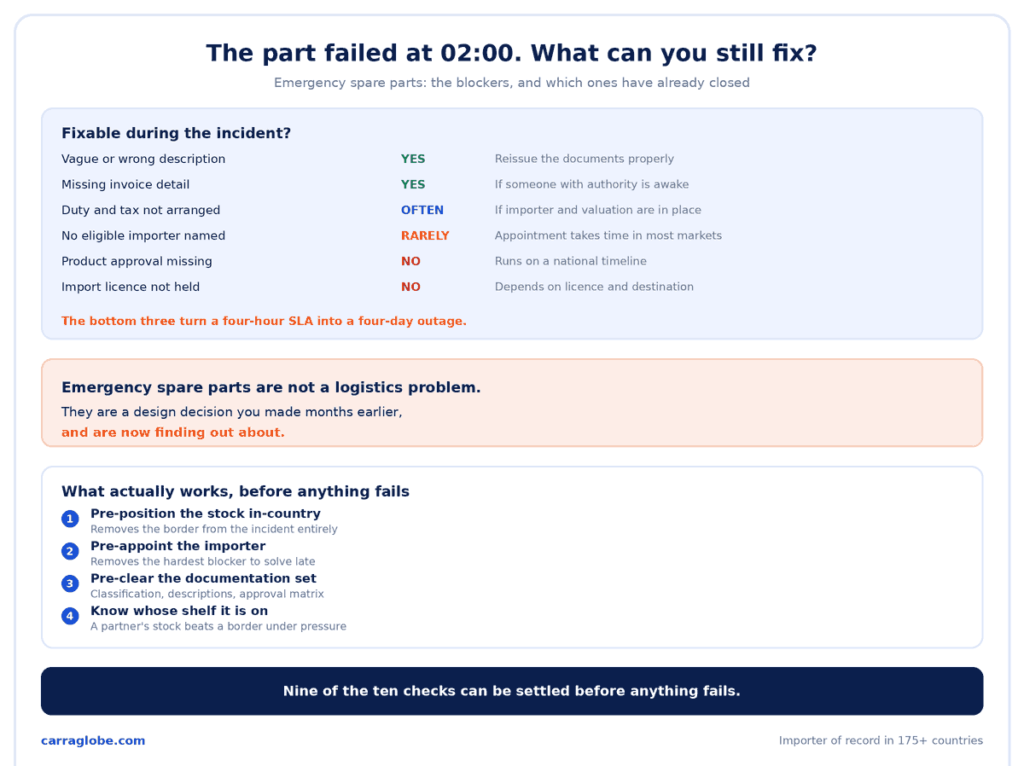
| Problem | Fixable during the incident? |
|---|---|
| Wrong or vague description | Yes. Reissue the documents properly |
| Missing commercial invoice detail | Yes, if somebody with authority is awake |
| Duty and tax not arranged | Often, if the importer, valuation and payment mechanism are already in place |
| No eligible importer named | Rarely. Appointment takes time in most markets |
| Product approval missing or superseded | No. These run on national timelines |
| Import licence required and not held | Usually not immediately. Depends on the licence and destination |
Read the bottom three rows. Those are the ones that turn a four-hour SLA into a four-day outage, and none of them can be solved by paying more or shouting louder.
Find out which of these applies to your markets →
Which produces the uncomfortable conclusion of this article. Emergency spare parts are not a logistics problem. They are a design decision you made months earlier, and are now finding out about.
The architecture that actually works
Four approaches, in ascending order of cost and descending order of risk.
- Pre-position the stock in-country. The only approach that removes the border from the incident entirely. Spares clear once, in advance, as an ordinary shipment with ordinary lead time, and sit in local storage until needed. Costly in working capital, and the only thing that genuinely delivers a next-day restore in a difficult market.
- Pre-appoint the importer. Cheaper, and it removes the blocker that is hardest to solve once a part is already in the air. The party who will be named on the entry is established and ready before anything fails, so an incident starts at the paperwork rather than at the eligibility question.
- Pre-clear the documentation set. Classification agreed, descriptions templated with serial number fields where required, pro forma wording settled, and an approval and permit matrix mapped against every relevant part in the bill of materials. An afternoon’s work that saves a week.
- Know whose shelf it is on. You do not need the part in your own warehouse. You need to know which partner in that region holds it, which is often faster and always cheaper than shipping across a border under pressure.
Most operations end up with a combination: pre-positioned stock for the critical few components in the difficult markets, and a pre-appointed importer plus templated documents for everything else.
The question to ask when you sign the SLA
This is where the money is won or lost, and it happens in a contract negotiation rather than a warehouse.
If you are committing to a four-hour response and next business day restore in a market where you hold no stock, no entity and no pre-appointed importer, you have written a promise that customs is under no obligation to help you keep.
Either the commitment reflects the import reality, or the import architecture gets built to support the commitment. Signing one and hoping for the other is how service organisations acquire penalties.
Importer of record for emergency spare parts
The honest position first. Once a part is at a border without an eligible importer or a missing approval, we can work the problem, but we cannot compress a national approval timeline and neither can anyone else. Anyone promising otherwise is selling you optimism.
What we do is make the incident boring.
- Providing importer of record coverage across 175+ countries, with the local import structure established in advance so a failed part arrives to an entry that can actually be filed.
- Mapping the approval position across your bill of materials, not just the headline units, so a superseded module is discovered on a Tuesday rather than during an outage.
- Holding pre-positioned spares in-country, with white glove delivery to the rack rather than to a loading bay.
- Running the routine imports too, through freight forwarding and delivered duty paid, so the emergency path is one you have already tested.
Where a local partner already holds the part, we will say so. That is usually faster than anything we can arrange, and our note on customs holds on IT shipments covers what happens when the alternative goes wrong.
Running field service into markets where you have no entity? Send the destination list and the critical parts. We will tell you which markets will fail you under pressure, before they do.
Importer of Record · 175+ countries
The time to solve an emergency spare is before the emergency.
Nobody compresses a national approval timeline at two in the morning, and anyone who says otherwise is selling optimism. What we do is make the incident boring: importer appointed in advance, approvals mapped across the bill of materials, spares held in-country where the market warrants it. Where a local partner already holds the part, we will say so.
- Importer of Record services
- IOR by country
- In-country warehousing
- White glove delivery
- Returns and reverse logistics
- Customs holds on IT shipments
Free tools HS Code Finder Volumetric Weight Calculator Pallet Calculator
Running field service where you have no entity? Send the destination list and the critical parts. We will tell you which markets will fail you under pressure, before they do.
Stress-test your spares routeFrequently asked questions
Do spare parts need the same approvals as the original equipment?
Not necessarily. A spare can be subject to the same, a different, or no separate approval depending on the product, destination and regime. Do not assume the original system’s approval carries across.
Revision changes are common in networking and server modules, where a part is superseded between the deployment and the failure, so a different model number is worth checking rather than assuming.
Does a low value mean simpler clearance?
It can reduce duty and simplify some procedures, but it does not remove product approvals, licensing or the requirement for an eligible importer.
Low-value treatment also varies by destination, so a threshold that helps in one market may not exist in the next.
How do I document a warranty replacement with no sale?
With documentation that identifies it as a warranty replacement and states an appropriate customs value. A pro forma is common where there is no sale, but the valuation method depends on the destination.
Treatment of the failed unit going back is a separate question, covered in our note on exporting equipment for repair.
Can an express courier handle the whole thing?
Often, and usually the fastest route. The limitation appears when a shipment raises a question, because you are then in a volume process rather than with a named broker.
Carriers offer a broker select option so your own broker completes clearance, though the timeline then depends on that broker rather than the carrier.
Can Carra Globe act as importer of record for a spare part shipment?
Yes, where we are eligible in that destination and appointed before the shipment moves. The appointment is the part that takes time, so it is worth setting up in advance of any incident.
Our IOR by country index sets out where a third party can act, and what a spare part shipment needs alongside it.
How long does spare part clearance actually take?
Hours where everything is prepared and an eligible importer is in place. Days or weeks where it is not, because the delay sits in the prerequisites rather than the clearance.
Our note on how long customs clearance takes covers the general picture.
Sources and verification
- Descriptions: carrier customs guidance consistently recommends accurate, detailed commodity descriptions and warns that generic terms and incorrect tariff codes cause delays.
- Broker select: express carriers offer designated broker arrangements under various names, including DHL’s designated broker procedure, FedEx International Broker Select and UPS Broker of Choice. Availability and service coverage vary.
- Customs valuation: World Customs Organization valuation principles and destination-specific rules. Customs value is not simply the figure on an invoice, and free-of-charge replacements can require a specific valuation treatment rather than a zero value. HMRC publishes guidance on valuing goods that are free of charge, used, rented or leased, and separate guidance on warranty, repairs and defective goods, both linked in the text above.
- Eligibility and approvals are national. Whether a third party may act as importer, and which product approvals or licences apply, are set by each destination and change. Confirm the position per market before relying on it in a service commitment.
Disclaimer: This guide is for informational purposes only and does not constitute legal or customs advice. Importer eligibility, product approval requirements, documentation standards and clearance procedures vary by destination country and by product, and change over time. This article reflects publicly available information as at 14 September 2026. Always confirm the position for your equipment and destinations with a qualified adviser or the relevant customs authority.