
On 20 July 2026, the United States imposed an additional 50% tariff on a range of Canadian goods under Section 338 of the Tariff Act of 1930, and the duty takes effect at 12:01 a.m. Eastern Time on 19 August 2026. Two things make this different from the tariff changes importers have already absorbed this year. First, it is the first time in the modern era that a US president has used Section 338, a rarely invoked, decades-old provision, to impose tariffs.
Second, and this is the detail catching importers off guard, a valid USMCA certificate of origin does not exempt covered goods. A product that would otherwise cross the border duty-free under the agreement still carries the full 50% if it appears in one of the annexes.
This matters more than many technology importers realise. The broadest of the three annexes reaches deep into Chapters 84 and 85 of the tariff schedule, the machinery and electrical-equipment chapters where servers, networking hardware, and other IT and data centre equipment are classified. If you import technology hardware from Canada, you have real exposure that is easy to miss if you only read the headlines about cars, alcohol, and dairy.
If you import from Canada, the practical window to act is short. This guide sets out exactly what the tariff is, what it covers, what is excluded, why USMCA does not help, and the specific checks to run before the 19 August effective date.
The deadline: the additional 50% duty applies to covered Canadian goods entered for consumption, or withdrawn from warehouse for consumption, on or after 12:01 a.m. ET on 19 August 2026. Arrival, release, or physical customs clearance alone does not decide treatment: confirm the entry date with your broker. If you import from Canada, check your exposure against the official annexes now, not after the date.
Section 338 Canada Tariffs: At a Glance
- What it is: an additional 50% ad valorem duty on specified Canadian-origin goods, imposed under Section 338 of the Tariff Act of 1930, on top of any existing duties, taxes, and fees.
- When it starts: 12:01 a.m. Eastern Time on 19 August 2026, for goods entered for consumption or withdrawn from warehouse on or after that moment.
- The trap: USMCA does not exempt covered goods. There is no USMCA carve-out in any of the three proclamations, so a valid certificate of origin does not remove the duty.
- What is excluded: energy products, potash, goods already subject to Section 232 tariffs, fish, critical minerals, and certain civil aircraft goods are carved out.
- How long it lasts: unlike the Section 122 surcharge, Section 338 carries no fixed expiry, so it stays in force indefinitely unless the President modifies or terminates it.
What Is Section 338 of the Tariff Act of 1930?
Section 338 is a long-standing but rarely used provision of US trade law. It authorises the President to impose duties of up to 50% on goods from a country found to discriminate against US commerce, compared with how that country treats other trading partners. The provision has existed for decades but had not been used for a tariff action of this scale in the modern era, which is part of why it has taken many importers by surprise.
The administration identified Canadian trade practices in three areas as the discriminatory conduct behind the action: provincial and territorial liquor-board restrictions on US alcoholic beverages, Canada’s supply-management system for dairy, and treatment of US automobiles. On 20 July 2026, the President signed three separate proclamations, each targeting a distinct set of goods, and each imposing the same additional 50% rate. Because Section 338 is a different legal authority from the ones behind the other 2026 tariffs, it comes with its own rules, and crucially its own set of exclusions and its own silence on USMCA.
The Detail That Catches Importers Out: USMCA Does Not Help
This is the single most important point in the entire action, and the one most likely to cause an unexpected bill. Under several of the other Canada tariff measures this year, USMCA-qualifying goods received relief, and the wider stakes of the agreement are covered in our USMCA 2026 review guide. Under Section 338, they do not.
None of the three proclamations creates a USMCA carve-out. This means a Canadian-origin good that qualifies as originating under USMCA, and that would normally enter the United States duty-free on that basis, is still subject to the full additional 50% if its classification appears in one of the annexes. For importers who have built their landed-cost models and their sourcing decisions around USMCA preference, this is a structural change, not a minor adjustment.
A certificate of origin that has reliably reduced duty to zero on a product does nothing against this particular tariff. Any importer currently relying on USMCA treatment for Canadian goods needs to reassess those specific lines immediately.
What Is Covered, and What Is Excluded
The 50% duty applies only to the specific Canadian products listed in the annexes to the three proclamations. The headline sectors are alcohol, dairy, and motor-vehicle-related goods, but the coverage is broader than those headlines suggest, extending across a wide range of products in the annex lists. Across the three annexes the duty reportedly reaches roughly 554 tariff lines, and the covered categories include items well beyond the three named sectors, such as cement, furniture, paper, textiles, cosmetics, wine, and various sporting goods.
Because coverage is defined by tariff classification rather than by broad category, the only reliable way to know your exposure is to check your specific codes against the official annexes.
One point causes particular confusion. The proclamation framed around motor vehicles does not actually cover cars or auto parts, because those are already subject to Section 232 tariffs. Instead, its annex is the most extensive of the three and applies to a broad, cross-sector basket of unrelated goods, reportedly including cement, furniture, apparel, consumer electronics, and machinery. So a question like “does Section 338 apply to Canadian cars?” has a counterintuitive answer: no, cars sit under Section 232, while the proclamation named after them hits hundreds of non-automotive product lines.
Several categories are expressly excluded from the Section 338 duty:
- Energy products and potash, which are carved out entirely.
- Goods already subject to Section 232 duties, which must be confirmed at the specific HTSUS-line level. Not every steel, aluminium, copper, automobile, or auto-parts product automatically qualifies: the test is whether the line is already carrying a Section 232 duty.
- Fish and critical minerals, which are excluded from the action.
- Certain civil aircraft goods covered by the WTO Agreement on Trade in Civil Aircraft, other than unmanned aircraft.
The Section 232 exclusion matters in practice: if a Canadian good is already carrying a Section 232 metals or auto tariff, it is not stacked with the new Section 338 duty on top. It is worth being precise about what this is: goods like autos, steel, aluminium, and lumber escape Section 338 only because they already face Section 232, so this is an anti-stacking rule, not a blanket exemption. That makes correct classification and an accurate read of what a good is already subject to essential to knowing your true exposure.
Importer of Record · 175+ countries
Importing IT or high-value hardware? We can be your Importer of Record.
Carra Globe acts as your Importer of Record so you can ship into markets where you have no local entity. We carry the legal liability, handle certifications and duties, and give you one itemised quote:
Have a shipment in mind? Send us your lane and goods, we will confirm and quote.
Get a compliance quoteWhy IT and Data Centre Hardware Importers Should Pay Attention
The headlines about this tariff talk about cars, alcohol, and dairy, so many technology importers have assumed it does not concern them. That assumption is risky. The broadest proclamation, the one framed around motor vehicles, does not cover vehicles at all, and instead reaches across sectors into Chapters 84 and 85 of the tariff schedule.
Chapters 84 and 85 are the machinery and electrical-equipment chapters, and they are where a great deal of IT and data centre hardware is classified: servers, networking equipment, storage arrays, power and cooling equipment, and many components and peripherals. Reported coverage of the annexes includes machinery, electrical equipment, and electronics, which is precisely the classification territory technology importers live in. That does not mean every server or switch of Canadian origin is caught, coverage is line by line, but it does mean a technology importer cannot assume they are outside this action just because their goods are not cars, alcohol, or dairy.
For any business importing IT or data centre hardware from Canada, the practical implication is direct: your specific HTS codes need to be checked against the annexes, especially anything classified in Chapters 84 and 85, and any USMCA preference you currently rely on gives no protection here. Our guide to IT hardware and data centre trade compliance covers the wider compliance picture for this equipment. This is exactly the kind of classification-level exposure that is easy to miss and expensive to discover at the border.
How Section 338 Fits the Rest of the 2026 Canada Tariff Picture
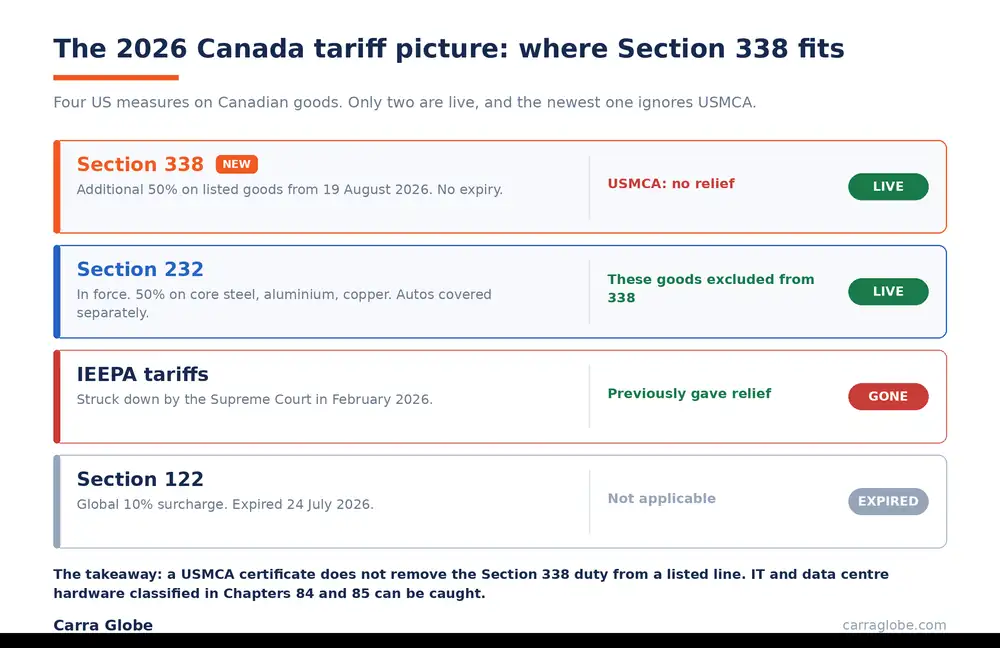
Section 338 does not replace the other measures affecting Canadian goods; it stacks alongside them, which is why the exclusions matter so much. We cover the wider US picture in our guides to the Section 301 tariffs and the now-expired Section 122 surcharge. Here is how the major 2026 Canada tariff authorities compare on effective date, whether USMCA gives relief, and current status, so you can see where the new duty fits.
| Measure | Status for Canadian goods (August 2026) | USMCA relief? |
|---|---|---|
| Section 338 (new) | Additional 50% on listed goods from 19 August 2026, no expiry | No |
| Section 232 (steel, aluminium, copper, autos) | In force; 50% on core metals; these goods are excluded from Section 338 | Not applicable |
| IEEPA tariffs on Canada | Struck down by the Supreme Court in February 2026 | Previously yes |
| Section 122 global surcharge | Expired 24 July 2026 | Not applicable |
The key takeaway from this picture is that the tariff landscape for Canadian goods has shifted repeatedly through 2026, and Section 338 is the newest and, for the products it covers, one of the most significant layers. Any duty model built earlier in the year is now out of date for affected lines.
Import IT or data centre hardware from Canada and not sure if the 50% applies? Carra Globe specialises in technology hardware compliance and can check your specific HTS codes, especially in Chapters 84 and 85, against the Section 338 annexes and the Section 232 exclusion before the 19 August deadline, so you know your real exposure rather than guessing.
Book a free HTS code check against the Section 338 annexes before 19 August →
What to Do Before 19 August
The action window is measured in days, not weeks. Here is the practical sequence for any importer of Canadian goods.
- Check your specific HTS codes against the annexes. Do not rely on a product-category summary. Coverage is defined by classification, so confirm each Canadian-origin line against the official annex lists or with your broker. Our free HS code finder helps you identify the right classification to check.
- Do not assume USMCA protects you. A valid certificate of origin does not exempt covered goods from this tariff. Treat USMCA-qualifying Canadian lines as exposed until you have confirmed they are not in an annex.
- Check the Section 232 position. If a good is already subject to a Section 232 metals or auto tariff, it is excluded from Section 338. Confirming this avoids both overpayment and a misread of your exposure.
- Re-run landed cost for goods entered for consumption on or after 19 August. It is the entry-for-consumption date, not the ship or order date, that decides whether a line is caught. Rebuild your cost models for affected lines at the new rate.
- Watch for Canadian retaliation. If Canada responds with its own measures, US exporters to Canada could face new costs on the export side, separate from this action.
How Carra Globe Helps
A dated tariff change with a hard effective date is exactly the kind of event where getting the classification right, quickly, is what protects your margin.
Carra Globe acts as importer of record and provides global trade compliance support across 175+ countries, with particular focus on IT and data centre hardware, checking your Canadian-origin lines, especially those classified in Chapters 84 and 85, against the Section 338 annexes and the Section 232 exclusion so you know your true exposure before the deadline.
Our landed cost guide shows how the new duty flows through to your total cost, and our delivered duty paid service builds duty-rate changes like this one into the delivered price so they do not become a surprise at the border. For the wider US picture, see our guide to reducing US import duty in 2026.
Official primary sources: the White House fact sheet summarising the three proclamations, an example proclamation with its product annex, the USITC Harmonized Tariff Schedule for classification, and US Customs and Border Protection for entry and effective-date guidance.
Frequently Asked Questions: Section 338 Canada Tariffs
What is the new 50% tariff on Canadian goods?
It is an additional 50% ad valorem duty on specified Canadian-origin goods, imposed under Section 338 of the Tariff Act of 1930, effective 19 August 2026, on top of any existing duties.
It was created by three presidential proclamations signed on 20 July 2026, targeting alcohol, dairy, and a broad range of other Canadian products listed in the annexes.
When does the Section 338 tariff on Canada take effect?
It takes effect at 12:01 a.m. Eastern Time on 19 August 2026, applying to covered goods entered for consumption or withdrawn from warehouse for consumption on or after that moment.
Goods entered for consumption before that time are not subject to the additional duty. Physical arrival or release alone does not decide it, so the entry date is what matters.
What happens if my goods clear customs on 18 August instead of 19 August?
Goods entered for consumption before 12:01 a.m. ET on 19 August 2026 are not subject to the additional 50% duty. The tariff applies only to covered goods entered on or after that moment.
This makes the timing of entry, not the shipping or order date, the deciding factor for whether a given shipment is caught.
Will my Canadian cheese shipment cost 50% more after 19 August?
Only if that specific dairy product is listed in the dairy proclamation’s annex. The dairy action covers many dairy goods, but coverage is defined by tariff classification, so you need to confirm your exact code.
If your product is in the annex, the additional 50% applies on top of existing duties for goods entered on or after 19 August, with no USMCA relief.
Do the Section 338 tariffs apply to IT or data centre hardware from Canada?
They can. The broadest annex reaches into Chapters 84 and 85, the machinery and electrical-equipment chapters where much IT and data centre hardware is classified, so technology importers may have exposure.
Coverage is line by line, not by category, so check your specific HTS codes against the annexes. USMCA preference does not exempt covered technology goods.
Does USMCA exempt goods from the Section 338 tariff?
No. None of the three proclamations creates a USMCA carve-out, so a good that qualifies as originating under USMCA is still subject to the full 50% if it appears in an annex.
This is a significant departure from some other Canada tariff measures, where USMCA-qualifying goods received relief. A certificate of origin does not remove this duty.
Can I use my USMCA certificate to avoid the new Canada tariff?
No. A valid USMCA certificate of origin does not exempt a good from the Section 338 duty if that good is listed in one of the annexes. The 50% applies regardless of USMCA qualification.
The certificate still matters for other duties, but it gives no relief against this specific tariff, which is the point importers most often get wrong.
Which Canadian goods are excluded from the 50% tariff?
Energy products, potash, goods already subject to Section 232 tariffs, fish, critical minerals, and certain civil aircraft goods are excluded from the Section 338 duty.
The Section 232 exclusion applies only to goods already carrying a Section 232 duty, confirmed at the HTSUS-line level, not to every metal or auto product by category.
What is Section 338 of the Tariff Act of 1930?
Section 338 is a long-standing US trade law provision that lets the President impose duties of up to 50% on goods from a country found to discriminate against US commerce compared with other trading partners.
The 2026 Canada action is the first time it has been used for a tariff measure of this scale in the modern era.
Does the Section 338 tariff stack on top of Section 232 tariffs?
No. Goods already subject to Section 232 duties are excluded from Section 338, so the two do not stack. Confirm this line by line, as not every metal or auto product is automatically covered.
This makes it important to confirm what a Canadian good is already subject to before assuming the 50% applies.
Do Section 338 tariffs apply to Canadian steel and aluminium?
No. Canadian steel, aluminium, and copper are already subject to Section 232 tariffs, and goods under Section 232 are excluded from Section 338, so they are not charged the additional 50% on top.
The same applies to autos and auto parts. This is an anti-stacking rule: those goods are excluded only because they already carry a Section 232 duty.
How long will the Section 338 Canada tariff last?
There is no fixed expiry date. Unlike the Section 122 surcharge, which had a statutory time limit, Section 338 tariffs remain in force indefinitely unless the President acts to modify or terminate them.
Ongoing US-Canada negotiations could change the position, so the status should be monitored rather than assumed fixed.
What should I do if I import Canadian goods?
Check your specific HTS codes against the official annexes, do not assume USMCA protects you, confirm whether Section 232 already applies, and re-run landed cost for anything shipping on or after 19 August.
Because coverage is defined by classification, confirming your exact codes with a broker or compliance partner is the only reliable way to know your exposure.
Disclaimer: this guide is educational and does not constitute legal or customs advice. The position described is current as of the date above and may change through further proclamations or negotiations. Coverage is determined by tariff classification against the official annexes, so always confirm the treatment of your specific goods with US Customs and Border Protection or a licensed customs broker before making import decisions.