
A quote request lands: “Please quote incoterms DDP + EOR + IOR from Denmark to Brazil.”
Three acronyms, one shipment. Most people reading that either think it is redundant, or quietly wonder whether they have been missing one of them on every shipment so far.
This page exists to settle that question and nothing else. It does not explain what the roles are, which our guide to IOR versus EOR already covers. It answers one thing: for your route, do you need one, both, or neither.
Carra Globe sells both services, so we have a commercial interest in your answer. That is exactly why this page is built to tell you when the answer is neither, which for most shipments it is.
Do I need both an exporter of record and an importer of record?
You may need both when you cannot act as the exporter at origin and cannot act as the importer at destination. Whether a third party is actually required depends on the rules of both countries.
Export and import are separate legal events in separate jurisdictions. The party answerable for the goods leaving Denmark is governed by Danish and EU rules. The party answerable for them arriving in Brazil is governed by Brazilian rules. Appointing someone for one does nothing for the other.
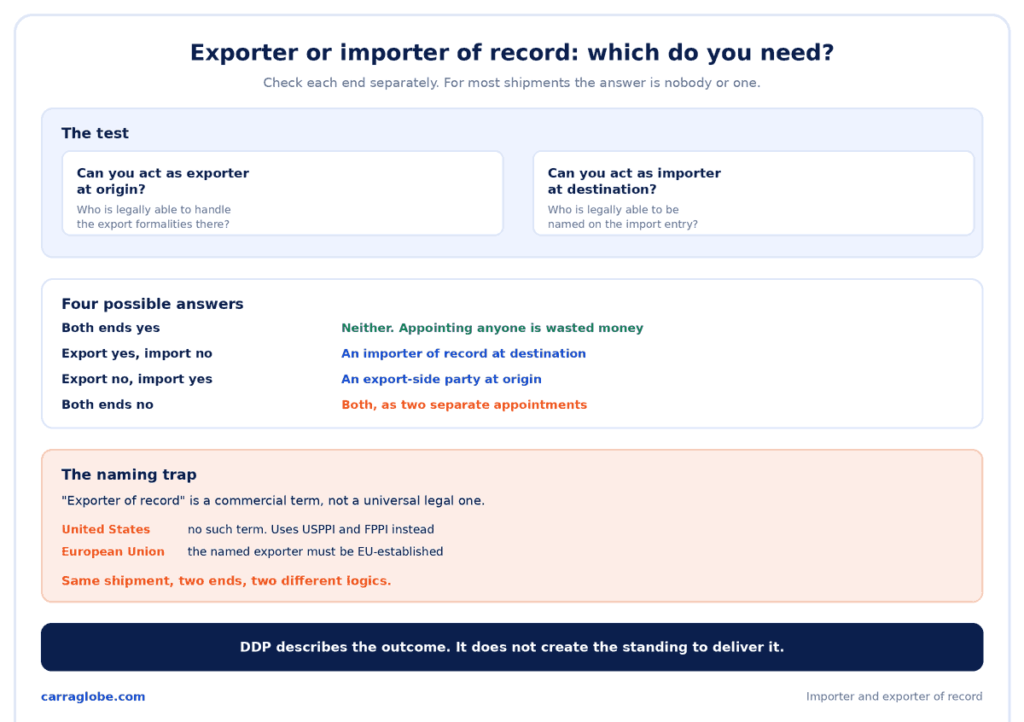
Check each end separately. Who is legally able to handle the export formalities at origin, and who is legally able to act as importer at destination? If your business can occupy both, you need nobody. If it can occupy one, you need an eligible party for the other. If neither, you need two. For most shipments the answer is nobody or one.
The naming problem nobody mentions
Here is the part that trips up people who assume the two roles are mirror images.
“Exporter of record” is a commercial term rather than a universal legal one. It does not appear in the US Export Administration Regulations, the Foreign Trade Regulations or ITAR. Those rules use defined roles instead: the US Principal Party in Interest, the Foreign Principal Party in Interest, and the exporter.
That matters practically. Under 15 CFR 30.3, a foreign entity that is the USPPI is prohibited from filing the Electronic Export Information itself and must authorise an agent, and that filer must maintain a physical office or residence in the United States. Our page on exporter of record in the USA covers what that requires.
The EU handles the same question in an entirely different way, which is exactly why you cannot reason from one country to another.
Under Article 1(19) of the UCC Delegated Regulation, as amended in 2018, the exporter named on an EU export declaration must meet an establishment test: it has to be a person established in the customs territory of the Union. So a non-EU business cannot simply name itself as the exporter on the strength of owning or selling the goods.
There are two routes out of that. An EU-established party can be designated as the exporter where it is a party to the contract under which the goods leave the Union. Or a non-EU business can appoint an indirect customs representative established in the EU, which lodges the declaration in its own name and takes on the associated liability.
The word indirect is doing real work there. A direct representative acts in your name, which does not solve the establishment problem at all.
So the United States has no such term but permits a foreign principal party, while the EU has a strict establishment test on the export declaration itself. Same shipment, two ends, two different logics.
Which makes the useful question not whether a provider uses the phrase “exporter of record”. It is which legally defined role they will occupy in that specific country, and whether they qualify for it.
Which of these is your shipment?
| Your situation | What you are likely to need |
|---|---|
| You are established at both ends and meet the applicable export and import requirements | Neither. You can handle both roles yourself, and appointing anyone is wasted money |
| You can export from your own country but cannot import at destination | An importer of record at destination |
| Your goods sit in a country where you cannot legally handle the export | An eligible export-side party may be required |
| You can occupy neither role | Both, and they are separate appointments under separate rules |
| Your customer will import in their own name and has agreed to | Just the export side, if you are not established at origin. Otherwise neither |
Find your row rather than reading the whole table.
The Denmark to Brazil case, worked
Take the quote request at the top. A vendor holds stock in a Danish warehouse and sells it to a Brazilian customer. It is registered in neither country.
At origin. Denmark is in the EU, so the establishment test above applies directly. A vendor that is not EU-established does not meet it, so it needs an EU-established contracting party, or an indirect representative lodging in its own name.
At destination. Brazil requires the importer to hold the relevant customs registration and Siscomex habilitation. A foreign seller without that structure generally cannot act as the importer through the ordinary import process. Our Brazil page covers what that involves.
Two ends, two eligibility failures, two appointments under unrelated bodies of law. Which is why that quote request listed all three items rather than assuming DDP would cover it.
Where DDP fits
DDP is the commercial term that says you will deliver the goods cleared for import, duties paid. It describes the outcome. It does not create the legal standing to produce that outcome.
Quoting DDP does not make you eligible to export or import anywhere. If you cannot lawfully be the exporter at origin or the importer at destination, the term describes a promise you cannot personally keep. Somebody has to hold each role, and that is what the EOR and IOR appointments do.
The failure mode is specific. Goods arrive, nobody eligible is named on the entry, and the consignment waits while somebody is found. Storage accrues, the deployment date moves, and the party who ends up appointed is chosen under time pressure rather than on merit.
Which is why the three usually appear together in a quote request. Our guide to comparing DDP quotes covers what to check before accepting one, and DDP versus DAP covers when a different term suits you better.
Four questions before you ask for a quote
- Where are the goods physically sitting now? Not where your company is. Where the stock is.
- Are you registered in that country? If not, the export side needs someone who is.
- Is your customer willing and able to import? If yes, you may only need the export side.
- Are the goods export controlled? Classification and screening sit with whoever holds the exporter role, and our note on export controls for data centre hardware covers what that involves.
Importer and Exporter of Record
Know which roles your route needs? Here is where the detail sits.
This page was only meant to settle the question. If you now know which roles your route needs, the pages below take it from there. If your answer was neither, none of these apply, and that is a perfectly good outcome.
- Importer of Record services
- Exporter of Record services
- IOR by country
- EOR by country
- Holding both ends with one partner
- How to compare DDP quotes
Free tools HS Code Finder Volumetric Weight Calculator Pallet Calculator
Route still unclear? Send the origin, the destination, where the stock is sitting and whether you are registered in either country. We will tell you which roles it needs, including where the answer is none of ours.
Ask which roles you needTwo things worth knowing if the answer is both
It is two engagements, not one with a discount. Each role carries its own eligibility, its own filings and its own liability in a different jurisdiction. A provider holding both ends may save you coordination, but expect the commercial structure to reflect two distinct pieces of work rather than a bundled rate.
The two roles share paperwork, so decide early who produces it. The export side needs the commercial invoice, packing list and classification. The import side needs the same documents plus anything the destination requires, and the values and descriptions have to match across both declarations.
That last point is the practical argument for holding both ends with one party. Where two providers work from separately prepared documents, the reconciliation happens after a discrepancy rather than before one.
How long it takes, and what actually sets the clock
Ask any provider for a lead time and the honest answer starts with a question: do you already hold standing in that market, or does it need establishing?
Where a provider is already registered and licensed in the destination, appointment is largely contractual. Work starts when you confirm, so the pace is set by how quickly the details come back rather than by any queue at the provider’s end. Where standing has to be established first, you are waiting on a registration process set by that country, and the range is wide enough that any general figure would mislead you.
In practice the appointment itself may not be the longest step. Product approvals, registrations, licensing or other destination requirements can take considerably longer. Our India guidance shows how far apart those routes can sit, with some equipment approvals running to weeks and certain regulated categories to months. If your equipment needs an approval it does not have, that timeline governs the shipment regardless of how quickly the roles are filled.
Check the destination country page for current estimates rather than working from a figure quoted elsewhere, since approval timelines move.
So the useful question to a provider is not “how long does it take”. It is “are you already able to act in this country for this product, or does something have to be obtained first”. Those are very different answers.
Where to go next
Once you know which roles your shipment needs, the detail sits elsewhere. This page is only meant to get you to the right one.
- You need the import side. Start with importer of record services and what an importer of record does, then the country position on our IOR by country index.
- You need the export side. Start with exporter of record services and what an exporter of record does, then EOR by country.
- You need both. Our note on using a single IOR and EOR partner covers why holding both ends together tends to be simpler.
- You are comparing quotes. Our guide to comparing DDP quotes sets out what to check before signing one.
If the answer is still unclear because the route is unusual, send the origin, the destination, where the stock is sitting and whether you are registered in either country. We will tell you which roles it needs, including where the answer is none of ours.
Ask which roles your route needs →
Frequently asked questions
Can one company be both the exporter and importer of record?
Yes, where it separately qualifies in both countries. The roles are distinct appointments under distinct national rules, so qualifying at one end says nothing about the other.
Holding both usually keeps the classification and documentation consistent across the two entries.
Is “exporter of record” a legal term?
Not everywhere. It is a widely used commercial term, but US export regulations do not use it, relying instead on defined roles such as the US Principal Party in Interest.
Ask which legally defined role a provider will occupy in the specific country rather than whether they use the phrase.
Does DDP mean I do not need an EOR or IOR?
No. DDP allocates contractual responsibilities, costs and risk between buyer and seller. It does not override the customs, tax, licensing or registration requirements of the countries involved.
Somebody eligible still has to hold each role, which is why quotes often ask for all three together.
How long does it take to appoint an EOR or IOR?
Where the provider already holds standing there, work starts once you confirm, so the pace depends on how fast your details come back. Where standing must be established, you wait on a national process.
Either way, outstanding product approvals or registrations can set the real timeline rather than the appointment itself.
Can my freight forwarder be the exporter of record?
Not automatically. In the EU a customs representative needs specific authorisation and not every forwarder holds it. In the US a forwarder can file the EEI as an authorised agent but is not the USPPI.
Filing on your behalf and holding the role are different things. Confirm which entity will actually be named in the export declaration before the goods move.
Sources and verification
- United States: 15 CFR 30.3, which sets out the parties to an export transaction, prohibits a foreign USPPI from filing the Electronic Export Information itself, and requires the filer to maintain a physical office or residence in the United States.
- European Union: Article 1(19) of the UCC Delegated Regulation, as amended by Regulation (EU) 2018/1063, under which the exporter must be established in the customs territory of the Union.
- Terminology and eligibility are national. Who may act as exporter or importer, and what the role is called, is set by each country and changes. Confirm the position for both ends of your route before shipping.
Disclaimer: This guide is for informational purposes only and does not constitute legal or customs advice. Exporter and importer eligibility, filing requirements and terminology vary by country and change over time, and the correct structure depends on the facts of the specific shipment. This article reflects publicly available information as at 3 September 2026. Always confirm the position for your route with a qualified adviser or the relevant authority before shipping.