
A shipment of servers clears Durban. Duty paid, VAT settled, the NRCS letter and the ICASA certificate both in the file. From a customs perspective the job is finished.
From a regulatory perspective it has just started. By placing that equipment on the South African market, somebody became a producer, with registration, reporting and recycling obligations attached to every unit for the rest of its life. And in 2026 that has become much harder to treat as theoretical.
This guide covers what South Africa’s EPR rules mean for a company importing IT hardware: which equipment is in scope, who counts as the producer, what registration involves, and the local-standing problem underneath the country’s approval gates.
Carra Globe acts as importer of record in South Africa, so we have a commercial interest in this subject. We are not a producer responsibility organisation and do not run EPR schemes, and what follows is written to be usable whether or not you ever speak to us.
What is EPR in South Africa?
Extended Producer Responsibility makes whoever places electrical and electronic equipment on the South African market responsible for it after use, through DFFE registration, an EPR scheme, and ongoing reporting against collection targets.
The framework sits under Section 18 of the National Environmental Management: Waste Act. The EPR Regulations, published as Government Notice R.1184 in Government Gazette 43879 on 5 November 2020, came into effect on 5 May 2021, covering electrical and electronic equipment, lighting, and paper and packaging. Portable batteries, lubricant oils and pesticides were added in 2023.
What changed in 2026
Nothing in the law. What has changed is the commercial temperature, and it is worth being precise about that rather than overstating it.
Trade reporting through 2026 describes e-waste compliance as still low while enforcement capacity builds.
The sector mistook the quiet years for a grace period. They were not. Industry bodies have pushed back on that reading, pointing out that obligations ran from the moment the regulations commenced, that existing producers were required to register by 5 November 2021, and that slow action reflected the department building capacity rather than granting a concession.
If there was never a grace period, a company registering in 2026 is not early. It is late, with the reporting history that implies. Public evidence of systematic prosecution remains limited, so the realistic near-term exposure is financial and commercial rather than criminal.
Two things have genuinely moved. The EEE scheme sets collection and recycling targets that increase over the implementation period, expressed in tonnes rather than as a percentage of your own imports, so paying a fee once and treating the matter as closed does not work. And the commercial consequence has arrived ahead of the regulatory one: large retailers and procurement teams increasingly require proof of EPR compliance as a condition of trading.
That second point is the one to plan around. For an importer the nearer-term exposure is commercial rather than criminal, and catching up runs backwards rather than starting from the day you register.
Which equipment is actually in scope
Worth pinning down before anything else, because “identified products” gets repeated a great deal without being identified.
Electrical and electronic equipment means equipment dependent on electrical currents or electromagnetic fields to work, designed for a voltage rating not exceeding 1,000V AC or 1,500V DC. Almost all IT hardware sits comfortably inside that.
The categories are then set by physical size rather than by function, which surprises people expecting an IT-specific list.
| Class | Test | Typical IT examples |
|---|---|---|
| Small EEE | No external dimension more than 50cm | Laptops, WiFi routers, access points, handsets |
| Medium EEE | Any external dimension between 50cm and 100cm | Monitors, rack-mount switches, smaller UPS units |
| Large EEE | Any external dimension more than 100cm | Full racks, large printers and copiers, enclosures |
The EEE notice identifies batteries separately from the three size classes. Portable batteries, meaning sealed batteries that can be hand-carried and are neither automotive nor industrial, moved to their own EPR scheme published in March 2023. Lighting also sits under a separate notice with its own targets. So a laptop with an internal battery, or a rack with lighting elements, can touch more than one scheme.
Classify the equipment by its own external dimensions, not by its shipping carton. And note that the class matters commercially rather than just administratively, because fees attach by class and mass.
Why the importer is usually the producer
This is the part that catches technology companies.
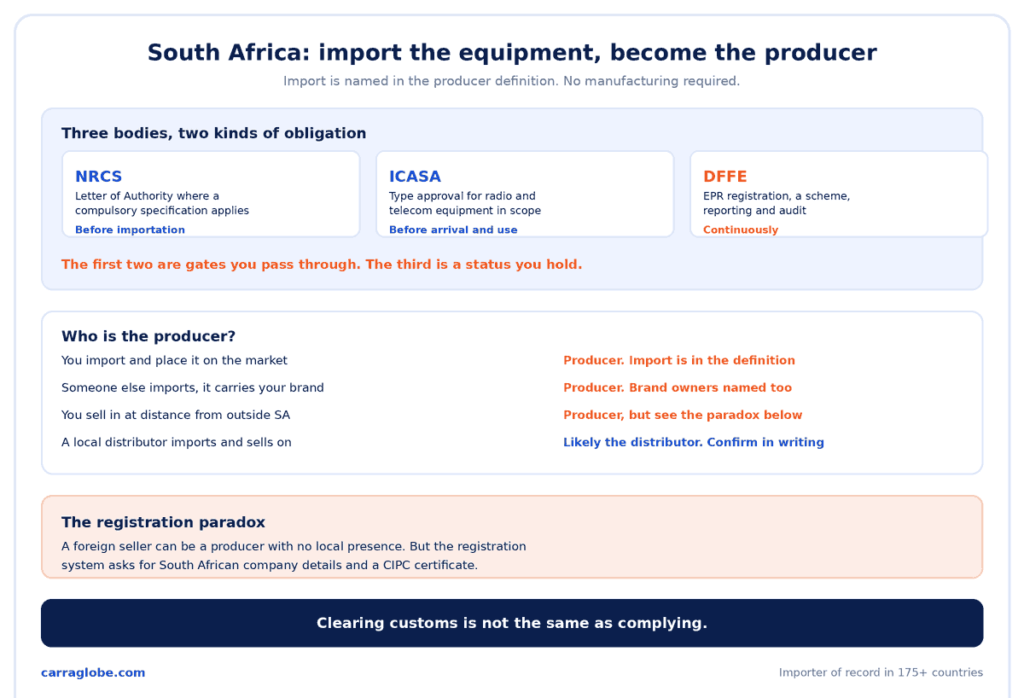
“Producer” in ordinary usage means the company that manufactured the thing. Under the EPR Regulations it is a legal status, and the definition says so directly: a producer is any person or category of persons, including a brand owner, engaged in the commercial manufacture, conversion, refurbishment where applicable, or import of new or used identified products.
Import is named in the definition itself. A business that commercially imports identified electrical and electronic products into South Africa can fall within the statutory definition of producer even though it did not manufacture the equipment. No manufacturing, no design work, no factory.
The same structure appears in the EU under a different statute, covered in our guide to WEEE producer obligations. In producer-responsibility regimes generally, importing is a form of producing.
Quick check: are you a producer in South Africa?
You import the equipment and place it on the South African market.
Producer. Import is named in the definition.
Someone else imports, but it carries your brand.
Producer. Brand owners are named too.
You sell in at distance from outside South Africa.
Producer by definition. Registering is a separate problem.
A local distributor imports and sells under the maker’s brand.
Likely the distributor, not you. Confirm in writing.
Some notices set volume thresholds below which smaller operators may fall outside scope. They are set low enough that most commercial importers will not benefit, but confirm rather than assume.
If you sell through a South African distributor
This is the arrangement most foreign vendors default to. Who imports and who first places the product on the South African market is what matters. Do not determine producer status from the brand name alone.
- The distributor imports and sells on under the manufacturer’s brand. The distributor may carry the producer obligation where it is the importing party placing the products on the South African market. Confirm this against the transaction structure rather than the brand relationship, and get the registration number in writing.
- The distributor sells under its own brand. Same answer, more firmly, since brand owners are named in the definition.
- You import and the distributor only resells domestically. You placed the goods on the market, so the obligation is likely yours even though your customer holds the relationship with the end user.
- You sell at distance into South Africa from outside it. Selling to South African businesses or consumers by distance communication brings you inside the definition without any local presence at all. Which creates the problem in the next section.
The practical instruction is to settle this contractually before the first shipment. Two parties each assuming the other registered is the common failure, and it surfaces when a customer asks one of them for a registration number.
Used and refurbished equipment counts
Easy to miss, and directly relevant if you move decommissioned or refurbished hardware. The definition covers the commercial import of new or used identified products, and names refurbishment where applicable as a producing activity in its own right.
So importing second-hand servers or refurbished laptops into South Africa raises the same producer question as importing new ones. Age does not take equipment out of scope, and a lower declared value does not reduce the obligation, because fees follow mass and class rather than value.
If you have just worked out that this applies to you, the useful next step is establishing which entity is the producer before the next shipment rather than after. Send us the destination, the equipment and how it is sold and we will map it. Ask us to check →
The registration paradox for foreign sellers
This is where the two halves of the problem collide, and it is worth knowing before you build a structure around it.
A foreign seller can fall inside the producer definition with no South African establishment at all. Selling in at distance is enough. But registering as a producer is a separate question, and the department’s system asks for South African company registration details and a CIPC certificate.
So a foreign company can be a producer and still be unable to complete the registration in its own name. Confirm with the department how the obligation is to be registered or represented before relying on a structure with no local entity. Being in scope and being able to comply are different questions, and discovering the gap after shipping is the expensive order to find out.
What registration and compliance involve
The compliance structure has three practical layers, and only the first is a one-off. The regulations contain more than three obligations, including record-keeping and financial reporting duties, but these are the three that shape the work.
Register with the department. Producers register with the DFFE through the South African Waste Information Centre, and the department issues a producer registration number on acceptance. Producers in existence when the regulations took effect were required to register by 5 November 2021. A business established after that has three months from establishment to register.
Worth separating two systems that sound alike. SAWIC is where you register as a producer. Reporting on quantities placed on the market and recovered runs through SAWIS, the waste information system. Registration and reporting are different obligations on different infrastructure, and assuming the first covers the second is a common way to end up with a gap in the record.
Implement a scheme. A producer must implement an EPR scheme, either by establishing its own, joining an existing one, or appointing a producer responsibility organisation to establish and implement one on its behalf. For most importers the PRO route is the realistic option. eWASA is a registered PRO for the electrical and electronic equipment sector. Other registered PROs also operate in it, so compare the scheme structure, fee basis and reporting requirements before joining.
There is no single universal EPR fee. Fees are determined within the applicable scheme and depend on factors including product category, weight, recyclability and the costs of collection, transport, treatment and administration. Some PROs publish current fee schedules by category and weight, though rates differ between schemes and change over time, so compare rather than assume.
Two mechanics are worth knowing before you read a schedule. Fees work on a net cost recovery basis, so the cost of collection, transport and treatment is offset by revenue from recovered materials. And the regulations cap administration costs on a declining basis, starting at 20% in the first year and reducing to 12% by the third. The DFFE also issued a Guideline and Toolkit for the Determination of EPR Fees in 2024 setting out the approaches.
Report, and be audited. You report the volumes placed on the market and what has been recovered or recycled through your chosen pathway. The framework includes interim performance reporting and annual audit requirements, and the exact audit obligation depends on whether you operate your own scheme or participate through a PRO. Either way this is an obligation that never finishes rather than an annual form.
The data problem is where non-compliance usually originates, rather than in any decision not to comply. Placed-on-market volumes typically live across finance, sales and logistics systems never designed to produce a single reconcilable number.
A usable dataset is narrower than people expect. For each shipment you want the product category as the notice defines it, the unit count, the mass, the date placed on the market, and a reference tying it back to the customs entry. Mass is the field most often missing, because commercial systems track units and value rather than weight, and it is the one the scheme needs. Build it off your shipment records from the start; reconstructing it under audit is the hard version.
What happens if you do not register
Start with what is most likely to happen, because it is not the thing that gets quoted.
Your historical volumes do not disappear. Obligations applied from the implementation dates, not from the day you registered. A producer addressing this late should expect questions about historical placed-on-market volumes, and should establish with its PRO and the DFFE how those volumes and any outstanding scheme obligations are to be reconciled. Catching up is not the same as starting.
You lose deals before you lose cases. Where a customer’s procurement process asks for proof of compliance and you cannot produce a registration number, that is a commercial exclusion with no regulator involved. For an importer selling into corporates or the public sector, this is the exposure that actually bites.
Then the patterns that get noticed. Registration for one waste stream but not others, placed-on-market volumes that cannot be reconciled, under-reported figures, unpaid scheme fees, and gaps in the reporting history.
The statutory position sits behind all of that. Failure to comply is an offence, and on conviction the regulations provide for a fine, imprisonment for up to 15 years, or both. That is a ceiling rather than an expected outcome, and public evidence of prosecutions here is limited. Worth knowing, because it places this in criminal rather than administrative territory. Not worth planning around.
What about equipment only passing through?
Worth raising because it is the first thing a logistics reader asks. The regulations contain an exclusion for identified products that are exported only, or produced for export purposes only.
That is not a blanket exemption for anything touching South African soil. The question remains whether the product was placed on the South African market, so transaction structure and customs treatment both matter. Genuine transit sits differently from goods entered for home use and later shipped on, and that is worth establishing in advance rather than arguing afterwards.
EPR comes after the border gates, but does not end there
For IT hardware specifically, South Africa runs approvals through three separate bodies, and they operate at different points in the shipment’s life. Missing any of them stops the deployment, but they fail in different ways.
| Body | What it covers | When it bites |
|---|---|---|
| NRCS | Letter of Authority where the equipment falls within an applicable compulsory specification, typically mains-connected products | Before importation, where it applies |
| ICASA | Type approval for radio and telecommunications equipment in scope, including anything with WiFi, Bluetooth or cellular | Before arrival, and before the equipment may be used |
| DFFE | EPR registration, an EPR scheme, and ongoing reporting and audit | Continuously, from the moment goods reach the market |
The first two are gates you pass through. The third is a status you hold. That difference is why EPR gets overlooked: a shipment that clears customs feels like a shipment that complied, and nothing at the border signals that a continuing obligation has just begun.
NRCS approval is also reinforced at the border by arrangement with SARS, so customs and regulator are joined up on the safety gate in a way they are not on the producer-responsibility one.
The local-standing problem
The three gates share a common requirement, and it is the question a foreign vendor should ask before anything else.
For many imported IT products, the structure ultimately requires a South African registered party somewhere in the chain. ICASA states that type approval certificates are issued only to South African registered companies. Non-South African companies generally apply for an NRCS Letter of Authority through a South African agent. DFFE registration and scheme obligations attach to the party placing goods on the market. A vendor with no South African presence may therefore face more than one local-standing problem at the same time.
ICASA requires supporting conformance test reports from recognised or accredited test facilities, and the report has to correspond to the equipment being submitted. That is worth confirming against your existing evidence early rather than at application stage. Our note on foreign test report recognition covers the general question of which reports travel.
That leaves the familiar three routes: establish a South African entity, rely on a local customer or distributor to carry the roles, or appoint a party that already holds local standing and can act as importer of record. Which fits depends on whether this is one deployment or a market entry, and on whether you are willing to tie your approvals to a distributor relationship you might later want to change.
Our page on importing without a local legal entity sets out the wider options, with South African detail on our importer of record in South Africa page.
A working sequence
Six steps, ordered to avoid the rework that comes from doing them in the sequence they occur to you.
- Establish who places the goods on the market. Your entity, a distributor, or an appointed importer of record. That answer determines who the producer is, and everything else follows from it.
- Screen the equipment against both approval gates, at model level. Mains-connected products point to NRCS. Anything carrying a radio points to ICASA. Many products point to both.
- Start the approvals before you book freight. Both are pre-arrival requirements, and goods without them are not released.
- Register with the DFFE and implement the required scheme structure, normally through a PRO or another permitted arrangement, in the name of whichever party is the producer.
- Set up placed-on-market reporting from your shipment data, at the point you start importing rather than at first reporting deadline.
- Record the analysis. If the producer question is ever asked, contemporaneous reasoning is worth considerably more than a reconstruction.
For hardware that will come back out again, whether for repair or at end of life, our note on returned goods and reverse logistics covers the customs handling that runs alongside this.
How Carra Globe helps
The boundary first, because it matters here. We are not a producer responsibility organisation and we do not run EPR schemes. Registration with the DFFE and membership of a PRO sit with the producer, and where that is your entity we work alongside whichever scheme you join.
- Establishing who the producer will be before shipment, so the answer is a decision rather than something discovered from a compliance query.
- Acting as importer of record in South Africa and across 175+ countries, including for data centre equipment and telecom hardware.
- Screening the SKU list against NRCS and ICASA scope so the pre-arrival approvals are known rather than assumed, and flagging where the producer-responsibility obligation will land.
Where a product genuinely needs testing or approval that has not been done, we say so. That is slower than anyone wants and better than a container sitting at Durban.
Shipping IT equipment into South Africa and unsure who carries which obligation? Send us the SKU list, the destination and how the equipment will be sold, and we will map the roles before anything moves.
Map the South Africa roles before you ship →
Frequently asked questions
Is the importer a producer under South Africa’s EPR rules?
Usually yes. The definition expressly covers any person engaged in the commercial import of new or used identified products, so importing brings you inside it without any manufacturing.
Sourcing hardware from an overseas supplier and bringing it in under your own brand or trading name typically makes you a producer without any manufacturing involved.
Do I need to register for EPR in South Africa?
If you are a producer of identified products, yes. Register with the DFFE through SAWIC and join a producer responsibility organisation, or establish your own compliant scheme.
New producers are expected to register within three months of being established. Annual reporting against rising recovery targets follows.
Can a foreign company get ICASA type approval?
Not in its own name. ICASA states that type approval certificates are issued only to South African registered companies, and the application requires local company registration details.
The certificate has to be issued to a South African registered company, so a foreign vendor works through an eligible local party where it does not have one itself.
What is an NRCS Letter of Authority?
An authorisation confirming a product meets South Africa’s compulsory safety specifications. It is required before importation and sale for products falling within those specifications.
Mains-connected equipment commonly falls in scope, and the requirement is reinforced at the border through arrangement with SARS.
Does EPR apply to used or refurbished IT equipment?
Yes. The producer definition covers the commercial import of new or used identified products, and names refurbishment as a producing activity in its own right.
Refurbishing for the South African market raises it too, which catches companies that assume only new imports count.
Does EPR apply if equipment only transits South Africa?
The regulations exclude identified products that are exported only, or produced for export purposes only. The test is whether the product was placed on the South African market.
Genuine transit sits differently from goods entered for home use and later shipped on, so establish the customs treatment and transaction structure in advance.
What is the penalty for not registering for EPR?
In practice, questions about your historical placed-on-market volumes, and exclusion from customers whose procurement requires proof of compliance.
The regulations also make non-compliance an offence carrying a fine, imprisonment for up to 15 years, or both, on conviction. That is a statutory ceiling, and public evidence of prosecutions in this sector is limited.
Does clearing customs mean my shipment is compliant?
No. Customs clearance addresses the pre-arrival gates. Producer responsibility is a continuing obligation that starts when the goods reach the market and does not appear at the border.
That gap is the single most common reason importers discover the obligation late.
Sources and verification
- Framework: EPR Regulations, Government Notice R.1184, Gazette 43879, published 5 November 2020 under the National Environmental Management: Waste Act (Act 59 of 2008), in effect 5 May 2021, amended by Government Notice 400, Gazette 44539 (2021).
- Sector notice: the EPR scheme for the electrical and electronic equipment sector, Government Notice R.1185, Gazette 43880, which sets the classes of EEE in scope and the collection and recycling targets.
- Fees: the DFFE Guideline and Toolkit for the Determination of EPR Fees, Government Notice 5535, Gazette 51534 (2024), setting out fee approaches on a polluter-pays basis.
- Registration: producers register with the Department of Forestry, Fisheries and the Environment through the South African Waste Information Centre EPR system, with the department’s registration guidance setting out what the process requires.
- Type approval: ICASA type approval requirements, including that certificates are issued only to South African registered companies.
- Confirm before shipping. Scope lists, targets, fees, reporting cadence and approval requirements change, and the position depends on the specific product. Verify with the relevant authority or a qualified adviser.
Disclaimer: This guide is for informational purposes only and does not constitute legal, regulatory or customs advice. Carra Globe is not a producer responsibility organisation and does not operate EPR schemes. Producer definitions, registration requirements, targets, fees and approval scopes are set by South African law and regulators and change over time, and the position for any given product depends on its characteristics. This article reflects publicly available information as at 4 September 2026. Always confirm current requirements with the relevant South African authority or a qualified adviser before importing.