
If you ship IT hardware at volume, you already have people who handle import VAT. A finance team, a tax adviser, a recovery process that works. This article is not about doing their job.
It is about the thing that sits upstream of them and quietly decides whether their process can work at all: how the import is structured, and specifically who is named as importer of record. The import structure, and the facts surrounding ownership at the time of import, can determine who is entitled to recover the import VAT. If the wrong party is on the entry, the options open to your VAT team afterwards are usually narrower and slower.
On a rack of GPU servers or a multi-site data centre rollout, that is not a technicality. On a six-figure IT hardware shipment the VAT exposure alone can be substantial enough that an import-structure decision, often made by whoever booked the freight, becomes a material financial issue.
Quick answer
| Question | Short answer (verify for your country and transaction) |
|---|---|
| Who can reclaim import VAT? | In the UK, generally the owner of the goods at import who meets the relevant VAT conditions. Other countries apply their own tests |
| Does being on the declaration give the right? | No. Paying the VAT and holding the evidence does not by itself create a right to deduct |
| Can a third-party IOR reclaim it? | Being the IOR does not by itself give the provider a right to deduct. Where it does not own the goods, that right will usually sit elsewhere |
| What does “owner” mean here? | In the UK, for VAT purposes, having the right to dispose of the goods as owner |
| Does postponed VAT accounting fix it? | No. It changes when the VAT is accounted for, not who is entitled to deduct it |
| When does it matter? | The ownership and import facts at the time of import are critical, which makes this a pre-shipment structuring question |
Where the line falls. Your VAT team handles the recovery. What we handle is the import structure that can determine the recovery position, which needs to be settled before the entry is filed.
Who can reclaim import VAT?
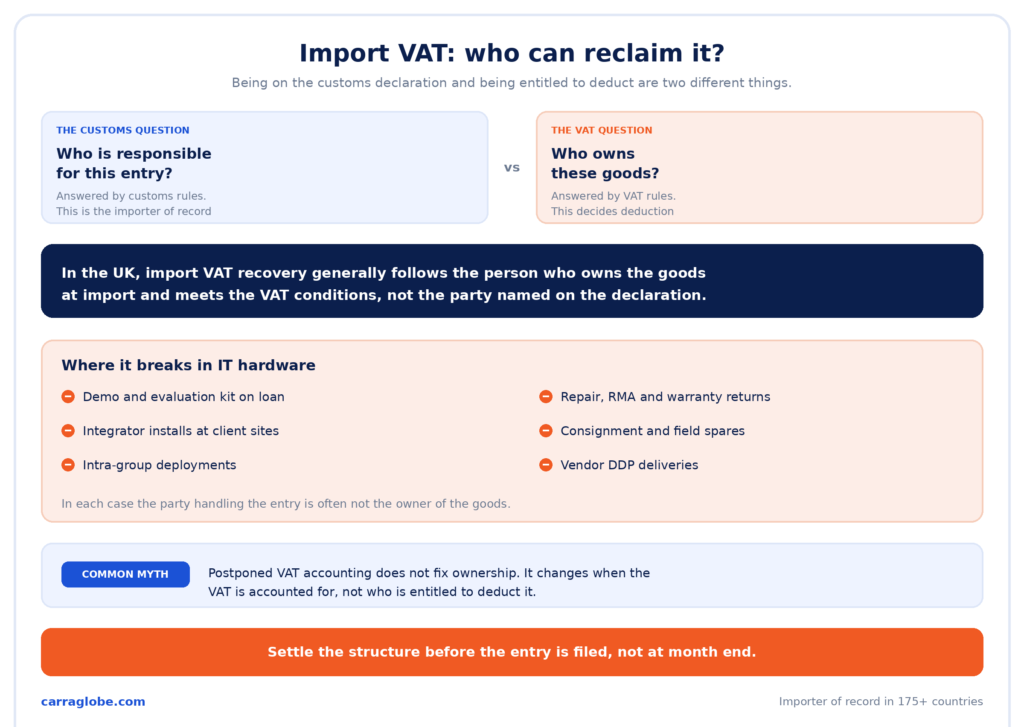
In the UK, import VAT recovery generally follows the person who owns the goods at import and meets the relevant VAT conditions, not simply the party named on the customs declaration. Being named as importer of record places the party shown on the declaration in the relevant customs-import role. It does not, on its own, determine who is entitled to deduct the import VAT.
HMRC states the position directly in its VAT Input Tax manual: import VAT may only be claimed by the owner of the goods, who as importer of record would be entitled to reclaim it either under section 24 of VATA 1994 where registered for VAT in the UK, or under Part XXI of the VAT Regulations 1995 where not, provided the legislative conditions are met.
The manual sets out the principle underneath it as well. Only the person to whom the supply was made, for use in furtherance of their taxable business, can make a valid input tax claim. That overrides who paid, and it overrides who holds the evidence.
For UK VAT purposes, HMRC uses a specific concept of ownership: the right to dispose of the goods as owner. That does not necessarily mean whoever holds legal title in the ordinary commercial sense. The policy has run since 15 July 2019 and the manual was refined in 2021 to make that VAT sense of ownership clearer.
Two different questions.
The customs question is “who is responsible for this entry?” The VAT question is “who owns these goods?” They are answered by different rules, and on a lot of IT hardware shipments they are answered by different companies.
The principle has been tested. A UK tribunal reached this outcome where a company was named as importer of record but only performed packaging, with the client owning the goods the whole time.
Why IT hardware is unusually exposed
Most commentary on this rule uses contract-manufacturing examples. The exposure in technology hardware is wider, because a large share of what moves is not a straightforward sale to the party receiving it.
- Evaluation and demonstration kit. A server, switch or appliance shipped on loan for a proof of concept. Nobody buys it, so title never transfers.
- Repair, RMA and warranty returns. A faulty unit belongs to the customer throughout. The repairer handling the import performs a service on goods it does not own.
- Integrator and installer shipments. Equipment imported by a systems integrator for installation at a client site, where the client bought direct from the vendor and held title from the outset.
- Consignment and field spares. Stock held at a local depot but owned by the vendor until consumed or sold.
- Intra-group deployments. Hardware moved to a subsidiary for use rather than sold to it, with title staying at the parent.
- Vendor DDP deliveries. An overseas vendor sells on delivered duty paid terms and acts as importer. Without the appropriate local VAT registration, evidence and recovery structure, the import VAT may end up recoverable by neither the overseas seller nor the customer.
These movements are routine at volume, and they frequently create situations where the party handling the customs entry is not the owner of the goods. Our guides to equipment sent for repair and IOR and EOR for returned goods cover the customs handling of those movements.
Import VAT and the importer of record you appoint
Worth being straight about our own service. A third-party importer of record solves a real problem: it lets goods enter a market where you have no legal entity. What it does not do automatically is give the provider a right to reclaim import VAT on goods it does not own.
HMRC identifies this pattern specifically. Where an operator acts as importer for an overseas business, performs services such as distribution, pays the import VAT and receives the certificate, but does not take ownership, recovering that VAT through its own return is the wrong treatment. The same applies where goods are sold shortly before import so that title has already passed, while the seller remains named as importer.
That is not an argument against using an IOR. It is an argument for deciding, before the entry is filed, which structure you are in.
| Structure | Who is on the entry | The VAT recovery issue |
|---|---|---|
| Your own local entity | Your entity | Your VAT team assesses recovery under local rules in the normal way |
| Third-party IOR, goods owned by the overseas seller or its customer | The IOR provider | Being the IOR does not automatically give the provider a right to deduct the VAT, so the recovery position has to be planned deliberately |
| Third-party IOR, goods owned by the IOR | The IOR provider | A different analysis, because ownership and import responsibility may align. Local rules and the commercial structure both need checking |
There can also be agency and principal structures in which the VAT treatment differs from a straightforward third-party IOR arrangement. In the UK, for example, an agent acting as principal under section 47 of the VAT Act may be able to recover the import VAT as input tax, but would then treat the onward transaction as its own supply and account for VAT on it. The contractual and VAT roles should be reviewed together.
Which one works depends on the country, the transaction and your registration position. The point is that it is a decision taken before shipment, not something that resolves itself once goods land. Our note on the difference between a paper IOR and an operational IOR covers what a provider should be doing beyond filing the entry.
Example: a server shipment with a third-party IOR
A US technology company ships a large consignment of servers to the UK for deployment at a customer site. The customer owns the equipment. The US company has no UK entity and appoints a third-party importer of record.
If that IOR is simply acting as importer without owning the equipment, the fact that it appears on the customs declaration and pays or accounts for the import VAT does not automatically give it the right to deduct that VAT. The ownership, importer and recovery structure needs establishing before the declaration is submitted, not after the statement arrives.
If the commercial structure instead has the IOR acquiring and supplying the goods as principal, the VAT analysis may be different and should be reviewed against the applicable UK rules. Either route can work. What does not work is leaving it undecided.
Postponed VAT accounting does not fix ownership
This is a common misconception, and it can cost money precisely because it feels like a solution.
Postponed accounting lets a VAT-registered importer account for import VAT on its return rather than paying at the border, which is a genuine cash flow benefit. In the UK it removed the wait for a certificate, and several EU member states operate their own versions.
The UK conditions matter here. HMRC guidance states that you can account for import VAT on your return where the goods are for use in your business, you have the right to dispose of them, usually as the owner, and your VAT registration number is on the import declaration. The business must be UK VAT-registered to use it at all.
So the ownership question survives untouched. Postponed accounting changes when and how import VAT is accounted for. It does not override the normal rules determining whether the import VAT is deductible as input tax, and HMRC states expressly that those normal rules continue to apply. HMRC’s position goes further: an importer that could not treat the import VAT as input tax because it is not the owner of the goods is not permitted to use postponed accounting at all.
The position outside the UK
Across the EU, the right to deduct import VAT is governed by the EU VAT framework, but the practical conditions and evidence requirements vary by Member State. CJEU case law shows why an importer cannot assume that paying import VAT is enough. In Weindel Logistik Service (C-621/19) a business imported goods to repackage them while the customer retained ownership throughout, and deduction was refused: the goods must be connected with the taxable person’s own taxable economic activity, and the relevant deduction conditions must be satisfied.
The precise importer, ownership, registration, refund and representation rules therefore need checking in the destination Member State. In practice, four variables decide the answer.
- Whether import VAT is payable at the border or accounted for on a return. Deferral and postponed accounting exist in some Member States and not others, and are often subject to authorisation rather than available by default.
- Whether a non-established business can register locally, and on what terms, since that determines whether recovery runs through a domestic return at all.
- Whether fiscal representation is required. Several Member States require a non-established importer to appoint a representative, which changes both the cost and the structure.
- Which refund route applies if there is no local registration, and what its evidence requirements and deadlines are.
Those four answers can differ between two Member States on the same shipment lane, which is why the destination has to be settled as a specific question rather than as a regional assumption.
A non-EU business importing into the EU needs to establish how import VAT is accounted for in the destination Member State. Deferral, postponed accounting, refund mechanisms and fiscal representation can each change the practical cash flow and recovery position. Non-established businesses are frequently required to work through a local representative, and refund routes exist for businesses not registered locally but carry their own conditions and deadlines.
The customs and VAT treatment therefore needs checking country by country rather than assumed from the UK or another EU market.
Because the mechanics differ, the country detail sits on the market pages: United Kingdom, Germany, Netherlands and Ireland, with the full set on our IOR by country index.
Settle it before the entry is filed
The import VAT recovery position depends on the facts surrounding the import, including who has the right to dispose of the goods as owner and who is entitled to account for and deduct the import VAT. That is why the structure needs to be settled before the declaration is filed. Six questions, in order.
- Establish who owns the goods at import. Not who ordered them, not who receives them, not who pays the freight. Read the contract and the Incoterm together and identify where title and the right to dispose actually pass.
- Check whether that owner can recover locally. Is it registered in the destination country, could it be, or does a refund route apply?
- Decide the import structure around that answer, rather than choosing the structure first and discovering the VAT position later.
- Look hard at DDP. Delivered duty paid is a common place for the import VAT position to be decided commercially before the tax consequences have been considered. Our comparison of DDP and DAP sets out the trade-offs.
- Confirm how the evidence will be recorded. Under UK postponed VAT accounting, check that the import VAT is allocated to the correct EORI and appears on the relevant postponed import VAT statement. HMRC specifically advises businesses using an agent to confirm the VAT was allocated to the correct EORI.
- Record the analysis at the time. Explaining a position contemporaneously is far easier than reconstructing it during an enquiry.
If you think you are already in the wrong structure
Some readers will recognise their own arrangement in the sections above. That is worth acting on rather than filing away, because the exposure repeats on every shipment until the structure changes.
- Separate the past from the future. Entries already filed are a question for your tax adviser, including whether any correction or disclosure is appropriate. The structure for future shipments is a separate decision you can make now.
- Establish the ownership position on paper. Pull the contracts and Incoterms for the affected lane and identify who actually holds the right to dispose of the goods at import.
- Check whether a customs procedure fits better. For loans, evaluations, repairs and processing, temporary admission, inward processing or a similar procedure may suit the movement better than a permanent import.
- Fix the next shipment first. Getting the following entry right stops the exposure growing while the historic position is being assessed.
To be clear about the division of labour: the historic reclaim is your adviser’s question. The structure for what ships next is one we can help with.
The questions to ask your IOR provider before shipping
If you are appointing an importer of record, or reviewing one you already use, these five questions surface the VAT position before it becomes a reconciliation problem.
- Who will be named as importer of record on the entry?
- Who owns the goods at the time of import?
- Who will receive the import VAT evidence, whether a certificate or a postponed statement?
- On what basis is the VAT expected to be recovered, and by which entity?
- What happens if the destination country’s rules do not allow the provider to recover it?
One point on question three: the evidence supports the claim, it does not create the underlying entitlement. In the UK, HMRC’s rules still determine who can deduct the import VAT.
If a provider cannot answer those clearly before the shipment moves, the VAT position has not been structured. That is worth knowing at the quoting stage rather than at the end of the quarter.
Importer of Record · 175+ countries
Shipping IT hardware into a market where you have no entity? Structure the import before it moves.
Carra Globe acts as your importer of record, maps who is named on the entry against who owns the goods, and flags the structures that put your VAT position at risk before the declaration is filed. Explore how we help:
Free tools: HS Code Finder|Volumetric Weight Calculator|Pallet Calculator
Planning a deployment into a new market? Tell us the goods, the route and the contract terms, and we will map the import structure before anything moves.
Map it before you shipHow Carra Globe helps
The problem we solve on this is structural: making sure the party named on the entry, the party that owns the goods, and the party your finance team expects to recover the VAT are the same answer, or at least a deliberate set of answers. We move IT hardware, data centre equipment and other high-value regulated goods as importer of record across 175+ countries, and on the VAT question our role sits upstream of your tax team rather than parallel to it.
- Mapping the roles before shipment. Who owns the goods at import, who is named on the entry, who receives the evidence, and whether those three line up with the recovery your finance team expects to make.
- Acting as importer of record where you have no local entity, including for data centre equipment and AI server deployments, structured so the entry does not undermine your position.
- Flagging the structures that trap VAT, so a DDP term or a loan arrangement is a decision you took rather than one you discover in a reconciliation.
One point worth stating plainly: we are not tax advisers, we do not recover VAT, and acting as importer of record does not by itself confer a right to recover VAT on goods we do not own. Where a recovery position needs establishing, we say so and work alongside your advisers rather than absorb the question.
Planning a deployment into a market where you have no entity, and want the import structured before it moves? Tell us the goods, the route and the contract terms. Ask us to map it before you ship →
Frequently asked questions
Who can reclaim import VAT?
Broadly, the owner of the goods at the time of import, where that owner meets the local conditions. Paying the VAT or being named on the declaration does not by itself create the right.
In the UK, HMRC treats ownership for these purposes as the right to dispose of the goods as owner. Other countries apply their own tests.
Can my third-party importer of record reclaim the import VAT for me?
Not automatically. Where the provider does not own the goods, that right will usually sit elsewhere. Being responsible for the customs entry and being entitled to deduct are separate questions.
Plan the recovery position separately from the customs appointment, before the entry is filed.
Can we reclaim import VAT on demo or loan equipment?
Often not, because nobody acquires ownership. Where a party imports goods it does not own and never will, it is generally not positioned to deduct the import VAT it paid.
For loans, evaluations and repairs, consider whether temporary admission or a similar customs procedure fits better than a permanent import.
Does postponed VAT accounting solve the ownership problem?
No. It changes when and how import VAT is accounted for, not who is entitled to deduct it. A party that could not recover under the certificate route does not gain the right by postponing.
HMRC goes further: an importer that could not treat the import VAT as input tax because it is not the owner of the goods is not permitted to use postponed accounting at all.
Why is DDP a problem for import VAT?
Because DDP places import clearance, duties and import taxes on the seller under the agreed Incoterm. The seller then needs to be able to operate the required import and VAT structure in that country.
The buyer may not have been the importer or the party entitled to deduct, so it should not assume it can recover the VAT simply because it ultimately receives the goods. See our guide to delivered duty paid.
Does Carra Globe handle VAT recovery?
No. We act as importer of record and structure the import. Recovery itself sits with your own finance team or tax adviser, and we work alongside them rather than replacing them.
What we can do is make sure the entry is structured so the party entitled to recover is positioned to do it.
Sources and verification
- UK: HMRC VAT Input Tax manual, including VIT44400 on import VAT deducted by non-owners, and guidance on refunds of UK VAT for non-UK businesses, which states that import VAT may only be claimed by the owner of the goods and defines ownership as the right to dispose of the goods as owner. The policy has applied since 15 July 2019.
- UK postponed VAT accounting: HMRC guidance on when you can account for import VAT on your VAT Return, which sets the conditions and confirms that the normal input tax rules continue to apply, and on completing your VAT Return to account for import VAT.
- EU: the deduction principle in the VAT Directive as applied by the Court of Justice in Weindel Logistik Service (C-621/19). Member State practice on postponed accounting, fiscal representation and refund procedures varies.
- Verify before shipping. Recovery rules, registration thresholds and evidence requirements differ by country and change. Confirm the position for your specific transaction with a qualified adviser or the relevant tax authority.
Disclaimer: This guide is for informational purposes only and does not constitute tax, legal or customs advice. Carra Globe is not a tax adviser and does not provide VAT recovery services. Import VAT recovery depends on the country, the transaction, ownership of the goods and the registration position of the parties, and the rules change. Always confirm your position with a qualified tax adviser or the relevant tax authority before importing.