
There is one sentence in Amazon’s own seller guidance that has cost more FBA sellers more money than almost any other: Amazon will not act as the importer of record for your FBA inventory, for any shipment, of any size or value, regardless of origin or product. It sounds like a technicality. It is not. It means that the moment your goods reach the border, someone other than Amazon has to be the legally accountable importer, and if that someone is not properly in place, the shipment is refused and returned. For any seller importing into a marketplace, the importer of record for Amazon FBA is the single most misunderstood and most consequential link in the entire supply chain. Getting your Amazon inbound customs responsibilities right is, in 2026, a precondition for selling at all. This guide explains exactly who has to fill that role, why it cannot be Amazon, and how non-resident sellers stay compliant in 2026.
This is the complete guide to the importer of record for Amazon FBA in 2026, written for Amazon FBA sellers, marketplace and e-commerce sellers, private-label brands, and anyone shipping inventory into a fulfilment network from another country. We will keep it practical, because the cost of getting this wrong is measured in held containers, lost inventory, and suspended selling privileges.
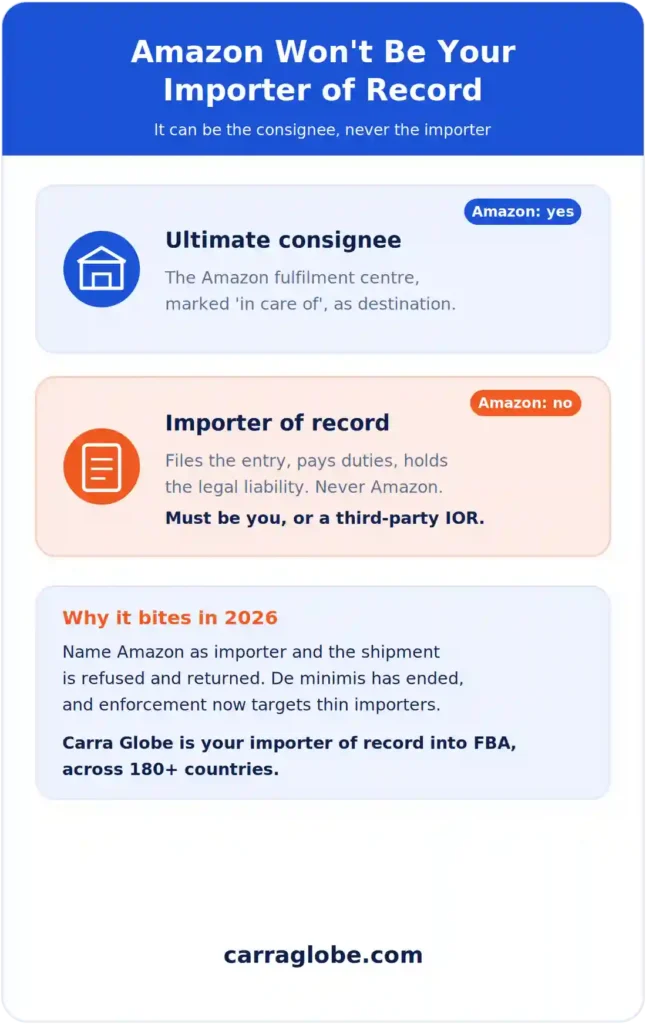
Amazon will not act as the importer of record for FBA inventory, for any shipment of any size or value. The seller, or a designated importer of record acting on the seller’s behalf, must be the legally accountable party that files the customs entry, pays duties, and takes responsibility for the import. Naming Amazon as importer of record gets the shipment rejected.
Why Amazon Will Not Be Your Importer of Record
The confusion is understandable. Amazon stores your inventory, fulfils your orders, and through Amazon Global Logistics will even arrange your freight. It feels like Amazon is handling the import. But there is a hard line Amazon draws, and it draws it deliberately.
Amazon is a logistics and retail platform, not a customs entity for your specific goods. The importer of record carries legal liability for the accuracy of the customs declaration, the payment of duties and taxes, and the compliance of the goods with all import regulations. Amazon will not take on that legal liability for inventory it does not own, so it refuses the role outright. Its guidance is explicit: Amazon, including its fulfilment centres, will not act as importer of record, consignee for customs purposes, or partner government agency importer for any shipment, regardless of size, value, origin, or product.
There is one nuance that trips sellers up. Amazon can appear as the ultimate consignee on your shipping documents, the final destination the goods are travelling to, as long as it is marked as in care of the Amazon fulfilment centre. What Amazon can never be is the importer of record. Confusing those two roles, consignee and importer, is one of the most common and most expensive mistakes new sellers make. If you name an Amazon fulfilment centre as the legal importer on a customs entry, customs will reject the shipment, and Amazon may treat it as a violation of its inbound shipping policies.
What Happens If You Get the Importer of Record Wrong
This is not a paperwork formality with a gentle warning attached. The importer of record field on a customs entry cannot be left blank, and it cannot be filled with a party that refuses the role. The consequences of getting it wrong stack up fast.
- The shipment is refused and returned. Customs will not release goods with no valid importer of record. Amazon’s own guidance warns that leaving the field blank, or naming Amazon, can result in the shipment being refused and returned to sender.
- Storage and demurrage charges accumulate. While a shipment sits held at the port, the costs mount daily, often on inventory you have already paid for and cannot yet sell.
- Inventory can be disposed of. If non-compliant goods reach a fulfilment centre, Amazon may refuse, return, or dispose of the inventory, and impose non-compliance charges.
- Selling privileges are at risk. Repeated customs or inbound-compliance failures can trigger suspension of your inbound shipping privileges, or in serious cases your Seller Central account.
- Liability does not disappear after clearance. Customs authorities run post-clearance audits. If an audit finds duties were underpaid or the importer of record was not legitimate, the back-duties and penalties land on you, sometimes years later.
The pattern is consistent: every one of these failures traces back to the same root cause, a missing or invalid importer of record. Solve that one link properly and most FBA customs problems simply do not occur.
Selling on Amazon FBA but have no entity in the destination country? Carra Globe acts as your importer of record, filing the customs entry, paying duties, and clearing your inventory into the fulfilment network, so Amazon never has to be the importer it refuses to be.
The 2026 Reality: Why This Matters More Than Ever
For years, many FBA sellers sidestepped the importer of record question entirely, because low-value shipments entered duty-free and the stakes felt low. That escape route has closed, and 2026 has made the importer of record decision unavoidable for sellers who could previously ignore it.
The single biggest change is the collapse of duty-free de minimis treatment. The United States suspended the 800-dollar duty-free exemption that countless FBA sellers relied on, first for China and Hong Kong and then for all countries, so most commercial FBA shipments now require a formal customs entry with duties paid, even when the value is under 800 dollars.
The European Union is removing its own low-value exemption in 2026. The duty-free era that let sellers ship small parcels without thinking about an importer of record is over, and we analyse the full picture in our 2026 importer of record landscape report.
At the same time, enforcement has tightened sharply. The June 3, 2026 US Customs Enforcement Executive Order, analysed in full in our breakdown of the 2026 Customs Enforcement Executive Order, raised the bar on who may act as an importer, and it hits non-resident sellers hardest. The concrete consequences for a foreign FBA seller are direct:
- Foreign importers can be barred from informal entry. Low-value informal entries are being restricted to US importers, so a non-resident seller may be pushed into formal entry, with its bonding and documentation requirements, on shipments that once cleared informally.
- Continuous bonds are restricted for foreign importers. Many non-resident sellers are now being forced off the cheap annual continuous bond and onto single-entry bonds, which multiplies per-shipment bonding cost and can tie up critical working capital exactly when you are stocking up for peak season.
- Minimum domestic assets or higher bonding. Every importer of record must now hold minimum tangible US assets, increased bond coverage, or both, a bar a thin offshore selling entity may not clear.
- A minimum penalty floor with no mitigation for repeat offenders. The order sets a floor on penalties and removes the mitigation that used to soften the cost of a customs error, so getting the import wrong is materially more expensive than it was last year.
Read together, these measures mean a foreign seller relying on a thin, paper importer of record with no real US substance is exactly the structure the order targets. The importer of record decision, once optional in practice, is now central to whether an FBA business can operate at all.
Your Importer of Record Options as an Amazon FBA Seller
If Amazon will not be your importer of record, who can be? You have a limited set of options, and the right one depends on whether you have a legal entity in the destination country.
| Option | Best for | What it involves | Who carries the liability |
|---|---|---|---|
| Be your own importer of record | Sellers with a legal entity, or non-residents able to register one | Register via CBP Form 5106, post a customs bond, classify and file entries yourself | You, in full |
| Appoint a third-party importer of record | Non-resident sellers with no entity in the destination country | A provider acts as IOR under power of attorney, files entries, pays duties, clears to FBA | The provider, on your behalf |
| Rely on your freight forwarder | Generally not an option for the IOR role itself | The forwarder or broker files paperwork, but does not become the importer of record | Still you, unless an IOR is appointed |
Option 1: Be Your Own Importer of Record
If you have a registered legal entity in the destination country, you can act as your own importer of record. In the United States, even non-resident sellers can register as a foreign importer of record using CBP Form 5106 to obtain an importer number, and post the required customs bond. This route gives you full control, but it also puts the full legal liability, the bond, and the ongoing compliance burden directly on you, and it requires the knowledge to classify goods, value them correctly, and file accurate entries.
Option 2: Appoint a Third-Party Importer of Record
If you do not have an entity in the destination country, or you do not want to carry the importer liability and compliance burden yourself, you appoint a third-party importer of record. The provider, established in the destination country, acts as the importer of record on your behalf under a power of attorney, files the customs entry, pays the duties, and clears your inventory into the fulfilment network. For most non-resident FBA sellers, this is the cleaner and lower-risk route, because it places the import in the hands of a party that does this for a living. The difference between this and simply using a freight forwarder is important, and we explain it in our guide to importer of record versus customs broker.
Why Your Freight Forwarder Usually Cannot Be Your IOR
A common assumption is that the freight forwarder handling your shipment is also your importer of record. Usually they are not. Freight forwarders and the customs brokers they work with file paperwork on behalf of the importer of record, but they do not take on the legal liability of being the importer themselves. The broker files the entry; the importer of record is still the accountable party. This distinction, set out further in our comparison of the freight forwarder versus importer of record roles, is exactly why a seller can have freight booked and a broker assigned and still have no valid importer of record in place.
Importer of Record Is Not Just a US Problem
If you sell on Amazon in more than one country, the importer of record requirement follows you into every market, and each one has its own mechanism. This catches sellers out the moment they expand beyond their first marketplace.
| Market | What a Non-Resident FBA Seller Needs |
|---|---|
| United States | A foreign importer number via CBP Form 5106 and a customs bond, or a third-party importer of record |
| United Kingdom | A UK EORI number and an established importer, or an appointed importer of record |
| Germany and the EU | An EU EORI number and an importer established in the EU, plus VAT and product-compliance obligations |
| Japan | A resident importer of record, or an appointed Attorney for Customs Procedures (ACP), since Amazon will not act as IOR in Japan either |
The universal rule across every Amazon marketplace: Amazon will not be your importer of record anywhere. Each country requires a locally recognised importer, and expanding into a new marketplace means solving the importer of record question again for that market. A single provider operating across markets removes that repeated friction.
How a Third-Party Importer of Record Works for FBA
When you appoint a provider as your importer of record, the process is designed so your inventory flows from your supplier to the fulfilment centre without you ever needing an entity in the destination country. In practice it runs like this.
- Set-up. You appoint the importer of record under a power of attorney, and they register or hold the importer credentials needed in the destination country.
- Pre-shipment. The provider classifies your products, confirms the duty position, and checks any product restrictions or permits before the goods move.
- In transit. While the goods are shipping, the importer of record prepares the customs entry and the required filings.
- Clearance. On arrival, the entry is filed, duties and taxes are paid, and the goods are legally cleared into the destination market.
- Delivery to FBA. The cleared inventory is delivered to the Amazon fulfilment centre, correctly documented with Amazon as ultimate consignee, in care of the fulfilment centre, never as importer of record.
Handled this way, FBA customs compliance becomes a solved problem rather than a recurring risk. The import is handled correctly end to end, your duties are calculated and paid accurately, and your inventory reaches the fulfilment network without the holds, rejections, and penalties that follow a botched importer of record. To model the full cost of landing your goods this way, our landed cost guide helps you build duties and fees into your pricing before you ship.
Frequently Asked Questions
Can Amazon be my importer of record for FBA?
No. Amazon will not act as importer of record for FBA inventory of any size or value. Naming Amazon as importer gets your shipment rejected.
Amazon can appear as the ultimate consignee, the final destination marked in care of the fulfilment centre, but never as the importer of record. This applies in every Amazon marketplace, not just the US. The seller, or a designated importer of record acting for the seller, must always be the accountable importing party.
Can I be the importer of record for my own FBA shipments if I live abroad?
Yes. Non-resident sellers can register as a US importer of record via CBP Form 5106 and post a bond, but full legal liability sits with you.
That burden includes accurate classification, entry filing, and the bond itself. Many non-resident sellers instead appoint a third-party importer of record to carry that liability and handle the filings, which is usually the lower-risk route when you have no local entity or compliance team.
Does the end of de minimis affect Amazon FBA sellers?
Yes, significantly. The US suspended the 800-dollar duty-free exemption, so most commercial FBA shipments now need a formal customs entry with duties paid.
The EU is removing its low-value exemption in 2026 too. The practical effect is that an importer of record is now needed for shipments that previously entered duty-free, and duties must be built into pricing. The decision FBA sellers could once ignore is now unavoidable.
Can my freight forwarder act as my importer of record?
Usually no. Freight forwarders and their brokers file paperwork for the importer of record, but do not take on the legal liability of being the importer.
The broker files the entry; the importer of record remains the accountable party for duties and compliance. This is why a seller can have freight booked and a broker assigned and still have no valid importer of record in place. The role has to be filled by you or an appointed third-party importer of record.
The one sentence every FBA seller has to internalise is simple: Amazon will not be your importer of record, so someone else must be. Solving the importer of record for Amazon FBA is the difference between inventory that flows and inventory that sits at a port. Get that link right and your inventory flows into the fulfilment network cleanly. Get it wrong and you face held containers, returned shipments, disposed inventory, and account risk. For sellers importing into Amazon without an entity in the destination country, Carra Globe acts as importer of record across more than 180 countries, handling Delivered Duty Paid clearance and delivery into the fulfilment network, with warehousing and logistics where you need to stage inventory. If Amazon just told you it will not be your importer of record, talk to our team about being it for you.