
A US IT provider ships eleven company laptops to client employees in Canada. The laptops stay the client’s property, on long-term loan for several years. Nothing is sold. The client does not want to register with the customs authority, and that is the entire reason they are looking for help.
Importing equipment with no sale is normal in IT, and every part of it sits awkwardly with a customs system built around sales. There is no invoice price to declare, no purchaser in the destination country, and the equipment is going to sit there for years, which rules out the temporary-import route people usually suggest.
This guide covers importing equipment with no sale: how the goods get valued, whether an importer of record can act when nothing is being bought, what happens to the registration question, and how the equipment comes back out again. The examples lean on Canada and the UK because their customs guidance addresses no-sale valuation particularly clearly, but the underlying problem exists in many markets.
Can you be importer of record when there is no sale?
Yes. An importer of record does not have to be the purchaser. The shipment still needs an importer and a customs value, and the absence of a sale mainly changes how that value is determined.
Canada’s border agency states the position plainly in its valuation guidance: there are circumstances where the importer of record of the goods differs from the person qualifying as the purchaser in Canada. Those are different questions, answered by different rules, and conflating them is what makes the no-sale scenario feel impossible when it is not.
The thing to hold onto. The absence of a sale changes which customs valuation method may be available. It does not, by itself, determine who may act as the importer of record. Those are separate decisions. Who is actually permitted to act as importer is then a country-specific question, and in some markets the categories are narrower than people assume, so confirm it for your destination rather than treating it as universal.
What “no sale” actually breaks
It breaks the default valuation method, and that is worth understanding because it is where the delays come from.
Customs valuation runs through six methods in a fixed sequence, set out in sections 48 to 53 of Canada’s Customs Act and mirrored in most systems under the WTO Valuation Agreement. The first and normal method is transaction value: the price paid or payable for goods sold for export. It is the one nearly every shipment uses, and it is the one your broker expects.
Transaction value requires a sale. Where there is none, method one is unavailable and you work down the sequence: identical goods, similar goods, deductive value, computed value, and finally the residual method under section 53, which asks you to reconsider the earlier methods flexibly using information available in the country of import. The value you arrive at must be fair and reasonable and should reflect commercial reality.
What does not happen is that the goods become value-free. Much IT hardware sits at low or zero duty rates, and readers reasonably conclude that a nil duty outcome makes the declared value academic. It does not.
The value still has to be established by a permitted method and supported by evidence, because it drives import taxes, statistical reporting and the record you will be asked to defend later. It is also why samples, replacements and warranty items still need a declared value. A nil duty rate removes the payment, not the obligation.
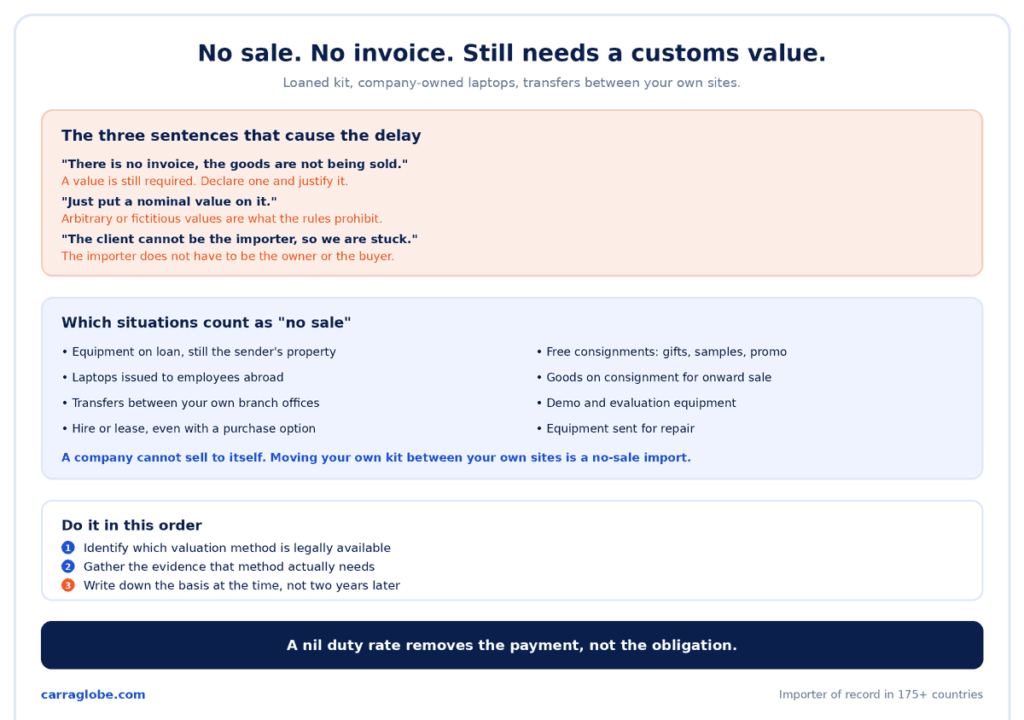
The three sentences that cause the delay
“There is no invoice, the goods are not being sold.” A value is still required. Declare one and be able to justify it.
“Just put a nominal value on it.” Arbitrary or fictitious values are precisely what the rules prohibit.
“The client cannot be the importer, so we are stuck.” The importer does not have to be the owner or the buyer.
Twenty laptops, no invoice, no sale
A company sends twenty used laptops to employees in another country. The laptops remain company property. There is no sale and no invoice price.
Transaction value is unavailable, because there was no sale. So the permitted method for that destination has to be identified first, and the evidence assembled to suit it. That evidence might cover model, age, condition and comparable transactions, depending on which method applies.
Notice what the work actually is. It is not arriving at a number. It is establishing which method the destination requires, then supporting the figure that method produces. Those are different tasks, and only the second one looks like valuation.
Which situations count as “no sale”
Worth being specific, because companies often assume their situation is unusual when it is one of a well-recognised set. UK government guidance lists the transactions that cannot be treated as sales, and the list will look familiar to anyone moving IT hardware.
| Scenario | Sale? | Typical customs issue |
|---|---|---|
| Equipment supplied on loan, remaining the sender’s property | No | Valuation, and whether the import is permanent or temporary |
| Laptops issued to employees abroad | No | Valuation, plus who acts as importer where the owner will not register |
| Transfer between branch offices that are not separate legal entities | No | A sale needs two separate legal entities, so transaction value is unavailable |
| Goods under a hire or lease, even with a purchase option | No | Not a sale for these purposes, whatever the contract calls it |
| Free consignments: gifts, samples, promotional items | No | No price paid, so a value still has to be established another way |
| Goods on consignment for onward sale | Not yet | No sale has taken place at the point of import |
| Demo and evaluation equipment | No | Temporary admission may fit, where the return is defined |
| Equipment sent for repair | No | Temporary admission and re-export considerations |
The row that catches most technology companies is the third. A transfer between two offices of the same legal entity cannot be a sale, because a sale requires two separate legal persons. Companies moving their own equipment between their own sites are frequently surprised to find they are in the no-sale category at all.
Where the value actually comes from
Do not start by inventing a resale price. Start by identifying which valuation method is legally available, because the sequence is prescribed and the answer depends on which method you land on rather than on what the equipment might fetch.
- Match the evidence to the method, not the other way round. For used IT equipment, comparable sales, age and condition may support the analysis, but this is not original cost minus depreciation. What counts as good evidence depends on which method applies.
- Write down the basis at the time. Which method you applied, what evidence supported it, and who decided. Reconstructing that reasoning two years later under a verification is the hard version.
- Be consistent across shipments. Ten identical laptops valued three different ways across three months is the pattern that invites a closer look.
- Keep the records. Canada requires importers to retain records supporting the value for duty for six years, and the burden of proof sits with the importer.
For used IT hardware specifically, the evidence set usually assembles from the same places: the model and specification, its age and purchase date, its condition and any refurbishment history, serial or asset numbers tying the declaration to the physical units, and open-market prices for comparable equipment at that age. Which of those actually carries weight depends on the method you have landed on, so gather them once you know which method applies rather than before.
There is also a step most companies never take. Where you are considering a valuation method other than transaction value, the border agency actively encourages requesting a ruling in advance, and registered trade chain partners can submit ruling requests electronically. For a programme that will repeat, an advance ruling converts a recurring judgement call into a settled position.
If you want to sanity-check the wider cost picture, our guide to calculating landed cost covers what else lands on top of the value once it is set.
Why a carnet or temporary admission often does not fit
This is the advice everyone gives for equipment that is not being sold, and it is frequently the wrong answer for IT.
Temporary admission regimes are built around goods that arrive, do a defined job, and leave within a defined window. They suit exhibition kit, demonstration units, test equipment and equipment sent in for repair. They fit poorly where a laptop is issued to an employee for the working life of the device, or where a switch is racked in a data centre and stays.
The mismatch is duration and intent. A multi-year deployment with no defined return arrangement may not fit the conditions of a temporary admission regime, and stretching one to cover it creates an exposure that surfaces at the worst moment, usually when the equipment is finally decommissioned and nobody can close out the original entry.
Where the movement genuinely is temporary, the mechanism is worth using properly. Our note on equipment sent for repair and our guide to temporary import bonds cover that side. Where the equipment is genuinely intended to remain in the country, a permanent import may be the more appropriate structure, subject to the destination’s rules and any available relief.
The registration question
This is often the real reason a company is reading an article like this, and it deserves a direct answer rather than a hedge.
Importers generally need an appropriate customs registration, identifier or account in the destination country, although the exact requirement varies. Canada uses the CARM system with a business number and import account, the EU uses EORI, and India uses the IEC for import and export activity.
Where a third party is legally permitted to act as importer of record, the relevant customs account or importer identifier will generally sit with that importer. The exact registration, residency and authorisation requirements vary by country, and naming an importer on an entry does not automatically answer every registration question. Confirm which account, identifier and accounting obligations a provider actually assumes in that specific country, in writing, before you ship.
Worth being blunt about what the role carries. An importer of record is not merely a name on a customs declaration. Where a provider legally assumes that role it may also assume customs accounting, record-keeping and duty liabilities, and it is the party the authority deals with afterwards. That is precisely why it is worth confirming who holds it.
The reason this matters commercially is that registration is rarely a form-filling exercise. It can bring account setup, security or bonding requirements, ongoing filing obligations and a compliance record that the authority will look at later. For a company doing a handful of shipments a year into a market it has no other connection with, that is a disproportionate amount of standing infrastructure to build.
Our page on importing without a local legal entity sets out the wider routes, with the Canadian specifics on our importer of record in Canada page and the full set on the IOR by country index.
Importer of Record · 175+ countries
Moving equipment that is not being sold? Check it works before you ship.
Tell us what the equipment is, where it is going, how long it stays and whether the owner can register locally. We will tell you whether the structure works, act as your importer of record where it does, and plan the return leg at the same time. Related reading:
Free tools: HS Code Finder|Volumetric Weight Calculator|Pallet Calculator
Laptops, demo kit or transfers between your own sites? Send the destination, the equipment and how long it stays, and we will map the structure before anything moves.
Check your no-sale shipmentDo not forget the return leg
Loaned equipment comes back. A laptop refresh replaces the device an employee is already using, and the old one has to leave the country it went into.
That is an export, and it needs its own analysis: who is the exporter of record, and what export declaration, valuation, classification, licensing and re-import considerations apply on the way out. It is also the leg most often left out of the original plan, which is how companies end up with equipment they cannot lawfully move sitting in a cupboard in another jurisdiction.
Worth scoping both directions at the same time. Our pages on exporter of record services and returned goods and reverse logistics cover the mechanics.
What to give an IOR provider before you ship
Importing equipment with no sale gets quoted badly, because the questions that decide feasibility are not the ones on a standard quote form. Send these and you will get a usable answer rather than a holding reply.
- What the goods are, and their HS code. Model, quantity, age and condition. Our HS Code Finder is a starting point if you do not have the code.
- That there is no sale, and who owns the goods. Say it explicitly. It changes the valuation route and providers need to know at quoting stage, not after.
- How long the equipment is staying, and whether it is coming back. Multi-year with no return date is a different structure from ninety days.
- Whether the owner is willing to register locally. If not, say so. It is a legitimate constraint and it narrows the options quickly.
- The route. Direct to site, or via a consolidation point. Ask whether the provider requires routing through their own facility.
- Frequency. A handful a year is a different commercial conversation from a one-off, and it affects whether an advance ruling is worth pursuing.
How Carra Globe helps
No-sale shipments are a regular part of what we handle: laptops issued to employees abroad, equipment moved between group sites, demo and evaluation kit, and hardware that stays for years rather than weeks.
- Acting as importer of record across 175+ countries, so the registration and the entry sit with us rather than requiring your client to build standing infrastructure in a market they otherwise have no presence in.
- Acting as exporter of record on the return leg, so the refresh or decommission is planned rather than improvised.
- Working through the valuation position before shipping, so the declared value is reasoned and documented rather than assembled at the border.
Where a movement genuinely suits a temporary regime rather than a permanent import, we will say so, because using the wrong mechanism is the thing that causes trouble later rather than sooner. Our case studies cover comparable deployments.
Moving equipment that is not being sold? Tell us what it is, where it is going, how long it stays and whether the owner can register locally, and we will tell you whether it works before you ship.
Check whether your no-sale shipment works →
Frequently asked questions
Can an importer of record act when no sale takes place?
Yes. Importer of record and purchaser are different roles, and customs guidance recognises that the importer of record can differ from the person qualifying as the purchaser.
The absence of a sale changes how the goods are valued, not whether a third party can be named as importer.
Can I import company-owned laptops into another country?
Generally yes, even with no sale. The entry still needs an appropriate importer, a customs value and supporting documentation, and the requirements depend on the destination.
Whether the equipment is permanently imported, temporarily admitted or later returned changes the structure, so decide that before shipping rather than after.
How do you value goods when there is no sale price?
You work down the valuation methods in sequence. Transaction value needs a sale, so without one you move to identical goods, similar goods, deductive, computed, then residual.
The result must be fair and reasonable and reflect commercial reality. A nominal or arbitrary figure is not acceptable.
Does my company still need to register with customs if I use a third-party IOR?
Where a third party is legally permitted to act as importer of record, the registration and account requirements may be handled through that importer. The exact requirements depend on the destination country.
Using a third-party importer can therefore avoid requiring the equipment owner to establish a local customs presence, where the destination permits that structure.
Can I use a carnet for equipment staying several years?
Usually not a good fit. Temporary admission regimes are built for goods arriving for a defined purpose and leaving within a defined period, not for multi-year deployments with no return date.
Where equipment is intended to remain, a permanent import may be the more appropriate structure, subject to local rules and any available relief.
Do I still pay duty if nothing was sold?
A customs value is still needed even where nothing was sold. Whether duty is actually payable depends on the classification, origin and any applicable relief or trade agreement.
Some IT hardware may attract low or nil customs duty depending on classification, origin and any applicable tariff treatment, but that has to be checked for the specific product and destination.
How long do I need to keep the valuation records?
Canada requires records supporting the value for duty to be kept for six years, with the burden of proof on the importer. Other countries set their own periods.
Keep the reasoning alongside the figure, because the reasoning is the part nobody can reconstruct later.
Official sources and verification
- Valuation: the Canada Border Services Agency customs valuation handbook, covering the sequence of methods under sections 48 to 53 of the Customs Act, the six-year record retention requirement, the burden of proof under subsection 152(3), the point that the importer of record can differ from the purchaser in Canada, and the encouragement to request a ruling where a method other than transaction value is being considered.
- No-sale scenarios: UK government guidance on valuing imported goods using Method 1, which lists transactions that cannot be regarded as sales, including goods supplied on loan that remain the property of the sender, free consignments, hire and lease arrangements, and transfers between branch offices that are not separate legal entities.
- Wider framework: the valuation sequence derives from the WTO Valuation Agreement, so the structure is broadly comparable in other systems, though the detail and the registration requirements are national.
- Confirm per country and per shipment. Valuation methods, registration requirements, retention periods and relief provisions differ by destination and change. Confirm the position for your goods before shipping.
Disclaimer: This guide is for informational purposes only and does not constitute legal, customs or tax advice. Valuation methods, importer registration requirements and relief provisions are set by each destination country and change over time, and the correct treatment depends on the facts of the specific shipment. This article reflects publicly available guidance as at 31 August 2026. Always confirm the position for your goods and destination with a qualified adviser or the relevant customs authority before importing.