
A data centre programme is running to a commissioning date. The backup power package arrives on schedule: several multi-megawatt generator sets, procured from a manufacturer with a global footprint, shipped against a build deadline that has no float left in it. The units usually clear customs where the import documentation is complete, because a generator is a well-understood article of commerce with a settled tariff classification. Then the project discovers that the engines inside them are not certified to the emissions standard in force in the destination market, and the equipment that just cleared the border cannot lawfully be placed on the market, installed, or run.
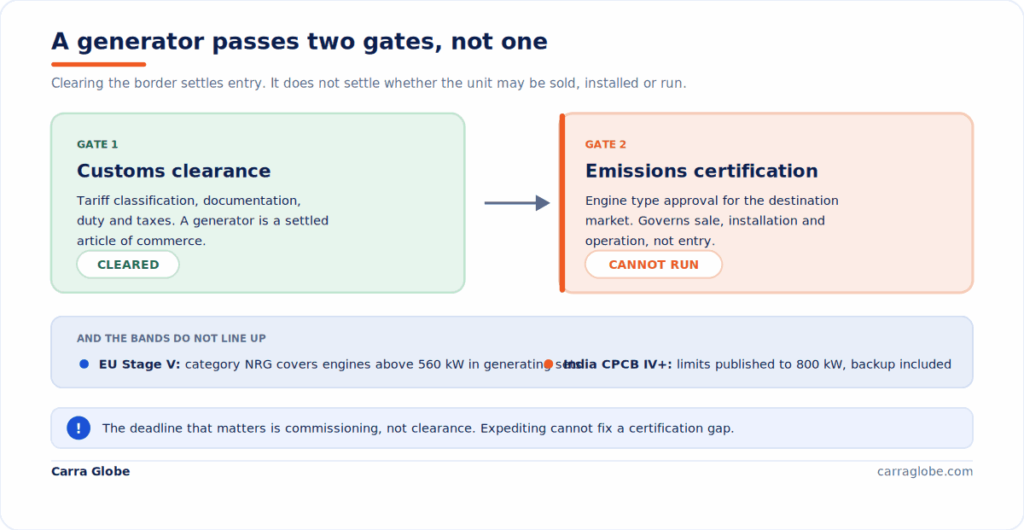
Customs clearance and permission to operate are two different gates, and emissions certification sits at the second one. An engine’s approval determines whether a generating set may be sold, installed and commissioned in a given market. Emissions type approval generally attaches to the engine family and configuration rather than to the packaged generating set, it is specific to the destination, and it is generally enforced at the point the unit is placed on the market rather than at the moment it crosses the border. A generator can therefore clear customs cleanly and still be unusable on site.
For most importers of IT hardware this is unfamiliar territory, because servers and networking equipment do not work this way. It is becoming unavoidable, because the constraint on data centre capacity in 2026 is not silicon or space. It is power.
Why Data Centres Are Importing Generation at All
Utility connections for large loads are quoted in years across most of the markets absorbing AI infrastructure investment. A campus that has secured land, capital and the AI hardware itself can still be sitting behind a grid queue, and the response has been to bring generation on site: diesel and gas generating sets for backup and, increasingly, for bridging power while a permanent connection is built.
That has quietly changed what a data centre import programme contains. Alongside the servers, switches and cooling systems, there is now heavy electrical plant moving across borders on the same critical path, alongside the network security equipment that carries its own licensing gate and the structured cabling that answers to a third set of rules again. Our analysis of data centre construction freight covers the logistics of moving these units. This article is about the approval that decides whether they can be switched on when they arrive.
Importing Diesel Generators: The Approval Sits on the Engine
The first thing to understand is where the certification actually lives, because it is not where most buyers assume.
A generating set is an assembly. An engine manufacturer builds and certifies the engine. A packager mounts it with an alternator, a control system, a fuel system and often an acoustic enclosure, and sells the result as a genset under its own brand. Emissions type approval attaches to the engine, to a specific engine family and configuration, tested against a defined duty cycle. The packaged product inherits that status. It does not create it.
Two consequences follow, and both catch buyers who are used to procuring IT equipment. The genset supplier may not be the party that holds the approval, so the documentation has to come up through the supply chain rather than from the invoice. And an engine certified for one market is not thereby certified for another, because the standards, the test cycles and the power bands that define them differ by jurisdiction. There is no global emissions approval to rely on, in the way there is no global product certification generally, a problem we have covered in the context of moving production between countries.
India: CPCB IV+ and the Backup Power Trap
India is among the largest data centre growth markets in the world, and it has recently tightened this regime considerably. The Central Pollution Control Board’s CPCB IV+ norms replaced the earlier CPCB II standards and took effect for new generating sets in 2023, sharply reducing permitted nitrogen oxide and particulate emissions and bringing India’s genset standards broadly into line with European and American benchmarks.
Two features matter for a data centre in particular.
The norms apply irrespective of how the set is used. There is no carve-out for standby or emergency duty. A generating set installed purely as backup, which is exactly what most data centre capacity is, sits within the same requirement as one running as a primary source. Buyers who assume that infrequent operation places a unit outside the regime are applying a distinction the rules do not make.
The published emission limits run to 800 kW gross mechanical power. That band covers a great deal of commercial and industrial equipment, but hyperscale backup sets are frequently specified well above it. The practical point is not that larger units are unregulated, it is that the applicable requirement for a unit above that ceiling has to be established for the specific rating rather than assumed from the headline standard everyone in the market is discussing. Noise limits apply alongside the emissions limits, which is why acoustic enclosure specification is part of the same compliance question rather than a separate comfort issue.
Type approval is granted against a specific model, so the correct question to a supplier is not whether their range is compliant but whether the exact model and rating being quoted holds a current certificate. Our guide to acting as importer of record in India covers the wider certification landscape for equipment entering the country.
Shipping generating sets into a market you have not supplied before? The emissions position is decided when the model is specified, not when the freight is booked, and it governs commissioning rather than clearance. Carra Globe acts as importer of record for data centre and power infrastructure across 175+ countries, and checks the destination-market approval position alongside the customs classification before an order is placed.
Europe: Stage V and the Category That Covers Generating Sets
In the European Union, emissions from engines in non-road mobile machinery are governed by Regulation (EU) 2016/1628, known as Stage V. It introduced a dedicated category, NRG, for engines with a reference power above 560 kW used exclusively in generating sets, and in doing so regulated engines above that output at EU level for the first time.
The operative concept is placing on the market. From the applicable dates, only a Stage V compliant engine, or a machine equipped with one, may be placed on the EU market, subject to defined transition and replacement provisions. Approved engines carry specific identification markings, which is what a market surveillance authority looks for. The obligation is therefore commercial rather than purely border-based: the question is not only whether the unit entered, but whether it may lawfully be supplied and put into service.
For a European data centre build this has a scheduling consequence. A unit sourced from a market with different standards, or an older-stage engine bought on price or availability, can be entirely legitimate at origin and unsupplyable at destination. Given the lead times on heavy electrical plant, discovering that after shipment is not a problem that can be solved by expediting, and it is a different failure from an ordinary customs hold, which at least has a documented route to release.
United States: Stationary Is a Different Rulebook From Mobile
The United States is the largest data centre market in the world, and it draws the line in a third place again. The EPA regulates stationary engines separately from non-road mobile equipment. A generating set installed on a site is a stationary compression ignition engine under 40 CFR Part 60, Subpart IIII, while the same machine specified to be transported falls under the non-road rules instead. The hardware does not change. The regulatory framework does, according to how it is installed and used.
Duty type matters as well. Emergency stationary engines are treated distinctly from non-emergency ones, which is directly relevant to a data centre where the sets exist to cover a utility failure. For most engines the compliance route runs through procurement rather than testing: the owner buys an engine holding an EPA certificate of conformity and then installs, configures and operates it according to the manufacturer’s instructions. The certificate belongs to the engine manufacturer, which is the same pattern seen everywhere else in this article.
There is a further layer that makes the point of this article unusually plain in the US. The federal standards are a floor. State and local air permitting authorities can and do impose stricter requirements, and it is the local permit that governs whether the installed set may actually be operated. A generator can hold a valid federal certification, clear customs without difficulty, and still be waiting on an air permit before it can run. Entry, certification and permission to operate are three separate things.
The Same Generator, Classified Differently in Each Market
The structural difficulty is that markets do not draw their boundaries in the same place. The power bands that define which rule applies are set independently, so a single specification can land in different regulatory categories depending on destination.
| Market | Instrument | How generating sets are framed | What it gates |
|---|---|---|---|
| European Union | Regulation (EU) 2016/1628, Stage V | Category NRG covers engines above 560 kW used exclusively in generating sets | Placing on the market and supply, evidenced by engine markings |
| India | CPCB IV+ norms, from 2023 | Published emission limits run to 800 kW gross mechanical power, with noise limits alongside | Sale and use of new sets, backup duty included, by model type approval |
| United States | EPA stationary engine standards, 40 CFR Part 60 Subpart IIII | Classified by installation and duty: stationary versus non-road, emergency versus non-emergency | Federal certification of the engine, with state and local air permits governing operation |
| Other markets | National standards | Bands, test cycles and stage numbering set independently | Typically sale, installation or operating permission rather than entry |
Read the rows together and the trap becomes visible, because the three markets do not even classify along the same axis. The EU divides by power, so a 700 kW set sits above the threshold that defines the generating set category. India publishes limits to a ceiling and applies them irrespective of duty, so the same set sits below that ceiling and is caught whether it runs continuously or twice a year. The United States divides by installation and use, so the identical machine is governed by one rulebook when it is bolted down and another when it is specified to move.
One physical unit, three different questions, and none of the answers transfers. Nothing about the equipment changed. Only the destination did.
What to Establish Before the Order Is Placed
Because this is a specification decision rather than a shipping decision, almost all of the value sits in asking early. By the time a multi-megawatt set is on the water, the options have closed.
- Ask for the certificate against the exact model and rating. Not the product range, not the manufacturer’s general compliance statement. Type approval is granted to a specific engine configuration, and the quoted rating is the thing that has to match.
- Identify the engine, separately from the genset brand. The approval belongs to the engine. Where the packager and the engine manufacturer are different companies, the evidence has to be traced through to the engine, and that request takes longer than a procurement cycle usually allows for.
- Confirm the standard in force at the destination, for that power band. The applicable rule depends on where the unit’s rating falls in that market’s structure, and the bands differ. This is the check that catches units sitting near a threshold.
- Treat commissioning as the deadline, not clearance. Emissions rules generally govern supply, installation and operation. Build the compliance milestone against the date the set must run, which is the date the project actually cares about.
- Keep the documentation with the entry. Certificates, markings and test evidence support both the customs position and any later inspection. Our guide to the difference between a paper IOR and an operational IOR explains why the party named on the entry needs to be able to stand behind that record.
None of this is exotic work. It is the same discipline that applies to any regulated import, described in our overview of global trade compliance. What makes generators distinctive, compared with the server and storage hardware covered in our guide to the importer of record role, is that the consequence of getting it wrong does not appear at the border, where problems are visible and recoverable, but at commissioning, where the project has no time left.
Frequently Asked Questions
Can a generator clear customs and still not be usable?
Yes. Customs clearance settles entry. Emissions rules generally govern whether a unit may be placed on the market, installed and operated. A set can therefore clear the border and still not be lawfully commissionable in that market.
This is why the compliance milestone belongs against the commissioning date rather than the arrival date.
Do emissions norms apply to backup generators that rarely run?
In India, CPCB IV+ applies irrespective of whether a set is a primary source or standby backup. Assuming that infrequent operation removes a unit from scope applies a distinction the rules do not make.
Most data centre generating capacity is standby duty, so this is the assumption most likely to cause a problem.
Does the genset manufacturer hold the emissions approval?
Often not. Approval attaches to the engine and its configuration. Where a packager mounts a third party engine and sells the set under its own brand, the certification evidence has to be traced back to the engine manufacturer.
Ask which engine is inside, then ask about that engine’s status in your destination market.
Can I retrofit a non-compliant diesel generator?
Usually not in the way buyers hope. Meeting another market’s standard is a type approval question, not a parts question, and it can require testing and approval of the engine configuration rather than a modification to an installed set.
Retrofit emission control devices do exist in some markets for units already installed, and India certifies such devices for genset engines within defined power ranges. That is a different exercise from making a unit eligible for sale where it did not previously qualify, so treat it as a route for existing assets rather than a fix for a procurement error.
Is a generator certified in one country accepted in another?
No. Standards, test cycles and the power bands defining them are set nationally or regionally. An engine certified to one market’s stage is not automatically acceptable elsewhere, and the categories do not align across jurisdictions.
This is what makes a globally sourced power package harder to specify than it looks.
The generators are rarely the most expensive line in a data centre programme, and they are almost never the line that gets the most attention during procurement. They are, increasingly, the line that determines whether the facility can energise on schedule, because a campus with power constraints has no fallback if its own generation cannot be commissioned. The compliance question is unglamorous and it is answered cheaply at specification: which engine, what rating, certified to which standard, in which market. Answered then, it costs an email. Answered at commissioning, it costs the date the entire programme was built around.
Disclaimer: This article is for informational purposes only and does not constitute legal, customs, environmental or engineering advice. Emissions and noise requirements for generating sets vary by engine, rating, jurisdiction and date, and are subject to change and to transition provisions. Always confirm the current position for your specific equipment and destination markets with the relevant authority, the engine manufacturer, or qualified counsel before ordering or shipping.