
Cable is the least interesting line on a data centre bill of materials, which makes importing data centre cabling easy to underestimate. It is bought by the kilometre, it costs a fraction of what the compute costs, and it is usually the last thing anyone reviews. It is also, on a large build, one of the few items where the paperwork can stop the installation rather than the shipment. Reels arrive, clear customs against a straightforward classification, reach the site, and are then rejected at inspection because the fire performance of the cable is not documented in the form the destination market requires.
The short version. Cable intended for permanent installation is generally treated as a construction product, not as IT equipment. Its fire performance has to be classified and declared according to the rules of the country it is installed in, and the major data centre markets do not classify it along the same axis. Europe grades measured fire behaviour, the United States lists by where the cable is installed, and India certifies against product standards built around materials and emissions. None of the three converts into the others, so a reel that is fully documented for one market can be simply undocumented for the next.
Carra Globe provides importer of record, exporter of record, delivered duty paid and freight forwarding services, so we have a commercial interest in your answer. What follows is written to be usable whether or not you ever speak to us.
This catches technology buyers because every other item in the hall behaves differently. Servers, switches and storage are products that travel, carrying certifications that at least attempt international recognition, and the importer of record clears them through customs as goods, with no building product rules attached. Cable that is pulled into a building becomes part of the structure, and that intended use can bring it under construction product rules with a different rulebook.
Why Cable Is the Line Nobody Checks
The volumes involved in a modern facility are substantial. Structured cabling, power distribution, fibre trunks and the containment that carries them run through every plenum, riser and floor void in the building. In a high density hall the cable count rises with the rack count, and much of it is installed early, during the construction phase, before the equipment that justifies it has arrived.
That timing is what makes a documentation failure expensive. It is why importing data centre cabling deserves a review step that its unit cost never justifies on its own. Cable goes in during the fit-out, ahead of the hardware deliveries that everyone is tracking closely. If the wrong reels are on site, the problem surfaces at electrical inspection, when the containment is already populated and the schedule has no slack.
That is a harder failure to unwind than a customs hold, which at least has a documented route to release. Stripping and replacing installed cable is not a procurement exercise, it is closer to a demolition exercise.
Importing Data Centre Cabling: Three Systems That Do Not Translate
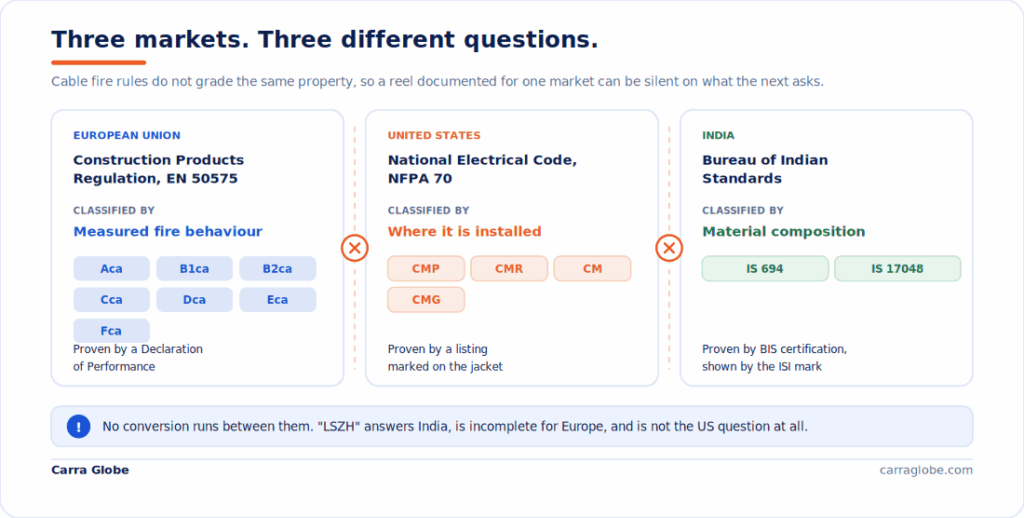
Every market asks the same underlying question, which is how a cable behaves in a fire, and each answers it with its own marking or declaration. The difficulty is that they do not classify along the same axis at all.
- Europe classifies by measured behaviour. A cable is tested and graded on how fast fire spreads, how much heat it contributes and how much smoke it produces.
- The United States classifies by installation environment. A cable is listed for where it may be installed, with the test following from that use.
- India certifies against product standards. A power cable is specified against a BIS standard that sets its materials and the fire and emission tests it must pass.
Three markets, three different questions. There is no conversion table because the systems test and classify differently, which is why a cable that satisfies one can be silent on what another wants to know.
Europe: The Construction Products Regulation and Euroclass
In the European Union, cable intended for permanent installation in construction works can fall within the Construction Products Regulation, Regulation (EU) No 305/2011. The harmonised standard covering reaction to fire for power, control and communication cables is EN 50575, and it became mandatory for cables placed on the EU market from July 2017. Confirm that EN 50575 covers the exact cable before relying on its declaration or CE marking.
The 2026 transition in brief. Regulation (EU) 2024/3110 has applied since 8 January 2026 and replaces the 2011 Regulation product family by product family. Standards cited under the old rules, including EN 50575, stay valid until withdrawn or replaced, and parts of the old regulation run to 8 January 2040. Ask the supplier which route covers the exact part number, and whether it issues a Declaration of Performance or the new Declaration of Performance and Conformity.
Performance is expressed as a Euroclass, running from Aca down to Fca, with the “ca” suffix denoting cable. Supplementary classifications cover smoke production, flaming droplets and acidity, which is why a full declaration reads something like Cca-s1b,d1,a1 rather than a single letter.
On the current EN 50575 route, the manufacturer issues a Declaration of Performance and applies CE marking. The regulation does not distinguish by operating voltage, and optical fibre cable is included, so the scope is wider than many buyers assume.
The class affects the certification burden, not just the product. Commission Delegated Regulation (EU) 2026/1310 assigns System 1+, the most demanding verification system, to classes A, B and C once cables move to the new framework. A higher class can therefore change the certification behind the cable, and with it price and lead time, depending on the supplier.
The EU harmonises the classification, not the requirement. The Regulation creates a common language for declaring fire performance, but individual member states decide which class is acceptable for which building type and installation. A cable can therefore be entirely lawful to place on the EU market and still be unacceptable for a particular installation in a particular country. Compliance and permission are separate questions, exactly as they are for the generating sets that power the same building.
Sourcing cable for a build in a market you have not supplied before? The fire classification is decided at specification and proven with documents that are market specific, so a reel that is correct in one country can be undocumented in another. Carra Globe acts as importer of record for data centre infrastructure across 175+ countries, and checks the destination’s documentation requirement before the cable ships rather than at inspection.
Check your cable specification with Carra Globe →
United States: NEC Listing, Plenum and Riser
The United States, the largest data centre market in the world by electricity use, arrives at the same objective through an unrelated route. Communications and optical fibre cable are governed by the National Electrical Code, NFPA 70, which is adopted locally edition by edition, and the 2026 edition regroups the cable articles, so check the edition in force. The cable type and listing mark appear on the jacket, and both have to suit the space the cable runs through.
The familiar designations follow the installation environment. They apply to communications and optical fibre cable, while power cable follows its own NEC rules.
- CMP, plenum. Listed for plenum spaces where the code permits it, and evaluated under the NFPA 262 tunnel test.
- CMR, riser. For vertical runs between floors, evaluated under a vertical shaft flame propagation test.
- CM and CMG, general purpose. Each with its own test and listing requirements.
The hierarchy runs one way only. Where the code and the listing allow it, a higher rated cable may substitute for a lower requirement, so plenum cable may be used where riser cable is specified, but riser cable may never be used where plenum is required. Whether a ceiling void counts as a plenum depends on whether it is part of the return air path, a question for the mechanical design and the local code rather than the cable.
None of these designations exists in the European system, and no Euroclass exists in the American one. For anyone buying into the United States and Europe from the same supplier, that is already a documentation problem. A third market makes the pattern clear.
India: BIS Requirements Depend on Cable Type
India is one of the fastest growing data centre markets in the world, and it approaches the question from a third direction. Low voltage power cables are specified against Bureau of Indian Standards specifications and, where a quality control order requires it, carry BIS certification with the ISI mark as the visible evidence.
The two standards most often cited are for power cable. IS 694 covers PVC household wiring cable up to 450/750 V, with flame retardant and low smoke categories, while IS 17048 covers halogen free flame retardant cable up to 1,100 V. For communications and optical fibre cable, confirm the requirement for that cable type rather than assuming these two apply. Building level fire requirements sit alongside these in the National Building Code and in state fire regulations.
The emission tests depend on the standard and the category. Each standard sets its own method and limit, so compare the exact standard, edition and declared result rather than putting figures from different standards side by side.
This is where the most common cross-border mistake happens. Halogen free cable is often sold simply as LSZH, and buyers treat the label as a universal fire specification. It is not. LSZH describes halogen content and smoke characteristics, not how the cable performs on flame spread, heat release or smoke under the test a destination requires. Cables classified B2ca, Cca and Dca in Europe can all be halogen free and still perform very differently.
So LSZH alone is incomplete in all three markets. India asks which BIS standard and category, Europe which Euroclass, and the United States which listing. Our guide to acting as importer of record in India covers the wider BIS certification position for equipment entering the country.
The Same Reel, Documented Differently
| Market | Framework | Classified by | Expressed as | Evidence |
|---|---|---|---|---|
| European Union | Construction Products Regulation, with EN 50575 | Measured fire behaviour under a standardised test | Euroclass from Aca to Fca, with smoke, droplet and acidity sub-classes | Declaration of Performance, with CE marking |
| United States | National Electrical Code, NFPA 70, with article numbers varying by edition | Where the cable is installed | Listing marks such as CMP, CMR, CM | Listing marked on the jacket |
| India | Bureau of Indian Standards specifications, with National Building Code alongside | Product standards setting materials, fire and emission tests | Named standards such as IS 694 and IS 17048 | BIS certification and Standard Mark, where a quality control order requires it |
| Recognised by the others? | No. None of the three converts into either of the others. | |||
The final row is the one that costs money. These are different frameworks with different tests, rules and evidence, so their labels are not interchangeable even where the fire concerns overlap, and the India row shows power cable examples only. A globally available part number is usually made to one system and documented for one region, and it is the documentation, not the copper, that has to match the destination.
Reduced to decision rules, the position is short enough to keep in your head.
- Cable rated CMP or CMR. Not enough for permanent installation in the EU without a declared Euroclass.
- Cable carrying only a Euroclass. Does not show the NEC listing a US installation needs.
- Cable specified only as LSZH. Incomplete in all three markets.
- Documentation missing or for the wrong market. The cable may clear customs and still fail inspection.
- Higher rating within one system. May be accepted where a lower one is specified, if the code, listing and installation allow it, but never the reverse and never across systems.
What to Establish Before the Cable Is Ordered
- Ask which market the documentation covers, not whether the cable is compliant. Ask for the Declaration of Performance and Euroclass for a European site, or the listing mark for an American one, issued for the exact part number.
- Get the required class from the project, in writing, per country. A supplier can tell you what a cable achieves. Only the project specification and the local rules can tell you what it needs.
- Treat higher classes as a lead time question. If the specification moves up a class late in the programme, availability may move with it.
- Check the containment and the void, not just the cable. Whether a space counts as a plenum depends on the air handling design, so confirm it with the mechanical designer rather than assuming it.
- Keep the fire documentation with the import record. Whoever must demonstrate compliance at import, installation and inspection needs to produce it, which is part of what an importer of record does. Our guide to the difference between a paper IOR and an operational IOR explains why that matters when documents are requested later.
Customs clearance and installation approval are separate checks. The tariff code and the duty treatment depend on the cable’s construction, such as copper or optical fibre, voltage and connectors, and our guide to classifying electronics and technology equipment covers the mechanics. Much of the risk sits in the building, at inspection, the same pattern seen with cooling fluids and network security equipment.
Cable rarely gets senior attention on a data centre programme, and on cost alone it does not deserve much. On risk it deserves more, because it goes in early, it is buried in the fabric of the building, and a local inspector judges it against a local rule, using a document a global supplier may never have produced for that market.
The question is not whether the cable is good. It is whether the fire performance is declared in the form the destination recognises, which is settled at order stage, not with the containment already full.
How Carra Globe Handles Data Centre Cabling Imports
Carra Globe acts as importer of record for data centre infrastructure across 175+ countries, from cabling and containment to AI server and GPU clusters. We check the destination’s fire documentation requirement before the cable ships, keep that evidence with the import record, and coordinate multi-country deployments from one supplier. For equipment going back out, our exporter of record service covers the export side.
Carra Globe works through importer-side registrations and local importing structures appropriate to the goods and destinations it accepts, its own in some markets and established local structures in others. Approvals falling outside the available structure are flagged before a delivery date is agreed. Send your cable schedule, datasheets and destinations to info@carraglobe.com and we will tell you which fire documentation each market expects.
Frequently Asked Questions
Can I use plenum rated cable on a European data centre project?
Not on that rating alone. Plenum and riser designations come from the American code and carry no Euroclass. For permanent installation in the EU, the cable needs a Declaration of Performance stating a Euroclass.
Does the Construction Products Regulation really apply to network cable?
Often, where it is intended for permanent installation and covered by EN 50575. That standard covers power, control and communication cables, includes optical fibre, and does not distinguish by operating voltage.
Is specifying LSZH cable enough for a global data centre programme?
No. LSZH describes halogen content and smoke, not full fire behaviour. Cables classified B2ca, Cca and Dca can all be halogen free while performing very differently under the European test.
Is one Euroclass acceptable everywhere in the EU?
No. The Regulation harmonises how fire performance is classified and declared, but member states set which class is required for which building type and application, so the acceptable level varies by country.
What documents are needed when importing data centre cabling?
It depends on cable type and destination. Typical examples are a Declaration of Performance under the applicable EU route, NEC listing evidence in the US and BIS certification for covered products in India.
What happens if the wrong cable is already installed?
It is usually found at inspection, once containment is populated. Remediation means removing and replacing installed cable, which is far more disruptive and expensive than correcting the specification at order stage.
Adjacent ground: export controls on data centre hardware, when an accredited lab’s test report is rejected and importing into Germany.
Sources and verification
Sources checked on 15 October 2026.
- EU cable verification systems. Commission Delegated Regulation (EU) 2026/1310, published 28 August 2026, verification systems under the new framework, with System 1+ for power, control and communication cables in reaction to fire classes A, B and C. Irish National Market Surveillance Office, information note, harmonised standards in force on 8 January 2026 remain valid until withdrawn or repealed, and are replaced product family by product family. FPS Economy Belgium, the Declaration of Performance and Conformity replaces the Declaration of Performance under Regulation (EU) 2024/3110.
- EU Construction Products Regulation. Regulation (EU) No 305/2011, with cable reaction to fire classes set by Commission Delegated Regulation (EU) 2016/364. CE marking under EN 50575 mandatory from 1 July 2017.
- New CPR. Regulation (EU) 2024/3110. Government of Ireland, Construction Products Regulation 2024, in force 7 January 2025, applicable from 8 January 2026, with certain provisions of the 2011 Regulation applying until 8 January 2040.
- US cable listing. NFPA 70, National Electrical Code, 2023 and 2026 editions. Local adoption varies by state and city. Minnesota Department of Labor and Industry, 2026 NEC adoption review, limited-energy and cable rules regrouped into Articles 720, 722 and 723.
- US market size. IEA, Energy and AI, the United States accounted for the largest share of global data centre electricity consumption in 2024, at 45 percent.
- India. BIS, product manual for IS 694, including halogen acid gas testing for FR-LSH. IS 694:2010, PVC household wiring cable, rated up to 450/750 V, with FR and FR-LSH categories. IS 17048, halogen free flame retardant cables up to 1,100 V. Cables (Quality Control) Order, 2020, Standard Mark required for IS 17048 cables.
Disclaimer: This article is for informational purposes only and does not constitute legal, customs, fire safety or engineering advice. Cable fire classification requirements vary by product, application, jurisdiction and date, and required performance levels are set nationally. This article reflects the position as at 15 October 2026, so confirm the current requirement for your specific installation and destination market with the relevant authority, the project’s fire engineer, or qualified counsel before ordering.
Data Centre Cabling · Fire Ratings · Import
Match the fire documentation to the destination before the reels ship.
A reel can clear customs and still fail at inspection. So the useful conversation is which fire documentation the destination recognises, whether your supplier has issued it for the exact part number, and who holds it on the import record. Where an approval sits outside the structure available, you hear that before a delivery date is agreed.
- Importer of record in the Netherlands
- Importer of record in the UK
- Importer of record in Singapore
- Importer of record in the UAE
- Importer of record in Saudi Arabia
- Importer of record in Japan
- Importing without a local entity
- How to choose an importer of record
- Packaging standards for IT hardware
- EU digital product passport
- EU Cyber Resilience Act for importers
- WEEE producer obligations
- Emergency spare parts clearance
- Global warehousing
- White glove delivery
Free tools HS Code Finder Volumetric Weight Calculator Pallet Calculator
Specifying cable for a new market? Send the cable schedule, destinations and datasheets. We will come back on the fire documentation each market expects and how the import will be structured.
Check my cable import