
You checked your tracking and it says in-transit from origin processing. It sounds technical, and if the status has not changed in a day or two it can feel like something has gone wrong. In almost all cases it has not. This is one of the most common and most normal statuses in the entire shipping journey, and this guide explains exactly what it means, what is physically happening to your shipment, how long it usually lasts, why it sometimes appears to stall, and what you should do while it shows, whether you are tracking a single parcel or moving high-value commercial cargo across borders.
By the end, you will understand this status completely and know precisely when there is nothing to worry about and when it is worth acting. This guide is written for both people tracking personal parcels and businesses moving international commercial shipments, because the same tracking status can mean different things depending on what is being shipped.
In-Transit from Origin Processing: At a Glance
- What it means: your shipment has been picked up, processed, and cleared for departure at the origin facility, and is now moving through the carrier’s network toward the next point in its journey.
- Is it a problem? No. It is a normal, positive status that means your shipment is progressing, not stuck. It is one of the earliest movement statuses in the journey.
- Has it left the country? Not necessarily. It may still be at the origin hub with all pre-departure steps complete, waiting for the next transport leg.
- How long does it last? Usually a few hours to a few days, depending on the carrier, service level, distance, and how often the carrier scans updates.
- For businesses, it is a window: while the goods are in transit, the destination-side compliance work, the importer, the certifications, the duty calculation, should already be underway, not started when the goods land.
What Does In-Transit from Origin Processing Mean?
In-transit from origin processing means your shipment has completed its handling at the origin facility and is now moving through the carrier’s network toward the next stage of delivery. It is two ideas joined together. “Origin processing” is the work done where the shipment starts. “In-transit” means it is now on the move. Put together, the status tells you the starting-point work is finished and the shipment has begun its journey. Different carriers describe this stage slightly differently. DHL, UPS, FedEx, and postal operators may use similar wording, but the underlying meaning is broadly the same.
The most important thing to understand is that this is a good status. Once you see it, the carrier has accepted the shipment, completed the origin handling, and released it into the transport network. In practice, that is good news rather than a warning sign. Many people see the word “processing” and assume a delay, but it signals the opposite: the processing is done, and movement has started.
What Actually Happens During Origin Processing
Before a shipment can show as in-transit, several distinct things happen at the origin facility. Understanding them explains why the status exists and why it sometimes takes a little time to clear.
- 📦 Pickup and intake. The carrier collects the shipment from the sender, warehouse, or drop-off point and logs it into its tracking system. This first scan is what makes the shipment visible to you.
- 🏷️ Sorting and labelling. The shipment is sorted by destination and service level, and routing labels are applied so the network knows where to send it and how fast.
- 📄 Documentation check. Shipping labels, the commercial invoice, and any customs paperwork are checked for accuracy. For international shipments this is where export documentation is verified.
- 🛃 Export and customs formalities. For cross-border shipments, export clearance at the origin country is handled here, confirming the goods are legally allowed to leave and the paperwork supports it.
- ✅ Release to the network. Once the above is complete, the shipment is marked as processed and released, and the status updates to in-transit from origin processing.
All of this happens before the “in-transit” status appears, which is why, by the time you see it, the shipment is genuinely ready to move rather than still being prepared.
Why This Status Appears on Your Tracking
Carriers publish this status for three practical reasons, and knowing them helps you read your tracking correctly.
- To confirm departure readiness. It tells you the shipment has left, or is leaving, the origin facility and the starting-point work is done.
- To confirm documents are checked. For international shipments, it signals that export and customs paperwork has been verified at origin.
- To give tracking transparency. Both sender and receiver can see that the shipment is progressing, which reduces uncertainty on both sides.
One nuance worth repeating: this status does not always mean the package has physically left the country or the origin city. Sometimes the shipment is still at the hub, simply waiting for the next available transport. That is still normal, and the status is still accurate.
How Long Does In-Transit from Origin Processing Take?
There is no single fixed duration, because it depends on several factors. In most cases it lasts from a few hours to a few days. The status can appear to sit unchanged for longer than you expect for reasons that are usually harmless.
| Factor | Effect on how long the status lasts |
|---|---|
| Service level | Express services move out of this status faster than standard or economy. |
| Distance and route | Long-haul and international shipments spend longer in transit between scans. |
| Transport mode | Air moves faster than ocean; a shipment awaiting an ocean sailing can sit longer. |
| Scan frequency | Some carriers update tracking at every checkpoint; others scan less often, so the status looks static even while the shipment moves. |
| Hub schedules | A shipment can wait at the origin hub for the next scheduled departure, which is normal. |
As a general rule, if the status is a few days old on an international shipment, that is well within normal. If it has not changed for a week or more with no other explanation, that is the point at which contacting the carrier makes sense.
Why Your Tracking Sometimes Does Not Update
Shipment tracking is event-based rather than continuous. Most carriers only update the status when the parcel reaches a scanning point, such as a hub, a border, or a sorting facility. That means your shipment may be moving for many hours, or even a day or two, without the tracking page changing. A lack of updates does not necessarily mean the shipment has stopped moving.
In our experience, many customers become concerned after seeing this status unchanged for 48 hours. Most of the time nothing is actually wrong. It simply reflects the carrier’s scanning schedule rather than a delay. This is one of the most common reasons a package tracking page looks frozen while the shipment is, in fact, progressing normally. It is worth remembering that shipping updates and courier tracking status reflect the last scan, not the shipment’s live position.
Common Misunderstandings About This Status
A few beliefs about this status are widespread and mostly wrong. Clearing them up removes most of the worry it causes.
- “It means my package is stuck or delayed.” Usually false. It is a movement status, not a delay status. A static status often just means the carrier has not scanned a new checkpoint yet.
- “It means the package is already on a plane or truck.” Not necessarily. It may be moving, or it may be at the hub with all pre-departure steps complete, waiting for the next transport leg.
- “It has definitely left the country.” Not always. Origin processing being complete does not guarantee the shipment has physically crossed the border yet.
- “Nothing is happening.” The opposite is usually true. The status only appears after pickup, sorting, documentation, and export checks are done, which is a lot of activity.
What This Status Means for a Business Importer
If you are tracking a personal parcel, the guidance above is all you need: it is normal, and it will move. But if you are a business importing commercial goods, and especially high-value goods like IT hardware, industrial equipment, or medical devices, this status means something more useful. It is not a waiting period. It is a window.
In our experience, businesses often assume that once a shipment is moving, the difficult part is over. In reality, many commercial delays happen after arrival because the import paperwork was not prepared during transit.
Here is the key insight most tracking guides miss. The status confirms the goods have cleared the origin and are heading toward your destination country. That means the clock is now running on everything that has to be ready for the goods to clear customs at the other end. Origin processing handled the export side.
Nothing about this status addresses the import side, and the import side is where high-value shipments actually get held. We see many businesses wait until the shipment lands before checking import requirements. By then, the transit time that could have been used to organise documentation has already been lost.
Specifically, while a commercial shipment shows in-transit from origin, three parts of your import readiness should already be confirmed for the destination country:
- The importer of record is confirmed. Someone must be the legally recognised importer at the destination. If you have no local entity there, an importer of record needs to be arranged before the goods arrive, not after. A shipment that lands with no legal importer sits at the border.
- Certifications and permits are in place. If the goods need product approvals, type approvals, or import licences in the destination market, those must be secured before arrival. Customs will not release goods that lack a required approval, no matter how smooth the transit was.
- Duties and taxes are calculated and planned. Knowing the landed cost and how duties will be paid avoids a surprise bill or a delay at clearance. Our guide to calculating landed cost covers how to work this out in advance.
Think of the transit window as free time. The goods are moving anyway, so any step you complete now, arranging the importer, securing a certificate, calculating the duty, is one that will not hold up clearance later. Leave those steps until arrival and the same problems become expensive, because the goods are sitting while you solve them.
Importer of Record · 175+ countries
Importing IT or high-value hardware? We can be your Importer of Record.
Carra Globe acts as your Importer of Record so you can ship into markets where you have no local entity. We carry the legal liability, handle certifications and duties, and give you one itemised quote:
Have a shipment in mind? Send us your lane and goods, we will confirm and quote.
Get a compliance quoteHave a commercial shipment in transit and not sure your import requirements are ready? Carra Globe can act as your importer of record, confirm the certifications, and calculate the duties while your goods are still moving, so they clear on arrival instead of stalling.
Is your shipment in transit? Get your destination compliance ready before it lands →
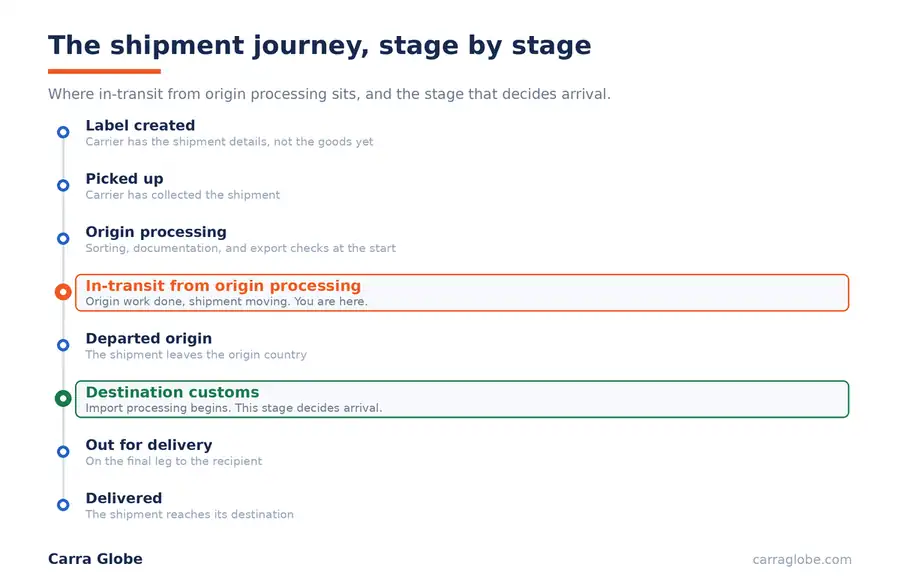
Where This Status Sits in the Full Shipment Journey
It helps to see where in-transit from origin processing falls in the sequence of statuses you will see on a typical international shipment. The exact wording varies by carrier, but the order is broadly consistent.
- Label created / shipment information received. The shipment is registered but not yet collected.
- Picked up. The carrier has the shipment in hand.
- In-transit from origin processing. Origin work is done and the shipment is moving through the network. You are here.
- Departed origin country / arrived at destination country. The shipment crosses the border.
- Customs clearance at destination. The destination country processes the import. This is where compliance readiness matters most.
- Out for delivery / delivered. The final leg to the recipient.
For quick reference, here is what each common tracking status actually means:
| Status | Meaning |
|---|---|
| Label created | Carrier has the shipment information only, not the goods yet |
| Picked up | Carrier has collected the shipment |
| In-transit from origin processing | Origin work is complete and the shipment is moving |
| Arrived at destination | Shipment reached the destination country |
| Customs clearance | Import processing begins at the destination |
| Out for delivery | Final delivery stage to the recipient |
Seen this way, in-transit from origin processing is an early, reassuring milestone. The status that genuinely determines whether a commercial shipment arrives on time is the customs clearance step later in the journey, which is exactly why the transit window is the time to prepare for it.
What to Do While Your Shipment Shows This Status
Whether you are tracking a parcel or managing a commercial import, here is the practical checklist for this status.
- Do not panic if it sits for a day or two. On international shipments this is normal, and a static status usually means a scan gap, not a problem.
- Check the tracking periodically, not obsessively. Most carriers refresh the shipment status at each checkpoint, so daily is plenty for international parcel tracking.
- Keep your documents ready. For any international shipment, make sure the commercial invoice, packing list, and any licences or certificates are complete and to hand.
- For commercial goods, confirm your import readiness now. Importer of record, certifications, and duty planning should be in progress while the goods move, as covered above.
- Contact the carrier if it stalls. If the status has not changed for a week or more with no explanation, ask the carrier for an update.
- Consider insurance for valuable shipments. High-value goods should be insured against loss or damage in transit.
How Carra Globe Helps
For a personal parcel, this status needs nothing more than patience. For a business moving commercial goods across borders, the transit window is an opportunity, and that is where Carra Globe works.
Carra Globe acts as importer of record and exporter of record across 175+ countries, handling the destination import requirements that decide whether a shipment clears on arrival or waits at the border. While your goods are in transit, we confirm the legal importer is in place, ensure the product certifications and import permits are secured, and calculate the duties and taxes so there are no surprises at clearance. Our global trade compliance team manages the classification and documentation, and our delivered duty paid service means the goods arrive with duties handled.
Our freight forwarding service coordinates the movement itself. If you want to understand the clearance step this status leads toward, see our guide to how long customs clearance takes.
Frequently Asked Questions: In-Transit from Origin Processing
What does in-transit from origin processing mean?
It means your shipment has completed origin facility handling and is now moving through the carrier’s network.
It is a normal, positive status indicating progress. The origin-side work is complete, and the shipment has started moving rather than still being prepared.
What does origin processing mean?
Origin processing is the work a carrier does at the starting facility before a shipment begins moving.
It includes pickup, sorting, labelling, documentation checks, and export customs clearance. Once origin processing is complete, the status updates to in-transit from origin processing.
Why is my package stuck in origin processing?
It usually is not stuck. The status often appears static because carriers scan at checkpoints, not continuously.
Between scans, the status and location can look unchanged even though the shipment is moving or waiting for its next scheduled transport. Contact the carrier only if it sits for a week or more with no update.
How long does origin processing take?
Origin processing itself is usually quick, often completed within a day, though it can take longer for international shipments that need export clearance or where the origin facility is busy.
Once it finishes, the status moves to in-transit from origin processing, which is the point at which the shipment starts moving through the network.
Has my shipment already left the country?
Not necessarily. The status confirms origin processing is complete and the shipment is moving, but it may still be at the origin hub awaiting the next transport leg rather than having physically crossed the border.
This is normal. The shipment is progressing through the network whether or not it has left the country yet.
Does this status mean my parcel has left the origin country, for example China?
Not necessarily. For a shipment from any origin country, including China, this status confirms origin processing is done but not that the parcel has physically departed the country.
It may still be at the origin hub awaiting its international transport leg. The border crossing shows as a separate status later in the journey.
Does this status mean export customs is complete?
Generally yes. For international shipments, export clearance at the origin is part of origin processing, so by the time this status appears the export formalities are typically done.
Import customs at the destination is a separate step that still lies ahead, and is the one that most affects a commercial shipment’s arrival timing.
Is in-transit from origin processing a sign of a delay?
No. It is a standard movement status that indicates progress, not a problem. A status that appears static usually means the carrier has not scanned a new checkpoint yet, not that the shipment is stuck.
On international shipments, seeing this status for a day or two is completely normal and expected.
How long does in-transit from origin processing take?
Usually a few hours to a few days.
Duration depends on service level (express versus standard), distance, transport mode (air versus ocean), and carrier scan frequency. If it has not changed for a week or more with no explanation, contact the carrier.
What should I do if it stays in this status for too long?
If the status has not updated for several days to a week on a normal shipment, contact the carrier and ask for confirmation of the shipment’s location and status. Keep your tracking number ready.
For commercial shipments, also use the time to confirm the destination-side compliance is in place, so no time is lost once the goods arrive.
Does in-transit from origin processing involve customs?
It involves export customs at the origin country, where the goods are cleared to leave. It does not involve import customs at the destination, which happens later in the journey.
Both sides follow customs procedures that are broadly harmonised worldwide under standards set by the World Customs Organization, though each country applies them in its own way.
This distinction matters for businesses: the destination clearance is where high-value shipments are most often held, so it should be prepared for during transit.
Can customs hold a shipment after origin processing?
Yes. Completing origin processing only means the export-side handling is finished. Your shipment can still be delayed by import customs at the destination.
That happens when duties, documentation, certifications, or importer requirements are not ready when the goods arrive. Preparing these during transit is what prevents the hold.
What is the difference between origin processing and customs clearance?
Origin processing is the carrier’s handling and export checks where the shipment starts. Customs clearance at destination is the import country’s official process for allowing the goods in, and happens later.
They are separate steps at opposite ends of the journey. A shipment can pass origin processing smoothly and still face a hold at destination customs if the import side is not ready.
Can I track a package that says in-transit from origin processing?
Yes. The status itself confirms the shipment is in the carrier’s tracking system, and you can continue to follow it using your tracking number as it moves through each checkpoint.
Updates appear each time the shipment is scanned, so the tracking page refreshes at checkpoints rather than continuously.
Is in-transit from origin processing different from just in-transit?
“In-transit from origin processing” means the shipment has just completed origin facility work and is beginning its journey.
Plain “in-transit” means moving between any two points. The “from origin processing” qualifier specifically confirms the starting-point work is done. You may see plain “in-transit” later as it moves between hubs.
What happens after in-transit from origin processing?
Next, the shipment departs the origin country, arrives in the destination country, and goes through customs clearance there before delivery. The clearance step most affects timing for commercial goods.
Preparing the destination-side compliance during transit is what keeps that clearance step from causing a delay.
Why does my shipment show this status but the location has not changed?
Because carriers scan shipments at checkpoints, not continuously. Between scans the status and location can appear unchanged even though the shipment is moving or waiting for its next scheduled transport.
A static location for a day or two is normal and does not mean the shipment is stuck.