
Two things happened in the Red Sea this month that should not be happening together. Carriers moved more services back through the Suez Canal, and Houthi forces made further territorial gains along the Yemeni coast that the canal’s southern approach runs past. Both are documented, and they point in opposite directions.
That gap matters commercially. What is being reported as a recovery is a calculated bet on a corridor where the ground position has deteriorated, taken without the toll incentive that was meant to encourage it, and with war risk pricing above where it sat a year ago.
This guide sets out what changed, which carriers moved and which did not, where the security and insurance position stands, and what an importer should do with a routing every carrier has called reversible.
Carra Globe provides importer of record and exporter of record services, so we have a commercial interest in your answer. What follows is written to be usable whether or not you ever speak to us.
Red Sea Shipping 2026:What actually changed in September
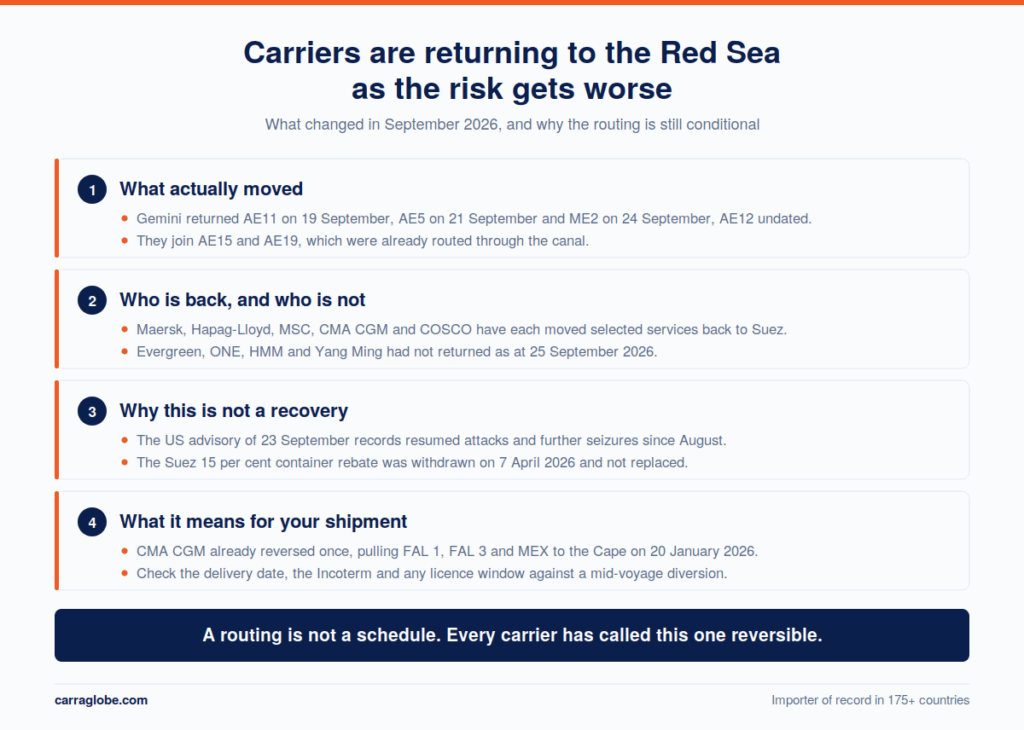
Are ships going back through the Suez Canal? Some are, service by service. Maersk, Hapag-Lloyd, MSC, CMA CGM and COSCO have each moved selected loops back. Evergreen, ONE, HMM and Yang Ming have not. Canal traffic remains well below pre-crisis levels, and every carrier statement makes the routing conditional on security. This is a partial and reversible return of container services, not a return to normal traffic levels.
On 14 September 2026 the Gemini Cooperation, which is Maersk and Hapag-Lloyd, issued a customer advisory moving four more services off the Cape of Good Hope and back through the canal. It names the vessels and the dates.
| Service | Trade | First westbound Suez sailing | Vessel |
|---|---|---|---|
| AE11 | Asia to Mediterranean | 19 September 2026, ex Tanjung Pelepas | Antonia Maersk, voyage 635W |
| AE5 | Asia to North Europe | 21 September 2026, ex Tanjung Pelepas | Marchen Maersk, voyage 635W |
| ME2 | India to Europe | 24 September 2026, ex Colombo | Cornelia Maersk, voyage 638W |
| AE12 | Asia to Mediterranean | To be announced | Not yet named |
Eastbound, the first Suez sailings are AE5 on 22 September from Algeciras, AE11 on 28 September from Vado Ligure and ME2 on 31 October from Port Tangier. AE15 and AE19 were already routed through the canal.
The port rotations tell you how committed this is. Maersk publishes AE5 as a single round trip: Qingdao, Ningbo, Tanjung Pelepas, Suez, London, Bremerhaven, Hamburg, Rotterdam, Algeciras, Suez, Tanjung Pelepas. The canal appears on both the westbound and the eastbound leg, which makes this a structural service decision rather than a one-way positioning move.
On 16 September the Suez Canal Authority recorded the transit of the OOCL Portugal, a roughly 24,000 TEU vessel on the Ocean Alliance NEU2 service, which the authority described as the first COSCO Shipping Lines southbound transit since the Red Sea and Bab el-Mandeb tensions began. Thirty-nine vessels totalling about 2.3 million net tons passed the canal that day.
Which carriers are back, and which are not
| Carrier or alliance | Position as at 25 September 2026 |
|---|---|
| Maersk and Hapag-Lloyd (Gemini) | AE15 and AE19 already routed via Suez, joined by AE11, AE5 and ME2 in September, with AE12 announced but not yet dated. Lloyd’s List Intelligence reported in August that more than 30 per cent of Maersk’s previously Cape-routed Asia to Europe volume was back on the canal |
| MSC | Partial restoration from 24 August 2026 on Jade, Albatros, Tiger and Himalaya, described by MSC as a limited number of East to West services with contingency arrangements retained |
| CMA CGM | Back, then off, then partly back. FAL 1, FAL 3 and MEX were pulled to the Cape on 20 January 2026, followed by a broader suspension of Suez transits in March. FAL 3 returned eastbound only in August, with westbound still routing via the Cape |
| COSCO and OOCL | RES4 through Bab el-Mandeb from late July 2026, first NEU2 transit on 16 September. OOCL was reported to be planning a trial transit in October |
| Maersk MECL, outside Gemini | Maersk’s first structural return, announced on 15 January 2026 for the Middle East and India to United States East Coast trade, westbound from Jebel Ali on the Cornelia Maersk and eastbound from North Charleston on the Maersk Detroit |
| Evergreen, ONE, HMM, Yang Ming | Not returned. The Premier Alliance network is built around Cape routing. Yang Ming has said it would move as an alliance rather than on isolated sailings |
Read that table as a market that has not agreed with itself. Several major carriers are returning selected services while others keep routing around the Cape on the same intelligence, which tells you this is a judgement rather than a resolution.
The reversal has already happened. On 15 January 2026 Maersk announced its first structural return to Suez on the MECL service. Five days later, on 20 January, CMA CGM pulled FAL 1, FAL 3 and MEX back to the Cape of Good Hope, saying it had decided to reroute them “in light of the complex and uncertain international context”. It went further in March, suspending Suez transits more broadly during the wider Middle East escalation. Any delivery date you agree on the strength of a Suez routing should survive that routing being withdrawn, because a major carrier has already reversed a Suez decision this year.
The security picture moved the other way
On 10 September 2026 Houthi forces seized the port city of Mocha. Reporting over the following days described further advances along Yemen’s southern Red Sea coast and claims of control over Perim Island, also called Mayun, and part of the Hanish archipelago, with the area involved put at around 5,400 square kilometres. The precise extent of control over the islands has been reported inconsistently.
The official assessment is a firmer basis than the island-by-island reporting. United States Maritime Administration advisory 2026-013, issued on 23 September 2026, states that “since August, the Houthis have seized additional strategic Red Sea islands and territory along the west coast of Yemen adjacent to the Bab el Mandeb”. It also states that the Houthis have resumed attacking commercial ships, and records the blockade they declared on Saudi-affiliated shipping through Bab el-Mandeb on 20 July 2026.
Perim sits inside the strait, which is about twenty miles wide, with a narrow eastern channel for regional craft and a western channel of roughly sixteen miles used by international shipping. Traffic follows designated navigation routes rather than the full width, so control or surveillance of the island can matter operationally, depending on capability and on how vessels are routed.
The at-risk list has widened, and it now reaches your carrier. Earlier advisories centred on Israeli, United States and United Kingdom association. Advisory 2026-013 adds Saudi association, and any vessel in a company fleet identified as making port calls in Saudi Arabia. If your carrier’s wider fleet trades to Saudi Arabia, that is a stated risk factor whether or not your own container has any connection to the region.
Nor was the ceasefire often cited as the reason for calm a maritime security guarantee. The May 2025 understanding was reached between the United States and the Houthis. Attacks on commercial vessels resumed in July 2025, including those that sank the Magic Seas and the Eternity C, with loss of life and crew taken from the second ship.
Naval cover continues. The Council of the European Union extended Operation Aspides to 28 February 2027 and widened its mandate in March 2026. The operation exists because the threat to commercial shipping has not ended.
No toll discount is driving this
There is a further part of the story that changes how the move should be read. The current return is happening without the Suez toll incentive that was introduced to encourage exactly this.
The Suez Canal Authority introduced a 15 per cent rebate on transit dues for container ships of 130,000 Suez Canal net tons and above, applied automatically on transit with no application required, effective from 15 May 2025. It was extended twice, first to 31 December 2025 and then to 30 June 2026.
It was then withdrawn on 7 April 2026, roughly three months before it was due to expire. The suspension notice did not state a reason for withdrawing the rebate early, and no replacement scheme has been announced since.
The rebate did not produce a broad return. Through mid-2025, with it live, only around ten large container ships a month were using the canal, and in July nine of those were CMA CGM vessels transiting under French naval protection. That limited take-up suggests a toll discount on its own was not enough to outweigh the security concerns shaping carrier routing.
Why this matters to your planning. If price is not what brought ships back, price will not keep them there. The return is being driven by transit time, vessel productivity and competitive pressure between carriers, all of which reverse the moment the risk calculation moves. Treat Suez routing as a schedule improvement you can enjoy, not a structural change you can plan a year of deliveries around.
What insurance pricing says about the risk
War risk pricing is a second observable signal of how underwriters are reading the route, and it has not returned to its pre-crisis profile. Red Sea and Bab el-Mandeb cover was reported at around 0.2 per cent of hull value per transit in December 2025, its lowest since November 2023. Reuters reported indicative rates of roughly 0.3 per cent immediately before the Houthi blockade declaration of 20 July 2026 and around 0.75 per cent immediately after it, with further increases following attacks later that month.
Marsh’s marine practice quoted about 0.5 per cent for Bab el-Mandeb transits on 22 July. Quoted rates vary by vessel, flag, ownership and route, so treat all of these as market indications rather than a rate card.
The broader change in how the risk is priced matters as much as any single quoted rate. Protection and indemnity clubs moved to buyback arrangements after reinsurers withdrew support, and Red Sea transit cover is now being priced case by case rather than off a standing schedule. Pricing by exposure rather than off a uniform schedule is what a market does when it is not treating a corridor as routinely low risk.
For cargo owners the practical question is not the hull rate but your own cover. A routing through a listed war risk area can affect the terms of a cargo policy, and our guide to cargo insurance for IT equipment covers what to check before the booking rather than after the incident.
What comes back with the ships
Cape routing absorbs capacity because the same cargo takes longer to move. Drewry estimated in January 2026 that roughly two million TEU was tied up that way, and Xeneta estimated in September 2026 that a large scale return could release the equivalent of six to eight per cent of the global container fleet. Both are analyst estimates, not observed counts.
That release is already visible. Canal figures from the Suez Canal Authority show container vessel net tonnage of 72.1 million tons for January to August 2026 against 46.7 million tons in the same period of 2025, an increase the authority puts at 54.2 per cent. That percentage is quoted as the authority published it; the rounded tonnage figures alone would give 54.4 per cent. Drewry recorded container ship transits rising from 41 in the week to 17 September to 48 in the week to 24 September, against roughly 80 a week before the crisis.
Rates have followed. Asia to Europe spot rates have come under downward pressure through September as returning capacity outpaces the blank sailings carriers have used to defend them, The decline has been most visible on Mediterranean lanes, where several of the returning services operate.
The Drewry World Container Index recorded Shanghai to Genoa down 5 per cent and Shanghai to Rotterdam down 4 per cent in the week to 24 September, and the Freightos Baltic Index recorded falls on the same lanes on 15 September. Our ocean freight rates outlook for October 2026 tracks the numbers, and pay to play ocean freight explains why headline rates and what you actually pay have drifted apart.
One caution on the headline volume. Lloyd’s List Intelligence’s assessment in August 2026 put traffic through the Red Sea’s northern chokepoint around 41 per cent below pre-crisis levels. On that assessment the canal was running at roughly three fifths of what it used to do, which is not what most people mean by a recovery.
What this means if you are moving hardware
Most commentary on this stops at freight rates. For anyone importing technology hardware, the routing question lands in four other places first.
- Your delivery commitment. A shorter sea leg is not a delivery date. If you have promised a site date on the strength of a Suez schedule, the contract needs to survive a mid-voyage diversion back to the Cape, which published comparisons commonly put at seven to fourteen additional days on Asia to North Europe services, depending on the service rotation and operating conditions, and more on some Mediterranean lanes.
- Your Incoterm. A routing change can affect freight cost and delivery timing, and, depending on the Incoterm and the wider contract, which party carries particular additional costs and risks. Our guide to which Incoterm protects tech shipments sets out how DDP, DAP and CIF behave differently when the voyage does.
- Your licence and documentation windows. Export licences, conformity certificates and some import permissions carry validity periods. A voyage that gains or loses two weeks can move a landing date across the end of one of them, which is a compliance problem rather than a freight one.
- Your modal decision. Cape routing pushed urgent hardware into the air. A sustained sea recovery could release some of that cargo back, which would affect air capacity and pricing on the same lanes, though the size of the effect depends on demand, belly capacity and charter availability. Our note on Asia air cargo capacity in 2026 covers the other side of that trade.
The same logic applied when the Strait of Hormuz came under pressure earlier in 2026, and the lesson was the same one. Our analysis of the Strait of Hormuz closure goes through how a chokepoint event moves through a compliance calendar, not just a freight invoice, and supply chain resilience and compliance covers building for it in advance.
The questions to ask your forwarder this week
- Which routing is my booking actually on? Not which routing the service is advertised on. Ask for the named service and whether it is Suez or Cape on this specific sailing, in both directions.
- What happens if it diverts after loading? Get the answer in writing, including who carries the cost of the additional days and whether the quoted rate is protected.
- Does my cargo profile sit in a flagged category? Ownership, flag and the trading pattern of the wider fleet all feature in the current advisories.
- What does my cargo policy say about listed war risk areas? Ask before the vessel is nominated, not after.
- What is my fallback if the routing reverses? For time-critical hardware that usually means a pre-agreed air option rather than a hope.
How Carra Globe handles routing volatility
We provide importer of record and exporter of record services for technology hardware across 175+ countries, with roughly 95 per cent of what we move going by air, which is precisely the lane companies reach for when an ocean routing becomes unreliable.
Routing volatility is a compliance problem before it is a freight problem. A diversion moves a landing date, and a moved landing date can run past a licence window, a certificate validity or a contractual delivery obligation. We work the compliance calendar first, then the transport plan, whether the shipment is a first shipment into a new country or one leg of a multi-country deployment.
Carra Globe already holds the importer-side licences, certifications and approvals its local importing structures require for the goods we handle, so your cargo moves without any delay, with customs clearance in 1 to 2 business days. Where a shipment needs something outside that scope, we say so before a delivery date is agreed rather than after the goods land.
Importer of Record · Routing Risk
A routing is not a schedule. Plan the compliance calendar around the diversion.
Being clear about the boundary: appointing an importer of record does not control a carrier's routing, and nobody can promise a vessel will stay on Suez. What we do is work the compliance calendar first, check licence and certificate validity against the realistic landing window rather than the optimistic one, hold a costed air fallback for time-critical hardware, and tell you in writing where a diversion would break the date.
- Importer of record services
- Exporter of record services
- Strait of Hormuz closure 2026
- Ocean freight rates, October 2026
- Pay to play ocean freight
- Asia air cargo capacity 2026
- Cargo insurance for IT equipment
- Which Incoterm protects tech shipments
- Supply chain resilience and compliance
- IOR for data centre equipment
- First shipment into a new country
- IOR by country
Free tools HS Code Finder Volumetric Weight Calculator Pallet Calculator
Have hardware booked on a Suez routing? Send the service, the destination and the date you have promised. We will check what a diversion back to the Cape would do to your licence windows and your delivery commitment, and price an air fallback before you need it.
Stress-test your routingFrequently asked questions
Is the Suez Canal reopening in 2026?
It never closed. Traffic is returning service by service but remains well below pre-crisis levels, and every carrier has made the routing conditional on Red Sea security.
Which carriers have returned to the Red Sea?
Maersk, Hapag-Lloyd, MSC, CMA CGM and COSCO have each moved selected services back. Evergreen, ONE, HMM and Yang Ming had not returned as at 25 September 2026.
Is the Red Sea safe for shipping now?
No. The United States advisory of 23 September 2026 says the Houthis have resumed attacking commercial ships and have seized further Red Sea islands and coastal territory since August. Risk is managed, not removed.
How much time does Suez save over the Cape of Good Hope?
On Shanghai to Rotterdam the Cape adds roughly 3,200 nautical miles. Published comparisons commonly put the added transit at seven to fourteen days depending on the service rotation and operating conditions.
Could carriers go back to the Cape again?
Yes, and one already has. CMA CGM withdrew FAL 1, FAL 3 and MEX on 20 January 2026 and suspended transits more broadly in March. Every carrier advisory is conditional on regional stability.
Is the Suez Canal offering a discount to bring ships back?
Not currently. The 15 per cent rebate for large container ships was withdrawn on 7 April 2026, three months early, and no replacement has been announced. The present return carries no toll incentive.
Will freight rates fall because of the Suez return?
Asia to Europe spot rates have been falling through September as returned capacity outpaces blank sailings. Mediterranean lanes have moved fastest. A routing reversal would unwind that quickly.
Does a routing change affect customs or compliance?
It can. A changed landing date can fall outside a licence validity window, a certificate period or a contractual delivery obligation, and transhipment points may change with the service rotation.
If your project depends on hardware landing inside a fixed window, the routing question and the compliance question are the same question. Our guides to importer of record for data centre equipment and data centre construction freight go into how that plays out on a build programme.
Sources and verification
- Canal traffic: the Suez Canal Authority for the container vessel net tonnage figures and the OOCL Portugal transit of 16 September 2026, and its tolls table for the current transit dues position.
- Carrier service changes: the Gemini Cooperation advisory of 14 September 2026 issued by Maersk, for the AE5, AE11, AE12 and ME2 rotations, sailing dates, vessels and the conditional wording quoted above; Maersk’s MECL announcement of 15 January 2026; and CMA CGM’s statement of 20 January 2026. MSC and COSCO positions come from their own announcements as reported in the trade press. The Suez Canal Authority separately confirmed in September 2026 that selected CMA CGM, Maersk, MSC, Hapag-Lloyd and COSCO services had returned, which is the official anchor for the table above.
- Security position: United States Maritime Administration advisory 2026-013, effective 23 September 2026 to 22 March 2027 on the advisory index, for the resumption of attacks, the 20 July 2026 blockade declaration, the seizures since August and the at-risk categories. Its predecessor 2026-006 was cancelled on 22 September 2026 and is not relied on. The Joint Maritime Information Centre update of 9 August 2026, published by UKMTO, is the source for the August risk ratings.
- Naval operations: the Council of the European Union on the extension of Operation Aspides to 28 February 2027 and its March 2026 mandate update.
- Territorial changes: the capture of Mocha on 10 September 2026 is widely reported and not in dispute. Control of Perim and the Hanish archipelago rests on inconsistent battlefield reporting, so the island detail is framed as reported and advisory 2026-013 carries the confirmed position. The July 2025 attacks on the Magic Seas and the Eternity C are recorded in United Nations and human rights reporting.
- Rates, capacity and insurance: Drewry and Xeneta for capacity, the Drewry World Container Index and the Freightos Baltic Index for the September rate movements, Lloyd’s List Intelligence for the pre-crisis comparison, Reuters for the July war risk indications and Marsh’s marine practice for the 0.5 per cent quotation of 22 July 2026. These are commercial market sources rather than official ones, and are named rather than linked.
- Verification note. Everything time-sensitive here was last checked on 25 September 2026. Advisory 2026-013 confirms seizures since August but is not an island-by-island assessment, which is why that detail is framed as reported. We could not locate a war risk quotation later than 22 July 2026. Where a decision turns on either point, confirm with your underwriter and flag state before fixing the booking.
- This is not legal or insurance advice. Routing, war risk cover and voyage risk assessment are matters for the carrier, the shipowner, your broker and your insurer.
Disclaimer: This guide is for informational purposes only and does not constitute legal, customs, insurance or regulatory advice. The security and commercial position in the Red Sea changes quickly, and the position described is as at 25 September 2026. Confirm the current position with the competent authority or a qualified adviser before acting.