
Update, 28 July 2026: The Section 301 forced-labour action is now final and in effect. It took effect at 12:01 a.m. Eastern on 24 July 2026, the same moment the Section 122 surcharge expired. The exemptions are set out in two annexes, Annex I and Annex II, and the final exemption list is broader than the June proposal: USTR added 471 HTSUS subheadings after the comment period and removed none. The analysis below, written while the action was still proposed, holds up against the final rule, but the qualifications now carry more weight, not less, because the money is real and being charged today.
An importer with servers that landed in early August was budgeting for a 10% surcharge that no longer existed by the time the goods cleared. On 24 July 2026, the Section 122 import surcharge expired by operation of law. Most of the market was told the same thing about that date: do not celebrate, because a new Section 301 tariff is lined up to replace it. For the general importer, that advice was correct. For an importer of servers, networking hardware, or data centre equipment, it was wrong, and the difference is worth roughly ten percent of customs value on every shipment.
The Section 301 electronics exemption refers to the exclusions in the 2026 Section 301 forced-labour action, set out in Annexes I and II, which remove most IT hardware, including servers, computers, semiconductors, and telecommunications equipment, from the new tariff. Those goods lost the 10% Section 122 surcharge on 24 July without picking up a replacement duty. For technology importers it is a genuine reduction in landed cost, not the wash the wider market braced for.
The timing had a hard edge to it. A shipment of identical hardware entered on 23 July carried the 10% surcharge. The same shipment entered on 25 July may carry nothing. On a container of servers, that is the difference between a five-figure duty line and none at all, decided by the entry date.
Section 301 Electronics Exemption: At a Glance
- What it is: the exclusions in the 2026 Section 301 forced-labour action, set out in Annexes I and II, covering most IT hardware.
- Effect: exempt goods lost the 10% Section 122 surcharge on 24 July and picked up no replacement duty.
- Who it helps: importers of servers, networking, storage, and telecom equipment whose HTS codes are in the annexes and not under Section 232.
- The catch: the exemption is by HTS code, not by category, so a product qualifies only if its specific ten-digit code appears in the annex.
What Expired on 24 July
The Section 122 surcharge was 10% ad valorem, not 15%. That distinction matters because a great deal of commentary quoted the higher figure. The 15% was the statutory ceiling under 19 U.S.C. § 2132(a). An increase to that ceiling was announced in February but never enacted by proclamation, so the rate importers actually paid from 24 February was 10%, imposed by Proclamation 11012 and administered under HTSUS 9903.03.01. Our full guide to the Section 122 tariff sets out the structure and exemptions.
The expiry was not a policy decision. Section 122 permits a surcharge for a maximum of 150 days without an act of Congress. The clock started on 24 February and ran out at 12:01 a.m. Eastern on 24 July 2026. The President could not extend it unilaterally, Congress passed no legislation to extend it, and the surcharge therefore ended automatically. The 10% stopped being collected on that date.
What Is the Section 301 Electronics Exemption?
On 2 June 2026, USTR issued affirmative determinations in Section 301 investigations covering 60 economies, together representing over 99% of US import value. USTR found that each had failed to impose or effectively enforce a prohibition on goods produced with forced labour. USTR announced the final action on 23 July, and it took effect the next day.
The action imposes duties in two tiers. Economies that impose a prohibition, have committed to one under a reciprocal trade agreement, or operate a partial regime face 10%. Every other investigated economy faces 12.5%. The United Kingdom sits in the 10% tier, alongside India, Canada, and Mexico. China and Vietnam sit at 12.5%.
A limited set of major partners are charged net of the existing MFN duty, so the charge is capped rather than stacked: the European Union and Taiwan at 10% net of MFN, and Japan, South Korea and Switzerland at 12.5% net of MFN. Where an economy’s MFN duty already meets the cap, the Section 301 rate is zero.
The investigations were initiated on 12 March precisely so that a successor would be ready when the surcharge sunset. The broader picture is covered in our guides to the Section 301 investigations and Section 301 tariffs in 2026.
Here is the part that changes the calculation for technology importers. The action does not apply to every product. The annexes set out exclusions, and two of them matter enormously:
- All articles already subject to Section 232 tariffs are excluded. This is an explicit de-stacking provision, confirmed in the final rule through US Note 52. The default rule in tariff law is that measures stack on each other. USTR did the opposite here: if a good already carries a Section 232 duty, the new Section 301 duty does not apply on top of it.
- The annex product list itself covers electronics. The exclusions include computers, servers, semiconductors, integrated circuits, telecommunications equipment, smartphones, display modules, batteries, and semiconductor manufacturing equipment, alongside categories such as raw materials, pharmaceuticals, minerals, and aviation parts. The final list added 471 subheadings beyond the June draft, so it is broader than first proposed.
Put those two together and you have the Section 301 electronics exemption. An apparel importer lost the 10% Section 122 surcharge on 24 July and picked up a 10% or 12.5% Section 301 duty the same day: a wash, or slightly worse. An IT hardware importer lost the same 10% and, if the goods sit in the annexes, picked up nothing.
What This Means for IT Hardware and Data Centre Importers
Does Section 301 Apply to Servers and IT Hardware?
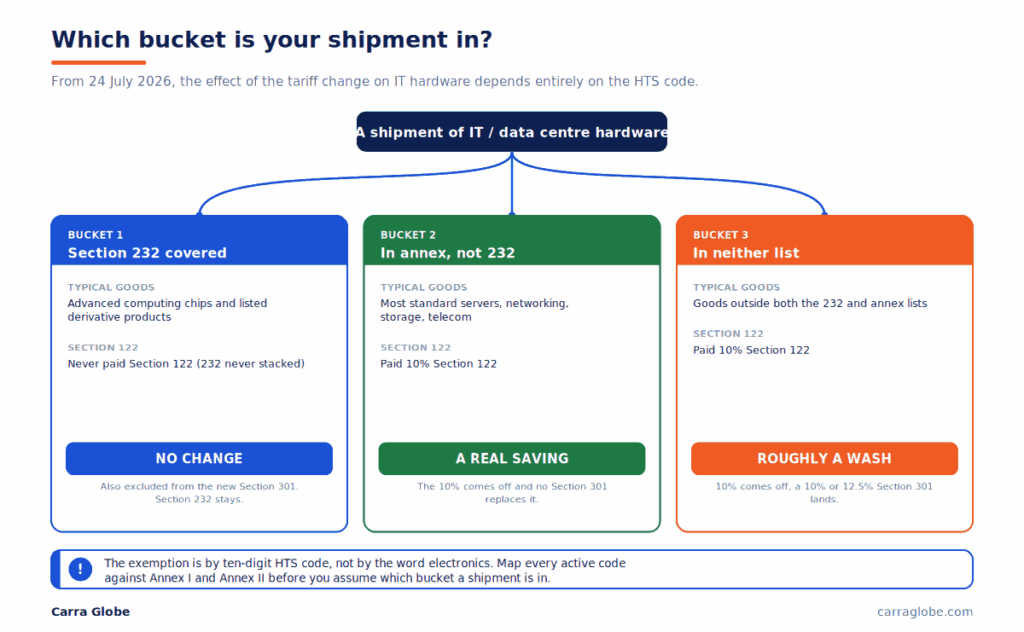
The entire cost shift turns on whether your goods fall inside the electronics exemption. The honest answer depends on which of three buckets a shipment falls into, and most importers have goods in more than one.
| Bucket | Typical goods | Paid Section 122? | Effect from 24 July |
|---|---|---|---|
| 1. Section 232 covered | Advanced computing chips and listed derivative products | No: Section 122 never stacked on Section 232 | No change. Section 232 stays. Also excluded from the new Section 301 |
| 2. Annex listed, not Section 232 | Most standard servers, networking, storage, telecom equipment | Yes: 10% | The 10% comes off and no Section 301 replaces it. A real reduction |
| 3. Neither | Goods outside both lists | Yes: 10% | The 10% comes off, a 10% or 12.5% Section 301 lands. Roughly a wash |
The rule reduces to three lines:
- If the HTS code is already subject to Section 232, the new Section 301 does not apply, and Section 122 never did either. No change.
- If the HTS code is in the annexes but not under Section 232, the new Section 301 does not apply and the 10% Section 122 surcharge has ended. A real saving.
- If the HTS code is in neither, the Section 122 surcharge has ended and a 10% or 12.5% Section 301 duty replaces it. Roughly a wash.
Bucket 2 is where the electronics exemption does its work, and where most data centre hardware sits. On a USD 2 million shipment of servers and switching, the Section 122 surcharge was USD 200,000. If the goods are in the annexes and carry no Section 232 exposure, that USD 200,000 does not simply move to another line on the entry. It stops being charged. For a buyer running several such shipments through a build programme, the difference across a quarter is not a rounding error.
Shipping IT or data centre hardware into the US? Whether your goods fall inside the exemption comes down to the classification on the entry. Carra Globe acts as importer of record for technology and infrastructure hardware across 175+ countries, classifying every entry correctly, claiming the exclusions that apply, and modelling landed cost on both sides of the date.
Bucket 1 is the one that surprises people. Importers of advanced chips and covered derivative systems often assume they have been paying Section 122 as well. They have not, because Section 122 never stacked on Section 232. Those goods saw no change on 24 July, and the compliance layer around them, including export-control obligations, did not move either. Our guide to AI and GPU import compliance covers that layer in detail, and our guide to Section 232 on full customs value explains how the duty is calculated.
Four Qualifications That Keep This Honest
The relief is real, but a technology importer who banks on it without understanding the qualifications is taking a risk. Four things shape the picture.
1. The exemption is by HTS code, not by category
The exclusions are specified at the level of the ten-digit HTS subheading, not by product description. “Electronics” is not a qualifying category. A given server, switch or module either has a subheading that appears in Annex I or Annex II, or it does not. Because USTR added 471 subheadings to the final list, the annexes are broader than the June proposal, but the only way to know your position is to check your specific codes against the final notice rather than assume the category is covered.
2. Section 232 does not move
The 25% Section 232 duty on advanced computing chips and covered derivative products is untouched by any of this. It was not created by Section 122, it did not expire with Section 122, and the Section 301 action explicitly steps around it. An importer whose exposure is mostly Section 232 saw no relief on 24 July and should not plan for any.
3. A second Section 301 investigation is still open, and it targets electronics directly
This is the qualification that matters most for the medium term. Alongside the forced-labour investigations, USTR initiated a separate set of Section 301 investigations into structural excess capacity in the manufacturing sectors of 16 major economies. The sectors named include electronics, semiconductors, and batteries. That investigation has not yet produced tariffs.
If it does, the resulting duties would be a different action, carrying no obligation to repeat these exclusions, and could land on precisely the goods the forced-labour action exempts. The relief described here is real, and it may not be permanent.
4. Section 122 is still in litigation
The Court of International Trade ruled Proclamation 11012 invalid on 7 May 2026. The Federal Circuit issued an administrative stay of that ruling on 12 May, so collection continued to the surcharge’s expiry. If the surcharge is ultimately struck down, importers who paid it from 24 February onward may become eligible for refunds, a separate track from the expiry itself. The practical consequence is that entries filed during the surcharge period should be documented as if a refund claim may follow.
What to Do Now
- Map your HTS codes against the annexes. This is the step that decides whether the electronics exemption applies to you. The exclusions are code-specific, not category-generic. A ten-digit code either appears in Annex I or Annex II or it does not. Pull every active code in your catalogue and check it against the final Federal Register notice. Our guide to HS codes for electronics and tech equipment is the starting point for getting those classifications right.
- Recalculate landed cost by bucket. A single blended assumption across your catalogue will be wrong, because different products land in different buckets. Model bucket 1, bucket 2, and bucket 3 separately. Our landed cost guide sets out the full duty stack.
- Check in-transit status for goods on the water. The forced-labour action carried a short in-transit grace: goods loaded on the final mode of transit before 24 July and entered for consumption before 28 July escaped the new duty. That window has now closed, but for any entry near the line during it, the entry date and loading date are worth confirming with your broker.
- Do not relax the compliance posture. Nothing here reduces classification, valuation, or export-control obligations. If anything, a duty saving that depends on an annex listing makes correct classification more important, not less, since the saving evaporates if the code is wrong. Our guide to reducing import duty in the US covers the legitimate mechanisms that survive the transition.
- Preserve surcharge-period records. Because the Section 122 refund question is still live at the Federal Circuit, keep the entry records for any surcharge you paid between 24 February and 24 July, so a refund claim stays possible if the appeal succeeds.
Frequently Asked Questions
What is the Section 301 electronics exemption?
The Section 301 forced-labour action excludes goods already subject to Section 232, and its annexes list computers, servers, semiconductors, telecom equipment, and batteries. Those goods do not carry the new duty.
The exclusions are specified by HTS code, so a product qualifies by its classification, not by being broadly described as electronics.
Are laptops and smartphones exempt from Section 301?
Many are, because the annexes list computers, smartphones, and display modules among the exclusions. But exemption is by HTS subheading, so a device qualifies only if its ten-digit code appears in the annexes.
Check the exact classification against the final Federal Register notice rather than assuming all consumer devices are covered.
Are consumer electronics exempt from the Section 301 forced-labour tariff?
A large share of consumer electronics fall within the annex exclusions, alongside servers and telecom equipment. The exemption is not a blanket category: it operates code by code, so two similar devices can differ.
The reliable test is whether the product’s HTS subheading is listed, not whether it is described as a consumer electronic.
What HTS codes are in the Section 301 Annex II exemption?
Annex II lists exempt HTS subheadings across computers, semiconductors, telecom equipment, batteries, pharmaceuticals, minerals, and aviation parts. The final list is broader than the June draft, with 471 subheadings added and none removed.
Because the list runs to hundreds of ten-digit codes, the only reliable step is to check your own active codes against the annex in the Federal Register notice.
Did the Section 122 surcharge really end on 24 July?
Yes. Section 122 caps a surcharge at 150 days without an act of Congress. The clock started on 24 February and ran out on 24 July, and Congress did not extend it.
The rate that ended was 10%, not the 15% often quoted, which was the statutory ceiling rather than the rate charged.
Did my server imports get cheaper after 24 July?
If the goods sit in the annexes and carry no Section 232 exposure, yes: the 10% surcharge stopped and nothing replaced it. If they already carry Section 232, nothing changed.
Check the specific HTS codes rather than assuming the whole catalogue moves together.
Could the electronics exemption disappear later in 2026?
It could. A separate Section 301 investigation into structural excess capacity covers 16 economies and names electronics, semiconductors, and batteries. It has not yet produced tariffs, and carries no obligation to repeat these exclusions.
Treat the relief as real but not guaranteed to last, and keep modelling a second-wave scenario.
Does the Section 301 forced-labour tariff stack on Section 232?
No. Goods already subject to Section 232 duties are excluded from the forced-labour action under US Note 52, and the new duty does not apply on top of Section 232.
It mirrors how Section 122 treated Section 232 goods, so advanced chips already under Section 232 see no additional forced-labour duty.
The market was told to expect a handover on 24 July, and for most importers that is exactly what happened: one surcharge ended, another duty began, and landed cost barely moved. For servers, networking, and data centre equipment, the handover has a gap in it, and the gap is worth about ten percent of customs value.
Whether a given shipment falls into that gap comes down to a ten-digit code on an entry, the least glamorous and most valuable detail in the whole transition. The importers who benefit are the ones who checked their classifications, not the ones who work out afterwards that they could have. If you would like that classification checked and your landed cost modelled by bucket, Carra Globe acts as importer of record across 175+ countries and can help you put it in place.
This guide is for informational purposes only and does not constitute legal, customs, or trade advice. Rates, exclusions, and effective dates may be amended. Always confirm your specific HTS classifications and duty exposure with the relevant customs authority, a licensed customs broker, or qualified counsel before making commercial decisions.