
A server refresh signed off in March, set for late April, is still half-installed in July. No port strike, no customs seizure, no single failure to blame. The delay hid where hardware projects almost always lose time: the operational stages between the factory and the rack, where the shipment changes hands and no one owns the transitions. That is the Silent Middle, and a two-week slip there can mean a missed deployment window, idle infrastructure spend, and installation teams rebooked around dates that keep moving.
An IT hardware supply chain from purchase order to installation typically takes six to sixteen weeks in 2026: five to twelve weeks for manufacturing, then the operational middle (freight booking, transit, customs, and importer of record acceptance), which runs from a few days by air to several weeks by ocean, and finally one to four weeks for delivery and rack installation. Project delays rarely come from any single stage running long. They accumulate in the gaps between stages, where responsibility changes hands, which is why the “Silent Middle” of the supply chain is where projects quietly slip and no single supplier or forwarder can be blamed.
Why the Middle Is Invisible
Procurement dashboards track two events: the PO and the arrival. Everything between runs on other companies’ systems the buyer never sees, the supplier’s factory schedule, the forwarder’s booking platform, the customs entry, the last-mile carrier’s dispatch. So a project five days behind in week two stays invisible until week eight, when the arrival date slips and the delay has already compounded across three hand-offs. This is why our guide to how long customs clearance takes is only half the answer to “why is my hardware late”: the border reveals part of the story, but most of the slip happens before it.
The Six-Stage Model: The PO-to-Rack Timeline Framework
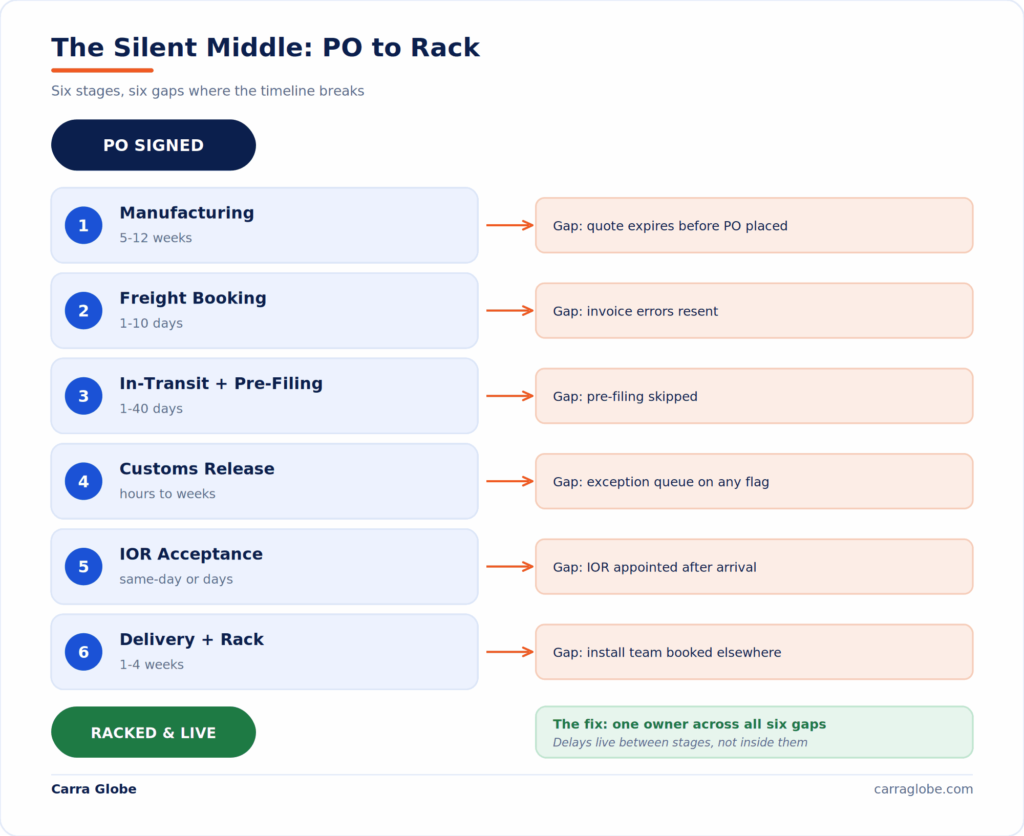
Every commercial hardware shipment moves through six stages: a manufacturing window at the front, four operational stages in the middle, and an installation window at the end. The table below gives each stage its typical duration and the specific gap where the schedule slips. Custom AI configurations run materially longer at manufacturing and installation in particular, and destination market matters: clearance and last-mile windows into emerging markets routinely sit at the top of these ranges, while mature trade lanes with pre-filing infrastructure sit at the bottom.
| Stage | Owner | Duration (2026) | Biggest Risk | Preventable? |
|---|---|---|---|---|
| 1. Manufacturing | Vendor | 5 to 12 weeks | Quote expires before PO is signed | Yes: sign inside quote validity |
| 2. Freight booking | Forwarder | 1 to 10 days | Invoice errors force document rework | Yes: verify docs before handover |
| 3. Transit and pre-filing | Forwarder / broker | 1 to 40 days | Pre-filing skipped, cold-start clearance | Yes: pre-file before arrival |
| 4. Customs release | Broker / customs | Hours to weeks | Any flag drops entry into exception queue | Partly: clean paperwork lowers risk |
| 5. IOR acceptance | Importer of record | Same day or days | IOR appointed after arrival, not before | Yes: appoint IOR before shipping |
| 6. Delivery and install | Carrier / install team | 1 to 4 weeks | Install team booked to another project | Yes: schedule against real dates |
Stages two through five, freight booking through importer of record acceptance, are what this guide calls the Silent Middle: the four operational stages between the finished product and the loading dock, where the shipment changes hands repeatedly and the schedule is won or lost. Stage one (manufacturing) is predictable and stage six (installation) is visible; the middle four are neither. Each is unpacked below.
Stage 1: Manufacturing (Purchase Order to Build Complete)
Typical duration: five to twelve weeks for enterprise servers; eight to twelve weeks for custom or AI-optimised configurations; longer for tier-one hyperscale allocations.
This is the manufacturing window, and it holds the biggest single block of the timeline. Standard enterprise servers currently quote five to eight weeks, custom builds reach eight to twelve, and specialised AI-optimised systems can run substantially further. It is also the most predictable stage: the vendor commits to a date and usually meets it, which is precisely why the surprises live later, in the middle. For AI and data centre hardware specifically, allocation constraints stretch this window further, as our guide to importer of record for AI servers and GPU clusters covers.
The hidden risk here is quote validity: vendor quotes now expire in weeks rather than months, so if an internal approval process takes longer than the quote holds, the PO is placed against a repriced or reconfigured build. Every day the PO sits unsigned is a day of lead time consumed against a clock the buyer does not see.
Stage 2: Build Complete to Freight Booked (Silent Middle begins)
Typical duration: one to ten days.
The supplier has finished, but nothing moves until the forwarder has capacity, has priced the lane, and has the commercial documents, prepared to the destination standard by the exporter of record at origin. A well-run air lane books in a day; ocean into a constrained route stretches to ten. The bottleneck here is paperwork: a wrong invoice or a packing list that disagrees with the manifest gets sent back, and each round adds a day. Our guide on a wrong HS code on the invoice covers the classification errors that surface at this stage.
Stage 3: In Transit and Pre-Arrival Filing
Typical duration: one to five days air freight; twenty to forty days ocean, plus the pre-arrival filing window.
The shipment is moving, but the real work happens on paper. Security filings and entry summaries must be lodged before arrival, often well before; in the US, CBP entry summary requirements set a defined pre-arrival timeline. Leave the filing until arrival and the shipment lands with no entry started, so the broker begins cold. That alone can add three to seven days to what should have cleared in hours, and it is the most common reason clean shipments miss their dates.
Stage 4: Arrival to Customs Release
Typical duration: hours to three days for compliant, pre-filed shipments; three days to several weeks for anything flagged.
This is the visible stage, the one that generates status calls. A pre-filed, low-risk entry clears in hours. A flagged one enters a queue whose length depends entirely on what triggered it, and the triggers escalate in cost:
- Document review (a day or two): customs wants to see the invoice, packing list, or a licence before releasing. Fastest to resolve if the paperwork exists.
- Valuation query (days): the declared value looks wrong for the goods, and release waits on justification or a revised entry.
- Non-intrusive exam / X-ray (one to four days): the container is scanned rather than opened. Usually clears if the image matches the declaration.
- Physical examination (a week or more): the container is opened and contents checked against the entry. Costs storage and exam fees on top of the delay.
- Missing licence or approval (days to weeks): a regulatory hold that customs cannot lift; it waits on the certificate the goods needed before they shipped.
What sends a shipment into these queues is rarely random: a vague description invites the exam, an odd value invites the query, a missing importer of record or licence invites the hold. What matters for the timeline is how fast release then feeds the last-mile, which is the next stage.
Stage 5: Customs Release to Importer of Record Acceptance (Silent Middle ends)
Typical duration: same day if the importer of record is compliant and pre-authorised; days to weeks if not.
Someone has to legally take title and authorise onward movement, which in the US means a registered importer of record on file through CBP’s importer identity process. With an entity in-country and the paperwork right, it is a same-day step. Without one, a third-party importer of record takes the role, and acceptance is only same-day if that IOR was engaged before the goods shipped (the full scope is in our deep dive on importer of record requirements). The hidden delay here is retro-engagement: the buyer discovers at this stage that they need an IOR, tries to appoint one after arrival, and loses a week to due diligence while the goods sit in bonded storage.
Stage 6: Installation (Delivery to Site and Rack)
Typical duration: one to seven days delivery, plus one to four weeks to rack, cable, configure, and validate.
Delivery to a metro facility is one to two days; a secondary market or specialised handling runs a week or more. Then installation, which is routinely underestimated: racking a rack of servers is not a day but one to two weeks of cabling, network configuration, storage attachment, deployment, and validation. The risk here is scheduling: the install team is booked against the original arrival date, so any earlier slip leaves them working another project when the hardware finally lands.
Why IT Hardware Projects Run Late: Where the Silent Middle Fails
The failures cluster at the transitions, not inside the stages. Freight is booked but the pre-filing documents never reach the broker. Customs releases the goods but the importer of record is never told to accept. The goods clear but no one has scheduled the last-mile carrier. In each case the supplier shipped on time, the forwarder booked on time, the broker cleared on time, the importer took title on time. Every party did its job and can prove it. The project is late anyway, because no one owned the handovers between them.
Owning the Silent Middle: The Single-Owner Model
The organisations that consistently deliver infrastructure projects on schedule make one party accountable across the entire operational middle. It cannot be the supplier (done at the factory), the forwarder (done at the port), the broker (done at clearance, a boundary our guide to importer of record vs customs broker explains), or the carrier (done at the dock). It has to be a party that sits across all of them, which is what an experienced importer of record does for cross-border hardware projects where the buyer has no local entity, and what a DDP customs clearance arrangement delivers commercially.
The moves that shorten this sequence are simple: pre-file every entry before arrival; confirm the importer of record before the goods leave origin; schedule the last-mile against the actual release notification, not the planned date; book the install window with a rolling buffer against the current landing estimate, not the original PO date; and keep the classification and paperwork consistent across every stage, since one inconsistency sends the shipment to the slow queue at Stage 4. None of it is heroic. It is simply what a single accountable owner does by default.
One owner for the middle four stages. Most importers run freight, customs, importer of record, and last-mile as four separate vendor relationships that do not talk to each other. Carra Globe runs them as one, holding the classification, the filings, the licences, and the delivery under a single importer of record across 175+ countries.
Frequently Asked Questions
How long does it take to get IT hardware from PO to installation?
Typically six to sixteen weeks in 2026: five to twelve weeks for manufacturing, the operational middle (days by air, weeks by ocean), and one to four weeks for rack installation. Custom AI builds run further.
The manufacturing window is usually the largest single stage, but the middle hand-offs add more time than most procurement teams model.
Why do server projects always run late?
Because delays accumulate in the gaps between hand-offs, not inside any stage, and no one owns the gaps. Supplier, forwarder, broker, and installer each do their part on time; the project still slips.
The fix is a single accountable owner for the middle, not more oversight of each individual party.
Can pre-filing customs really save a week?
Yes. Pre-filed shipments are released electronically, often before arrival. Shipments not pre-filed enter the clearance process cold, which typically adds three to seven days for otherwise-compliant goods.
Pre-filing is the highest-leverage single move in the middle of the timeline.
When should we appoint an importer of record for a cross-border project?
Before the shipment leaves origin, ideally when the PO is signed. IOR retro-engagement after arrival typically costs a week in bonded storage charges and due diligence checks.
Same-day IOR acceptance at Stage 5 requires the appointment and licensing to have been completed at Stage 1.
The middle of the supply chain is invisible until it breaks, and it breaks in the same places every time: the gaps between the six stages, where responsibility changes hands and accountability falls through. Map the six stages on your next infrastructure project, ask who owns each stage and each gap between them, and the hidden delay usually shows itself. The organisations that consistently hit their dates make one party accountable across the entire middle. Carra Globe operates that role for tech and infrastructure hardware as importer of record across 175+ countries, from freight booking through last-mile delivery to the rack.
Disclaimer: This guide is for informational purposes only and does not constitute legal, customs, trade, or supply chain advice. Timelines and lead times are typical 2026 industry ranges and vary significantly by product, configuration, origin, destination, season, and market conditions. Always confirm current lead times, clearance procedures, and delivery windows with the relevant vendors, forwarders, and customs authorities for your specific project.