
Five regulatory regimes, working on unrelated problems, have moved the same way this year. Each one wants an identifiable party to answer for an import, and each one defines that party for itself.
Commercial paperwork collapses all of them into a single word: importer. The law does not. That gap is the subject of this page.
Carra Globe provides importer of record and exporter of record services, so we have a commercial interest in your answer. What follows is written to be usable whether or not you ever speak to us.
Five regimes, five roles, one overloaded word
This is not a forecast. Each row below is law that exists today, and we have cited the instrument for each one at the end of this page. The pattern only becomes visible when you put them side by side, which is rarely done because they sit with different teams and different advisers.
| Regime | The party that regime identifies | What that party must actually be able to do |
|---|---|---|
| Customs | The declarant named on the entry | Classify, value, declare origin, pay, retain records and answer a post-entry audit years later |
| Product safety | An economic operator established in the market, which is the importer where the manufacturer is not | Hold the declaration of conformity and technical documentation, demonstrate conformity on request, report risk and take corrective action |
| Export control | The exporter as the regulation defines it, which need not be the party on the transport document | Screen the item, the destination and the end use, and hold or obtain the licence before shipment |
| Import VAT | The person liable under the destination’s rules, with the import documentation forming part of the evidence | Satisfy the destination’s deduction or refund conditions. Liability and recoverability follow national law, so the party named on the documentation is not necessarily the party entitled to recover |
| Supply chain visibility | The entities identified in customs systems, with some systems using persistent business identifiers | Be identifiable across filings rather than shipment by shipment. This is visible in systems such as the CBP Global Business Identifier test, and it is not one harmonised global rule |
On many import structures several of those rows resolve to one entity. The customs declarant, the product-law importer and the party relevant for VAT are often the same company. They are the same company because the transaction was structured that way, not because one declaration makes the roles identical. Export control is the usual exception, since it looks at the party sending the goods rather than the one receiving them.
Is the importer of record the same as the importer under product law? Not necessarily, and that is the gap. One is a customs role created by a declaration. The other is a legal person defined by product legislation, with duties that continue long after the goods have cleared.
The obligation a customs entry cannot carry
The clearest example sits in European product law, and it is worth reading closely because it is the point at which the product-law importer becomes something more than a customs filing role.
Article 4 of Regulation (EU) 2019/1020 provides that a product within its scope “may be placed on the market only if there is an economic operator established in the Union”. Where the manufacturer is not established in the Union, that operator is the importer.
What that party must then do is not paperwork at the border. It verifies that the declaration of conformity and the technical documentation have been drawn up and keeps them available to authorities. It provides the information needed to demonstrate conformity on request. Where it has reason to believe a product presents a risk, it informs the market surveillance authorities. And it cooperates with those authorities to make sure immediate corrective action is taken.
Read that list again as an operational specification rather than a legal one. It requires somebody who can be contacted, who holds documents, who can answer a technical question about a product, and who can act when a regulator asks. A name on a declaration cannot do any of it. Whether your provider can is a separate question, and we set out how to test it in paper IOR versus operational IOR.
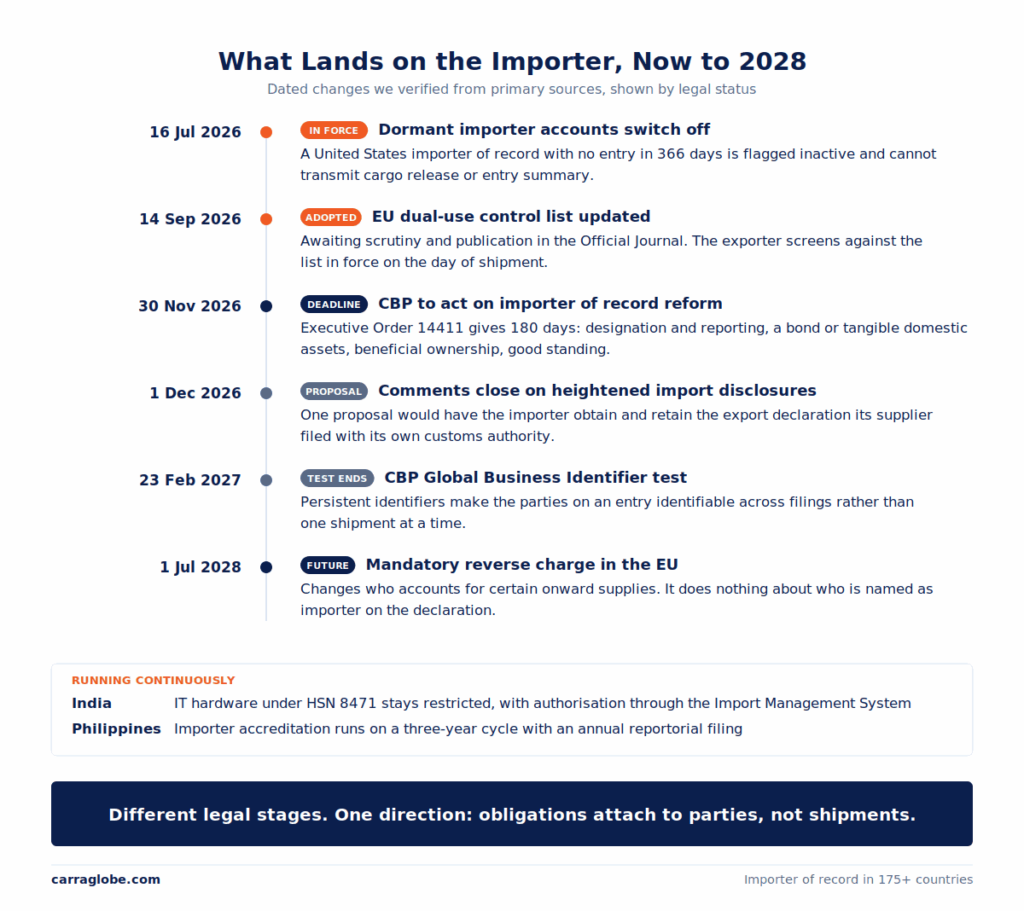
What lands between now and 2028
We built this calendar from instruments we verified ourselves while researching individual markets through 2026. Each entry is dated, each is sourced below, and we have left out anything we could not confirm from a primary source.
| Status | When | What it is | Why it lands on a named party |
|---|---|---|---|
| In force | Since 2023 | India restricts IT hardware under HSN 8471, servers included, with import authorisation administered through the Import Management System | The authorisation attaches to the importing entity. Appointing an importer of record does not transfer it |
| In force | Three-year cycle | Philippine importer accreditation under CAO 01-2026, with three-year validity and an Annual Reportorial Compliance due within 30 days of the accreditation anniversary | Accreditation is held by the importer and carries a recurring filing duty, not a one-off registration |
| Adopted, awaiting publication | 14 September 2026 | The European Commission adopted a delegated regulation updating the EU dual-use control list in Annex I of Regulation (EU) 2021/821 | Control lists move faster than product cycles, and the exporter is the party that must screen against the list in force on the day |
| Deadline for agency action | 30 November 2026 | Executive Order 14411 directs CBP to act within 180 days of the order of 3 June 2026 | It covers mandatory designation and reporting of the importer of record, a bond or tangible domestic assets, beneficial ownership disclosure, a good standing standard and removal of inactive importers |
| Proposal, comments close | 1 December 2026 | CBP advance notice on heightened import disclosures for supply chain visibility | One proposal would have the importer obtain and retain the export declaration its supplier filed with its own customs authority, and potentially produce it to CBP |
| Voluntary test | Ends 23 February 2027 | The CBP Global Business Identifier test | Persistent identifiers make the parties on an entry identifiable across filings rather than one shipment at a time |
| Future, needs national implementation | 1 July 2028 | Mandatory reverse charge under Council Directive (EU) 2025/516, where the supplier is neither established nor VAT identified in the member state and the customer is already VAT identified there | Included here because it is widely assumed to help. It changes who accounts for certain onward supplies, and it does nothing about who is named as importer on the declaration |
Read together these show one direction: more of the compliance burden is attaching to identifiable entities rather than being treated as a shipment-only question, and several of the obligations persist after delivery. They are not all at the same legal stage, and not all of them apply universally, which is why the status column matters as much as the date.
What this does to IOR, EOR and DDP
A serious importer of record is more than a filing service
The commercial model that treats an importer of record as a name to borrow is becoming harder to defend, and not because anyone has banned it. It is harder to defend because the obligations attached to that name are increasingly ones a borrowed name cannot discharge. An entity that cannot hold a technical file, answer a market surveillance authority or maintain an accreditation is not cheaper than an operating importer. It is an exposure that has not surfaced yet.
The United States has put specific directions for this reform on the table. Executive Order 14411 directs CBP to revise importer eligibility rules so that an importer of record is designated and reported, backed by “a bond, or sufficient tangible domestic assets, or both”, provides ownership and beneficial ownership disclosures, and maintains “good standing”, with importers not in good standing to “not be allowed to import”. It also directs the removal of inactive importers of record, and that a foreign importer of record “may not rely on a continuous bond”.
Those are agency-directed reforms rather than requirements already in force today, and the order gives CBP 180 days. One piece of the same thinking is already running. Since 16 July 2026 an importer of record account that has not filed an entry within 366 days is flagged inactive for entry purposes in CBP’s system and becomes ineligible to transmit cargo release and entry summary transactions. A dormant name is now switched off mechanically rather than discovered at a border. Our note on the customs enforcement executive order sets out what the wider reform means for United States entries.
The legally relevant exporter becomes the control point
Export control defines the exporter by law rather than by whoever appears on the transport document, and the control lists move. The September 2026 update to the EU dual-use list is an ordinary example rather than an exceptional one. The practical effect is that the party carrying this has to screen against a current list at the moment of shipment, which is an operational capability and not a document.
For a technology bill of materials this is not an abstract exercise. GPU and high-performance computing hardware, security appliances with cryptographic functionality and certain telecommunications equipment are the lines that most often raise an export control question, and the answer comes from the list rather than from the product description on the invoice.
Worth naming the trap in our own vocabulary. That legally relevant exporter is not automatically the same entity a logistics provider describes commercially as the exporter of record. It is the same collapse this page started with, applied to the export side, and it is one we have to be careful about ourselves.
DDP becomes a promise across regimes, not just across costs
Delivered duty paid was always a cost and risk allocation between a seller and a buyer, and it still is. The Incoterm creates none of the obligations above. What has changed is the range of regulatory questions a seller may have to resolve in order to perform that commercial promise: product conformity, export screening, VAT treatment and importer identification. The Incoterm determines none of those legal roles, which is why pricing a DDP deal without settling the importer first can leave more regulatory exposure unresolved than the commercial price suggests.
What to check in your own structure
- Find out who is named, in writing, in each destination. Not who arranges clearance. The entity in the importer box. If nobody in your business can answer that per market, that is the finding.
- Ask what that entity holds. Registrations, accreditations, product approvals and the authority to keep a technical file. A provider that answers this with a service description rather than a credential is answering a different question.
- Separate the customs role from the product-law role. They can be the same party, and they often should be, but you need to know which party is which before a regulator asks.
- Check who screens, and against which list. Export control turns on the list in force on the day of shipment, not the one in force when the product was designed.
- Check what happens in year three. Accreditations renew, authorisations expire and audits arrive after delivery. A structure that works for one shipment is not the same as one that survives a cycle.
How Carra Globe works with this
We provide importer of record and exporter of record services for technology hardware across 175+ countries, alongside DDP customs clearance, warehousing and delivery to site. The reason this page exists is that the question clients bring us has changed. It used to be who can clear this. It is now who can stand behind it afterwards.
Before a structure is agreed we will tell you which entity can be named in that destination, what that entity holds, where the product-law obligations land, whether the export side needs screening or a licence, and what the arrangement looks like at renewal rather than only at first shipment.
Four things let us answer that: the destination and the delivery address, what the goods are with model numbers and whether anything is refurbished or carries wireless or encryption functionality, the commercial value and the Incoterm you intend to use, and whether this is a one-off or a programme that will repeat.
Carra Globe already holds the importer-side licences, certifications and approvals its local importing structures require for the goods we handle, so your cargo moves without delay at the border. Where a shipment needs an approval outside that scope, we say so before a delivery date is agreed rather than after the goods land. That applies whether this is a first shipment into a new country or one leg of a multi-country deployment.
Importer of Record · Obligations to 2028
Find out what your importer is actually carrying.
Being clear about the boundary: we are not your product-compliance consultant or your export-control counsel, and an article arguing that these obligations sit in different places should not pretend to cover all of them from one desk. What we can do is map the structure before you ship: which entity can be named as importer in that destination, what that entity holds, where the product-law and export-control roles land, and what the arrangement looks like at renewal rather than only at first shipment.
- Importer of record services
- Paper IOR vs operational IOR
- Customs enforcement executive order
- Exporter of record services
- IOR for technology OEMs
- Importer of record vs customs broker
- DDP customs clearance worldwide
- DDP versus DAP
- First shipment into a new country
- Multi-country deployment
- How to calculate landed cost
- Freight forwarding services
- White glove delivery to site
- IOR by country
- IT hardware import rules by country
Free tools HS Code Finder Volumetric Weight Calculator Pallet Calculator
Not sure which entity is carrying what in your structure? Send the destination, the goods with model numbers, the value and the Incoterm, and whether this repeats. We will tell you who can be named, what that entity holds, where the product and export obligations land, and what happens at renewal.
Check what my importer carriesFrequently asked questions
Can the importer of record also carry product-law obligations?
Yes, in some structures. Under EU product law an importer can be the economic operator carrying specified tasks, but other operators can occupy that role. Check the customs and product-law roles separately.
Can I appoint an importer of record to take on a licence I hold?
Not automatically. Many authorisations are entity-specific, so appointing an importer does not by itself transfer your permission. The destination decides whether a fresh application or another structure is needed.
How long does the obligation last after delivery?
Longer than the shipment. Record retention, post-entry review and market surveillance all operate after clearance, and periods are set by national law rather than harmonised, so they differ by destination.
Does a persistent entity identifier change anything for me?
In systems that use persistent identifiers, it can. An identifier links filings to one entity instead of treating each shipment separately. The CBP Global Business Identifier test is one example, not a universal requirement.
Where should this sit, with logistics or with compliance?
With whoever can decide before the price is committed. The importer decision drives landed cost, tax recovery and regulatory exposure at once, and no single function usually owns all three.
Adjacent ground: importer of record versus customs broker, IT hardware import rules by country, calculating landed cost and our IOR by country index.
Sources and verification
- Product law: Regulation (EU) 2019/1020, Article 4, for the requirement that there be an economic operator established in the Union, for the importer filling that role where the manufacturer is not established there, and for the tasks listed in Article 4(3).
- Export control: the European Commission’s announcement of 14 September 2026 that it adopted a delegated regulation updating the control list in Annex I of Regulation (EU) 2021/821, Commission document C(2026)6323, a number the Commission’s own page carries as a link into its transparency documents register. At the date of writing it awaits scrutiny and publication in the Official Journal, so no Official Journal number is cited here.
- Philippines: CAO 01-2026 on importer accreditation for the three-year validity and the Annual Reportorial Compliance due within 30 days of the accreditation anniversary, and the Department of Finance announcement confirming the single PHP 5,000 fee for a three-year period. Note that the figure quoted here is the fee set by the order itself; Bureau of Customs payment materials have shown a slightly higher processing figure at the application stage, so confirm the amount payable at the time of filing.
- India: DGFT Notification 23/2023 amending the import policy for items under HSN 8471, which is the instrument creating the restriction. The Import Management System procedure for restricted IT hardware including servers, under which importers apply for an import authorisation, is then set by a DGFT policy circular issued for each calendar year, currently Policy Circular No. 08/2025-26 of 17 December 2025 for calendar year 2026. Because that circular is reissued annually, the one in force at the date of import should be taken from the current DGFT policy circular index rather than from an earlier year.
- United States, importer of record reform: Executive Order 14411 of 3 June 2026, for mandatory designation and reporting of the importer of record with a bond or tangible domestic assets at Section 2(a)(ii), ownership and beneficial ownership disclosure at Section 2(a)(iii), the good standing standard at Section 2(d), removal of inactive importers at Section 2(e), and the restriction on a foreign importer of record relying on a continuous bond at Section 2(c). The order gives CBP 180 days, which falls on 30 November 2026.
- United States, dormant importer accounts: CBP message CSMS 69241265, for the inactive for entry purposes status deployed on 16 July 2026 covering accounts that have not filed an entry within 366 days under 19 CFR 24.5(e), and for those accounts becoming ineligible to transmit cargo release and entry summary transactions.
- United States, disclosure proposal: the CBP advance notice of proposed rulemaking at 91 FR 56408, docket USCBP-2026-1058, for the 1 December 2026 comment deadline, and the Global Business Identifier test running to 23 February 2027.
- European VAT on onward supplies: Council Directive (EU) 2025/516 for the amended Article 194 and the mandatory reverse charge applying from 1 July 2028.
- Verification note. Checked on 2 October 2026. Several instruments above are national rather than harmonised, so retention periods, liability and renewal cycles differ by destination even where the direction of travel does not. The EU dual-use update had been adopted but not published in the Official Journal at the date of writing, so it is described as adopted rather than in force.
- What we did not open. The DGFT portal blocks automated access, so the Indian policy circular is cited by its published particulars rather than from the issuing file itself. We have otherwise left out any change we could not confirm, including dates reported in trade press that the issuing authority’s own site did not carry.
Disclaimer: This guide is for informational purposes only and does not constitute legal, customs, export control or regulatory advice. Obligations differ by destination, by product and by transaction structure, and the position described is as at 2 October 2026. Confirm the current position with the competent authority or a qualified adviser before acting.