
The deal is signed. The customer is in a country where you have no entity, no registration and no intention of opening one. Procurement asked for delivered to site, and you quoted it, because the competitor who said “ex works, you sort out customs” lost.
Now somebody has to be named as importer. Whether that can be you is decided by the destination, not by your quote.
Carra Globe provides importer of record and exporter of record services, so we have a commercial interest in your answer. What follows is written to be usable whether or not you ever speak to us.
The goods may never touch you
A reseller’s hardware usually ships from somewhere the reseller has never been. You buy from a distributor or direct from the vendor, the consignment leaves their hub in Amsterdam, Singapore or Memphis, and it goes straight to your customer’s site. You are the seller on every document that matters commercially, and you are nowhere near the goods.
That is efficient, and it puts the import declaration in an awkward position. The commercial invoice, the packing list, the country of origin statement and the model and serial data all originate with a party you do not control. Whoever is named as importer has to declare on that paperwork and stand behind it afterwards.
Three things go wrong often enough to plan for. The vendor’s logistics team names a consignee of its own choosing before anyone tells them an importer of record is involved. The origin stated on the vendor’s invoice does not match what the destination expects for that model. And the invoice travelling with the goods is the vendor’s invoice to you rather than yours to the customer, which raises a valuation question at the border that nobody in the chain was expecting.
This is a sequencing problem, not a paperwork problem. The import structure has to reach the vendor’s shipping desk before your purchase order does. Once their system has generated the documents, changing them is slower than changing the delivery date you promised the customer.
One purchase order, several regulatory paths
The reason a customer buys through you is that they get one quote, one order and one point of contact for hardware from five manufacturers. Customs does not see one order. It sees line items, and it applies a different rule to each.
On a single enterprise refresh you might ship servers that clear routinely, a wireless access point that needs local type approval, a firewall whose encryption functionality changes the screening, a PDU that falls under electrical conformity, and a refurbished switch that meets used-equipment controls none of the other lines touch.
The consequence for a reseller is a scheduling one rather than a compliance one. The slowest approval on the bill of materials sets the delivery date for the entire consignment, not just for the line that needed it. One access point can hold a pallet of servers that were ready to move three weeks ago.
Which is why the review has to run at line level. “IT equipment, 14 pallets” tells an importer nothing about which lines carry a lead time, and on a reseller’s bill of materials the items that cause the delay are rarely the expensive ones.
What DDP actually commits you to
Can a reseller be the importer of record? Only where it holds, or can appoint, a structure that qualifies as an importer in that destination. Incoterms allocate cost and risk between buyer and seller. They do not confer import eligibility, and quoting DDP does not create a right to be named on the declaration.
DDP is a contractual term from the International Chamber of Commerce. You carry cost and risk to the delivery point, duties and taxes included. It binds you and your customer and nobody else. No customs authority is a party to your sales contract.
So the quote creates an obligation you may have no lawful way to discharge yourself. That gap is the whole subject of this page, and it shows up in three places: the import VAT, the registration position, and the customer relationship.
Where the margin goes: the import VAT pincer
Import VAT or GST is calculated on a destination-specific base that usually starts with the customs value and adds specified costs. In the United Kingdom, HMRC starts with the customs value and adds incidental expenses such as “commission, packing, transport and insurance costs incurred up to the goods’ first destination in the UK”, plus any customs or excise duty payable.
The rate and the base both depend on the destination. EU law requires a standard rate of no less than 15 per cent and leaves each member state to set its own level above that floor, so the rate on a given lane is something to check rather than assume.
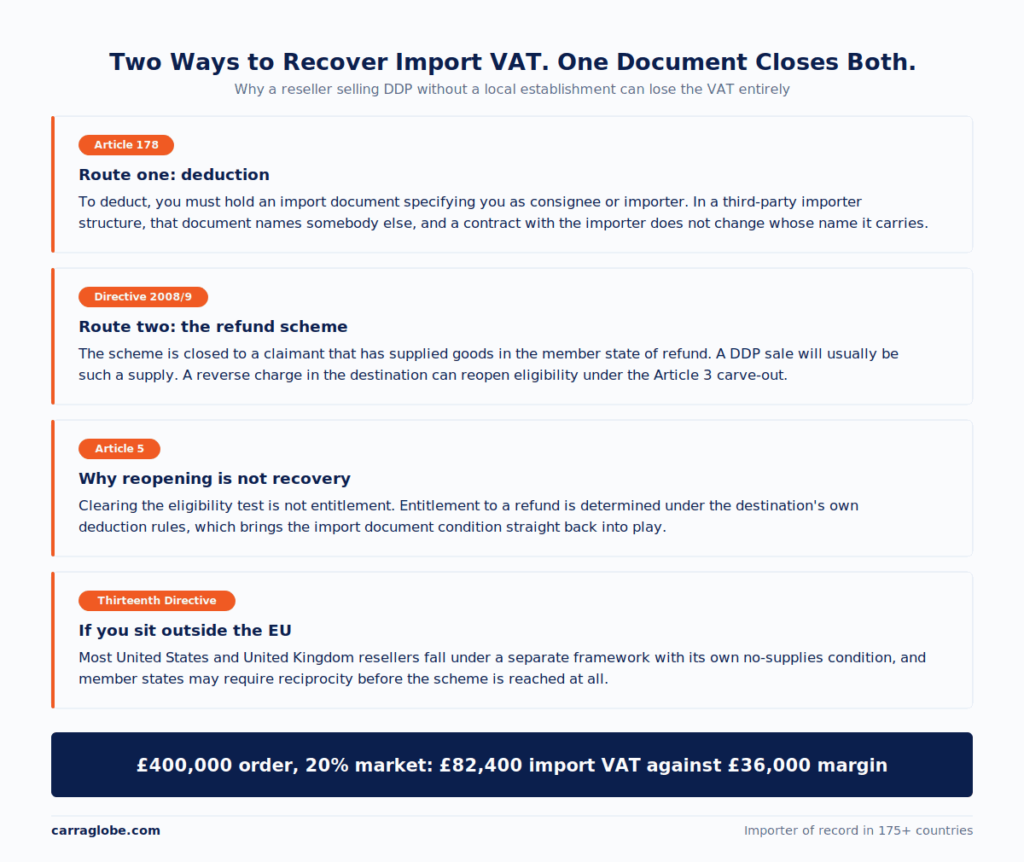
Put numbers on it. Take a £400,000 order of networking hardware into a 20 per cent market, with £12,000 of freight and insurance to the first destination and duty taken as nil to keep the arithmetic clean. For this simplified illustration the import VAT base is £412,000, so the import VAT would be £82,400.
Quote that deal at a 9 per cent gross margin and you are working for £36,000. The tax is more than twice the margin, and if the structure leaves it unrecoverable the deal loses £46,400. Everything turns on one question: can anybody recover it?
Here is what catches resellers. You may well own the goods at import, because you bought them from the vendor and you are selling them on, so on ownership you look like the right claimant. You can still fail to recover. There are two recovery routes to examine here, deduction and a refund scheme, and a DDP sale into a country where you have no establishment can block both at once. Ownership itself we cover separately, in our note on import VAT and the importer of record.
Route one: deduction, closed by the paperwork
Deduction is governed by the VAT Directive. Article 178 sets the condition for exercising it on an import, and it is documentary rather than economic. To deduct, a taxable person “must hold an import document specifying him as consignee or importer, and stating the amount of VAT due or enabling that amount to be calculated”.
In your structure the import document identifies a third party as consignee or importer, which is precisely what Article 178 looks at. That condition is not satisfied by obtaining a copy. What matters is whose name the document carries, and no contract with the importer changes that.
The United Kingdom gets there faster. HMRC’s guidance on operators who pay import VAT for overseas customers is blunt: “there is no provision in UK law for such deduction.” That rules out the arrangement resellers reach for most often, paying the VAT under a contract with the importer and treating it as their own input tax.
Route two: the refund scheme, closed by the sale itself
Which scheme applies turns on where you are established, not where the goods landed. Most resellers assume one is waiting for them. If you are established in another EU member state, Directive 2008/9/EC governs, and it applies only to a taxable person who “has not supplied any goods or services deemed to have been supplied in the Member State of refund”. A DDP sale will usually be such a supply, so the exclusion bites.
One carve-out matters. Article 3 preserves eligibility for supplies made “to a person who is liable for payment of VAT in accordance with Articles 194 to 197 and Article 199”, meaning supplies where the destination shifts the VAT to your customer under a reverse charge. Clearing that condition only gets you through the door. Article 5 provides that “entitlement to an input tax refund shall be determined pursuant to Directive 2006/112/EC as applied in the Member State of refund”, so the refund route runs back into the deduction rules, document condition included.
If you are established outside the European Union, which covers most United States and United Kingdom resellers, 2008/9 is not your route at all. The Thirteenth Directive governs, carries its own no-supplies condition in Article 1, and lets member states make refunds “conditional upon the granting by third States of comparable advantages regarding turnover taxes”. A reciprocity test can therefore sit in front of the scheme.
The United Kingdom runs its own domestic scheme on a similar condition rather than the same one. You qualify only if you “have no place of business or other residence in the UK and do not make any supplies in the UK”. It also requires the VAT copy of the import entry or another customs document showing the VAT paid, issued against the declaration rather than against your contract.
This is the trap, and it can close from both sides. Where your DDP sale is treated as a supply in the destination, that normally shuts the refund scheme. And if the import document names somebody else, the deduction condition is not met either. A reverse charge in the destination can get you past the eligibility test, but entitlement then runs back into the deduction rules, so in this structure the document is the lock that holds.
None of this means the VAT is irrecoverable in principle. It means the entitlement follows the destination’s rules, which can turn on ownership and registration as much as documentation, and on most reseller structures they do not land on you. Settle it before you price, not after the goods land.
The registration question your quote may have triggered
Does a DDP sale make me liable to register in the destination? It can. After an import your onward sale is often located in that country rather than in yours, and whether you must register then turns on whether the destination shifts the liability to your customer through a reverse charge.
Here is the provision that catches resellers who assume a DDP sale is still an export sale.
Article 32 of the VAT Directive deals with where a supply is located. Its second paragraph provides that where dispatch begins outside the European Union, “both the place of supply by the importer designated or recognised under Article 201 as liable for payment of VAT and the place of any subsequent supply shall be deemed to be within the Member State of importation of the goods”.
Where goods enter the EU from outside and are then supplied onward, your sale to the customer is a supply subsequent to the import, and where Article 32’s conditions apply it places that sale in the member state of importation rather than in yours. Commercially you shipped from Slough or San Jose. For VAT purposes the onward sale can be a domestic sale in the country of import.
Whether that forces you to register depends on the destination. Article 194 lets a member state shift the liability to the customer through a reverse charge, but the wording is permissive: member states “may provide” for it and “shall lay down the conditions”. Some apply it broadly, some narrowly, some not at all. There is no single European answer, which is why a structure that worked in one market can produce a registration obligation in the next.
One change is worth knowing about if your contracts run several years out. Council Directive (EU) 2025/516 makes the reverse charge mandatory from 1 July 2028 where the supplier is neither established nor identified for VAT in that member state and the customer is already identified for VAT there, subject to the exceptions in the amended article. Member states still have to transpose it, so check the national implementing legislation before pricing a contract on it.
Read that condition closely, because it cuts two ways. It ties your position to your customer’s VAT status rather than your own, and it bites only where you are not identified for VAT there, so registering takes you back outside it. The reform changes the default for the onward supply, not your options. Nor is it nothing for import VAT, since a reverse charge is what gets you past the refund scheme’s eligibility test. What it does not change is who is identified on the import document, and that is where the recovery problem sits.
The account risk nobody puts in the compliance review
The obvious fix for the import problem is to bring in a local partner who can import and resell. It works, and it costs you something that does not appear on the deal sheet.
A local reseller that takes the import also takes a position inside your account. It typically sees the pricing, the scope, the renewal date and the customer contacts, and it sells technology for a living. You spent months developing the opportunity. The partner you brought in to clear the goods is now in the room at the refresh.
An importer of record is a different arrangement. It performs the import function under a service agreement, it does not buy the technology business, and the arrangement gives it no reason to be in the account next year. Our note on who is liable when a reseller imports sets out where the liability sits in each structure.
Who can be named as importer
| Party | Workable? | What it costs you |
|---|---|---|
| You, through a local entity | Where that entity is eligible to import | Registration, filings and a permanent presence in a market you may be entering once |
| The end customer | Sometimes | May require registrations they do not hold, and many refuse the liability. See when the customer will not be importer of record |
| A local reseller or distributor | Where permitted and willing | Solves the import and puts another technology seller inside your account |
| A third-party importer of record | Where permitted | A service fee, and the discipline of settling the structure before you quote. The appointment does not by itself decide who recovers the VAT |
| Your freight forwarder | Not automatically | Clearing goods and carrying the importer role are different jobs, as importer of record versus customs broker explains |
What to settle before you quote, not after
- Ask whose name goes in the importer box. Not who arranges clearance. Who is named. That answer determines who carries the import liability on the entry, and it is the first of the facts that decide who can recover the VAT.
- Price the VAT as a cost until somebody proves otherwise. If no party in the chain can both hold the import document and satisfy the local conditions, it is margin, not working capital.
- Check whether your sale is local. After an import, a DDP sale can be a domestic supply in that country. Find out whether the destination applies a reverse charge or expects you to register.
- Decide what the import partner is allowed to sell. If they also sell technology, assume they will meet your customer.
- Put the structure in the quote. A DDP price built on an unresolved importer question is a number you may not be able to honour. Our guide to comparing DDP quotes covers what a complete one contains.
What it costs to ask the question late
The importer question has the same answer at every stage of a deal. What changes is how much it costs to act on it.
| When you ask | What is still open | What it costs |
|---|---|---|
| Before you quote | The importer, the Incoterm, the VAT position, the line items that need approval and the price itself | Nothing. This is the only stage where the structure can still change the number you give the customer |
| After the order, before dispatch | The importer can still be named correctly and the documents aligned to it | The price is fixed, so any approval lead time comes out of the delivery date you have already promised |
| After dispatch | Very little. Documents are issued and the consignee is set | Storage and demurrage exposure, and a conversation with your customer about a date or a price you can no longer hold |
How Carra Globe works with resellers
We provide importer of record and exporter of record services for technology hardware across 175+ countries, alongside DDP customs clearance, freight forwarding, warehousing and white glove delivery to site.
We do not sell technology. That matters more to a reseller than it sounds, because it means we have no commercial reason to be anywhere near your customer after the goods are delivered. You keep the account, the contract and the renewal.
Before a quote goes out we will tell you which entity can be named as importer in that destination, where the import VAT lands and who can recover it, whether your onward sale creates a local registration question, and what the structure does to the landed cost you are about to commit to. Six things let us answer that.
- The destination country and the final delivery address.
- What the goods are, with model numbers, and whether any line is refurbished or carries wireless or encryption functionality.
- The commercial value and the Incoterm you intend to quote.
- Where your selling entity is established. This decides which refund framework you fall under, and it is the question most quotes never ask.
- Whether your customer is registered for VAT in the destination. It decides whether a reverse charge can move the liability off you.
- The delivery date you are about to commit to.
Send those six and you get back the structure in writing before you price the deal: who can be named, where the VAT sits, whether you need to register, and what it does to your landed cost. If the deal cannot be structured compliantly, we say so then rather than after you have quoted.
Carra Globe already holds the importer-side licences, certifications and approvals its local importing structures require for the goods we handle, so your cargo moves without delay at the border. Where a shipment needs an approval outside that scope, we say so before a delivery date is agreed rather than after the goods land. That applies whether this is a first shipment into a new country or one leg of a multi-country deployment.
Importer of Record · VARs and Technology Resellers
Send us the deal while the price can still change.
Being clear about the boundary: we are not tax advisers and we do not recover VAT for you, and an article arguing that entitlement is decided by the destination's own rules should not pretend otherwise. What we can do is settle the structure while your quote can still absorb the answer: which entity can be named as importer in that destination, where the import VAT lands and who is positioned to recover it, whether your onward sale creates a local registration question, and what all of that does to the landed cost you are about to commit to.
- Importer of record services
- IOR for technology OEMs
- Exporter of record services
- DDP customs clearance worldwide
- How to compare DDP quotes
- DDP versus DAP
- Import VAT and the importer of record
- Who is liable when a reseller imports
- When the customer will not be importer
- Importer of record vs customs broker
- First shipment into a new country
- Multi-country deployment
- How to calculate landed cost
- IOR by country
- IT hardware import rules by country
Free tools HS Code Finder Volumetric Weight Calculator Pallet Calculator
About to quote DDP into a country where you cannot import? Send the destination, the product list, the value, the Incoterm and where your selling entity is established. We will tell you who can be named as importer, where the VAT sits, whether you need to register, and what it does to your margin before you commit a price.
Check my structure before I priceFrequently asked questions
Does quoting DDP make me the importer?
No. DDP allocates cost and risk between you and your customer. It does not make you eligible to be named on a declaration in a country where you do not otherwise qualify as importer.
I own the goods at import. Why can I still not recover the VAT?
Ownership is not the only test. Under EU rules, deduction requires an import document naming you, and the EU and UK refund schemes can exclude businesses making supplies there. A DDP sale can trip both.
Can I pass the import VAT on to my customer?
Contractually you can try, but a recharge is not recovery. It creates no deduction right for the party that paid, and a DDP price has already promised the customer they will not pay it.
Does a DDP sale mean I must register for VAT there?
It may. The onward sale is often a domestic supply in the destination. Whether you register depends on whether that country applies a reverse charge to non-established suppliers, which varies.
Will the importer of record take my customer?
A specialist importer of record is normally engaged to perform the import function, not to resell your technology. A local reseller brought in to import does, and will know your price and your customer.
Can I fix the structure after I have quoted?
Rarely without cost. The importer decision changes landed cost, VAT recoverability and possibly your registration position, and a committed DDP price leaves you carrying whatever the structure turns out to be.
Adjacent ground: DDP versus DAP, paper IOR versus operational IOR, calculating landed cost and IT hardware import rules by country.
Sources and verification
- The deduction condition: Article 178 of Directive 2006/112/EC, for the requirement to hold an import document naming the person claiming, and Article 168 for the right of deduction itself.
- What the VAT is charged on: HMRC’s guidance on paying VAT on imports, for the valuation rule that adds incidental expenses and any customs or excise duty to the customs value, and the European Commission’s VAT rates page for the requirement that a standard rate be no less than 15 per cent.
- Where the supply is located: Article 32, second paragraph, for supplies following an import, and Article 194 for the optional reverse charge on supplies by non-established persons.
- The refund schemes: Directive 2008/9/EC, Article 3, for the condition that the claimant has made no supplies in the member state of refund and for the carve-out at point (b)(ii) covering supplies to a person liable for the VAT under Articles 194 to 197 and Article 199, Article 5 for the rule that entitlement is determined under Directive 2006/112/EC as applied in the member state of refund, and the Thirteenth Directive 86/560/EEC, Articles 1 and 2, for the separate framework governing businesses established outside the European Union and for the reciprocity power.
- The United Kingdom scheme: the refund scheme for non-UK businesses, for the no-supplies condition at section 2.2, the ownership rule at section 2.5 and the import document requirement at section 2.13.
- United Kingdom practice: HMRC’s VAT Input Tax manual at VIT44400, for the statement that there is no provision in UK law for a deduction by a party paying import VAT on behalf of an overseas customer.
- The 2028 change: Council Directive (EU) 2025/516, for the amended Article 194 and the conditions attaching to the mandatory reverse charge from 1 July 2028.
- Verification note. Checked on 1 October 2026. Three qualifications. Liability for import VAT is set by national law rather than harmonised, so who is liable differs by country even where the deduction rules do not. The reverse charge in Article 194 is optional under the framework in force today, so registration outcomes vary by member state and no general answer is possible until Council Directive (EU) 2025/516 changes that position from 1 July 2028. And Incoterms are a commercial publication of the International Chamber of Commerce rather than law, so DDP is described here by what it does rather than quoted.
Disclaimer: This guide is for informational purposes only and does not constitute legal, customs, VAT or regulatory advice. VAT recovery and registration outcomes depend on the transaction structure and the destination country, and the position described is as at 1 October 2026. Confirm the current position with the competent authority or a qualified adviser before acting.